A single miscalculation in globe valve design standards selection can transform a high-pressure system into a liability, compromising both infrastructure integrity and personnel safety. Engineering professionals recognize that the distinction between API and ASME requirements is often the thin line between operational continuity and catastrophic material failure. You likely face the challenge of navigating overlapping regulations while ensuring that every component withstands corrosive environments and extreme thermal cycles. It’s a high-stakes environment where ambiguity isn’t just an inconvenience; it’s a risk to the entire facility’s output.
This 2026 technical guide provides a clinical analysis of the primary regulatory frameworks, including API 600, 602, and 623, to eliminate ambiguity in your procurement process. We’ll establish a rigorous framework for selecting valves that meet international safety benchmarks, ensuring your specifications align with current ISO and ASME protocols. By the end of this analysis, you’ll have the technical clarity needed to minimize downtime through precise material selection and structural verification. We’ll move through the specific mechanical requirements and quality assurance protocols that define modern industrial valve excellence.
Key Takeaways
- Define the technical hierarchy of globe valve design standards to ensure full compliance across API, ASME, and ISO regulatory frameworks.
- Differentiate between API 602 for forged steel applications and API 623 as the primary specification for cast steel globe valve design.
- Utilize ASME B16.34 codes to establish precise pressure-temperature ratings and maintain operational safety in high-stress industrial environments.
- Integrate ASTM material specifications with NACE MR0175 protocols to prevent material failure in corrosive H2S or sour gas service.
- Apply a structured selection framework that aligns technical specifications with global logistics to reduce facility downtime during critical project phases.
The Hierarchical Framework of Globe Valve Design Standards
Globe valves function as the critical interface for flow regulation and positive isolation within high-pressure piping systems. This Globe valve overview clarifies the internal architecture that enables precise throttling, a characteristic that differentiates these units from gate or ball valves. To maintain structural integrity under extreme thermal and mechanical loads, engineers utilize a complex hierarchy of globe valve design standards. These frameworks aren’t suggestions; they’re codified requirements that dictate minimum shell thickness, stem diameter, and disc configuration.
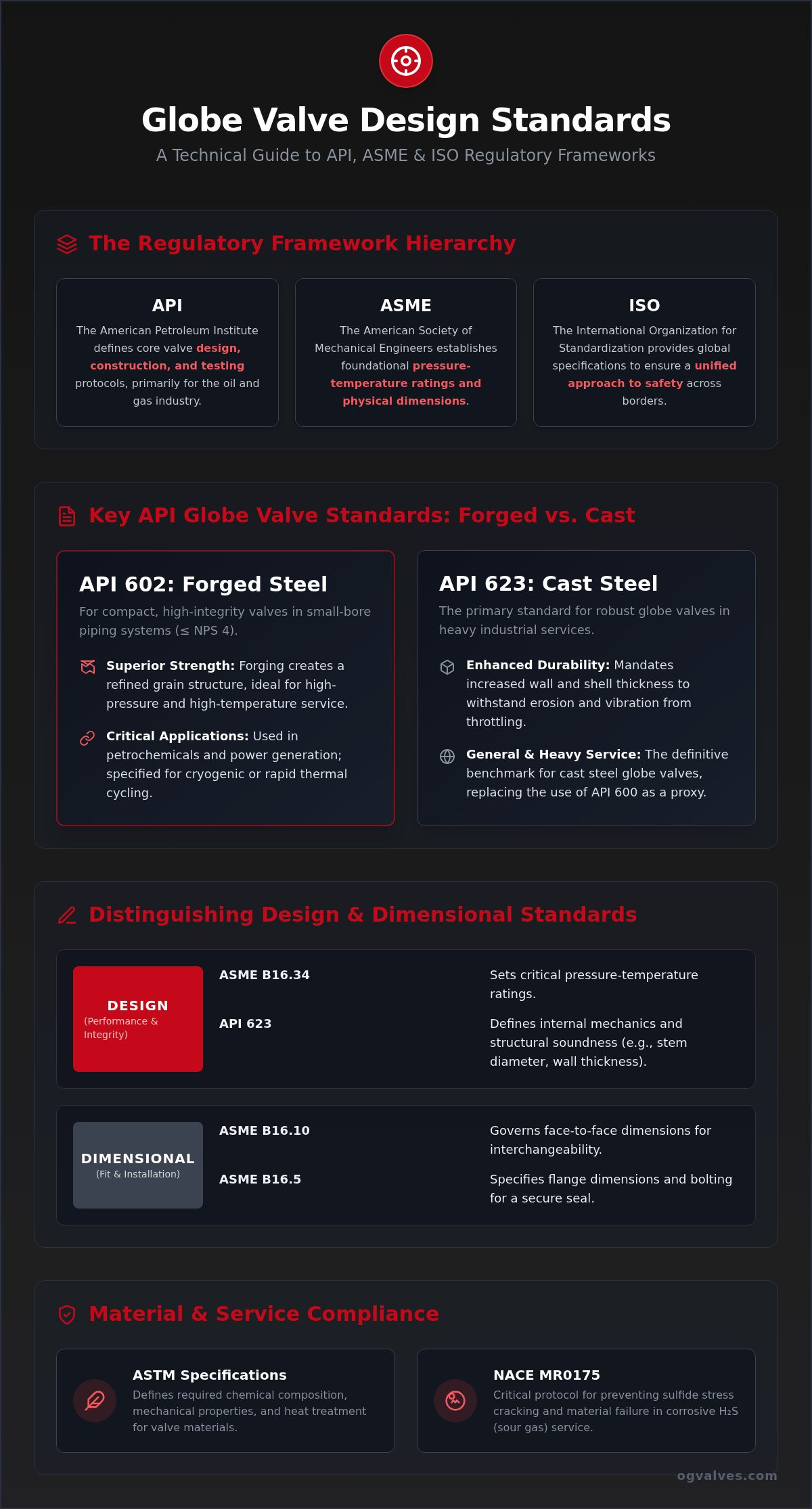
The regulatory landscape is shaped by the intersection of API, ASME, and ISO standards. API 623 is currently the primary benchmark for cast steel globe valves, offering enhanced durability over previous iterations. ASME B16.34 serves as the foundational code for pressure-temperature ratings across the industry. Simultaneously, ISO 15761 provides international specifications for forged steel valves, ensuring a unified approach to safety across global borders. These standards work in tandem to prevent the mechanical failures that lead to facility downtime.
The Necessity of Regulatory Standardisation
Standardisation is the bedrock of industrial safety and operational reliability. It allows for the seamless interchangeability of components across diverse global facilities. This is essential for maintaining global supply chains and reducing lead times during emergency maintenance. By following defined pressure-temperature ratings, manufacturers mitigate the risk of catastrophic failure in volatile environments. Standardised designs are also a mandatory requirement for passing rigorous insurance assessments and government safety audits. These codes provide a clinical, data-driven baseline that removes the ambiguity often associated with custom engineering. It’s about establishing a universal language of safety.
Distinguishing Between Design and Dimensional Standards
Technical experts must distinguish between design codes and dimensional standards. Design standards, such as API 623, focus on the internal mechanics and structural soundness of the valve. In contrast, dimensional standards like ASME B16.10 define the physical envelope, specifically the face-to-face dimensions. Correct specification is vital during system retrofits to ensure new hardware integrates perfectly into existing piping layouts. Connectivity is further governed by ASME B16.5, which specifies the flange dimensions and bolting requirements. Failure to align these globe valve design standards leads to installation delays and potential leakage points at the flange interface. Procurement specialists shouldn’t overlook the impact of ASME B16.5 on flange integrity; it defines the exact bolting patterns required for a secure seal.
API Standards for Cast and Forged Steel Globe Valves
The transition from using API 600 as a proxy for globe valve specifications to the full adoption of API 623 represents a significant evolution in globe valve design standards. While API 600 traditionally governed heavy-duty gate valves, the industry required a dedicated, clinical standard to address the unique mechanical stresses inherent in throttling service. API 623 now serves as that definitive benchmark for cast steel units. It incorporates more stringent requirements for stem diameters and shell thickness to mitigate the cumulative effects of erosion and lateral vibration.
API 602: Forged Excellence for Small-Bore Piping
API 602 governs compact, forged steel valves typically utilized in NPS 4 and smaller piping systems. Forging offers a refined grain structure that provides superior mechanical properties compared to casting, especially in high-pressure steam service. These globe valve design standards specify critical features like bellows seals for zero-leakage requirements and extended bonnets for cryogenic or high-heat applications. You’ll find these valves in power generation and petrochemical facilities where space is limited but pressure ratings are extreme. The forging process ensures the structural integrity required to withstand rapid thermal cycling without compromising the seal.
API 623: Robust Design for Heavy Industrial Service
API 623 addresses the performance gaps found in earlier cast steel globe valve designs by mandating increased wall thickness. This ensures longevity against the high-velocity flow characteristic of throttling. Globe valve body designs must adhere to specific stem guiding requirements to prevent lateral movement and packing wear. A critical requirement of API 623 is the hard-facing of seating surfaces, typically using Stellite 6, to resist galling and erosion. This standard ensures that cast units can match the durability of their forged counterparts in larger bore sizes, providing a reliable solution for heavy industrial output.
The choice between bolted and welded bonnets remains a technical focal point for engineering teams. Bolted bonnets follow API requirements for ease of maintenance and internal inspection, making them a standard for most refinery applications. Conversely, welded bonnets are preferred in high-pressure service where eliminating a potential leak path is paramount. Professional procurement specialists don’t overlook the importance of matching bonnet design to the specific volatility of the media. They often consult with a technical valve supplier to determine which configuration aligns with their facility’s safety protocols. Whether selecting cast or forged components, strict adherence to these API codes is the only way to guarantee long-term operational reliability.

While API codes define specific construction requirements, ASME B16.34 serves as the universal foundation for pressure-temperature ratings across the industry. It’s the primary reference for determining the structural boundaries of a valve under varying thermal loads. Engineering teams rely on these globe valve design standards to calculate the Maximum Allowable Working Pressure (MAWP) based on material group classifications. Without this data, specifying a valve for a high-stakes power generation or petrochemical environment is impossible. These benchmarks ensure that the shell and bonnet can withstand the internal stresses of the media without yielding or catastrophic deformation.
ASME B16.34: Determining Pressure-Temperature Limits
ASME B16.34 categorizes valves into Standard Class and Special Class based on the level of inspection and testing performed. Standard Class follows the baseline pressure-temperature tables found in the code. Special Class, however, is reserved for critical high-pressure service and requires mandatory non-destructive examination (NDE). This includes radiography, ultrasonic, or magnetic particle testing of the pressure-containing components. By opting for Special Class, procurement specialists ensure a higher level of material integrity, which is essential for steam headers and high-pressure feed water systems. The material group classifications, such as Group 1.1 for carbon steel, directly dictate the performance envelope of the valve.
ISO 15761 and Global Market Harmonisation
ISO 15761 provides an international framework for steel gate, globe, and check valves in sizes NPS 4 (DN 100) and smaller. This standard harmonises global requirements, often mirroring the technical specifications of API 602 while adding specific ISO performance benchmarks. It mandates the inclusion of anti-static devices and rigorous fire-safe testing protocols, typically referencing ISO 10497. Utilizing these globe valve design standards allows global facility operators to maintain a consistent safety profile across different geographical regions. ISO 15761 remains a prerequisite for projects requiring compliance with European or international regulatory bodies where API alone might not suffice.
Verification of these design benchmarks is achieved through standardized testing protocols like API 598 and ISO 5208. These codes define the requirements for shell pressure tests and seat leakage limits. Every globe valve must undergo a hydrostatic shell test to verify the integrity of the body-to-bonnet joint and the thickness of the pressure-containing walls. Seat leakage tests are equally critical; they ensure the valve provides the positive isolation required for safe maintenance. Adhering to these testing standards is the final step in confirming that a valve’s physical construction matches its theoretical design capacity.
Material Compliance and Testing Protocols within Design Standards
Structural integrity defined by globe valve design standards depends entirely on the metallurgical precision of the base materials. While design codes specify the physical dimensions and pressure boundaries, ASTM material standards define the chemical composition and mechanical properties required for those boundaries to hold. This integration ensures that a valve specified for high-temperature steam doesn’t suffer from creep or premature oxidation. Every component, from the pressure-retaining shell to the internal stem, must be traceable to its original heat through a verified Mill Test Report (MTR).
Corrosion Resistance and NACE Compliance
In environments containing hydrogen sulfide (H2S), adherence to NACE MR0175/ISO 15156 is a critical safety requirement. This standard establishes strict material hardness limits, typically below 22 HRC for carbon steels, to prevent sulfide stress cracking and stress corrosion cracking (SCC). When dealing with aggressive chemical media or offshore applications, engineering teams often specify Super Duplex or Inconel trims to ensure electrochemical stability. We verify these material specifications through a clinical review of MTRs, ensuring that the metallurgy aligns with the project’s environmental risk profile. Selecting the wrong alloy in a sour gas application isn’t just a technical error; it’s a significant risk to facility personnel and infrastructure.
Rigorous Testing and Quality Control
Verification of design compliance requires a multi-faceted testing regimen that includes both destructive and non-destructive methods. Positive Material Identification (PMI) is a mandatory quality assurance protocol that uses X-ray fluorescence to confirm the alloy composition of the valve body and bonnet. This prevents the accidental use of incorrect materials in the assembly line. Non-Destructive Testing (NDT), such as Radiographic Testing (RT) for cast bodies or Ultrasonic Testing (UT) for forged components, identifies internal defects like porosity or inclusions that could lead to shell failure under pressure.
Operational safety is further validated through hydrostatic shell testing and high-pressure gas testing according to API 598. For facilities focusing on environmental sustainability, API 624 fugitive emission testing ensures the stem seal and packing design minimize the release of volatile organic compounds. These rigorous globe valve design standards ensure that every unit delivered is capable of maintaining a zero-leakage profile in the field. If you require technical assistance in aligning material specifications with your project requirements, you can consult with our technical support team for a clinical analysis of your needs. Our global logistics network then ensures these high-spec components reach your site with minimal lead time.
Strategic Selection: Aligning Standards with Operational Requirements
Selecting the correct hardware requires a clinical alignment between theoretical globe valve design standards and the functional reality of the facility. It’s not enough to simply match a pressure rating to a pipe schedule. Engineers must evaluate how the valve performs under continuous throttling versus intermittent isolation. This decision-making process is a risk-mitigation exercise where the cost of failure far outweighs the initial procurement effort. For broader context on this process, consult Industrial Valves: The Engineer’s Comprehensive Guide to Selection and Standards (2026). A structured framework ensures that every component withstands the mechanical stresses of its specific environment.
Evaluating the Application Environment
Technical selection begins with the flow coefficient (Cv). This value determines the sizing necessary to avoid excessive pressure drops across the valve seat, which can lead to cavitation and premature erosion. For high-temperature cycles or cryogenic service, the standard design must be modified with extended bonnets to protect the packing from thermal degradation. Absolute isolation needs might dictate a different disc type than precise throttling requirements. Each choice must remain within the boundaries of established globe valve design standards to ensure long-term structural soundness. We prioritize functional reality over generic specifications to ensure component longevity.
The OG Valves Advantage in Technical Procurement
Procurement specialists often face a conflict between rigorous technical compliance and urgent project timelines. We bridge this gap by maintaining an extensive inventory of high-specification components, allowing for fast-track delivery when facility downtime is at stake. Our expertise in Understanding API Valve Standards ensures that every unit delivered meets the exact regulatory benchmarks required for heavy industrial applications. We don’t just act as a vendor; we function as a technical partner in global logistics and project management. This clinical focus on durability and regulatory adherence eliminates the ambiguity often found in complex supply chains.
By prioritizing clinical precision in selection, organizations can effectively mitigate the cost of failure in high-stakes infrastructure. Our project management capabilities ensure that technical validation occurs before the component leaves the warehouse. This methodical approach anchors project success in engineering excellence and unwavering reliability. We provide the technical support necessary to navigate overlapping international standards, ensuring your facility operates at peak capacity with minimal risk.
Securing Operational Integrity Through Standardized Specification
Adherence to rigorous globe valve design standards isn’t merely a regulatory hurdle; it’s the foundation of industrial risk management. The transition to API 623 for cast steel and the integration of NACE-compliant metallurgy ensure that critical infrastructure remains resilient under extreme thermal and chemical stress. By aligning your specifications with these established benchmarks, you eliminate the technical ambiguity that often leads to material failure or operational delays. It’s about establishing a clinical baseline for performance that withstands the mechanical realities of heavy industry.
Reliable procurement requires a partner with deep technical expertise in API and ASME standards and a proven ISO 9001 certified quality management system. Our global supply capability ensures that high-specification components are available for fast-track delivery to any facility, regardless of geographic complexity. We prioritize engineering excellence and clinical precision to help you maintain absolute operational continuity. Request a Technical Quote for Industrial Globe Valves to secure your infrastructure with components that meet the highest global benchmarks. We look forward to supporting your next high-stakes project.
Frequently Asked Questions
What is the primary difference between API 600 and API 623 for globe valves?
API 600 is fundamentally a gate valve standard, whereas API 623 is the dedicated standard for cast steel globe valves. API 623 mandates thicker walls and larger stem diameters to handle the high-velocity turbulence of throttling. It also requires specific hard-facing on seating surfaces to prevent erosion. Engineers previously used API 600 as a proxy, but API 623 provides the clinical precision required for modern globe valve design standards.
How does ASME B16.34 influence globe valve design?
ASME B16.34 establishes the universal pressure-temperature ratings that define a valve’s operational envelope. It dictates the minimum shell thickness and material group classifications required for specific pressure classes. This standard ensures the structural integrity of the body and bonnet under varying thermal loads. It’s the primary reference for calculating the Maximum Allowable Working Pressure, ensuring the valve doesn’t deform or fail during high-pressure industrial service.
Why is API 602 used for small-bore globe valves?
API 602 provides the technical specifications for compact, forged steel valves in sizes NPS 4 and smaller. Forging creates a refined metallurgical structure that’s superior for high-pressure, small-diameter piping found in steam and chemical systems. This standard includes requirements for bellows seals and extended bonnets, making it ideal for volatile or extreme-temperature media. It ensures that small-bore components maintain the same reliability as larger cast units under rigorous globe valve design standards.
What are the face-to-face dimension requirements for globe valves?
Face-to-face dimensions are governed by ASME B16.10 to ensure interchangeability during system installation or retrofitting. This dimensional standard defines the exact distance between the inlet and outlet flange faces. Adhering to these measurements is critical for project managers to avoid piping misalignment. While design codes focus on internal mechanics, ASME B16.10 provides the physical envelope data necessary for accurate facility layout and minimal project downtime.
How do NACE standards affect globe valve material selection?
NACE MR0175/ISO 15156 dictates material hardness and chemical composition to prevent sulfide stress cracking in sour gas environments. For globe valves, this often requires limiting carbon steel hardness to 22 HRC or utilizing corrosion-resistant alloys like Super Duplex for internal trims. These standards are essential for maintaining safety in H2S service. Every component must be verified against Mill Test Reports to ensure compliance with these rigorous metallurgical benchmarks.
What is the difference between Z-pattern and Y-pattern globe valve designs?
Z-pattern is the standard globe design where the fluid makes two 90-degree turns, resulting in a higher pressure drop. Y-pattern, or Wye-pattern, angles the stem and seat at approximately 45 degrees, creating a straighter flow path. This configuration significantly reduces flow resistance and pressure loss. Y-pattern valves are frequently specified for high-pressure steam service where minimizing turbulence and erosion is a priority for maintaining long-term durability.
Are ISO 15761 and API 602 interchangeable standards?
ISO 15761 and API 602 are technically similar but are not identical in regulatory scope. ISO 15761 is the international standard for small-bore steel valves, incorporating requirements for gate, globe, and check valves. While it mirrors many API 602 specifications, it includes additional ISO-specific performance benchmarks and fire-safe testing protocols. Global projects often require ISO 15761 compliance to meet European or international safety audits where API alone might be insufficient.
What testing is required for a globe valve to be considered fire-safe?
Fire-safe certification typically requires testing according to API 607 or ISO 10497. The valve is subjected to a burn period at temperatures reaching 750 to 1000 degrees Celsius while under pressure. It must maintain seat and external seal integrity both during the fire and after water quenching. This testing validates that the valve will provide a reliable seal during a facility emergency, preventing the spread of volatile media in high-stakes environments.
 Responsive Menu