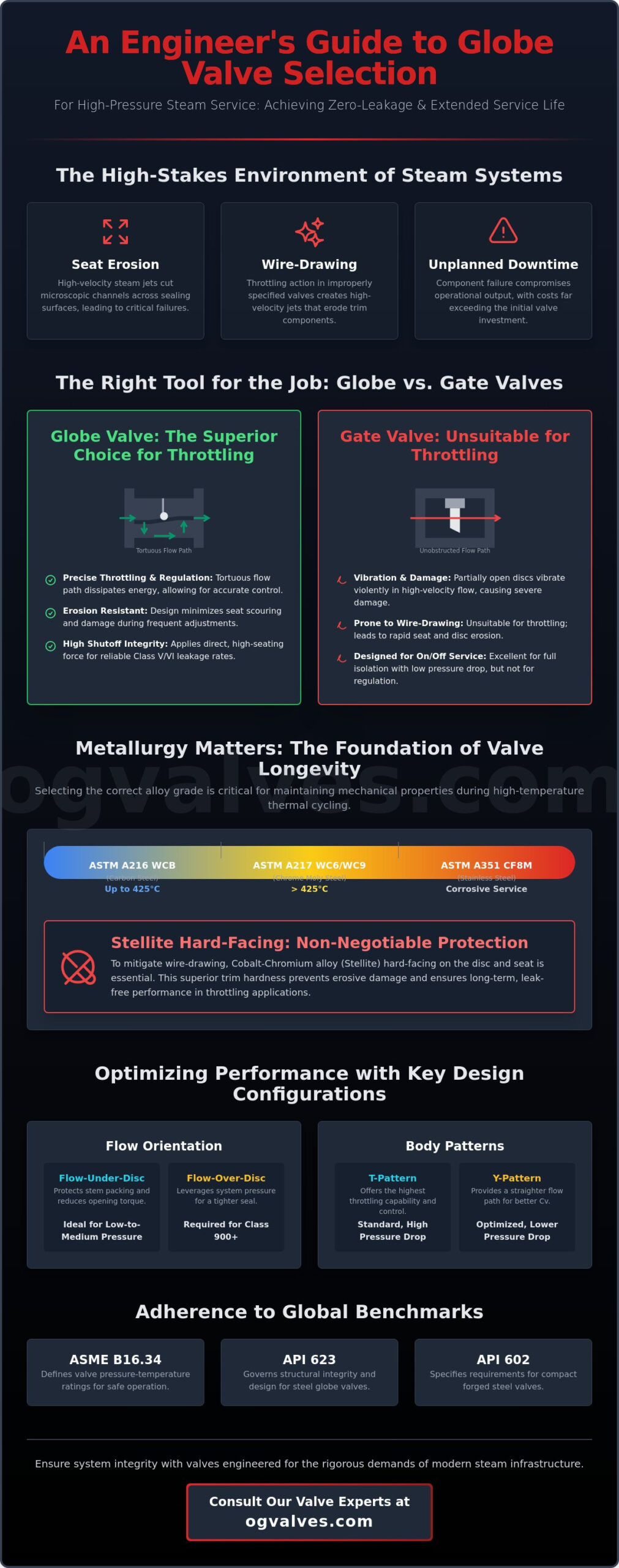
The integrity of a high-pressure steam system depends less on nominal pipe size and more on the specific metallurgical hardening of the valve trim. You recognize that in high-temperature environments, the cost of a single component failure far exceeds the initial capital expenditure of the valve itself. Inaccurate throttling and wire-drawing often lead to terminal seat erosion, resulting in unplanned downtime that compromises operational output. Effective globe valve selection for steam service requires a rigid adherence to material classifications and design standards that go beyond basic pressure-temperature ratings.
This guide provides a clinical analysis of the technical specifications necessary to achieve zero-leakage performance and extended service life. We’ll examine the structural requirements of API 623, the 1st Edition, alongside the 2025 edition of ASME B16.34 to define a benchmark for industrial safety. You’ll gain a detailed overview of critical design features, including pressure seal bonnets for Class 900 applications, Stellite-faced discs for erosion resistance, and the necessity of OS&Y construction for stem thread protection. This technical review ensures that procurement and engineering decisions align with the rigorous demands of modern steam infrastructure.
Key Takeaways
- Analyze how the tortuous flow path of globe valves enables precise pressure drop management and isolation in high-pressure steam applications.
- Identify the critical metallurgical requirements for globe valve selection for steam service, specifically the use of Stellite hard-facing to mitigate seat erosion and wire-drawing.
- Evaluate the operational trade-offs between T-Pattern and Y-Pattern body configurations to optimize the balance between throttling control and flow resistance.
- Verify structural integrity by aligning technical specifications with global benchmarks, including ASME B16.34 pressure-temperature ratings and API 602 forged valve standards.
- Determine the appropriate alloy grades, such as ASTM A217 WC6 or WC9, required to maintain mechanical properties during high-temperature thermal cycling.
Mechanics of Globe Valves in High-Pressure Steam Systems
Globe valves function as multi-turn, linear motion devices. They provide precise isolation and regulation for industrial steam lines. The fundamental Mechanics of Globe Valves involve a disc moving perpendicular to the plane of the seat, creating a tortuous flow path that forces steam to change direction multiple times within the valve body. This design is intentional. It facilitates a controlled pressure drop and dissipates kinetic energy that would otherwise cause rapid component wear in high-velocity steam environments.
Standard gate valves offer low flow resistance and are excellent for full-open isolation, but they fail in throttling service. Partially open gate discs suffer from vibration and wire-drawing erosion. Globe valves eliminate these risks because their seat-to-disc contact is more uniform. The design minimizes seat scouring during intermediate positioning, making it the superior choice for systems requiring frequent adjustment. Proper globe valve selection for steam service depends on understanding these mechanical advantages over friction-based sealing designs.
Flow orientation is a critical technical specification that dictates performance and safety. Engineers prioritize flow-under-disc for most low-to-medium pressure applications. This configuration protects the stem packing from constant pressure and reduces the torque required to open the valve. In Class 900 systems or higher, flow-over-disc designs are often utilized. This leverages system pressure to maintain a tight seal, preventing the valve from opening unexpectedly under extreme pressure surges. This choice directly impacts actuator sizing and long-term reliability.
Throttling Dynamics and Pressure Regulation
Managing high-velocity steam requires careful control to prevent localized erosion of the valve internals. The relationship between disc lift and the flow coefficient (Cv) is more predictable in globe valves than in quarter-turn alternatives. Engineers prefer linear flow characteristics for manual steam regulation. This ensures that a specific increase in stem rotation results in a proportional increase in flow. Such predictability is vital for maintaining system efficiency and preventing thermal shock during globe valve selection for steam service.
Shutoff Integrity in Steam Applications
Achieving Class V or VI leakage rates is essential for safety and energy conservation. Steam quality significantly influences sealing performance; saturated steam poses a higher risk of droplet-induced erosion compared to superheated steam. The mechanical advantage of the globe design lies in its ability to apply direct, high-seating force. This enables repetitive cycling without the rapid degradation of sealing surfaces. The robust construction ensures that the valve maintains its shutoff integrity even after thousands of operational cycles in high-temperature environments.
Material Selection and Trim Specifications for Steam Service
Metallurgical integrity is the primary determinant of valve longevity in high-pressure steam systems. Stellite hard-facing, specifically cobalt-chromium alloys, is non-negotiable for seating surfaces to mitigate the effects of wire-drawing. This erosive phenomenon occurs when high-velocity steam jets cut microscopic channels across the seat face during throttling or initial opening. Without superior trim hardness, standard carbon steel seats suffer terminal degradation, leading to bypass leakage and system inefficiency. Precise globe valve selection for steam service requires specifying a minimum hardness differential between the disc and seat to prevent galling while maintaining a clinical focus on surface planar integrity.
Material selection follows a rigid hierarchy based on operating temperatures and environmental stressors. ASTM A216 WCB carbon steel remains the benchmark for saturated steam applications up to 425°C. For superheated steam exceeding this threshold, alloy steels such as ASTM A217 WC6 or WC9 are required to provide necessary creep resistance. In corrosive condensate return lines, stainless steel grades like ASTM A351 CF8M are utilized to prevent pitting and oxidation. As of May 2026, North American stainless steel prices were recorded at $2.66/KG, a factor that procurement specialists must weigh against the long-term durability of the installation. Compliance with Industry Standards and Certifications, including the 2025 edition of ASME B16.34, ensures that these materials meet the required pressure-temperature ratings for industrial safety.
Standardizing on API Trim 8, which features 13% Chrome (SS410) with at least one hard-faced seating surface, provides a reliable baseline for most heavy industrial steam headers. This trim configuration balances cost-effectiveness with the mechanical toughness needed to survive repetitive thermal cycling. For extreme service, a full Stellite Trim 5 is often specified to ensure maximum resistance to the abrasive nature of high-velocity steam particulates.
Stem and Packing Integrity
Maintaining a zero-leakage seal at the stem is a significant challenge in high-temperature environments. Flexible graphite packing is the industry standard due to its thermal stability and chemical inertness. For this seal to remain effective, stems must be precision ground and polished to a finish of 16 RMS or better, reducing friction and preventing packing shredding. In applications with stringent fugitive emission requirements, bellows seal configurations provide a physical barrier for total containment. These components must adhere to API 624 standards for rising stem valves to ensure documented emissions compliance.
Erosion and Corrosion Resistance
Cavitation-induced damage is a frequent failure point in steam condensate lines where pressure drops cause rapid phase changes. Specifying hardened trim and utilizing Y-pattern body designs can help manage these energy transitions. When evaluating body construction, forged valves per API 602 offer superior grain structure and density compared to cast alternatives, making them ideal for high-pressure headers. If your project requires a transition from isolation to throttling, understanding the differences between gate and globe valve metallurgy is essential for maintaining operational safety. This technical rigor ensures the valve assembly can withstand the unique erosive stresses of steam service.
Evaluating Body Designs and Bonnet Configurations
Body geometry selection directly dictates the fluid dynamics and mechanical stress distribution within a steam system. For globe valve selection for steam service, the T-Pattern, or Z-body, remains the industry standard for high-differential pressure throttling. Its internal diaphragm requires the steam to navigate a tortuous path, providing the necessary resistance for precise control. While this configuration offers the most accurate regulation, it results in a higher pressure drop and can become a site for condensate accumulation if not properly trapped. Technical experts specify this design when the primary objective is fine-tuned pressure reduction rather than flow efficiency.
In systems where flow capacity is prioritized without sacrificing the control characteristics of a globe design, the Y-Pattern (oblique) body is the appropriate specification. The stem and seat are angled at approximately 45 degrees, straightening the flow path and significantly reducing the flow coefficient (Cv) loss compared to T-patterns. Angle pattern valves serve a dual purpose by managing 90-degree directional changes in piping while effectively handling slug flow. This design reduces the total number of line fittings and minimizes the impact of water hammer in systems prone to condensate carryover.
Bonnet selection must account for the extreme thermal expansion encountered in high-pressure steam headers. For applications exceeding Class 900, the pressure-seal bonnet is the technical benchmark. Unlike bolted designs, the pressure-seal configuration utilizes internal system pressure to compress a specialized gasket against the body wall. This ensures that higher operating pressures actually increase sealing integrity. It’s a critical safety feature for power plant main steam lines where temperatures frequently exceed 500°C.
Bonnet Integrity and Thermal Cycling
Thermal expansion remains a primary cause of bonnet failure in steam service. Bolted bonnets are common in lower pressure classes, but they’re susceptible to gasket relaxation during rapid system startups. As steam temperature rises, bolt elongation can occur, compromising the seal and leading to fugitive emissions. Welded bonnets offer a zero-leakage alternative for high-pressure, low-maintenance applications where internal access isn’t frequently required. Specifying the correct bonnet type ensures the assembly can withstand the mechanical stresses of repetitive thermal cycling without loss of containment.
Flow Path Optimization
High-velocity steam generates significant acoustic energy and turbulence. Optimizing the flow path through proper body selection helps dissipate this energy, reducing vibration and noise levels that can lead to fatigue in adjacent piping. Body shape also influences how effectively a system manages condensate; stagnant areas in Z-body valves can lead to localized cooling and water hammer. In many critical infrastructures, engineers specify check valves in series with globe designs to prevent backflow during system shutdowns, ensuring the entire valve train remains protected from pressure surges.
Adherence to Industry Standards and Certifications
Strict adherence to international regulatory frameworks is the only method to ensure the structural soundness of a steam system. The 2025 edition of ASME B16.34 serves as the foundational technical benchmark for globe valve selection for steam service. This standard defines the mandatory pressure-temperature ratings, wall thicknesses, and body dimensions required to maintain containment under extreme thermal loads. Compliance isn’t optional. It’s a clinical requirement for risk mitigation in high-stakes industrial environments. Engineering specifications must explicitly reference these benchmarks to prevent the procurement of sub-standard components that fail under operational stress.
Standardization varies by valve construction and size. API 602, currently in its 11th Edition (published May 2022), governs forged steel globe valves for sizes DN 100 (NPS 4) and smaller. For larger cast steel configurations, BS 1873 remains the governing standard, detailing the requirements for heavy-duty isolation and throttling. These standards work in conjunction with ISO 15848-1 to address fugitive emissions. In modern steam plants, preventing steam loss at the stem is both an efficiency mandate and a safety protocol. Utilizing certified high-specification globe valves ensures that every component has undergone the rigorous testing necessary to meet these global benchmarks.
Pressure-Temperature Rating Nuances
Steam temperature significantly de-rates the maximum allowable working pressure of a valve body. A Class 600 carbon steel valve that handles high pressure at ambient temperatures has a much lower capacity at 400°C. Engineers must consult the material group tables in ASME B16.34 to verify that the selected flange rating matches the steam header’s peak parameters. Verification of Material Test Reports (MTRs) is a critical step in this process. These documents provide the quantifiable data needed to confirm that the heat of steel used in production meets the chemical and mechanical properties required by the project specification.
Testing and Quality Assurance Protocols
Every valve must undergo a series of standardized tests before commissioning. API 598, 11th Edition (February 2023), provides the protocol for hydrostatic and pneumatic seat leakage testing. For steam service, achieving a zero-leakage result during a high-pressure closure test is vital. Positive Material Identification (PMI) is also utilized to verify that alloy components, such as WC6 or WC9 bodies, haven’t been cross-contaminated during manufacturing. For projects within the European Union, compliance with the Pressure Equipment Directive (PED) is mandatory to ensure the assembly meets essential safety requirements for pressurized systems.
Procurement and Technical Specification with OG VALVES LTD.
Effective globe valve selection for steam service necessitates a procurement partner capable of translating complex thermal parameters into precise mechanical specifications. OG VALVES LTD functions as a technical consultant for heavy industrial sectors, ensuring that every component aligns with the rigorous safety requirements of high-pressure steam infrastructure. By maintaining a global supply chain focused on high-specification metallurgy, the organization provides reliable access to industrial valves that meet or exceed the 2025 edition of ASME B16.34. This strategic approach mitigates the risk of material non-compliance and operational failure in critical steam headers.
Technical consultation extends to the verification of material compatibility for extreme steam parameters. Whether specifying ASTM A217 WC9 for superheated lines or hardened Stellite trim for throttling service, the focus remains on long-term mechanical stability. Fast-track delivery capabilities are prioritized for critical maintenance intervals and unplanned shutdowns, where the cost of system inactivity is measured in significant hourly losses. Every procurement cycle follows a methodical progression from data-sheet review to final quality assurance verification, ensuring that functional reality matches engineering design.
Customized Valve Solutions
Standard globe valves often require modification to meet specific automation or severe service requirements. OG VALVES LTD manages the integration of multi-turn actuators for precise, automated steam control; this ensures the assembly is calibrated for the high-torque demands of high-pressure shutoff. Specialized trim configurations, including anti-cavitation and noise-attenuation designs, are available for applications where standard linear plugs are insufficient. For large-scale valve replacement projects in power generation, comprehensive project management ensures that every unit is tagged, tested, and documented per project-specific regulatory requirements.
Global Logistics and Technical Support
Minimizing downtime requires rapid global supply chain execution and robust logistical support. Every valve shipment includes in-depth technical documentation, including Material Test Reports (MTRs) and pressure test certificates, ensuring full traceability and regulatory compliance. Technical support teams provide guidance on the integration of various components within steam loops, such as the strategic placement of butterfly valves for low-pressure isolation alongside globe valves for high-pressure regulation. This clinical oversight ensures that the entire valve train functions as a cohesive, high-performance system capable of withstanding the most demanding industrial environments.
Optimizing Industrial Steam System Integrity
Achieving operational reliability in high-pressure steam headers requires a meticulous approach to component specification. The clinical analysis of body geometry and hardened trim metallurgy presented in this guide highlights the necessity of preventing wire-drawing and thermal fatigue. Adherence to the 2025 edition of ASME B16.34 and current API standards is the only method to ensure structural soundness and regulatory compliance. Proper globe valve selection for steam service remains a critical decision that dictates the safety and efficiency of your entire infrastructure.
OG VALVES LTD provides the technical expertise and high-specification inventory required for these demanding environments. Our API 600 and ASME B16.34 compliant products are supported by specialist technical support for severe service applications. We understand the cost of downtime and offer fast-track global delivery for industrial shutdowns to maintain your project timelines. It’s essential to partner with an expert who understands the technical realities of heavy industry.
Request a Technical Quote for Steam-Rated Globe Valves and secure the performance of your high-pressure systems today.
Frequently Asked Questions
What is the best material for a globe valve in high-temperature steam service?
ASTM A217 WC6 or WC9 alloy steel is the technical standard for high-temperature steam exceeding 425°C. These materials provide the creep resistance necessary to maintain structural integrity under prolonged thermal stress. For saturated steam at lower temperatures, ASTM A216 WCB is acceptable. Regardless of the body material, seating surfaces must be hard-faced with Stellite to ensure resistance against the erosive nature of high-pressure steam.
Why are globe valves preferred over gate valves for steam throttling?
Globe valves are preferred for throttling because their design allows the disc to move perpendicular to the seat, ensuring uniform contact and precise flow coefficient control. Gate valves are designed for full isolation only. When a gate valve is partially open, high-velocity steam causes the disc to vibrate against the guides, leading to seat scouring and eventual loss of shutoff integrity.
How do I prevent wire-drawing in a steam globe valve?
Preventing wire-drawing requires specifying cobalt-based alloys, such as Stellite, for all seating surfaces. Wire-drawing occurs when high-velocity steam jets erode the metal during the initial stages of valve opening. Rigorous globe valve selection for steam service ensures that the trim hardness is sufficient to withstand these abrasive forces, maintaining a gas-tight seal even after repetitive throttling cycles.
What is the difference between a bolted bonnet and a pressure-seal bonnet for steam?
The primary difference lies in how the seal is maintained under pressure. Bolted bonnets rely on external mechanical force to compress a gasket, which can fail during thermal cycling. Pressure-seal bonnets utilize internal system pressure to force a specialized gasket against the body wall. This design is the technical benchmark for Class 900 systems and higher, as increased pressure actually improves the sealing performance.
Which API standards govern the design of steam globe valves?
API 623 is the specific standard for cast steel globe valves, providing more stringent wall thickness requirements than ASME B16.34. Small-bore forged valves are covered by API 602, 11th Edition. For final quality assurance, all valves must undergo hydrostatic and pneumatic testing per API 598, 11th Edition, to confirm that leakage rates meet the specified industrial safety benchmarks.
Can globe valves be used for saturated and superheated steam?
Globe valves are compatible with both saturated and superheated steam, provided the metallurgy is correctly specified. Saturated steam applications often prioritize corrosion and droplet erosion resistance, frequently utilizing stainless steel or 13% chrome trim. Superheated steam requires alloy steels like WC6 or WC9 to prevent mechanical degradation and creep at temperatures that can exceed 540°C in modern power generation facilities.
How does flow direction affect the performance of a steam globe valve?
Flow direction dictates the seating force and the pressure exerted on the stem packing. Flow-under-disc is standard for most applications because it reduces the torque required to open the valve and isolates the packing from pressure when the valve is closed. In contrast, flow-over-disc is used in high-pressure service to assist in shutoff, though it necessitates larger actuators to overcome the system pressure during opening.
What are the common causes of globe valve failure in steam systems?
Leading causes of failure include seat erosion from wire-drawing, stem packing leaks, and mechanical fatigue from thermal cycling. Inaccurate globe valve selection for steam service often results in using materials that cannot withstand the specific temperature or velocity of the application. Regular inspection of the flexible graphite packing and the planar integrity of the Stellite seats is required to prevent unplanned system downtime.
 Responsive Menu