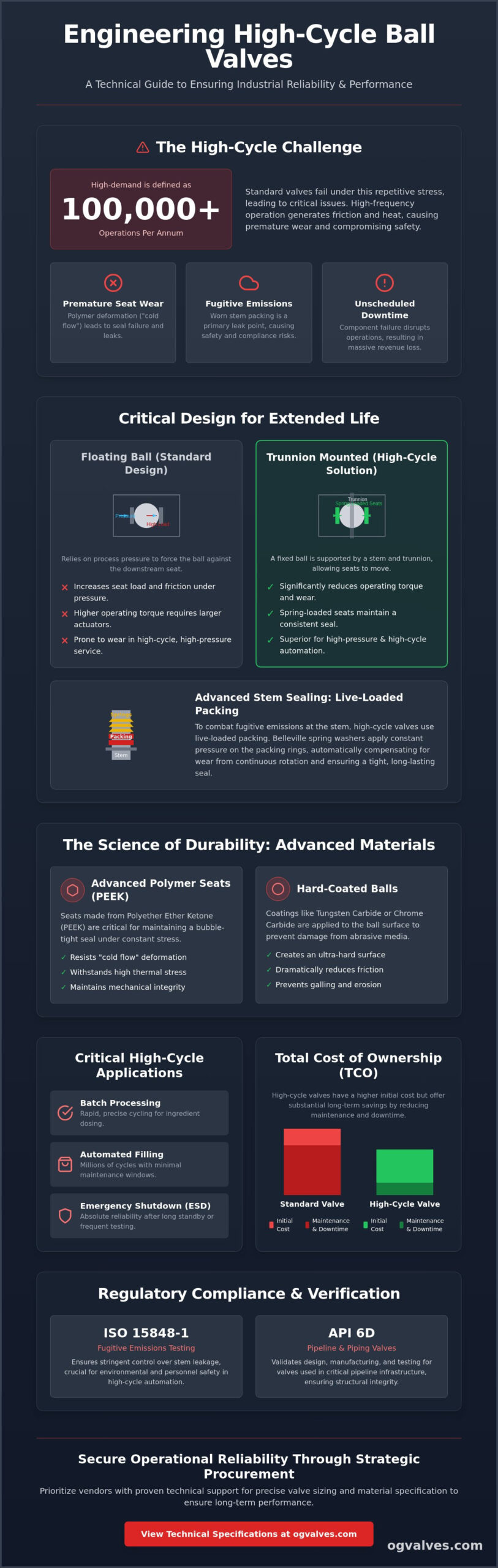
High cycle life is not an inherent property of ball valves but a result of precision-engineered load distribution and advanced polymer science at the seat-to-ball interface. Engineers in heavy industrial sectors recognize that standard valve designs often succumb to premature seat wear, leading to costly unscheduled downtime and potential fugitive emissions penalties. It’s a technical reality that high cycle life ball valves must be engineered to withstand millions of operations without compromising the structural soundness of the seal.
You likely understand the operational burden of high maintenance costs in remote or inaccessible facilities where a single component failure disrupts critical infrastructure. This article delivers an authoritative engineering analysis of the design standards and material selections necessary to ensure long-term performance. We’ll examine how to identify valves that meet ISO 15848-1 standards, evaluate the synergy between actuation and cycle life, and select specialized materials that resist deformation under constant mechanical stress. This technical overview provides the quantifiable data needed to secure high-stakes trust in your procurement process and ensure operational reliability.
- Define the technical threshold for high-demand applications by quantifying high cycle as operations exceeding 100,000 cycles per annum.
- Evaluate the engineering advantages of trunnion-mounted configurations and live-loaded packing for maintaining fugitive emission compliance over extended durations.
- Identify the optimal synergy between advanced polymers like PEEK and hard-coatings for high cycle life ball valves to resist seat deformation and wear.
- Navigate global regulatory benchmarks including ISO 15848-1 and API 6D to ensure product validation for critical infrastructure.
- Streamline procurement by prioritizing vendors with established technical support capabilities for precise valve sizing and material specification.
In industrial fluid control, standard specifications often fail to account for the cumulative stress of high-frequency operation. While many general-purpose valves satisfy basic pressure and temperature requirements, they lack the structural integrity required for continuous duty. High cycle life ball valves are components engineered to maintain zero-leakage performance under repetitive mechanical stress exceeding standard API 608 benchmarks. For technical experts, quantifying high cycle is essential; this designation typically applies to installations exceeding 100,000 operations per annum. This frequency demands a Ball valve design that prioritizes the interface between the seat and the rotating element.
The distinction between mechanical endurance and sealing integrity over time is fundamental. A valve might continue to cycle mechanically while failing to provide a bubble-tight shutoff. This leads to process contamination or hazardous leaks. This requirement is particularly critical in the following applications:
- Batch Processing: Where rapid cycling is necessary for precise ingredient dosing.
- Automated Filling: Demanding millions of cycles with minimal maintenance windows.
- Emergency Shutdown (ESD) Systems: Requiring absolute reliability after long periods of inactivity or frequent testing.
The Mechanics of Cycle-Induced Wear
High-frequency operation generates friction-induced heat at the seat-to-ball contact point. This thermal stress can lead to polymer seat deformation or “cold flow,” which compromises the seal. Maintaining torque consistency is also vital. If torque requirements fluctuate, it causes premature actuator fatigue and inconsistent cycle times. When media contains particulates, the risk of accelerated seat erosion increases. Abrasive particles get trapped between the ball and seat during high-frequency operation, creating leak paths that standard valves cannot resist.
Total Cost of Ownership (TCO) vs. Initial Capital Expenditure
Procurement specialists often focus on initial capital expenditure, yet the true cost lies in operational downtime. In petrochemical facilities, a single hour of unscheduled downtime can result in massive revenue loss and safety risks. High cycle life ball valves reduce the frequency of “Turnaround and Inspection” (T&I) cycles. By extending the interval between required maintenance, these components offer substantial long-term savings. They also reduce the strain on the entire automated system. Lower actuator wear and optimized air or power consumption contribute to a more efficient and reliable facility over the product’s full lifecycle.
Engineering for longevity requires a fundamental shift from standard commodity designs to purpose-built architectures. The mechanical configuration of the valve determines its ability to maintain sealing performance over hundreds of thousands of cycles. For engineers, the primary decision involves the method of ball support and the management of friction at the seat interface. High cycle life ball valves must be selected based on their capacity to handle these stresses without degrading the internal components.
Floating vs. Trunnion: Managing Mechanical Stress
Floating ball valves rely on process pressure to push the ball against the downstream seat. While effective for low-cycle applications, this design increases seat load and friction proportionally with pressure. In contrast, trunnion-mounted configurations utilize a fixed ball position. Spring-loaded seats maintain contact without relying on the ball’s movement. This configuration significantly reduces operating torque and wear. It’s a superior choice for high-pressure classes defined by ASME B16.34, where mechanical endurance is a prerequisite for safety.
Stem Sealing and Fugitive Emissions
Stem sealing remains the most vulnerable point for fugitive emissions in high-frequency automation. Traditional V-ring packing often fails because it lacks the resiliency to compensate for the wear caused by constant rotation. Live-loaded stem packing systems solve this by incorporating Belleville spring washers. These washers exert a constant, predetermined load on the packing, ensuring a tight seal even as material wears down. This design is a critical baseline found in high-specification industrial ball valves.
Adherence to API standards for ball valves ensures that these design features meet rigorous safety benchmarks. High-cycle environments also require anti-static designs. Rapid cycling at high velocities can generate static electricity. This creates an ignition risk in volatile media. Integrated grounding paths between the ball, stem, and body mitigate this hazard. These safety features are mandatory for facilities handling flammable or hazardous materials.
Self-relieving seat technology is essential for managing cavity pressure. Rapid cycling can trap fluid in the body cavity. If temperature fluctuations occur, this trapped fluid expands. This leads to seat deformation or valve seizure. Self-relieving seats allow excess pressure to bypass the seat and return to the pipeline. This protects the valve’s structural integrity. For those seeking durable solutions, you can view our ball valves to find a specification that matches your facility’s cycle demands.

The operational lifespan of high cycle life ball valves is fundamentally dictated by the material properties at the primary sealing interface. Engineering for longevity requires a precise balance between material hardness, chemical compatibility, and the coefficient of friction. While mechanical design provides the framework, the physical interaction between the ball and the seat determines the failure point in high-frequency applications. Selecting the correct materials ensures that the valve maintains its structural integrity over millions of cycles without exceeding the torque limits of the automation system.
Polymer Science in Valve Seating
Soft seat materials are often the most cost-effective solution for non-abrasive media, provided the polymer can resist mechanical deformation. Polytetrafluoroethylene (PTFE) and Reinforced PTFE (RPTFE) offer excellent lubricity but may exhibit “cold flow” under constant high-load cycling. For more demanding environments, Polyetheretherketone (PEEK) is the preferred choice. PEEK provides superior resistance to deformation and maintains its mechanical strength at significantly higher temperatures than PTFE-based compounds. This resistance to cold flow is critical for maintaining a bubble-tight seal during the rapid pressure fluctuations common in automated batch processing.
Surface Hardening and Coatings
When media contains abrasive particulates or operates at extreme pressures, metal-to-metal seating becomes a technical necessity. Achieving a reliable seal in these conditions depends on the ball surface finish and the application of hard coatings. High-performance valves typically utilize Tungsten Carbide or Chrome Carbide applied via High-Velocity Oxy-Fuel (HVOF) thermal spraying. These techniques achieve surface hardness levels exceeding 60 HRC. This level of hardness is essential to prevent surface scoring that creates leak paths. Adherence to ASME standards for industrial ball valves, specifically regarding material classifications and pressure-temperature ratings, ensures that these coatings are compatible with the base metallurgy.
Surface finish, measured in Ra (Roughness Average), directly impacts seat longevity. A ball with a lower Ra value reduces the friction against the seat, which in turn lowers the required actuator torque. This reduction in torque prevents premature wear on the stem and actuator components. Stem material selection is equally vital. In high-torque automation, standard stainless steels may suffer from galling. Utilizing high-strength alloys like 17-4 PH stainless steel or XM-19 provides the necessary torsional strength and wear resistance to withstand the mechanical stress of continuous high-cycle operation. These material choices collectively ensure that the valve remains a dependable component in critical infrastructure.
Regulatory adherence serves as the primary benchmark for industrial safety and operational output. For high cycle life ball valves, general design standards like API 608 and API 6D provide the foundational requirements, but they differ in their scope of cycle testing. API 608 focuses on metal ball valves for heavy industrial use, prioritizing wall thickness and stem strength. API 6D addresses pipeline valves where long-term shutoff is the priority. Neither standard alone guarantees the endurance required for 100,000 annual operations without additional qualification through rigorous endurance protocols.
Fugitive emissions compliance is verified through ISO 15848-1. This standard provides the most rigorous framework for quantifying stem seal performance through high-sensitivity helium leak testing. In high-cycle hazardous environments, fire-safe certification according to API 607 or ISO 10497 is mandatory. This ensures the valve maintains pressure containment even after soft seat destruction in a fire event. Positive Material Identification (PMI) verifies that the alloy composition matches the technical specification. This prevents failures caused by material non-compliance or the accidental use of lower-grade forgings in critical components.
ISO 15848-1 Endurance Classes
Standards categorize valves into endurance classes based on the number of cycles achieved without exceeding specific leakage limits. Class CO1 requires 500 cycles, while Class CO3 demands 2500 cycles. For high-frequency applications, engineers specify benchmarks that simulate the valve’s full operational life. Helium leak testing is performed during thermal cycling to account for material expansion and contraction. Class AH certification represents the highest level of tightness under the most rigorous cycling protocols. It’s increasingly relevant as the IEA Global Methane Tracker 2026 places additional commercial pressure on reducing methane emissions.
Quality Assurance and Factory Acceptance Testing (FAT)
Factory Acceptance Testing (FAT) must be methodical to ensure reliability across global supply chains. Every unit undergoes high-pressure hydrostatic and pneumatic shell testing to verify structural soundness. Low-pressure air seat testing is equally critical for verifying zero-leak performance at the start of the valve’s life. These protocols fit into a broader compliance framework defined by industrial valve standards. To ensure your procurement meets these rigorous safety benchmarks, you can contact our technical department for detailed product specifications and testing documentation.
Actuation Synergy and Cycle Life
The interaction between the valve and its actuator determines the system’s overall mechanical endurance. Pneumatic actuators are generally preferred for high-frequency industrial environments due to their inherent durability and rapid response times. However, high-speed cycling can induce “hammering” or mechanical shock within the valve internals. This stress occurs when the actuator’s kinetic energy is transferred abruptly to the stem and ball during the end of the stroke. Engineers mitigate this risk by utilizing flow control valves or cushioned actuators to modulate the speed of operation. For a deeper analysis of these systems, refer to our valve actuators guide. Proper synchronization ensures that the actuator torque remains within the valve’s design limits, preserving the seat-to-ball interface and preventing stem deformation over millions of operations.
Partnering with OG VALVES for Industrial Solutions
OG VALVES functions as a dependable partner in critical infrastructure, providing high-specification fluid control solutions across the global market. Our engineering team prioritizes industrial precision and unwavering adherence to global regulatory benchmarks, including the latest API and ISO standards. We understand that high cycle life ball valves are essential for minimizing unscheduled downtime and avoiding fugitive emissions penalties in volatile environments. Our specialized project management capability allows us to handle large-scale industrial demands with a clinical focus on durability and safety. We anchor our claims in rigorous testing and quality control processes, positioning our brand as a benchmark for industrial safety. You can contact OG VALVES for a technical consultation and quote on high cycle life ball valves to ensure your facility maintains its operational integrity and long-term performance.
Industrial reliability hinges on the precise integration of high-performance materials and advanced mechanical design. As analyzed, high cycle life ball valves must utilize trunnion-mounted support and live-loaded stem packing to mitigate the cumulative stresses of high-frequency operation. These engineering choices, combined with strict adherence to ISO 15848-1 and ASME standards, ensure that critical infrastructure maintains its structural integrity over millions of cycles. By prioritizing total cost of ownership over initial capital expenditure, facilities effectively reduce the risk of unscheduled downtime and fugitive emissions penalties.
OG VALVES provides the technical expertise necessary to navigate complex industrial specifications and global supply chain demands. Our commitment to quality assurance ensures that every component meets rigorous performance benchmarks for safety and durability. We offer comprehensive technical support to ensure full compatibility between your automation systems and valve internals. Request a Quote for High-Specification Industrial Valves to secure a dependable partner for your facility’s future operations. We look forward to supporting your next project with precision and engineering excellence.
What defines a ball valve as “high cycle”?
High cycle life ball valves are components engineered to perform in applications exceeding 100,000 operations per annum. This technical designation separates industrial grade valves from standard utility valves. These components must maintain bubble tight shutoff and structural integrity under constant mechanical stress. Standard API 608 benchmarks don’t always cover the endurance required for these high frequency environments.
Why do standard ball valves fail in high-frequency applications?
Standard valves fail because their internal components aren’t designed to manage friction induced heat and seat deformation. Constant rotation leads to cold flow in standard polymers and increased operating torque. This wear eventually creates leak paths across the seat or through the stem packing. Standard designs also lack the robust load distribution found in high cycle specific architectures.
Is a trunnion-mounted ball valve better for high cycle life?
Trunnion mounted designs are technically superior for high cycle life due to their fixed ball position. This configuration utilizes spring loaded seats that maintain constant contact without increasing friction as line pressure rises. Floating ball valves rely on downstream pressure to seal, which significantly increases seat load and wear. Trunnion mounting reduces the required actuator torque and extends the component’s operational life.
Can I use a soft-seated ball valve for high-cycle abrasive media?
Soft seated valves are unsuitable for high cycle abrasive media because particulates cause rapid surface scoring. Abrasive particles get trapped between the ball and polymer seat, leading to immediate seal failure. High cycle applications with solids require metal to metal seating with Tungsten Carbide or Chrome Carbide coatings. These materials provide the 60+ HRC hardness necessary to resist erosion and maintain a zero leakage seal.
What is the significance of ISO 15848-1 for high-cycle valves?
ISO 15848-1 provides a clinical framework for verifying fugitive emissions and mechanical endurance. This standard categorizes valves into endurance classes, such as Class CO3 for 2,500 cycles. For technical specialists, Class AH certification is the most rigorous benchmark. It proves that the valve’s stem seal can withstand thermal cycling and high frequency operation without exceeding strict helium leakage limits.
How does actuation speed affect the lifespan of a ball valve?
Actuation speed directly impacts lifespan by introducing mechanical shock or hammering into the valve internals. Rapid cycling at high velocities transfers excessive kinetic energy to the stem and ball interface. This stress leads to seat deformation and potential stem galling. Modulating the speed with flow control valves or cushioned actuators preserves the mechanical integrity of the internal sealing surfaces.
What maintenance is required for high cycle life ball valves?
Maintenance for high cycle life ball valves focuses on monitoring torque consistency and packing load. While these valves reduce the frequency of Turnaround and Inspection cycles, periodic verification of the live loaded packing system is essential. Technicians should inspect for signs of seat erosion and ensure that Belleville spring washers maintain the specified load. This proactive approach prevents fugitive emissions and ensures long term performance.
Do high cycle valves require special stem packing?
High cycle valves require live loaded stem packing to compensate for the wear caused by constant rotation. Traditional V-ring packing lacks the resiliency to maintain a seal over hundreds of thousands of cycles. Systems utilizing Belleville spring washers provide a constant, predetermined force on the packing. This ensures a tight seal against fugitive emissions even as the packing material naturally wears down during operation.
 Responsive Menu