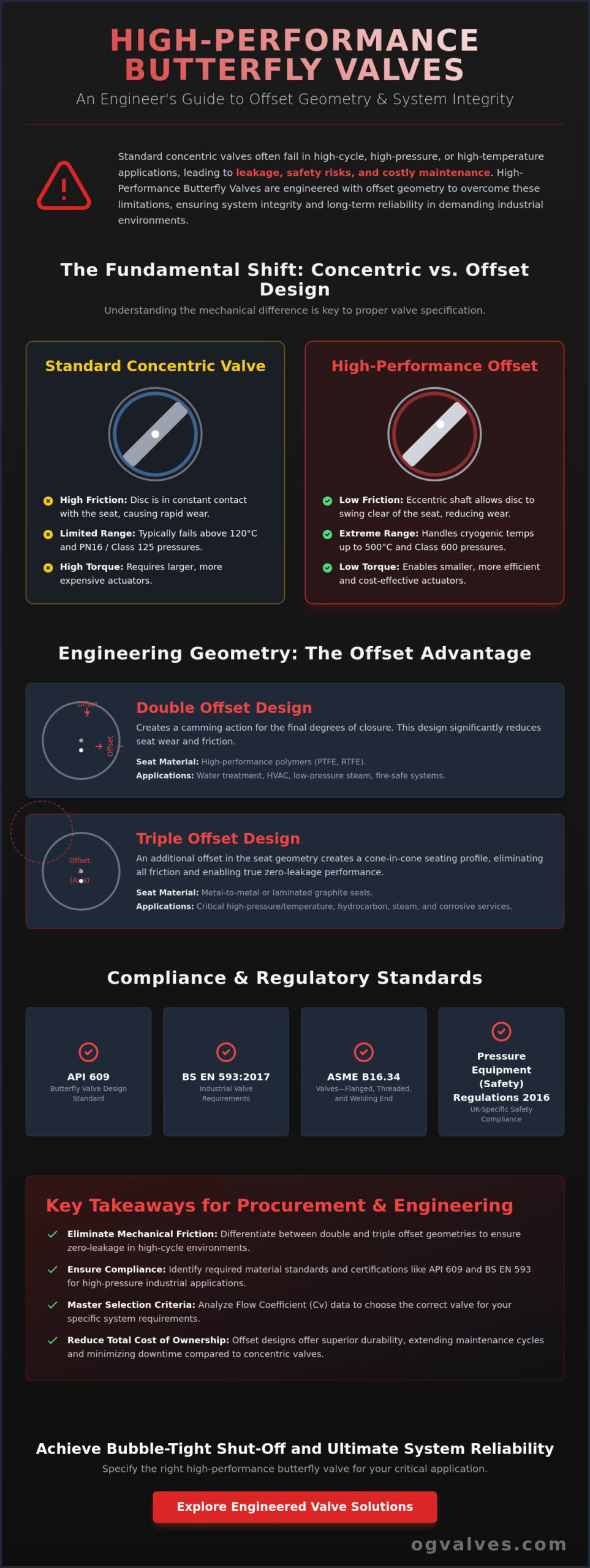
High performance is not a marketing descriptor; it’s a quantifiable engineering standard defined by offset geometry and rigorous material traceability. In the demanding landscape of UK heavy industry, selecting high performance butterfly valves uk is a critical step toward ensuring system integrity where standard concentric designs fail. You’re likely aware that inadequate shut-off in high-cycle applications leads to more than just lost revenue. It creates safety risks and necessitates frequent, costly interventions in remote or hazardous environments.
This technical guide provides an authoritative analysis of high-performance valve engineering, focusing on the mechanical advantages of double and triple offset designs. You’ll learn how to achieve bubble-tight shut-off in critical lines while ensuring strict compliance with API 609 9th Edition and BS EN 593:2017 standards. We’ll examine the procurement benchmarks required by the Pressure Equipment (Safety) Regulations 2016 and discuss how specific material classifications can mitigate failure in corrosive environments, ultimately extending your maintenance cycles and reducing total cost of ownership.
Key Takeaways
- Differentiate between double and triple offset geometries to eliminate mechanical friction and ensure zero-leakage performance in high-cycle environments.
- Identify the precise material standards and international certifications, such as API 609 and BS EN 593, required for high-pressure industrial compliance.
- Master the selection criteria for high performance butterfly valves uk by analyzing Flow Coefficient (Cv) data and standardized face-to-face dimensions.
- Understand the mechanical limitations of concentric designs compared to the engineered durability of offset valves in extreme temperature and pressure conditions.
- Optimize industrial procurement by leveraging technical benchmarks that reduce lead times for specialized alloy components and minimize maintenance intervals.
High performance butterfly valves uk represent a fundamental departure from standard concentric designs. While concentric valves utilize a centered shaft and a resilient liner, high-performance variants employ eccentric disc positioning. This design shift allows the valve to operate in environments exceeding the physical limits of standard elastomeric components. Specifically, these valves are engineered to meet Class 150, 300, and 600 pressure ratings, providing a robust solution for high-pressure industrial lines. The engineering focus here is on mechanical durability and the ability to maintain a bubble-tight seal under fluctuating thermal loads.
The core of this technology lies in the offset geometry. By moving the shaft away from the seat centerline and the pipe centerline, manufacturers eliminate the constant friction typical of resilient seated valves. This evolution in Butterfly valve technology ensures that the disc only makes contact with the seat in the final moments of closure. This reduces mechanical wear and significantly lowers the torque required for actuation. It’s a clinical approach to valve design that prioritizes long-term operational output over initial cost savings.
Material selection for seating surfaces defines the valve’s specific application range. Resilient seats are suitable for lower temperatures, while reinforced PTFE or metal-to-metal seats are essential for extreme thermal cycles or high-pressure gas services. Metal seats, often involving specialized alloys, provide the necessary durability for abrasive or corrosive media where polymers would inevitably degrade. This material integrity is what allows high performance butterfly valves uk to function reliably in the petrochemical and power generation sectors.
Operational Advantages Over Standard Valves
Standard valves often struggle with high-cycle throttling. High-performance models excel in these conditions. Because the eccentric disc minimizes seat contact, the valve maintains sealing integrity over thousands of cycles. This longevity reduces maintenance intervals in critical infrastructure. Additionally, the lower operating torque allows for smaller, more cost-effective actuators. This is particularly vital in offshore or remote UK industrial facilities where space and power consumption are primary constraints. These valves also provide superior sealing in vacuum applications, a requirement often unmet by standard designs.
High-Performance vs Concentric Designs
Concentric valves rely on mechanical interference between the disc and a rubber liner. This creates high friction and rapid wear patterns. High-performance designs mitigate this through their offset shafts. Standard elastomeric liners typically fail above 120°C. In contrast, high-performance polymers and metal seals handle temperatures from cryogenic levels up to 500°C. Pressure ratings are another clear differentiator. While concentric valves are usually limited to PN16 or Class 125, high-performance units are built to ASME B16.34 standards, enabling safe operation in high-pressure steam and hydrocarbon lines.
Engineering Geometry: Double and Triple Offset Designs
Engineering geometry is the primary factor determining the operational limits of high performance butterfly valves uk. While the previous section established the baseline shift from concentric designs, the specific degree of offset defines the valve’s suitability for pressure and temperature extremes. These geometric configurations aren’t merely incremental improvements; they’re fundamental re-engineerings of how a disc interacts with its seat. By manipulating the shaft and seat axes, manufacturers can virtually eliminate the mechanical friction that causes premature failure in standard resilient-seated valves.
Double Offset Mechanics and Applications
Double offset mechanics rely on two distinct eccentricities. The first offset positions the shaft behind the seat, allowing the disc to swing clear of the seal almost immediately upon opening. The second offset shifts the shaft away from the pipe’s vertical centerline. This combination creates a camming action during the final degrees of closure. It’s a design that significantly reduces seat wear and allows for the use of high-performance polymers like PTFE and RTFE. These valves are highly effective in water treatment, HVAC systems, and low-pressure steam lines. You’ll often find fire-safe models in this category, which incorporate a secondary metal seat to maintain sealing integrity if the primary soft seal is compromised during a thermal event.
Triple Offset (TOV) for Critical Service
Triple offset designs are reserved for critical service where zero-leakage is non-negotiable under extreme conditions. The third offset is a geometric modification of the seating surface into an asymmetrical conical shape. This ensures that the disc and seat only make contact at the point of final closure. There’s no rubbing or sliding throughout the stroke. This non-rubbing action is essential for handling abrasive media and extreme thermal cycling, as it prevents the seat deformation that leads to bypass. TOVs achieve bubble-tight shut-off in cryogenic processes, high-pressure hydrocarbon service, and high-temperature petrochemical applications. They’re built to handle Class 300 and Class 600 pressure differentials without sacrificing sealing performance.
Selecting between these geometries requires a rigorous analysis of the media’s abrasive qualities and the system’s thermal profile. Double offset valves offer a cost-effective, high-performance solution for many industrial processes, while triple offset valves provide the necessary security for high-risk environments. Engineers seeking to specify these components for UK infrastructure projects can review the technical inventory at OG Valves to match specific geometry to their operational demands. This ensures that the chosen valve meets the required safety benchmarks while optimizing the total cost of ownership through reduced maintenance requirements.
Material Integrity and Regulatory Standards in the UK
Material integrity is the foundational requirement for high performance butterfly valves uk. While the geometric offsets discussed previously provide the mechanical framework for performance, the metallurgy determines the valve’s survival in aggressive industrial environments. Core specifications typically involve WCB Carbon Steel for general high-pressure service and CF8M Stainless Steel for corrosive media. For more demanding applications, Duplex and Super Duplex alloys are utilized to provide superior yield strength and resistance to pitting. These materials must align with rigorous international benchmarks, specifically ASME B16.34 for pressure-temperature ratings and the 9th Edition of API 609 for design standards.
Compliance with UK-specific regulations is mandatory for infrastructure projects. The Pressure Equipment (Safety) Regulations 2016 dictate that any equipment operating above 0.5 bar must meet strict safety criteria and carry the UKCA mark. Furthermore, metallic butterfly valves for general purposes must adhere to BS EN 593:2017. In the petrochemical sector, adherence to NACE MR0175/ISO 15156 is critical for sour gas environments to prevent sulfide stress cracking. Sealing security in the event of a fire is another non-negotiable standard; valves must be certified to API 607 or ISO 10497 testing protocols to ensure they maintain a seal even after the primary soft seats are destroyed.
Advanced Metallurgy for Corrosive Media
Offshore environments in the North Sea require metallurgy that exceeds standard stainless steel capabilities. Super Duplex and Monel are frequently specified for their exceptional resistance to seawater corrosion and chloride-induced stress cracking. In high-velocity steam or abrasive slurry applications, Stellite hard-facing is applied to the seating surfaces to prevent erosion. Reliability in these high-stakes sectors depends on material traceability. Procurement specialists must demand EN 10204 3.1 or 3.2 certification to verify the chemical and mechanical properties of the pressure-retaining parts, ensuring that the components meet the exact specification of the design phase.
Testing and Quality Assurance Benchmarks
Rigorous testing protocols are the final safeguard against operational failure. Every valve should undergo hydrostatic and pneumatic pressure testing according to API 598 to confirm seat and shell integrity. Environmental compliance now necessitates fugitive emission testing per ISO 15848-1, which quantifies the sealing capability of the stem packing over thousands of cycles. To eliminate the risk of material mix-ups in the supply chain, Positive Material Identification (PMI) is employed as a clinical verification tool. These quality assurance steps ensure that high performance butterfly valves uk deliver the expected service life in critical lines, minimizing the risk of unplanned downtime or environmental incidents.
Selection Criteria for High-Pressure UK Industrial Systems
Selecting high performance butterfly valves uk requires a clinical evaluation of flow dynamics and mechanical compatibility. Beyond the pressure-temperature ratings established in previous sections, engineers must calculate the Flow Coefficient (Cv) to ensure precise throttling accuracy. A valve with an incorrectly sized Cv leads to cavitation or poor control resolution, which compromises process stability. Face-to-face dimensions must adhere to international standards like ASME B16.10 or ISO 5752 to ensure seamless integration into existing pipework. Choice of configuration is equally critical. Wafer designs provide the most compact and lightweight profile, while Lug types allow for downstream piping removal during maintenance without depressurizing the entire system. Double Flanged configurations are typically reserved for larger diameters where additional structural support is required for high-pressure service.
Media compatibility is the next technical benchmark. The chemical resistance of both the seat and seal materials must be verified against the specific process fluid. While PTFE is the standard for a wide range of chemicals, high-velocity steam or abrasive slurries necessitate metal-to-metal seating with specialized hard-facing. For automated systems, the actuation interface is a vital data point. ISO 5211 mounting pads are the industry standard, ensuring that pneumatic or electric actuators can be mounted without custom brackets. This standardization simplifies the supply chain and reduces potential points of failure at the valve-actuator junction. To specify a solution that meets these rigorous benchmarks, technical experts can consult the industrial valve range at OG Valves for detailed specification data.
System Integration and Installation Factors
High-performance valves offer significant weight and space advantages over traditional gate valves. This is particularly vital for offshore platforms or modular skid construction where every kilogram impacts structural design. Sealing requirements must also be clearly defined; while many high-performance designs offer bi-directional sealing, some high-pressure configurations are optimized for uni-directional flow to maximize seat life. Orientation is another consideration. Installing these valves in vertical piping runs may require specific shaft support to prevent premature packing wear and ensure long-term sealing integrity.
Maintenance and Total Cost of Ownership (TCO)
Total Cost of Ownership should dictate procurement decisions rather than initial price. While the initial CAPEX for high-performance valves is higher than standard resilient designs, the reduction in OPEX is substantial. Field-replaceable seats allow for rapid on-site maintenance, avoiding the lengthy lead times associated with factory refurbishment. Advanced facilities now utilize torque signature monitoring as a predictive maintenance tool. By tracking the torque required to operate the valve, engineers can identify seat wear or stem friction before a failure occurs. This clinical approach to maintenance ensures unwavering reliability in critical infrastructure.
OG Valves maintains an extensive inventory of high-specification components to support critical infrastructure across the UK and global markets. Procuring high performance butterfly valves uk often involves navigating lengthy lead times for specialized alloys like Duplex or Monel. We mitigate this operational risk through a robust global supply chain and fast-track delivery capabilities specifically tailored for facility outages. Our technical expertise focuses on precise material selection for the petrochemical and power generation sectors. This ensures every valve meets the exact chemical and thermal requirements of the application, preventing premature material failure in corrosive environments.
Reliability in heavy industry depends on rigorous quality control and unwavering adherence to international standards. Every component in our inventory undergoes strict verification to ensure compliance with benchmarks like API 609 and BS EN 593. We prioritize industrial safety by anchoring our supply process in comprehensive project management and material traceability. This clinical focus on durability and regulatory compliance positions us as a dependable partner in critical infrastructure projects. We understand the cost of failure in high-pressure systems and maintain a clinical focus on engineering excellence to eliminate operational ambiguity. You don’t have to compromise on lead times for specialized specifications.
Specialist Procurement and Technical Support
Our seasoned engineering team provides detailed consultations for complex material and offset specifications. We handle the logistical challenges of large-scale infrastructure projects, managing global supply chains to ensure components arrive within critical project windows. This commitment to technical reliability and industrial safety standards builds high-stakes trust with technical experts. We provide specific data points and quality assurance protocols to ensure that every technical detail is accounted for before dispatch. This methodical approach ensures that procurement specialists receive components that meet the exact rigors of heavy industrial service.
Comprehensive Industrial Valve Solutions
Critical flow systems often require a unified approach to specification across different valve types. Our high performance butterfly valves uk integrate seamlessly with our broader range of ball valves and check valves. We also provide specialized gate valves to meet multi-valve project requirements in heavy industrial sectors. For specific technical data or to discuss project-specific benchmarks, contact our technical team for a bespoke industrial valve quote. This ensures your procurement process is supported by quantifiable data and engineering precision, maintaining the structural soundness of your entire facility.
Optimising Industrial Flow Integrity
Achieving unwavering reliability in high-pressure systems requires a clinical shift from standard concentric designs to the engineered precision of double and triple offset geometries. By prioritising quantifiable benchmarks such as API 609 and BS EN 593, engineers ensure that high performance butterfly valves uk deliver bubble-tight shut-off and extended service life. The integration of high-alloy metallurgy and adherence to NACE MR0175 standards are non-negotiable for mitigating material failure in the most aggressive corrosive environments. These technical specifications define the boundary between operational risk and industrial excellence.
OG VALVES LTD. maintains a compliant inventory designed for the rigours of petrochemical and power generation service. Our specialists provide deep expertise in high-alloy metallurgy and offer global fast-track delivery to support critical facility outages. To secure components that meet these rigorous engineering benchmarks, Request a Technical Specification & Quote from OG VALVES LTD. today. We’re ready to partner with you in maintaining the highest standards of safety and functional reality across your infrastructure.
Frequently Asked Questions
What defines a butterfly valve as ‘high performance’?
High performance butterfly valves are defined by their eccentric disc positioning and ability to maintain seal integrity at elevated pressures and temperatures. Unlike standard concentric designs, these units utilise double or triple offset geometry to reduce seat friction and torque requirements. This engineering allows them to meet Class 150, 300, and 600 ratings. They’re specifically built for demanding industrial environments where resilient-seated valves would fail due to thermal or mechanical stress.
When should I specify a triple offset butterfly valve over a double offset?
Specify a triple offset butterfly valve when your application requires bi-directional, bubble-tight shut-off in extreme conditions. While double offset valves are suitable for many high-pressure tasks, the triple offset design introduces a conical sealing surface that eliminates rubbing. This makes them essential for high-temperature steam, cryogenic services, and abrasive media. They provide a metal-to-metal seal that resists wear better than the polymer seats typically found in double offset configurations.
Are high performance butterfly valves suitable for steam service?
High performance butterfly valves are highly suitable for steam service when specified with metal-to-metal seating. Triple offset designs are preferred for high-pressure steam lines because their non-rubbing action prevents seat erosion and maintains sealing integrity over long cycles. When selecting high performance butterfly valves uk for steam applications, it’s critical to verify the pressure-temperature ratings against ASME B16.34 to ensure the metallurgy and seal materials can withstand the specific thermal loads.
What is the difference between fire-safe and non-fire-safe butterfly valves?
The primary difference lies in the valve’s ability to maintain a seal after exposure to extreme heat that destroys primary soft seats. Fire-safe valves incorporate a secondary metal seat and are tested to rigorous standards like API 607 or ISO 10497. Non-fire-safe valves rely entirely on polymer seals which liquefy or degrade during a fire, leading to catastrophic leakage. This distinction is critical for hydrocarbon and flammable gas services in heavy industrial sectors.
Can high performance butterfly valves be used for throttling applications?
High performance butterfly valves are excellent for throttling applications because their eccentric disc design reduces seat wear during partial opening. The camming action allows the disc to move away from the seat quickly, preventing the seat bunching common in concentric valves. For accurate control, engineers must evaluate the Flow Coefficient (Cv) and ensure the actuator is sized for the dynamic torque encountered during intermediate disc positions in high-velocity industrial lines.
What standards govern the testing of high performance butterfly valves in the UK?
In the UK, these valves are governed by BS EN 593:2017 for design and API 598 for pressure testing. Compliance with the Pressure Equipment (Safety) Regulations 2016 is also mandatory for equipment operating above 0.5 bar. These regulations ensure that high performance butterfly valves uk meet the required safety benchmarks and carry the UKCA mark. Additional standards like ISO 15848-1 may be applied to verify fugitive emission control for environmental compliance.
What are the common seat materials for high performance butterfly valves?
Common seat materials include reinforced PTFE (RTFE) for chemical resistance and metal-to-metal seats for extreme temperatures. RTFE provides a bubble-tight shut-off for temperatures up to approximately 230°C, while metal seats, often hard-faced with Stellite, are used for temperatures exceeding 500°C. The choice depends on the media’s corrosiveness and the system’s thermal profile. Hybrid fire-safe designs often combine a primary PTFE seal with a secondary metal backup for enhanced operational safety.
How do high performance butterfly valves compare to gate valves in weight and size?
High performance butterfly valves are significantly lighter and more compact than gate valves of the same pressure class. A typical butterfly valve can be up to 70% lighter than a comparable gate valve, which reduces structural support requirements and simplifies installation. Their short face-to-face dimensions, particularly in wafer or lug configurations, allow for more efficient piping layouts. This weight advantage is a primary consideration in offshore platforms and modular industrial skid construction.
 Responsive Menu