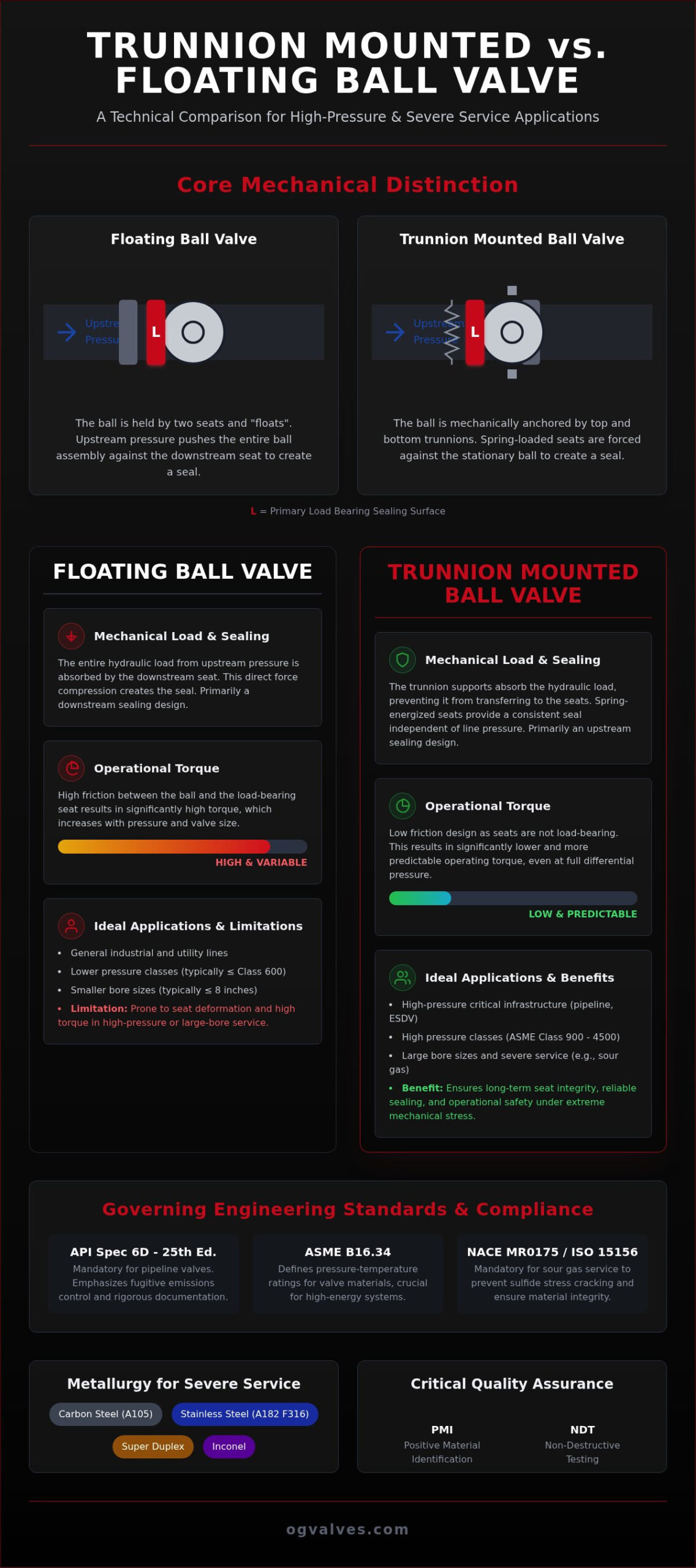
Specifying the incorrect valve architecture for high-pressure service is a calculated risk that frequently results in catastrophic structural failure or uncontrolled fugitive emissions. You understand that maintaining the integrity of critical industrial infrastructure requires a rigorous adherence to engineering benchmarks beyond basic pressure ratings. This guide provides a clinical examination of the trunnion mounted vs floating ball valve distinction, focusing on mechanical load management and compliance with the mandated API Spec 6D 25th Edition.
It’s clear that operational safety depends on understanding how pressure classes influence mechanical design and seat integrity. You’ll gain a technical framework for valve selection that accounts for high operational torque and material verification under NACE standards. We’ll detail the specific engineering differences between floating and trunnion designs to ensure your procurement process prioritizes long-term performance and regulatory adherence. This analysis moves from identifying technical needs to providing detailed specifications for your project’s quality assurance protocols.
Key Takeaways
- Identify the mechanical load management differences in trunnion mounted vs floating ball valve designs to prevent seat deformation and structural failure in large-bore applications.
- Analyze the critical regulatory frameworks governing high-pressure service, including the specific requirements of API 6D 25th Edition and ASME B16.34.
- Evaluate sealing efficiency by comparing downstream seat contact stress in floating designs with the upstream spring-loaded mechanisms found in trunnion-mounted architectures.
- Select appropriate metallurgy for severe service applications, ranging from standard carbon steel to advanced alloys such as Super Duplex and Inconel for corrosive environments.
- Implement rigorous quality assurance protocols through Positive Material Identification (PMI) and Non-Destructive Testing (NDT) to verify industrial safety and engineering excellence.
Engineering Standards and Pressure Ratings for Ball Valves
Industrial ball valves function as the primary isolation barrier in high-energy piping systems. The fundamental quarter-turn mechanism allows for rapid flow cessation, which is a standard requirement for emergency shutdown valves (ESDV). For technical experts, the distinction between standard industrial valves and severe service units is defined by their ability to maintain structural integrity under extreme mechanical stress. While standard valves may suffice for low-pressure utility lines, critical infrastructure demands adherence to ASME Class 900 through Class 4500. These classifications ensure that the mechanical distinctions between Trunnion vs. Floating Ball Valve Designs are matched to the specific pressure-temperature requirements of the application.
ASME Pressure Classes and PSI Thresholds
ASME B16.34 establishes the pressure-temperature ratings for various material groups, including carbon steel (ASTM A105) and stainless steel (ASTM A182 F316). High-pressure performance typically begins at the 2,000 PSI threshold and extends beyond 10,000 PSI in specialized petrochemical processes. At these levels, thermal fluctuations pose a significant risk to sealing integrity. Rapid temperature shifts cause volumetric changes in metallic components, potentially leading to seat deformation or stem binding if the valve architecture is incorrectly specified. Key factors in these environments include:
- Mechanical Load Distribution: How the valve body manages the forces exerted by fluid pressure.
- Sealing Stress: The pressure required to maintain contact between the ball and the seat.
- Differential Pressure: The stress placed on the internal components when the valve is in the closed position.
Regulatory Frameworks: API, ASME, and ISO
The regulatory landscape is dominated by API Specification 6D, which governs pipeline valves. The 25th Edition of API 6D, mandated for compliance by January 1, 2026, places rigorous emphasis on fugitive emissions and documentation. When evaluating a trunnion mounted vs floating ball valve for sour gas environments, compliance with NACE MR0175/ISO 15156 is mandatory to prevent sulfide stress cracking. Additionally, ISO 17292 provides the benchmark for metal ball valves used in petroleum and natural gas industries. These standards ensure that every component, from the stem to the sealing rings, meets quantifiable benchmarks for industrial safety and engineering excellence.
Floating Ball Valve Design: Mechanism and Limitations
Floating ball valves utilize a design where the ball is supported only by two elastomeric or metallic seats without a fixed pivot or trunnion support. In this configuration, the ball remains free to move linearly in the direction of the flow. This displacement is the fundamental mechanic of the downstream sealing principle. It’s a cost-effective solution for many general industrial applications, but it requires a precise understanding of the mechanical limitations inherent in the design. For technical experts, the choice depends on how the internal components manage the hydraulic loads exerted by the process media.
Seating Mechanics in Floating Valves
As upstream pressure increases, the fluid forces the ball against the downstream seat ring. This action compresses the seat material, creating a robust seal through increased contact stress. While this provides effective bi-directional sealing, the reliance on seat compression means that the valve’s performance is inextricably linked to the physical properties of the seat inserts. Materials such as PTFE, RPTFE, or Devlon are frequently utilized for their sealing capabilities at lower pressures. However, the integrity of the seal depends on the ability of these materials to withstand the mechanical load without permanent set or extrusion. In these designs, the upstream seat often remains inactive, functioning primarily as a guide until the flow direction is reversed.
Torque and Operational Constraints
The primary engineering challenge with floating valves involves the management of operational torque under high differential pressure. Because the downstream seat must absorb the entire hydraulic load of the ball, the resulting friction creates significant resistance to rotation. This torque requirement can become prohibitive in large-bore valves or high-pressure classes, often leading to seat deformation or “cold flow.” This deformation not only increases the risk of leakage but also necessitates larger, more expensive actuators. For this reason, the industry generally limits floating designs to smaller nominal pipe sizes (NPS), typically 6 inches or less.
When considering the trunnion mounted vs floating ball valve for critical infrastructure, engineers must prioritize the relationship between pressure class and mechanical load. High-pressure service in larger diameters almost always necessitates a move away from floating designs to prevent component failure. For precise sizing data and pressure-temperature charts, refer to the Industrial Ball Valves: A Technical Engineering & Specification Guide. Procurement specialists seeking durable components for low-pressure instrumentation should evaluate the technical specifications of our API-compliant ball valves to ensure long-term operational reliability.
Trunnion Mounted Ball Valves: Architecture for High Pressure
The trunnion-mounted architecture is the industrial standard for high-pressure isolation in large-diameter piping systems. Unlike the floating design, where the ball is free to move, the ball in this configuration is mechanically anchored by a stem at the top and a trunnion pivot at the bottom. This fixed-ball construction ensures that the internal components maintain precise alignment under extreme hydraulic stress. The primary technical distinction between a trunnion mounted vs floating ball valve is the mechanical support system that absorbs the fluid pressure, preventing the ball from being forced against the downstream seat.
Load Distribution and Structural Integrity
In high-PSI environments, the force exerted by the process media can reach thousands of pounds of linear thrust. Trunnion bearings or plates are engineered to absorb this hydraulic load, transferring the stress directly to the valve body rather than the soft seating materials. This mechanical rigidity is essential for managing the massive forces present in ASME Class 2500 and Class 4500 systems. By eliminating ball movement, the design prevents seat deformation and “cold flow” issues common in floating architectures. This structural integrity makes trunnion valves the only viable option for large-bore applications, typically defined as nominal pipe sizes (NPS) 8 and above, where operational torque must remain manageable for efficient actuation.
Sealing Technology in Trunnion Designs
Sealing in trunnion-mounted valves relies on a “floating seat” mechanism rather than a floating ball. These seats are spring-loaded to ensure constant contact with the ball surface, even at low differential pressures. As line pressure increases, it acts on the back of the seat ring, forcing it against the ball to create a tighter seal. This upstream sealing principle allows for Double Block and Bleed (DBB) functionality, where both the upstream and downstream seats provide independent isolation, allowing the body cavity to be vented for safety-critical maintenance. Key technical features of this architecture include:
- Secondary Sealant Injection: Integrated fittings allow for the emergency injection of specialized grease to restore sealing integrity if the primary seats are damaged.
- Fire-Safe Certification: Compliance with API 607 and API 6FA ensures the valve maintains shut-off capabilities during and after a high-temperature fire event.
- Reduced Operating Torque: The fixed-ball design significantly lowers the friction between the ball and seats, allowing for smaller, more cost-effective actuators.
When evaluating trunnion mounted vs floating ball valve options for pipeline manifolds or petrochemical processing, engineers must account for the long-term impact of seat wear. Trunnion designs offer superior durability in severe service by isolating the sealing surfaces from the primary mechanical loads. For projects requiring high-specification materials, OG VALVES LTD. provides API-compliant components that undergo rigorous Positive Material Identification (PMI) to verify structural soundness before global delivery.
Material selection serves as the final safeguard against structural compromise in high-pressure systems. While the mechanical debate of trunnion mounted vs floating ball valve focuses on load distribution, the metallurgy dictates the component’s resistance to erosion and chemical degradation. ASTM A105 carbon steel remains the benchmark for non-corrosive, high-pressure service in standard oil and gas applications. Conversely, 316 stainless steel (316SS) provides the necessary baseline for corrosion resistance in standard process environments where oxidation is a primary concern. For technical experts, the choice of material must align with both the pressure class and the chemical composition of the media.
Selecting Materials for High-Pressure Offshore Service
Offshore and subsea environments demand materials with superior mechanical strength profiles to withstand external hydrostatic pressure and internal process loads. Super Duplex (ASTM A890) and nickel-based alloys like Inconel 625 are specified where standard austenitic steels succumb to chloride stress corrosion cracking. Super Duplex variants provide approximately double the yield strength of standard 316SS, allowing for reduced wall thicknesses without sacrificing pressure integrity. These advanced alloys are critical for high-pressure manifolds where weight and durability are primary engineering constraints. For a detailed breakdown of these material standards, refer to Industrial Valves: The Engineer’s Comprehensive Guide.
Seating technology must match the metallurgical body to ensure long-term performance under high differential pressure. Soft seating using Devlon or PEEK (Polyether ether ketone) inserts is suitable for high-pressure clean gas service, as these materials resist extrusion at elevated PSI. However, abrasive media or high-temperature slurry applications necessitate a move toward metal-to-metal seating. These designs eliminate the risk of seat “washout” in high-velocity flow conditions.
High-Pressure Sealing Solutions
Metal-seated designs often utilize specialized surface treatments like Tungsten Carbide Coating (TCC) or Chrome Carbide to achieve a surface hardness exceeding 70 HRC. This erosion resistance is vital for maintaining the zero-leakage requirements of API 598 in hazardous chemical processes. Unlike the soft seats often discussed in a trunnion mounted vs floating ball valve comparison for general utility service, metal-seated trunnion valves are engineered for the most severe industrial outputs. Ensuring seat integrity in these units requires rigorous testing protocols to verify that the seal remains bubble-tight under maximum operating pressure.
Procurement specialists requiring high-specification components for critical infrastructure can explore our inventory of API-compliant ball valves for immediate global project deployment.
Procurement and Quality Assurance for Critical Infrastructure
The verification of mechanical integrity is the final phase of the procurement cycle. While the engineering selection of a trunnion mounted vs floating ball valve addresses the operational load, quality assurance protocols ensure the physical component meets the theoretical design. Positive Material Identification (PMI) is essential for high-pressure infrastructure to confirm that the alloy composition matches the Material Test Reports (MTRs). This process prevents the accidental installation of sub-standard materials that could fail under maximum differential pressure, ensuring the structural soundness of the entire piping system.
Non-Destructive Testing (NDT) provides a deeper examination of structural soundness without compromising the valve’s utility. Radiography (RT) is utilized to identify internal casting defects or weld porosity in high-pressure bodies. Ultrasonic Testing (UT) detects subsurface laminations or thickness variations, while Dye Penetrant (PT) reveals surface-level discontinuities. These tests are mandatory for valves specified for severe service, ensuring that the unit can withstand the mechanical stresses inherent in high-PSI manifolds and large-diameter pipelines.
Pressure testing protocols must adhere strictly to API 598 or API 6D standards. Hydrostatic shell tests are typically conducted at 150% of the maximum design pressure to verify the strength of the pressure-containing envelope. High-pressure pneumatic seat tests are performed to detect even the most minute gas leaks. For critical gas transmission, high-pressure gas testing validates the zero-leakage performance of the sealing mechanism. These rigorous testing cycles are the benchmark for industrial safety and engineering excellence.
Documentation and Certification Compliance
Traceability remains a cornerstone of industrial safety. Procurement specialists must demand EN 10204 3.1 or 3.2 certification to ensure a transparent chain of custody from the mill to the project site. Verification of fire-test certifications according to API 607 and fugitive emission compliance with API 622 or ISO 15848-1 is mandatory. With the API 6D 25th Edition compliance deadline of January 1, 2026 approaching, documenting these benchmarks is critical for regulatory adherence and long-term performance.
Global Logistics and Fast-Track Delivery
OG VALVES LTD. facilitates minimal operational downtime through strategic inventory management of API and ASME compliant components. The organization acts as a technical partner, providing expert guidance on material specifications and testing requirements for global projects. Maintaining a robust global supply chain allows for the fast-track delivery of high-specification valves to remote industrial sites. This capability ensures that critical infrastructure projects stay on schedule while meeting the most demanding technical standards. Contact OG VALVES LTD. for a technical consultation on high-pressure ball valves.
Optimizing Infrastructure Reliability through Technical Specification
Selecting the correct valve architecture is a critical engineering decision that dictates the safety and longevity of your piping network. The technical distinction between a trunnion mounted vs floating ball valve centers on the management of hydraulic loads and the prevention of seat deformation under high differential pressure. While floating designs offer efficiency for small-bore instrumentation, trunnion-mounted units are the industry benchmark for large-diameter, high-PSI service. It’s essential to prioritize structural integrity where operational torque is a primary concern for automated systems.
Ensuring long-term performance requires adherence to rigorous metallurgy standards and the mandated API 6D 25th Edition. OG VALVES LTD. acts as a specialist technical partner to the global oil, gas, and power sectors. We provide the expertise necessary to navigate complex API and ASME regulatory standards with clinical precision. Our fast-track delivery protocols are engineered to ensure minimal industrial downtime for your critical projects. Request a Technical Quote for High-Pressure Ball Valves to secure high-specification components for your next infrastructure development. We’re ready to assist with your technical procurement needs.
Frequently Asked Questions
What is the pressure rating for a high-pressure ball valve?
High-pressure service is typically defined by ASME Class 900 through Class 4500 ratings. These classifications correspond to working pressures ranging from 2,250 PSI to approximately 11,250 PSI at ambient temperatures. Engineers must consult ASME B16.34 pressure-temperature tables to determine the exact allowable working pressure based on the specific metallurgy of the valve body and the operating temperature of the process media.
When should I choose a trunnion mounted ball valve over a floating design?
You should specify a trunnion design for large-bore applications, typically NPS 8 and above, or for any high-pressure class where operational torque exceeds actuator limits. The mechanical distinction in the trunnion mounted vs floating ball valve comparison is that trunnion supports absorb hydraulic loads. This prevents seat deformation and ensures reliable actuation in severe service environments where floating designs would suffer from excessive friction and seat “washout.”
What are the common materials for high-pressure ball valve bodies?
Industrial bodies are frequently forged from ASTM A105 carbon steel for non-corrosive service or ASTM A182 F316 stainless steel for standard corrosion resistance. In severe offshore or subsea applications, advanced alloys like Super Duplex (ASTM A890) or Inconel 625 are required. These materials provide the necessary yield strength and resistance to chloride stress corrosion cracking required for high-PSI loads in hazardous environments.
Can ball valves be used for throttling in high-pressure systems?
Standard ball valves are engineered strictly for on/off isolation and aren’t suitable for throttling service. Utilizing a ball valve for flow regulation in high-pressure systems leads to localized high-velocity flow. This results in rapid seat erosion, cavitation, and potential structural damage to the ball. For precise flow control, technical experts recommend specifying globe valves or specialized control valves designed to manage high differential pressures.
What standards govern high-pressure ball valves in the oil and gas industry?
API 6D is the primary international standard governing the design, manufacturing, and testing of pipeline valves. Compliance with the 25th Edition is required by January 1, 2026, for US pipeline infrastructure. Other essential benchmarks include ASME B16.34 for pressure-temperature ratings, API 598 for valve inspection and testing, and NACE MR0175/ISO 15156 for materials used in H2S-containing sour gas environments.
What is the difference between soft-seated and metal-seated high-pressure valves?
Soft-seated valves utilize thermoplastic inserts such as PEEK or Devlon to achieve bubble-tight, zero-leakage shut-off in clean media. Metal-seated valves employ hardened metallic surfaces, often enhanced with Tungsten Carbide Coatings (TCC). These metal-to-metal designs are mandatory for abrasive slurries, high-temperature service, or applications where the process media would quickly degrade standard polymer inserts through erosion or thermal decomposition.
Why is PMI testing critical for high-pressure industrial valves?
Positive Material Identification (PMI) is a non-destructive verification process that confirms the chemical composition of the valve’s metallic components. It ensures the alloy matches the Material Test Report (MTR) provided by the mill. This verification is critical in high-pressure service to prevent the installation of sub-standard materials that don’t meet the required mechanical strength or corrosion resistance, thereby mitigating the risk of catastrophic failure.
Are high-pressure ball valves required to be fire-safe?
Valves installed in hydrocarbon or flammable media service must meet fire-safe standards such as API 607 or API 6FA. These certifications verify that the valve maintains its sealing integrity during and after exposure to a high-temperature fire. In trunnion mounted vs floating ball valve specifications, this typically involves a secondary metal-to-metal seal that activates if the primary soft seats are incinerated, preventing uncontrolled fuel release.
 Responsive Menu