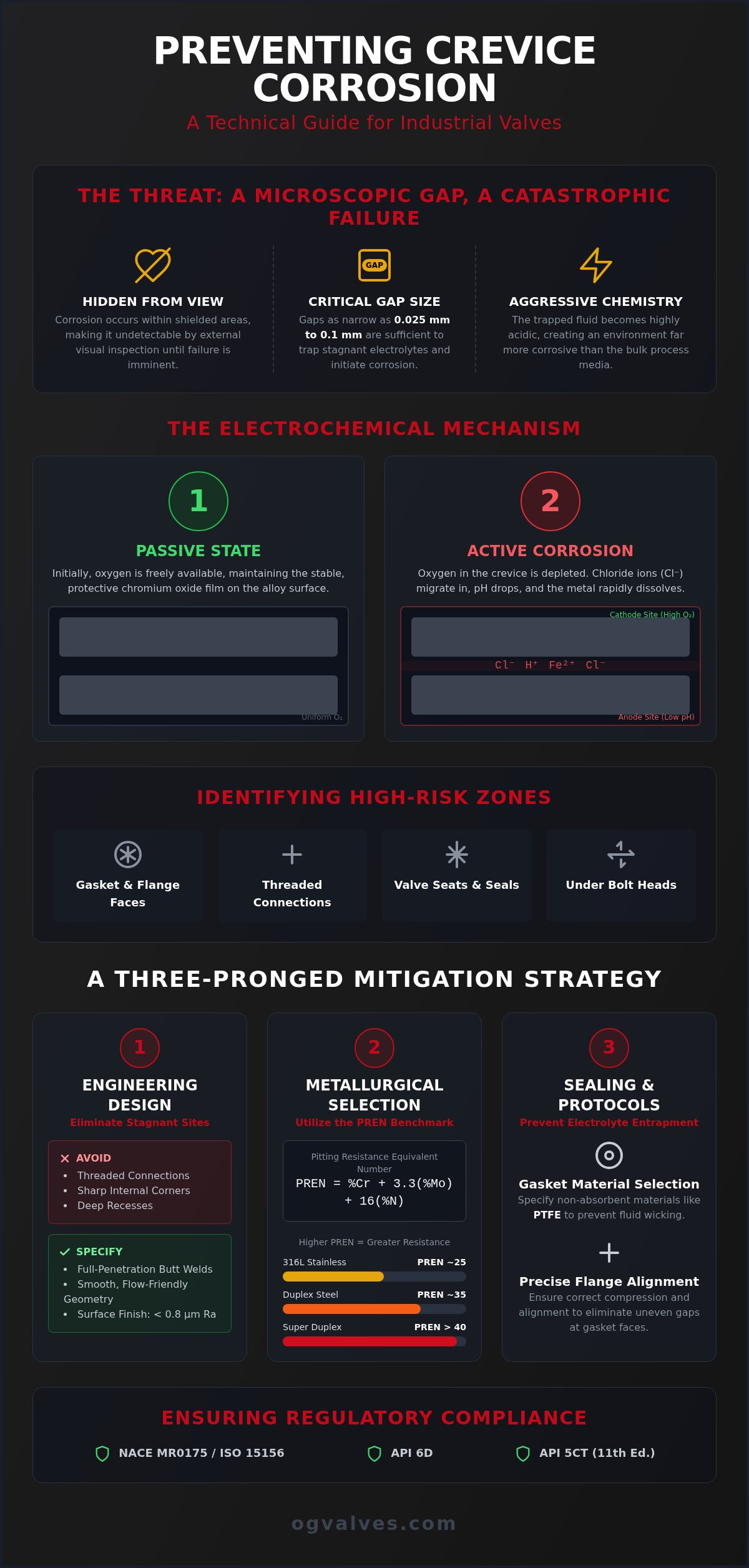
Can a gap as narrow as 0.025 mm compromise the integrity of a high-pressure industrial facility? In aggressive chemical environments, these microscopic clearances between gaskets, bolt heads, and valve seats act as the primary catalysts for catastrophic localised failure. For engineers managing critical infrastructure, the sudden loss of containment due to internal pitting isn’t just a maintenance hurdle; it’s a significant safety risk that demands a clinical, data-driven response.
You likely recognise that even the most robust high-alloy components aren’t immune to the chemistry of stagnant electrolytes. This guide details exactly how to prevent crevice corrosion in valves by integrating advanced metallurgical selection with precise geometric design. We’ll examine the technical strategies for identifying potential failure points, mitigating risk through the latest API 5CT 11th Edition standards, and selecting corrosion-resistant alloys that withstand H2S concentrations exceeding 0.15%. By the end of this analysis, you’ll have a technical framework to extend valve service life and ensure full compliance with ANSI/NACE MR0175-2021/ISO 15156:2020 regulatory benchmarks.
Key Takeaways
- Identify high-risk localised failure zones by understanding the electrochemical drivers of oxygen depletion and stagnant electrolyte buildup in shielded valve areas.
- Learn how to prevent crevice corrosion in valves through engineering design strategies that prioritise full-penetration butt welds over threaded connections to eliminate stagnant sites.
- Utilise the Pitting Resistance Equivalent Number (PREN) as a technical benchmark for selecting alloys with optimal Chromium, Molybdenum, and Nitrogen concentrations.
- Mitigate electrolyte entrapment by implementing rigorous sealing protocols, including the selection of non-absorbent gasket materials and precise flange alignment.
- Ensure operational durability and regulatory adherence by specifying valve components that comply with NACE MR0175/ISO 15156 and API 6D standards.
The Electrochemical Mechanism of Crevice Corrosion in Valves
Crevice corrosion is a localised form of attack that occurs within shielded metal surfaces where the working fluid’s access is restricted. This phenomenon is a primary cause of failure in high-alloy industrial components. It originates in narrow gaps, often between 0.025 mm and 0.1 mm, where stagnant electrolytes become trapped. The electrochemical mechanism of crevice corrosion involves a transition from a passive state to an active state, triggered by the exhaustion of oxygen within the confined space.
Valve assemblies are inherently susceptible because their operation requires tight mechanical clearances. These complex internal geometries facilitate the breakdown of the passive chromium oxide protective film that defines the durability of stainless steels and duplex alloys. Once this film is breached, the metal surface within the crevice becomes an active anode, leading to rapid material loss that remains hidden from external inspection.
Oxygen Depletion and Acidification in Localised Pockets
The process begins with a differential aeration cell. Oxygen is rapidly consumed within the crevice but cannot be replenished via diffusion from the bulk fluid. This stops the cathodic reaction inside the gap while it continues on the oxygen-rich exterior surfaces. To balance the resulting positive charge from metal dissolution, chloride ions migrate into the crevice. The subsequent hydrolysis of metal ions leads to a sharp drop in pH, creating an acidic environment. This localised chemistry is often several orders of magnitude more aggressive than the surrounding process media. Understanding these chemical drivers is essential for engineers determining how to prevent crevice corrosion in valves.
Identifying High-Risk Zones: Seals, Gaskets, and Threaded Joints
Metal-to-metal contact points represent the highest risk in industrial valve configurations. Gasket faces and flange surfaces are common sites for electrolyte entrapment, particularly if the gasket material is absorbent or incorrectly compressed. Threaded joints in needle valves and the sealing segments of plug valves are also vulnerable, as threads create numerous microscopic capillary paths. Surface roughness further complicates this issue; a rougher finish provides more sites for halide concentration. Identifying these zones is the first step in learning how to prevent crevice corrosion in valves across complex piping networks. Clinical attention to surface finish and the elimination of threaded connections in high-pressure systems are key technical strategies for maintaining structural integrity.
Engineering Design Strategies to Eliminate Crevice Sites
Eliminating the physical conditions that allow for electrolyte entrapment is the most effective method for long-term valve preservation. While metallurgical selection is critical, the primary technical objective remains the geometric removal of potential crevice sites. Engineering design strategies must prioritise the reduction of metal-to-metal contact areas and the elimination of stagnant fluid zones where oxygen depletion occurs. By focusing on structural transitions, engineers can determine how to prevent crevice corrosion in valves before the component enters service.
Geometric Optimisation: Reducing Stagnant Fluid Pockets
Internal valve body designs should facilitate continuous fluid flow and rapid drainage. Sharp internal corners and deep recesses, common in legacy gate valve and globe valve designs, act as reservoirs for corrosive media. During system downtime, these areas retain fluids that undergo acidification as oxygen is consumed. High fluid flow velocity promotes the continuous replenishment of oxygen at the metal surface, which maintains the stability of the protective oxide layer. Specifying a high-quality surface finish, typically achieving a roughness average (Ra) of 0.8 µm or better, reduces the micro-crevices where halide ions concentrate.
Structural Integrity: The Case for Welded Valve Assemblies
The choice of joining method significantly impacts the risk of localised attack. Threaded connections are inherently susceptible to crevice formation within the thread root. In highly corrosive environments, engineers should specify butt-welded industrial valves rather than socket-welded or threaded alternatives. Socket welds create an unavoidable gap between the pipe end and the socket shoulder, which becomes an ideal site for crevice initiation. Full-penetration butt welds provide a smooth, continuous internal bore that eliminates these gaps entirely. If threaded components are unavoidable, seal welding the threads provides a secondary containment measure to prevent fluid ingress into the thread clearances. For projects requiring high-specification components, consulting with technical experts ensures that all design parameters meet international safety benchmarks.

Determining how to prevent crevice corrosion in valves requires a clinical assessment of the process media’s chemical aggressiveness. While geometric design eliminates the physical site, metallurgical selection provides the chemical resistance necessary to maintain passivity within unavoidable clearances. The stability of the protective oxide layer depends on the concentration of Chromium, Molybdenum, and Nitrogen. Chromium establishes the base film; however, Molybdenum and Nitrogen specifically inhibit the localised breakdown caused by chloride ions in stagnant zones. Selecting the correct alloy is the most definitive answer to how to prevent crevice corrosion in valves when operating in aggressive media.
Calculating and Utilising the PREN for Valve Specification
The Pitting Resistance Equivalent Number (PREN) serves as the primary quantitative benchmark for material suitability in procurement. It’s calculated using the standard formula: PREN = %Cr + 3.3 * %Mo + 16 * %N. For standard industrial applications involving moderate chloride levels, a PREN of 24 to 35, typical of 316L or 2205 Duplex, may suffice. However, seawater and high-halide environments demand higher thresholds to resist acidification within crevices. A PREN above 40 is required for super duplex valves to ensure the alloy maintains its passive state in high-temperature, high-salinity conditions. This numerical value allows procurement specialists to verify that the specified components meet the minimum electrochemical requirements for the intended service environment.
High-Performance Alloys: Beyond Standard Stainless Steel
Standard austenitic steels often fail in extreme sour gas environments where H2S concentrations exceed 0.15%. In these scenarios, transitioning to nickel-based alloys like Alloy 625 or C276 is a technical necessity. These materials are frequently specified for ball valve trim and critical sealing components due to their superior resistance to hydrogen-induced stress cracking and localised attack. For power generation facilities, butterfly valve discs and stems benefit from the increased mechanical strength and corrosion resistance of Super Duplex alloys. These materials balance high yield strength with the chemical stability required for long-term operational output. This material choice isn’t just about durability; it’s about strict regulatory adherence to NACE MR0175/ISO 15156 standards. High-performance metallurgy must be coupled with rigorous Operational Maintenance and Sealing Protocols to prevent the accumulation of corrosive electrolytes that initiate the breakdown of the passive layer.
Operational Maintenance and Sealing Protocols for Mitigation
While design and metallurgy establish the baseline for durability, operational protocols govern the ongoing stability of the seal interface. The junction between the valve body and the gasket represents the highest risk for electrolyte entrapment. Implementing rigorous sealing standards is a fundamental component of how to prevent crevice corrosion in valves during high-pressure cycles. Failure to maintain uniform compression or selecting inappropriate sealing materials can negate the benefits of even the most advanced super duplex metallurgy.
Gasket Selection and Proper Compression Techniques
Sealing materials must be non-absorbent and chemically inert to the process media. It’s essential to avoid hygroscopic materials that retain corrosive moisture. The selection process should focus on the following high-performance options:
- PTFE Gaskets: Highly resistant to chemical attack and non-absorbent; however, they require careful monitoring for cold flow in high-temperature applications.
- Metallic Gaskets: Spiral wound gaskets with appropriate fillers provide excellent resilience and maintain a tight seal under fluctuating pressures.
- Flexible Graphite: Effective for high-temperature service, but engineers must ensure the graphite doesn’t facilitate a galvanic couple with the flange material.
Achieving precise flange alignment and uniform bolt torque is mandatory to eliminate microscopic gaps. These clearances allow for the concentration of halide ions, which leads to the rapid acidification of the micro-environment. Correct compression ensures that the gasket conforms to the surface finish, effectively blocking the entry of corrosive electrolytes into the crevice.
Cleaning and Flushing Schedules for Critical Infrastructure
Systematic maintenance involves regular flushing to remove accumulated chlorides and particulate matter. Stagnant zones are particularly vulnerable during system standby; therefore, flushing protocols should be timed to coincide with planned shutdowns or process shifts. Monitoring the bulk fluid chemistry, specifically pH and chloride levels, ensures that operational parameters remain within the safety thresholds defined by NACE MR0175. In closed-loop industrial systems, the addition of film-forming corrosion inhibitors provides a secondary layer of protection for internal clearances. The strategic placement of check valves is also critical; these components prevent the backflow of contaminated or stagnant media into sensitive process zones, thereby reducing the risk of localised attack. For facilities managing aggressive media, sourcing high-specification industrial valves with verified material certifications is the most reliable way to ensure long-term operational output.
Specifying Corrosion-Resistant Valves for Heavy Industry
The final phase in determining how to prevent crevice corrosion in valves involves rigorous procurement standards and verification protocols. Theoretical design and metallurgical selection must be validated through strict adherence to international benchmarks. For procurement specialists, the cost of failure in high-stakes environments like offshore oil platforms or power generation facilities necessitates a clinical focus on material certification. Ensuring that every component meets the specified chemical and mechanical properties is the only way to guarantee long-term operational output in corrosive media.
Regulatory Adherence: NACE and API Benchmarks
In the oil and gas sector, materials must comply with ANSI/NACE MR0175-2021/ISO 15156:2020. This standard defines the environmental limits for alloys based on H2S partial pressure, chloride concentration, temperature, and pH. Compliance is not merely about the alloy type; it also involves specific heat treatment processes to ensure the material resists sulfide stress cracking and localised attack. When specifying a gate valve, engineers must ensure the design adheres to API 600 or API 6D standards for wall thickness and structural integrity. All compliance data should be documented through comprehensive Mill Test Reports (MTRs) that provide a traceable history of the component’s manufacturing and testing phases.
Quality Assurance through PMI and Laboratory Testing
Positive Material Identification (PMI) is a non-negotiable requirement for verifying alloy composition at the point of delivery. Utilising X-ray fluorescence (XRF) technology allows inspectors to confirm that the molybdenum and nitrogen levels match the requirements for the calculated Pitting Resistance Equivalent Number (PREN). For critical applications where crevice initiation is a high risk, specifying ASTM G48 corrosion testing provides empirical data on the material’s performance in ferric chloride solutions. This laboratory validation is the definitive method for confirming how to prevent crevice corrosion in valves before they are integrated into the primary flow line.
Furthermore, the external environment must not be overlooked. Specifying actuator materials and coatings that withstand atmospheric salt spray or chemical fumes is essential for maintaining control system reliability. Leveraging technical support from established global suppliers ensures that specification accuracy is maintained across the entire supply chain. This structured approach to quality assurance transforms engineering theory into a functional reality, providing a benchmark for industrial safety and durability.
Optimising Valve Integrity through Engineering Precision
Achieving long-term durability in aggressive process media requires a clinical approach to both geometric design and material science. The transition from localised material loss to sustained passivity is managed through the strategic elimination of stagnant fluid sites and the specification of alloys with high Pitting Resistance Equivalent Numbers. By strictly adhering to NACE MR0175 and API 6D standards, facilities can effectively mitigate the risks of internal failure and the high costs associated with unexpected downtime. This technical framework provides a definitive methodology for how to prevent crevice corrosion in valves across heavy industrial sectors.
Structural soundness in high-pressure systems depends on component reliability. Precision matters. For organisations requiring high-specification components, Contact OG VALVES LTD. for technical specifications and high-alloy valve procurement. Our global entity leverages extensive supply chain expertise and a comprehensive inventory of API-standard valves to provide technical consultancy for the most corrosive environments. Implementing these rigorous engineering standards ensures that your critical infrastructure remains safe, compliant, and operationally sound for its intended service life.
Frequently Asked Questions
What is the primary cause of crevice corrosion in industrial valves?
The primary cause is the entrapment of stagnant electrolytes within narrow clearances, typically between 0.025 mm and 0.1 mm. Within these confined spaces, oxygen is rapidly consumed and cannot be replenished from the bulk fluid. This leads to a differential aeration cell where chloride ions migrate into the crevice to maintain charge neutrality. The resulting hydrolysis of metal ions causes a sharp drop in pH, creating an acidic micro-environment that aggressively breaches the passive oxide layer.
How does crevice corrosion differ from pitting corrosion?
Crevice corrosion occurs specifically in shielded metal areas or gaps where fluid flow is restricted, whereas pitting corrosion develops on open, unshielded surfaces. While both are localised forms of attack driven by halide ions, crevice corrosion is initiated by a lack of oxygen in a physical gap. Pitting is typically triggered by microscopic surface defects or inclusions in the metal. Understanding these distinctions is vital when determining how to prevent crevice corrosion in valves versus general surface pitting.
Can crevice corrosion be detected without disassembling the valve?
Detection without disassembly is technically challenging because the attack occurs within hidden internal geometries. Engineers often rely on indirect indicators such as unexpected pressure drops or minor leaks at flange interfaces. Advanced non-destructive testing (NDT) methods, including ultrasonic testing (UT) and radiographic testing (RT), can sometimes identify material loss in critical zones. However, periodic internal inspection during planned maintenance remains the most reliable method for verifying the structural integrity of internal sealing surfaces.
Which materials are most resistant to crevice corrosion in seawater?
Super Duplex stainless steels and high-nickel alloys provide the highest resistance in seawater applications. Materials like UNS S32750 or S32760 are specified for their high Pitting Resistance Equivalent Number (PREN), which must exceed 40 for sustained seawater service. Nickel-based alloys such as Alloy 625 or C276 are also utilised in high-salinity environments. These materials maintain a stable passive film even in the presence of high chloride concentrations and elevated temperatures common in offshore facilities.
What is a PREN and why is it important for valve selection?
The Pitting Resistance Equivalent Number (PREN) is a quantitative measure used to predict an alloy’s resistance to localised corrosion. It’s calculated using the formula %Cr + 3.3 * %Mo + 16 * %N. This value is critical for valve selection because it allows engineers to match the material’s chemical stability with the aggressiveness of the process media. Higher PREN values indicate a more robust passive layer that can withstand the acidic conditions found within stagnant crevices.
How do gaskets contribute to crevice corrosion in flange connections?
Gaskets can initiate corrosion by creating the physical clearance necessary for electrolyte entrapment. Hygroscopic or absorbent gasket materials retain corrosive fluids against the flange face, facilitating the depletion of oxygen. If the gasket isn’t compressed uniformly, microscopic gaps allow halide ions to concentrate at the metal-to-seal interface. Selecting non-absorbent materials like PTFE or metallic spiral wound gaskets is a technical necessity for engineers seeking how to prevent crevice corrosion in valves at flange connections.
Is 316 stainless steel sufficient for preventing crevice corrosion?
316 stainless steel is often insufficient for preventing crevice corrosion in high-chloride or seawater environments. With a typical PREN of 24 to 26, it lacks the molybdenum and nitrogen concentrations required to maintain passivity in stagnant, acidic crevices. While it performs well in mildly corrosive media, it remains susceptible to localised attack in shielded areas. For critical infrastructure, transitioning to Duplex 2205 or Super Duplex alloys is recommended to ensure long-term reliability and safety.
What maintenance procedures reduce the risk of localized corrosion?
Effective maintenance includes regular system flushing to remove accumulated solids and stagnant chlorides from internal pockets. Monitoring the bulk fluid’s pH and chloride levels ensures that the environment stays within the material’s safety limits. Checking flange bolt torque and ensuring uniform gasket compression prevents the formation of new crevice sites. In closed-loop systems, the addition of film-forming corrosion inhibitors provides a secondary chemical barrier that protects internal clearances from the initiation of localised attack.
 Responsive Menu