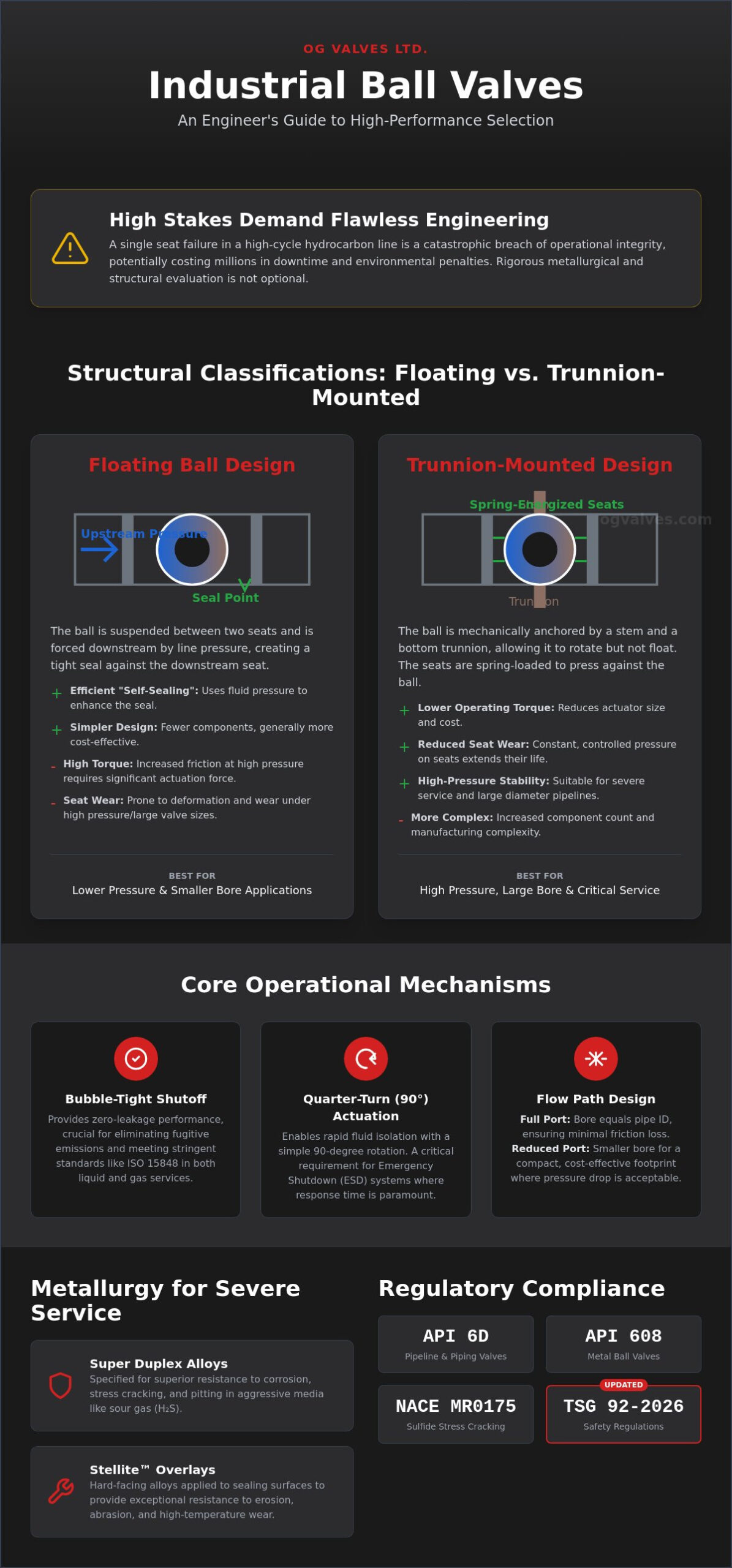
A single seat failure in a high-cycle hydrocarbon line isn’t just a maintenance issue; it’s a catastrophic breach of operational integrity that can cost millions in downtime and environmental penalties. Selecting high-performance industrial ball valves requires more than a standard review of pressure ratings. It demands a rigorous metallurgical and structural evaluation to ensure survival in sour gas or high-pressure applications. You recognize that adhering to NACE MR0175 or verifying fire-safe standards isn’t optional when engineering for 2026 infrastructure.
This article provides a clinical engineering analysis of ball valve mechanisms, structural classifications, and material specifications required for high-stakes industrial procurement. We’ll examine the technical distinctions between floating and trunnion-mounted designs, verify material compatibility for corrosive media, and detail the implications of the July 2026 TSG 92-2026 safety regulations. By the end of this guide, you’ll have the technical data necessary to ensure adherence to API 6D and modern ISO benchmarks, securing your project’s long-term performance and regulatory compliance.
Key Takeaways
- Differentiate between floating and trunnion-mounted designs to ensure structural stability and zero-leakage performance across varying pressure gradients.
- Select appropriate body and trim metallurgy, such as Super Duplex and Stellite overlays, to mitigate erosion and corrosion in severe service environments.
- Ensure strict adherence to API 6D, API 608, and the updated 2026 TSG 92-2026 regulations to maintain the operational safety of industrial ball valves.
- Streamline the procurement process by providing comprehensive technical documentation on media chemistry and pressure classes to minimize global lead times.
- Analyze the bubble-tight shutoff capabilities of quarter-turn mechanisms to prevent catastrophic seat failure in high-cycle industrial applications.
Operational Mechanism and Fluid Control Dynamics
Industrial ball valves utilize a quarter-turn rotational motion where a spherical, bored component aligns with the flow path to initiate or terminate fluid movement. This ball valve operational mechanism provides a high-integrity seal through a combination of fluid pressure and mechanical seating. Unlike multi-turn designs, the 90-degree actuation allows for rapid isolation; it’s a critical requirement in emergency shutdown (ESD) systems where response time determines the safety of the entire infrastructure. The simplicity of the mechanism minimizes the number of moving parts, which reduces the potential for mechanical failure in high-cycle environments.
The core of a ball valve’s reliability lies in its bubble-tight shutoff capabilities. This is essential for both liquid and gas services where fugitive emissions must be eliminated to meet ISO 15848 standards. Pressure integrity is maintained through the critical interface between the stem and the seat. As the ball rotates, the seats, typically composed of reinforced PTFE or metal-to-metal alloys, maintain constant contact. In high-pressure environments, the fluid itself often assists in energizing the seal by forcing the ball against the downstream seat, ensuring that the seal becomes tighter as the pressure increases.
Engineers must evaluate flow characteristics based on port design. Full port valves offer a bore diameter equal to the pipe’s internal diameter, resulting in negligible friction loss and allowing for pigging operations. Conversely, reduced port designs utilize a smaller bore. While this increases fluid velocity and pressure drop, it offers a more compact and cost-effective footprint for non-critical flow paths where slight turbulence doesn’t compromise system performance.
Quarter-Turn Efficiency and Torque Requirements
Operational efficiency is measured by torque requirements, specifically breakout torque and running torque. Breakout torque represents the maximum force needed to overcome static friction after the valve’s been in the closed position under pressure. Differential pressure significantly impacts these dynamics; higher pressure differentials increase seat friction, necessitating larger, more powerful actuators. The precise geometric sphericity of the ball component directly determines the uniformity of contact stress across the seat interface, which is the primary factor in extending seal longevity.
Flow Coefficient (Cv) and Pressure Drop Analysis
The Flow Coefficient (Cv) measures the volume of water at 60°F that will flow through a valve with a pressure drop of 1 psi. Industrial ball valves typically exhibit a much higher Cv than globe valves because they provide a straight-through flow path with minimal turbulence. Calculating the correct Cv is vital for high-velocity pipelines to prevent cavitation and excessive noise. For a deeper look at system-wide integration and sizing, consult our Industrial Valves: The Engineer’s Comprehensive Guide to understand how these dynamics influence total plant efficiency.
Structural Classifications: Floating vs. Trunnion Mounted Designs
The structural classification of industrial ball valves is fundamentally defined by the method of ball support within the valve body. This architectural choice dictates the valve’s performance under varied pressure gradients and determines its suitability for specific industrial applications. Engineers must choose between floating and trunnion-mounted configurations based on the required sealing integrity, operational torque, and the mechanical stresses inherent in the pipeline system.
In a floating ball configuration, the ball is not fixed by a lower support pin. Instead, it is suspended by the stem and supported by two seats. When the valve is in the closed position, upstream fluid pressure physically displaces the ball, forcing it against the downstream seat to create a seal. While this “self-sealing” effect is efficient, it introduces significant seat-to-ball friction. As pressure increases, the force exerted on the downstream seat can lead to excessive wear or seat deformation. Consequently, the transition to trunnion mounting is typically required when the combination of valve size and pressure class results in torque levels that exceed the material limits of the seats or the capabilities of standard actuators.
The Mechanics of Floating Ball Valves
Floating ball valves are typically utilized in low-to-medium pressure systems, generally ranging from ASME Class 150 to Class 600. They are highly effective for smaller nominal diameters where the total force on the downstream seat remains manageable. However, limitations arise in larger diameters due to high-torque requirements and accelerated seat wear. For low-pressure isolation where weight and space are primary constraints, engineers often compare these designs with industrial butterfly valves to determine the most efficient footprint for the application.
Trunnion Mounting for High-Pressure Severe Service
Trunnion-mounted designs utilize a fixed axis where the ball is supported by a trunnion at the bottom and the stem at the top. This prevents the ball from moving under pressure. Instead, the seats are spring-loaded and move independently against the ball to maintain the seal. This configuration is essential for structural integrity in large-bore (DN200+) and high-pressure (Class 900+) pipelines. Trunnion configurations also facilitate Double Block and Bleed (DBB) capabilities, allowing for the safe venting of the body cavity while the valve is in the closed position. If your project requires this level of high-pressure stability, you can view our technical specifications for trunnion-mounted valves to ensure structural compliance and operational safety.

The metallurgical selection for industrial ball valves is a critical engineering decision that dictates the lifespan of the asset in severe service environments. ASTM A216 WCB carbon steel remains the industry standard for non-corrosive applications, whereas CF8M stainless steel provides the necessary resistance for general chemical and petrochemical media. In high-chloride or offshore environments, Super Duplex alloys are specified to prevent localized pitting and crevice corrosion, offering a higher Strength-to-Weight ratio than standard austenitic steels.
Sour hydrocarbon service requires strict compliance with NACE MR0175/ISO 15156 to mitigate the risk of sulfide stress cracking (SSC). This standard imposes rigorous limits on material hardness and chemical composition, ensuring structural integrity in environments containing hydrogen sulfide. Trim components, specifically the ball and stem, frequently utilize 13Cr or Stellite overlays to provide erosion resistance in high-velocity flows. These hard-facing techniques are essential for maintaining pressure integrity and preventing seat scoring when handling abrasive media or particulates.
Corrosion Resistance and Alloy Integrity
Offshore and petrochemical infrastructure often demands specialized alloys like Inconel 625 or 718 to handle high-pressure, high-temperature (HPHT) conditions. The implementation of Positive Material Identification (PMI) is a mandatory quality control protocol to verify that the chemical composition of every supplied valve component matches the engineering specification. Monel trim provides exceptional resistance to stress corrosion cracking and localized pitting in hydrofluoric acid service.
Sealing Technology: Soft Seated vs. Metal Seated
Soft-seated valves typically employ PTFE or RPTFE to achieve bubble-tight shutoff in liquid and gas services. These thermoplastic materials are highly effective for general fluid control but possess distinct temperature limitations, generally losing structural integrity above 200°C. When handling steam, high-temperature oil, or abrasive slurries, metal-to-metal seating with Stellite or tungsten carbide coatings becomes the necessary standard to prevent seat erosion. While metal seats offer superior durability in extreme conditions, they demand precise manufacturing tolerances and higher actuation torque. For high-temperature isolation where a ball valve’s thermal limits are reached, engineers often refer to A Technical Guide to Industrial Gate Valves for design alternatives that accommodate thermal expansion more effectively.
Regulatory Standards and Testing Protocols
The regulatory framework governing industrial ball valves ensures that every component withstands the mechanical and thermal stresses of its designated service class. API 608 provides the definitive design criteria for metal ball valves in petrochemical refineries, imposing stricter requirements for stem retention and anti-static capabilities than general-purpose standards. For larger-scale midstream and upstream operations, API 6D serves as the specification for pipeline and piping valves, mandating rigorous testing for through-conduit and double-block-and-bleed configurations. These standards work in tandem with ASME B16.34, which defines the pressure-temperature ratings and minimum wall thickness requirements necessary to maintain structural soundness under load.
Safety in flammable fluid service is verified through fire-safe certification. Adherence to API 607 or ISO 10497 ensures that the valve maintains its sealing integrity even after the primary soft seats are destroyed by high-intensity heat. As of July 1, 2026, the enforcement of TSG 92-2026 has introduced unified supervision for emergency shut-off valves and stricter traceability for material testing documents. This regulatory shift emphasizes the necessity of full documentation for all pressure-bearing special equipment in modern industrial projects.
Pressure Testing and Leakage Rates
Every valve must undergo standardized pressure testing to confirm its performance before deployment. API 598 defines the protocols for high-pressure closure and shell testing, ensuring the valve doesn’t exhibit visible leakage under hydrostatic conditions. For precision applications, ISO 5208 categorizes leakage rates, with Rate A representing the zero-leakage standard required for critical gas services. Environmental compliance also dictates the use of fugitive emission testing, specifically API 622 for packing materials and API 624 for rising stem valves, to mitigate the release of volatile organic compounds. To ensure your infrastructure meets these evolving global benchmarks, you should consult with our technical specialists regarding certified inventory.
Certification and Quality Assurance
Quality assurance is anchored in the provision of Material Test Reports (MTRs) and EN 10204 3.1 certification, which provide a verified audit trail of the valve’s chemical and mechanical properties. This documentation is essential for verifying that the metallurgy matches the engineering specifications provided during the RFQ process. Furthermore, the mechanical interface for automation must now align with updated standards like ISO 5211:2026 to ensure seamless integration with part-turn actuators. For detailed information on automated system compliance, see our guide on Industrial Valve Actuators to understand how standardized mounting impacts long-term operational reliability.
Strategic Procurement and Technical Documentation
Procurement of industrial ball valves for high-stakes infrastructure requires a data-driven approach to eliminate technical ambiguities. A comprehensive Request for Quotation (RFQ) must specify the design standard, ASME pressure class, and exact media chemistry, including the concentration of H2S or the presence of abrasive particulates. Providing this level of detail ensures the valve’s structural integrity and seal compatibility align with the operational reality of the facility. Technical support in torque sizing and material selection is essential to avoid actuator mismatch or premature seat degradation during the commissioning phase.
Long-term reliability is anchored in the rigorous verification of technical documentation. Procurement specialists must demand Material Test Reports (MTRs) and EN 10204 3.1 certification to confirm the supplied metallurgy meets the chemical and mechanical requirements of the project’s engineering specifications. This documentation, combined with fugitive emission test results and fire-safe certifications, forms the core of the asset’s safety profile. Without these records, it’s impossible to ensure compliance with the 2026 TSG 92-2026 regulations or maintain the audit trail required for modern industrial insurance standards.
The Specification Process for Infrastructure Projects
Large-scale energy and power generation projects involve defining a scope of work that spans multiple international jurisdictions. Coordinating global supply chains for specialized industrial components demands a partner that understands the nuances of project management and regulatory adherence. OG VALVES LTD. acts as a technical partner, providing the engineering expertise required to manage inventory for critical infrastructure. We ensure that every valve meets the API and ASME benchmarks necessary for safe operation in the petrochemical and power sectors, facilitating seamless integration into existing automated systems.
Optimising Lead Times for Critical Spares
Mitigating operational downtime depends on fast-track global logistics and a strategic inventory of high-spec alloys. While lead times for specialized high-pressure ball valves in 2026 can fluctuate based on global demand, maintaining stock of Super Duplex, Monel, and Inconel components allows for significant schedule compression. Our logistics network is optimized to coordinate the delivery of heavy-duty components to remote industrial facilities globally, ensuring project timelines remain intact despite the complexities of modern supply chains. Consult with OG VALVES LTD. for technical ball valve specifications to secure your project’s compliance and operational efficiency.
Securing Infrastructure Integrity through Technical Precision
Achieving zero-leakage performance in high-stakes environments requires a meticulous alignment of structural design and metallurgical specification. The distinction between floating and trunnion-mounted industrial ball valves remains a primary factor in managing operational torque and long-term seat durability. As global regulations like TSG 92-2026 tighten material traceability requirements, the necessity for comprehensive technical documentation and clinical adherence to API 6D, API 608, and ASME B16.34 standards becomes a baseline for project safety. Selecting specialized alloys such as Super Duplex or Monel isn’t merely a preference; it’s a requirement for survival in corrosive hydrocarbon and power generation services.
OG VALVES LTD. serves as a specialist partner for the Oil, Gas, Petrochemical, and Power sectors, providing the engineering expertise required for complex infrastructure. We maintain a focus on fast-track global delivery to minimize operational downtime and ensure that critical industrial infrastructure remains compliant with the latest international benchmarks. Our commitment to quality control and rigorous testing protocols positions your facility for sustained excellence. Request a Technical Quote for Industrial Ball Valves from OG VALVES LTD. to ensure your next procurement cycle meets the highest standards of engineering precision.
Frequently Asked Questions
What is the primary difference between a floating and a trunnion ball valve?
The primary distinction lies in the method of spherical support and seal activation. In a floating design, the ball is suspended by the stem and moves downstream under fluid pressure to energize the seat. Trunnion-mounted industrial ball valves utilize a fixed axis with lower support pins, where spring-energized seats move independently against the ball. This trunnion configuration is required for high-pressure stability and reduced operational torque in larger nominal diameters.
When should a metal-seated ball valve be specified over a soft-seated design?
Metal-seated designs are mandatory when operating temperatures exceed the 200°C threshold typical of thermoplastic materials like PTFE. They’re also specified for abrasive service involving slurries or particulates that would otherwise compromise soft seat integrity. While metal seats require higher actuation torque, they provide the thermal and mechanical durability necessary for steam and high-temperature hydrocarbon applications where soft-seated valves would suffer catastrophic deformation or melting.
What are the essential API standards for industrial ball valves?
Engineering specifications for industrial ball valves are primarily governed by API 608 for petrochemical service and API 6D for pipeline systems. ASME B16.34 defines the required pressure-temperature ratings and minimum wall thicknesses. Testing protocols must adhere to API 598 for leakage rates and shell integrity. These standards ensure that every component meets the minimum safety and performance benchmarks required for heavy industrial infrastructure and regulatory compliance.
Can ball valves be used for throttling or flow regulation?
Standard ball valves aren’t designed for throttling and should primarily function in fully open or fully closed positions. Using them for regulation causes high-velocity fluid to concentrate on a small section of the seat, leading to rapid erosion and localized cavitation. If flow control is required, specialized V-port or characterized balls must be specified to distribute the pressure drop and protect the seating surfaces from mechanical damage during operation.
What materials are recommended for ball valves in sour gas service?
Sour gas service requires metallurgy that complies with NACE MR0175 or ISO 15156 standards to prevent sulfide stress cracking. Common selections include carbon steel with restricted hardness levels or high-alloy materials like Super Duplex and Inconel. All internal components, including the stem and bolting, must meet these hardness requirements. It’s essential to verify compliance through Material Test Reports (MTRs) to ensure the valve withstands prolonged hydrogen sulfide exposure.
What is a Double Block and Bleed (DBB) ball valve?
A Double Block and Bleed (DBB) configuration provides two independent seating surfaces that seal simultaneously to isolate the valve body cavity. This allows operators to vent or bleed the trapped fluid through a dedicated drain port while the valve is in the closed position. This feature is critical for verifying seal integrity and ensuring safety during downstream maintenance. It’s most commonly achieved in trunnion-mounted designs with independent upstream and downstream seating.
How is fire-safe certification verified for ball valves?
Verification of fire-safe design is achieved through rigorous testing according to API 607 or ISO 10497 protocols. During the test, the valve is subjected to temperatures between 750°C and 1000°C for a specific duration to ensure the secondary metal-to-metal seal holds after the primary soft seats have been consumed. Third-party certification bodies must witness these tests and issue a formal certificate to validate the valve’s performance in flammable fluid environments.
What is the typical lifespan of a trunnion-mounted ball valve in high-cycle service?
The operational lifespan of a trunnion-mounted valve in high-cycle service depends heavily on media chemistry and seat material selection. When properly maintained and sized, these valves can achieve over 100,000 cycles before requiring seat replacement. The updated ISO 22109:2026 standard now imposes stricter endurance criteria for valve gearboxes and actuators to enhance longevity. Regular lubrication and monitoring of breakout torque are essential to maximize the service life of the asset.
 Responsive Menu