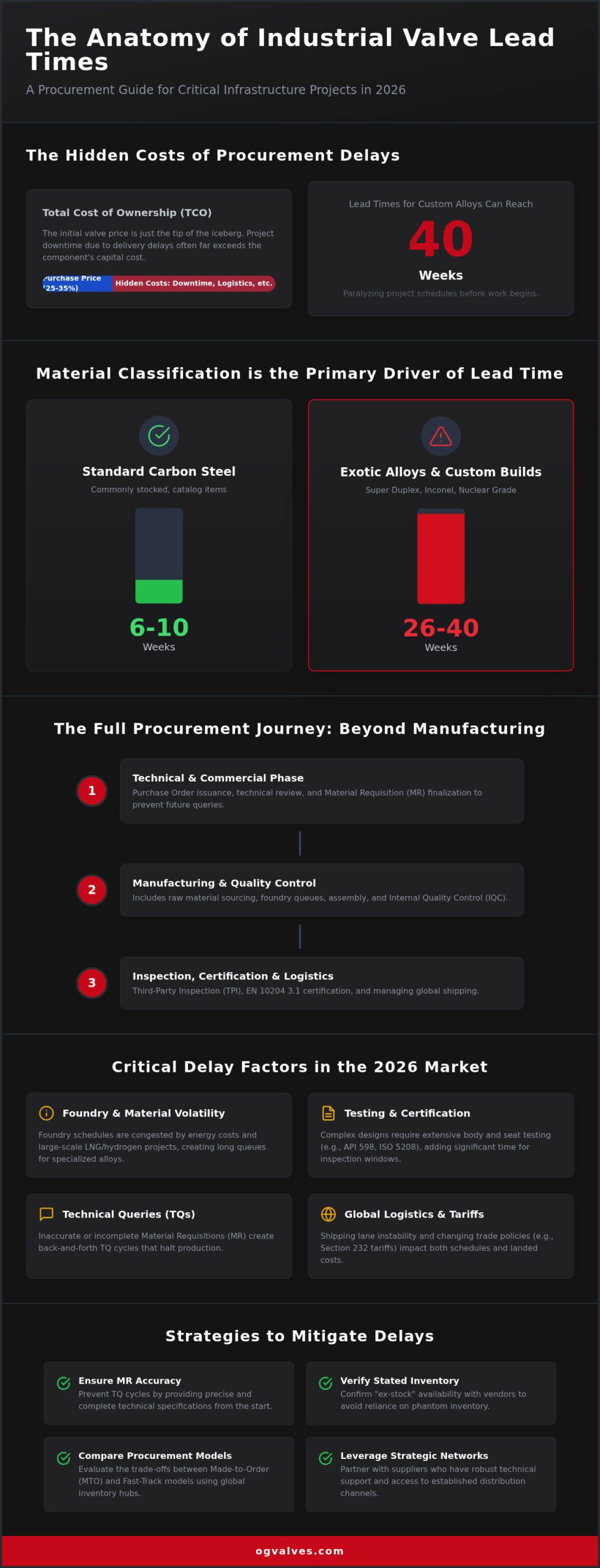
A lead time for industrial valve delivery reaching 40 weeks for custom-engineered alloys or nuclear grades can effectively paralyze a critical infrastructure project before the first weld is made. Procurement specialists in heavy industrial sectors understand that these delays are rarely the result of a single factor, but rather a complex convergence of material availability, rigorous testing requirements, and global logistics bottlenecks. In an industry where the initial purchase price of a control valve accounts for only 25% to 35% of its total cost of ownership, the hidden expense of project downtime often outweighs the capital expenditure of the component itself.
You likely recognize the difficulty of balancing precise technical specifications with the urgent demand of shutdown schedules. This guide provides the technical framework and logistics strategies required to minimize delivery timelines while ensuring full adherence to international standards such as EN 16668:2025 and PED 2014/68/EU. We will analyze the variables affecting production schedules for gate, ball, and globe valves, establish a framework for choosing between ex-stock and made-to-order models, and detail how to maintain heat number traceability and EN 10204 3.1 certification during fast-track procurement cycles.
Key Takeaways
- Understand how the 2026 logistics landscape and raw material volatility define the total lead time for industrial valve delivery from order placement to final site receipt.
- Identify the critical impact of material classifications and engineering complexity, such as the foundry queue differences between standard carbon steel and exotic alloys.
- Evaluate the trade-offs between standard Made-to-Order (MTO) production and fast-track delivery models utilizing established global inventory hubs.
- Reduce technical query (TQ) cycles and prevent project delays by ensuring Material Requisition (MR) accuracy and verifying vendor-stated inventory levels.
- Leverage strategic distribution networks and technical support to secure high-spec valve supply for critical infrastructure projects.
Defining Lead Time for Industrial Valve Delivery in 2026
Precise project scheduling requires a rigorous understanding of the total procurement cycle. For technical experts and procurement leads, Defining Lead Time extends well beyond the period spent on the factory floor. In the context of heavy industry, the total lead time for industrial valve delivery represents the comprehensive duration starting from the formal issuance of a purchase order to the final receipt of the component at the project site under DDP or CIF terms. This distinction is critical. Manufacturing Lead Time (MLT) often ignores the front-end technical review and the back-end logistics that can account for a significant portion of the total schedule.
The 2026 industrial environment presents unique volatility. While standard carbon steel catalog items currently maintain a lead time of 6 to 10 weeks, custom-engineered units in exotic alloys or nuclear grades have expanded to 26 to 40 weeks. When calculating the lead time for industrial valve delivery, procurement teams must also account for raw material sourcing, foundry queues, and the specific regulatory testing required for high-pressure applications. Identifying these variables early prevents the 15% to 20% delay often seen in unmanaged supply chains.
Components of the Procurement Timeline
A structured timeline consists of three primary phases. First, the technical review and Material Requisition (MR) finalization ensure that all specifications align with operational requirements. This phase prevents costly technical queries during production. Second, the manufacturing and assembly phase includes Internal Quality Control (IQC) to verify structural soundness and adherence to design codes. Finally, the Third-Party Inspection (TPI) and certification window is essential for valves requiring EN 10204 3.1 documentation or API 17D monograms. These inspection windows must be scheduled weeks in advance to avoid idling at the factory gates.
Why 2026 Lead Times Differ from Historical Averages
Historical benchmarks are no longer reliable indicators of performance. The 2026 market is heavily influenced by the availability of specialized alloys such as Inconel, Monel, and Super Duplex. Foundry scheduling is now dictated by energy cost fluctuations and the prioritization of large-scale LNG and hydrogen projects. Procurement for Gate Valves or actuated Butterfly Valves must now factor in global shipping lane stability and freight duration estimates. The June 2026 adjustment to U.S. Section 232 tariffs has also altered the landed cost and sourcing logic for many capital equipment imports, requiring a more agile approach to vendor selection.
Technical Factors Influencing Valve Delivery Schedules
Technical specifications serve as the primary determinant for the manufacturing schedule. While standard carbon steel components remain relatively accessible, the shift toward exotic alloys such as Super Duplex or Inconel significantly alters the production timeline. These materials require specialized foundry processes and are subject to longer raw material procurement cycles. Foundry queues for these materials are often congested, making the lead time for industrial valve delivery a critical path item in project management. Consequently, the duration for high-spec alloys typically ranges from 26 to 40 weeks, compared to the 6 to 10-week window for standard carbon steel units.
Complexity in design also dictates the assembly and testing duration. For instance, heavy-duty Gate Valves designed for high-pressure service require extensive body and seat testing per API 598. In contrast, high-performance Butterfly Valves often involve intricate sealing mechanisms that must meet ISO 5208 standards. Adherence to government procurement requirements often necessitates additional documentation and traceability. These administrative and technical layers must be factored into the initial schedule to prevent project slippage. Precision at the Material Requisition (MR) stage is essential to avoid the technical queries that frequently stall the lead time for industrial valve delivery.
The Impact of Material Quality Assurance
Rigorous quality assurance protocols are non-negotiable in critical infrastructure. Positive Material Identification (PMI) and Non-Destructive Testing (NDT), including ultrasonic and radiographic examinations, add necessary but time-consuming steps to the manufacturing process. Adherence to standards like API 600 or API 6D ensures long-term durability but requires specific certification windows. Custom trim requirements, such as Stellite-faced seats or specialized stem materials, frequently extend lead times by an additional 4 to 8 weeks due to the precision machining and hardening processes involved. Every testing phase must be completed before the valve proceeds to final assembly.
Actuation and Control Integration
The integration of automation systems introduces a separate set of logistical variables. Sourcing Industrial Valve Actuators from third-party manufacturers requires early coordination to align with the valve body production. Once the components arrive, the process of mounting, setting mechanical limits, and performing Factory Acceptance Testing (FAT) is essential for operational safety. Sourcing specialized solenoids, limit switches, and digital positioners can introduce further delays if these sub-components are not available ex-stock. For projects requiring rapid deployment, consulting with a technical partner like OG VALVES can help streamline these integration phases through established supply chain relationships.
Standard vs. Fast-Track: Procurement Model Comparison
Procurement strategies in 2026 require a decisive choice between standard factory production and fast-track inventory sourcing. The Standard Made-to-Order (MTO) model involves placing a requisition directly into a manufacturer’s production queue. While this ensures that every component is built to bespoke project specifications from the casting stage, it leaves the project schedule vulnerable to foundry delays and raw material shortages. For large-scale EPC projects with long horizons, the MTO model remains the baseline for cost efficiency, provided the 26 to 40-week windows for specialized alloys are integrated into the master schedule.
The fast-track model provides a necessary alternative by utilizing global inventory and stocking distributors. This approach bypasses the manufacturing phase entirely, focusing instead on the immediate dispatch of high-spec components. Utilizing Strategies to Mitigate… Delays often involves a cost-benefit analysis where the premium for expedited delivery is weighed against the financial impact of project stagnation. In many heavy industrial sectors, the daily cost of an idle facility far exceeds the expediting fees associated with fast-track procurement. A middle ground also exists through “Modified Stock,” where existing inventory is technically adjusted to meet specific trim or actuation requirements, providing a compromise between customization and speed.
When to Choose the Fast-Track Model
The fast-track model is mandatory during emergency shutdowns or unplanned maintenance where every hour of downtime represents a significant loss in operational output. It’s also the primary method for filling gaps in EPC bulk orders. If a handful of critical valves are missing from a large shipment, project momentum can’t be maintained without rapid intervention. Finally, securing critical spares for high-risk operational areas through fast-track channels ensures that safety-critical systems remain functional without waiting for a full manufacturing cycle.
The Role of Stocking Distributors
Stocking distributors act as the critical link in reducing the lead time for industrial valve delivery from months to days. By maintaining an extensive inventory of high-spec Ball Valves and other essential types, these partners provide immediate relief to pressured schedules. Strategic global logistics hubs, such as the Northern Ireland facility operated by OG VALVES, allow for the rapid movement of certified components to international sites. Every ex-stock item must undergo technical verification to ensure it meets the specific project’s regulatory and structural standards before dispatch. This rigorous internal quality control ensures that speed doesn’t compromise the lead time for industrial valve delivery or the ultimate safety of the installation.
Strategies to Mitigate Industrial Valve Delivery Delays
Mitigating schedule slippage requires a proactive approach that begins long before the physical assembly of components. The most significant administrative bottleneck in the lead time for industrial valve delivery is the Technical Query (TQ) cycle. These delays are frequently triggered by ambiguous Material Requisitions (MR) that lack precise data on material grades, pressure ratings, or trim specifications. Ensuring MR accuracy at the outset eliminates the need for back and forth clarifications between the engineering team and the manufacturer, which can otherwise consume two to four weeks of the procurement window.
Vendor qualification must extend beyond a simple review of price and stated capacity. Procurement leads should verify real-time inventory against the specific certification requirements of the project, such as EN 10204 3.1 or PED 2014/68/EU. Early engagement with technical specialists allows for the identification of potential supply chain risks, such as foundry congestion for exotic alloys. By locking in specifications early, projects can secure a slot in the manufacturing queue or identify ex-stock alternatives that meet the necessary safety and performance criteria.
Logistics planning serves as the final layer of schedule protection. The decision between air freight and sea freight involves a clinical assessment of downtime costs versus transportation premiums. For critical path components, air freight is the standard for minimizing the lead time for industrial valve delivery, reducing transit from weeks to several days. It’s only effective if pre-cleared customs documentation is in place to prevent terminal delays. Contact OG VALVES to optimize your fast-track procurement strategy today.
Optimizing the Technical Bid Evaluation (TBE)
The Technical Bid Evaluation (TBE) should prioritize technically acceptable ex-stock options over perfect Made-to-Order (MTO) specifications when the schedule is the primary driver. Engineering teams often find flexibility in non-critical parameters to utilize existing inventory. Standardizing valve types across a facility also allows for the maintenance of a smaller, interchangeable spares inventory. Reducing custom testing requirements to the essential regulatory minimums, such as standard API 598 protocols, prevents unnecessary expansion of the quality control window.
Logistics and Expediting Best Practices
Active manufacturing surveillance is essential for identifying casting flaws or assembly delays before they impact the final delivery date. Regular reporting from the factory floor ensures that the project team remains informed of the actual production status. Utilizing specialists for Industrial Valves procurement ensures that every logistical hurdle, from export licenses to final site receipt, is managed by experts. This high-stakes oversight is the benchmark for maintaining project momentum in heavy industrial sectors.
OG VALVES: Global Fast-Track Delivery Solutions
OG VALVES LTD. functions as a critical technical partner for heavy industrial sectors, providing engineering-led solutions that bypass the standard manufacturing bottlenecks identified in this guide. We maintain an extensive, high-specification inventory of Gate, Ball, Globe, Check, Butterfly, Plug, and Needle valves. By holding significant stock of components in both standard carbon steel and high-grade alloys, we effectively decouple the procurement cycle from the volatile foundry queues that currently dictate industry timelines. Our focus remains on the supply of durable, certified components that meet the rigorous safety requirements of petrochemical, power generation, and offshore environments.
The strategic location of our Northern Ireland hub is central to our ability to minimize the lead time for industrial valve delivery. This facility serves as a global logistics anchor, enabling the rapid dispatch of technical components to project sites across international borders. We recognize that in critical infrastructure, the cost of an idle facility often exceeds the capital value of the valves required to resume operations. Our logistics framework is designed for clinical precision, ensuring that every shipment is accompanied by the necessary regulatory documentation to prevent delays at customs or site receipt.
Our Global Supply Chain Capability
We possess a proven track record in supporting large-scale projects within the oil, gas, and power generation sectors. Our operational model is built for rapid response, specifically addressing emergency maintenance and unplanned shutdown scenarios where standard manufacturing windows are unacceptable. Technical reliability is the foundation of our supply chain. We provide comprehensive support from the initial Material Requisition (MR) review through to final site receipt. This ensures that the lead time for industrial valve delivery isn’t compromised by technical queries or specification misalignments. Our team verifies every component against project-specific design codes and structural benchmarks before it leaves our facility.
Securing Your Supply for 2026
Managing material volatility is a core competency at OG VALVES. We proactively secure raw materials and finished components to insulate our partners from the 2026 price increases and supply fluctuations seen in the wider market. Our commitment to quality is validated through rigorous technical testing and certification protocols. Every valve in our inventory is subject to internal quality control measures that align with global standards, including EN 10204 3.1 material traceability and PED 2014/68/EU compliance. This clinical focus on engineering excellence ensures that fast-track delivery never comes at the expense of operational safety or regulatory adherence. Contact OG VALVES for a fast-track delivery quote today.
Optimizing Your 2026 Procurement Strategy
The 2026 industrial landscape demands a transition from reactive purchasing to strategic inventory management. Success in minimizing the lead time for industrial valve delivery depends on the clinical alignment of technical specifications with available global stock. By prioritizing Material Requisition accuracy and engaging with specialists who hold extensive API-certified inventories, procurement teams can bypass the extended manufacturing queues that currently characterize the market.
OG VALVES has served as a specialist global supplier since 2014, providing the expert technical support necessary for high-stakes heavy industry sectors. Our Northern Ireland hub facilitates the rapid movement of gate, ball, and globe valves, ensuring that regulatory adherence and operational safety remain uncompromised even under urgent shutdown schedules. Precision in procurement remains the most effective safeguard against the financial impact of project downtime. Request a Fast-Track Valve Quote from OG VALVES to secure your infrastructure with engineering excellence and reliable delivery timelines.
Frequently Asked Questions
What is the typical lead time for an industrial gate valve?
Standard carbon steel gate valves typically carry a lead time of 6 to 10 weeks for catalog items. Custom-engineered units requiring specialized alloys or nuclear-grade certifications often extend to 26 to 40 weeks. These timelines are dictated by foundry queues and raw material availability. Ex-stock options can reduce this duration to several days, provided the technical specifications align with existing inventory.
How much does fast-track valve delivery typically add to the cost?
Fast-track delivery involves additional costs primarily driven by expedited manufacturing fees and premium logistics, such as air freight. While specific premiums vary based on the manufacturer and urgency, these expenses are often justified by the prevention of facility downtime. Procurement leads must weigh these logistical surcharges against the daily operational losses incurred during an unplanned shutdown or project delay.
Can ex-stock valves meet the same certification standards as made-to-order valves?
Ex-stock valves meet the same rigorous certification standards as made-to-order units, including EN 10204 3.1 material traceability and API 598 testing protocols. Stocking distributors maintain detailed documentation packages to ensure compliance with PED 2014/68/EU and other international benchmarks. The primary difference lies in availability rather than structural integrity or regulatory adherence, provided the technical verification process is completed before dispatch.
What are the most common causes of industrial valve delivery delays?
The lead time for industrial valve delivery is most frequently compromised by technical queries (TQs) resulting from ambiguous Material Requisitions. Other primary drivers include foundry congestion for specialized alloys and logistical bottlenecks at international customs. Proactive technical reviews and the use of pre-cleared documentation are essential strategies for mitigating these risks and maintaining project momentum within the 2026 supply chain landscape.
How does the choice of material (e.g., Duplex vs. Carbon Steel) affect lead time?
Material selection significantly dictates the manufacturing schedule due to foundry prioritization. Standard carbon steel is generally available within a 6 to 10-week window. In contrast, exotic materials like Super Duplex or Inconel require specialized casting processes and longer raw material procurement cycles, often resulting in lead times exceeding 26 weeks. Early specification of these materials is critical for accurate project scheduling.
What documentation is required to ensure smooth international delivery of industrial valves?
Smooth international transit requires a comprehensive documentation package, including EN 10204 3.1 material certificates, Certificates of Conformity (CoC), and detailed heat number traceability. For global distribution, pre-cleared customs documentation and adherence to specific regional standards, such as CE marking for European markets, are mandatory. These administrative requirements must be finalized alongside the manufacturing process to prevent delays at logistics hubs.
Is it possible to reduce lead times for actuated valve assemblies?
It’s possible to reduce lead times for actuated assemblies by sourcing valve bodies and actuators from ex-stock inventory rather than awaiting a factory-integrated build. Local mounting, limit switch setting, and Factory Acceptance Testing (FAT) can often be completed in a fraction of the time required for a manufacturer-led assembly. This approach requires precise technical coordination to ensure the actuator torque and mounting hardware align with the valve specifications.
How does OG VALVES ensure fast-track delivery for global industrial sites?
OG VALVES utilizes an extensive inventory of high-spec gate, ball, and butterfly valves to bypass manufacturing queues. Our Northern Ireland hub serves as a strategic logistics center for rapid global distribution. By maintaining stock of API-certified components and providing expert technical support, we ensure a reliable lead time for industrial valve delivery that addresses the urgent requirements of heavy industrial sectors like petrochemical and power generation.
 Responsive Menu