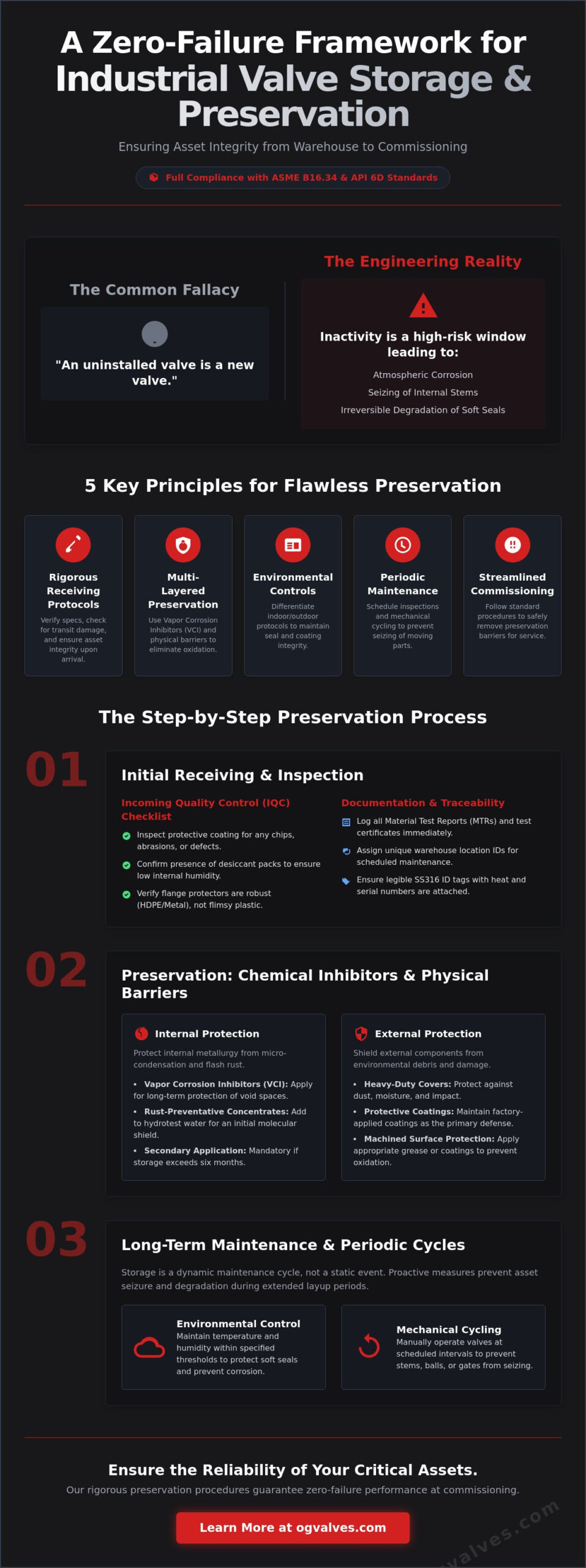
The assumption that a valve remains “new” simply because it hasn’t been installed is a critical engineering fallacy that often leads to catastrophic commissioning delays. In reality, the period between manufacturing and installation is a high-risk window where inactivity results in atmospheric corrosion, the seizing of internal stems, or the irreversible degradation of soft seals. You’re likely aware that maintaining the structural integrity of Gate, Ball, and Check valves requires more than basic warehouse sheltering. This technical guide establishes a rigorous industrial valve storage and preservation procedure designed to ensure a zero-failure rate upon final installation.
Adhering to this framework ensures full compliance with the ASME B16.34 2025 edition and API 6D 25th edition standards. We’ll detail the precise technical requirements for long-term layup, including environmental humidity thresholds, mechanical cycling protocols, and the application of industry-standard protective coatings. This methodical approach treats storage as a dynamic maintenance cycle rather than a static event, effectively extending the operational shelf-life of your critical infrastructure spares.
Key Takeaways
- Establish rigorous receiving protocols to verify physical asset specifications against shipping documentation and identify transit damage before warehouse entry.
- Implement a multi-layered industrial valve storage and preservation procedure using Vapor Corrosion Inhibitors (VCI) and rust-preventative concentrates to eliminate internal oxidation.
- Differentiate between indoor temperature-controlled requirements and outdoor drainage protocols to maintain the long-term integrity of soft seals and external coatings.
- Define periodic inspection frequencies and manual mechanical cycling schedules to prevent the seizing of critical moving parts during extended layup periods.
- Streamline the transition to operational service by following standardized commissioning steps that ensure the complete removal of temporary preservation barriers.
Pre-Storage Inspection and Initial Receiving Protocols
Internal cavity cleanliness is a non-negotiable requirement. Any residual water from factory hydrotesting or machining debris can cause immediate degradation. Staff should verify that factory-applied preservatives are present and compatible with the intended process fluids to avoid contamination during eventual commissioning. If there’s any evidence of internal moisture, the asset must be dried using filtered, oil-free compressed air before being sealed for storage. This proactive approach prevents the initiation of localized pitting corrosion that often remains undetected until the industrial valve is placed into high-pressure service.
Incoming Quality Control (IQC) Checklist
Technical personnel must utilize a structured IQC checklist to standardize the acceptance process. This prevents the entry of sub-standard assets into the inventory and ensures that every industrial valve storage and preservation procedure is anchored in a known baseline of quality.
- Inspect the integrity of the factory-applied protective coating for chips, abrasions, or holiday defects that expose the base metal.
- Confirm that flange protectors are constructed from high-density polyethylene (HDPE) or bolted metal. Standard thin-film plastic is rejected because it doesn’t prevent mechanical impact damage to critical sealing surfaces.
- Verify the presence and condition of desiccant packs within sealed valve assemblies to ensure internal humidity remains below the threshold for corrosion.
Documentation and Traceability Requirements
Precise record-keeping is the foundation of long-term asset integrity. Without accurate data, the maintenance cycle can’t be effectively managed or audited for compliance with API and ASME standards.
- Log all Material Test Reports and hydrostatic test certificates into the central asset management system immediately upon receipt.
- Assign unique warehouse location IDs to each asset to facilitate the scheduling of periodic inspection intervals and mechanical cycling.
- Ensure all SS316 stainless steel identification tags are securely attached and legible; these must include the heat number and serial number for full traceability throughout the lifecycle.
Preservation Methods: Chemical Inhibitors and Physical Barriers
Effective long-term asset management requires a dual-layered defense strategy. A comprehensive industrial valve storage and preservation procedure must address both the internal metallurgy and the external structural components simultaneously. While superficial covers prevent environmental debris from entering the valve, they don’t stop the micro-condensation that leads to internal flash rust. Relying solely on grease-based preservation is often insufficient for modern high-precision components, as grease can harden or fail to reach recessed internal geometries.
Internal void spaces are protected through the introduction of specialized chemical inhibitors. During factory acceptance testing, adding rust-preventative concentrates to hydrotest water provides an initial molecular shield. If the valve remains in storage for over six months, a secondary application of preservatives is mandatory. For high-performance Ball and Gate valves, ensuring these chemicals don’t react with seat materials is vital for functional integrity. This chemical layer prevents oxidation without the need for labor-intensive degreasing before installation.
External surfaces demand heavy-duty physical protection. Exposed machined parts, specifically stems and flange faces, require a thick coating of high-viscosity, water-displacing lubricant. Following lubrication, the entire unit should be encased in UV-stabilized shrink wrap or heavy-duty tarpaulins. This prevents the degradation of soft seals and paint systems caused by prolonged ultraviolet exposure or salt-laden air in coastal warehouses. These barriers must be inspected monthly for tears or breaches that could compromise the internal environment.
Vapor Phase Corrosion Inhibitors (VpCI)
Unlike traditional oils that require direct surface contact, VpCI technology works through sublimation. The inhibitors release a protective vapor that forms a monomolecular layer on all metal surfaces, including hard-to-reach internal cavities and crevices. Application typically involves fogging fluids for large-bore units or placing emitter capsules inside smaller, enclosed valves. Technical teams must confirm the compatibility of these inhibitors with EPDM or Nitrile seals. Certain chemical formulations can cause swelling or embrittlement in non-metallic components, which leads to seat failure during commissioning.
Barrier Materials and Flange Protection
Physical barriers serve as the final line of defense against mechanical impact and atmospheric moisture. Selection of flange protectors is a critical decision; while plywood is a common budget choice, it absorbs moisture and can promote localized corrosion. High-density polyethylene (HDPE) or specialized press-fit metal plugs are the industry standard for maintaining a hermetic seal. Inside these sealed cavities, desiccant bags are used to manage relative humidity levels. The required volume of desiccant is calculated based on the internal volume of the valve body, typically following a ratio of 50 grams per cubic foot of air space. For actuated valves, gearboxes and electrical housings must be taped or plugged to prevent the ingress of dust and moisture.
Environmental Control and Warehouse Standards
The physical environment of the storage facility is as critical as the chemical preservation applied to the asset. A technical industrial valve storage and preservation procedure requires strict atmospheric monitoring to prevent the failure of soft seals and the onset of surface oxidation. Indoor storage in a climate-controlled warehouse is the preferred industry standard. Within these facilities, maintaining a relative humidity level below 40% is mandatory. At this threshold, the electrochemical process of corrosion is significantly retarded. If temperatures fluctuate excessively, the resulting thermal expansion and contraction can compromise the integrity of gaskets and O-rings, leading to fugitive emissions once the valve is in service.
When indoor space isn’t available, outdoor storage protocols must be strictly enforced to mitigate environmental degradation. Assets must never be placed directly on the earth; moisture wicking from soil accelerates base metal corrosion. Use heavy-duty pallets or steel racking to provide a minimum elevation of 150mm above the ground. The storage area requires a slight gradient to ensure adequate drainage and prevent the pooling of rainwater around the valve body. For long-term outdoor layup, additional protective shelters or enclosures are necessary to shield the valves from direct precipitation and saline-heavy air, particularly in coastal industrial zones. These measures ensure that the industrial valve storage and preservation procedure maintains the asset in a “ready-for-service” state regardless of external conditions.
Warehouse Infrastructure Specifications
The structural integrity of the warehouse floor must support the high point-loads of heavy-duty industrial valves without subsidence. Concrete or asphalt surfaces are required to eliminate the risk of rising dampness associated with dirt or gravel floors. Shelving units must have certified weight capacities and include safety barriers to prevent mechanical impact from forklifts. Storage zones must be strategically located away from chemical processing areas or battery charging stations. Corrosive vapors from these sources can bypass physical barriers and react with machined surfaces, rendering the preservation chemicals ineffective. This separation is vital for maintaining the clinical environment required for high-specification alloys.
Orientation by Valve Category
Correct positioning during storage prevents mechanical deformation and ensures internal components remain aligned. Gate valves should be stored in a vertical orientation with the wedge in the fully closed position to prevent the ingress of debris into the seating area. Conversely, Ball valves must be stored horizontally with the ball in the fully open position. This protects the polished surface of the ball from localized pitting and prevents seat deformation. For Check valves, the disc must be securely blocked or strapped to the seat. This prevents the internal components from slamming during transit or warehouse relocation, which could damage the hinge pin or sealing faces. Proper orientation is a low-cost, high-impact step in the preservation cycle.
Long-Term Maintenance and Periodic Inspection Cycles
The technical integrity of critical flow control assets is contingent upon the execution of a recurring maintenance schedule. An effective industrial valve storage and preservation procedure isn’t a static event but a dynamic cycle of inspection and intervention. Depending on the criticality of the asset and the volatility of the warehouse environment, technical teams must establish a 3-month or 6-month inspection frequency. These intervals allow for the early detection of atmospheric oxidation or seal degradation before the damage becomes irreversible. During these cycles, inspectors must verify the presence of internal preservatives and ensure that external barriers haven’t been breached by mechanical impact or environmental wear.
Re-application of lubricants and inhibitors is a mandatory component of the storage lifecycle. Chemical preservatives, particularly Vapor Corrosion Inhibitors, possess a finite functional lifespan and require replenishment to maintain the protective monomolecular layer on internal surfaces. Monitoring desiccant saturation levels is equally vital. Most industrial-grade desiccants utilize color-change indicators to signal moisture capacity; once these indicators transition from blue to pink or clear, the bags must be replaced immediately. Failure to manage internal humidity leads to localized pitting on seating surfaces, which compromises the valve’s ability to achieve a bubble-tight seal during eventual service. For those managing complex inventories, consulting high-performance industrial valves technical data ensures that maintenance protocols align with specific material classifications.
Mechanical Cycling and Stem Care
Inactivity is a primary cause of mechanical failure in stored assets. To prevent the seizing of internal components, a partial stroke testing protocol must be implemented. Technical staff should manually cycle the stem or actuator at least 25% of its travel range during each inspection interval. This movement redistributes internal lubricants and prevents the “cold welding” of metal-to-metal contact points. Stem threads and yoke nuts require the application of industry-approved, high-viscosity greases to maintain low torque requirements. Every cycling event must be documented in the asset integrity log, noting any changes in operating resistance or manual torque. This data provides a baseline for evaluating the valve’s readiness for installation.
Inspection Reporting and Corrective Actions
Reporting must be clinical and data-driven to facilitate rapid corrective actions. Inspectors are trained to identify “weeping” from seals, which often indicates the breakdown of internal elastomers or the failure of packing sets. If surface rust is discovered, the protocol requires immediate cleaning to bare metal followed by passivation and the re-application of protective coatings. Simply painting over oxidation is an unacceptable practice that hides underlying structural thinning. External covers must be reviewed for UV degradation, tearing, or water pooling. If a cover shows signs of brittleness, it’s replaced to ensure the primary physical barrier remains intact. This disciplined approach ensures that every asset in the layup remains compliant with the original manufacturing standards.
Commissioning: Preparing Valves for Service
The transition from long-term layup to active commissioning is the final, critical phase of a professional industrial valve storage and preservation procedure. This stage requires a systematic reversal of all preservation steps to ensure that protective chemicals, desiccants, or physical barriers don’t interfere with process fluids or mechanical tolerances. Rushing this process often leads to seal contamination or the bypass of debris into downstream equipment. Technical staff must execute a clinical cleaning protocol that restores the valve to its original “as-manufactured” state before it’s integrated into the piping system. This isn’t merely an unwrapping exercise; it’s a formal quality assurance gate that validates the success of the entire storage cycle.
Final visual inspection of all sealing surfaces and machined threads is mandatory. Even with robust preservation, the potential for localized atmospheric impact exists if barriers were compromised during the final weeks of storage. Inspectors must verify that flange faces are free of pitting and that the internal bore is clear of any residual moisture or VCI emitters. For valves destined for oxygen or high-purity service, cleanliness verification must follow specific industry protocols, such as solvent wiping and UV light inspection, to detect trace hydrocarbons. Functional testing concludes the process, with a full-stroke cycle test to verify that torque requirements remain within the manufacturer’s specified range.
Depreservation Procedures
Removing temporary preservation materials requires precision to avoid damaging the underlying metallurgy. Solvent cleaning is the standard method for removing high-viscosity, water-displacing lubricants from flange faces; this ensures a clean surface for proper gasket seating and prevents leaks during the initial pressure test. If non-compatible preservatives were used in the internal cavities, the valve must be flushed with a compatible cleaning agent. It’s vital to account for all desiccant bags and VCI emitters documented in the storage log. Leaving these items inside the valve body during installation can cause catastrophic failure of the trim or downstream pump damage.
Final Pre-Installation Verification
Before the valve is bolted into the line, technical teams must perform a final verification of all mechanical fasteners. Bolted bonnets often require a check of bolt torque specifications, as thermal cycling during long-term storage can lead to minor relaxation of the pre-load. For actuated units, engineers must verify that actuator calibration and limit switch settings remain accurate and haven’t drifted during the layup period. This final sign-off ensures the asset aligns with the project-specific industrial valves standards. Documenting this transition provides the final link in the traceability chain, confirming that the asset is fit for purpose and ready for high-pressure service.
Securing Operational Readiness through Technical Asset Integrity
Maintaining the functional integrity of critical flow control assets requires disciplined adherence to engineering standards. A rigorous industrial valve storage and preservation procedure ensures that every Gate, Ball, or Check valve remains compliant with API and ASME specifications from the moment of receipt to final commissioning. By implementing systematic mechanical cycling, chemical inhibition, and environmental humidity controls, technical teams eliminate the risk of seized components or degraded seals. These protocols transform storage from a period of vulnerability into a controlled maintenance cycle that protects your capital investment.
Reliability in heavy industrial sectors is built on the foundation of quality assurance and material traceability. Since 2014, we’ve provided global supply chain expertise and maintained an extensive stock of API and ASME certified components to support complex project requirements. Our technical support ensures that your high-specification assets meet every regulatory benchmark. Request a Quote for High-Specification Industrial Valves to secure dependable infrastructure for your next project. Your facility’s long-term performance depends on the quality of its components today.
Frequently Asked Questions
How long can industrial valves be stored without re-preservation?
Standard factory-applied preservation typically remains effective for six months under controlled environmental conditions. Beyond this duration, the industrial valve storage and preservation procedure dictates a mandatory inspection and re-application of chemical inhibitors. Failure to replenish these coatings leads to the degradation of the protective monomolecular layer. This leaves internal metallurgical surfaces vulnerable to atmospheric oxidation and localized pitting that can compromise pressure-containing integrity.
Should ball valves be stored in the open or closed position?
Ball valves must be stored in the fully open position to ensure long-term functional reliability. This orientation protects the high-precision polished surface of the ball from localized atmospheric corrosion and prevents the permanent deformation of the soft seats. Storing these units in a closed or partially open state creates uneven pressure on the seat rings. This often results in seat leakage or increased operating torque once the valve is placed into service.
What is the role of VCI in valve preservation during ocean transit?
Vapor Corrosion Inhibitors (VCI) provide a critical defense mechanism by releasing protective molecules that sublimate into a gaseous state. These molecules form a monomolecular shield on all exposed metal surfaces, including hard-to-reach internal cavities and crevices. During ocean transit, this chemical barrier prevents salt-laden air from initiating electrochemical corrosion. It effectively neutralizes the corrosive impact of high-salinity environments without requiring direct contact with the metal substrate.
Can I store valves outdoors if they have end caps and covers?
Outdoor storage is permissible only when comprehensive secondary protective measures are implemented alongside standard end caps. Assets must be elevated at least 150mm above the ground on steel racking or heavy-duty pallets to prevent moisture wicking from the soil. The storage site requires a defined gradient to ensure rainwater drainage. Without UV-stabilized covers and periodic barrier inspections, the factory-applied coatings and soft seals will inevitably degrade under direct environmental exposure.
How often should I cycle the stem of a stored gate valve?
Technical staff should perform manual mechanical cycling of the stem every three to six months as part of the periodic maintenance schedule. A partial stroke of at least 25% of the total travel range is sufficient to redistribute internal lubricants and prevent the “cold welding” of metal contact points. Documentation of these events is a core requirement of a robust industrial valve storage and preservation procedure, ensuring the asset remains ready for immediate commissioning.
What are the risks of using standard plastic caps for flange protection?
Standard thin-film plastic caps are inadequate because they don’t offer resistance to mechanical impact during warehouse handling. These caps often fail to maintain a hermetic seal, allowing moisture and debris to enter the internal bore. High-density polyethylene (HDPE) or bolted metal protectors are the required standard for maintaining the integrity of critical flange sealing surfaces. Using sub-standard protection frequently results in costly re-machining of flange faces before installation.
Do I need to remove factory-applied preservatives before installation?
Removal of factory-applied preservatives is generally required to ensure compatibility with process fluids and proper gasket seating. Solvent cleaning must be applied to flange faces to remove water-displacing lubricants that could interfere with the sealing interface. If the internal preservation chemicals are non-compatible with the intended service medium, a full cavity flush is necessary. This prevents contamination of the downstream system and ensures the valve operates within its design parameters.
What is the best way to protect valve actuators during long-term layup?
Actuators require specialized protection to prevent the ingress of dust and moisture into sensitive internal mechanisms. All electrical conduit entries and gearbox breather ports must be sealed using specialized plugs or heavy-duty tape. If the actuator’s equipped with internal space heaters, these should be energized to maintain the internal temperature above the dew point. This prevents the formation of condensation that causes the failure of electronic components and limit switches.
 Responsive Menu