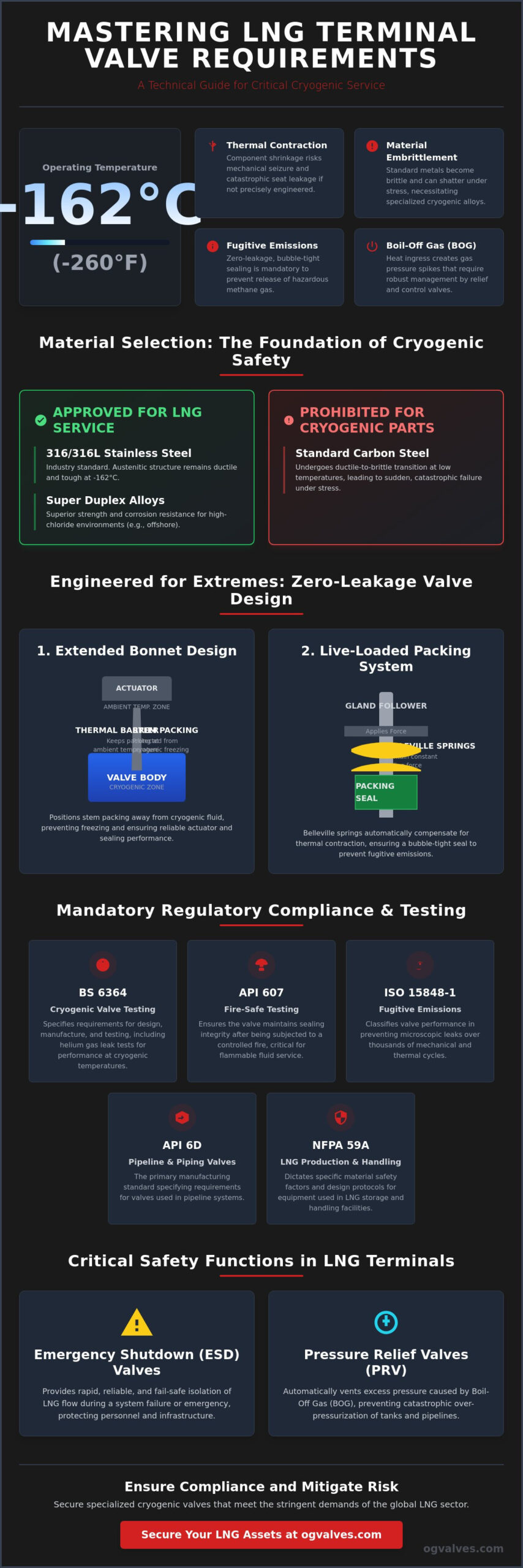
A single material failure at -162°C does more than halt production; it compromises the structural integrity of critical energy infrastructure and violates stringent global safety mandates. Engineering specialists recognize that managing liquefied natural gas demands more than standard hardware. It requires absolute adherence to specialized lng terminal valve requirements to mitigate the risks of thermal contraction and fugitive emissions. You’ve likely encountered the technical challenges of material embrittlement or the logistical strain of securing specialized cryogenic components within volatile global supply chains.
This technical guide provides a clinical analysis of the regulatory landscape and material standards essential for 2026 operations. We’ll examine the specific applications of API 6D 25th Edition and API 607 8th Edition while evaluating the performance of austenitic stainless steel under cryogenic stress. The following breakdown outlines the functional requirements for zero-leakage performance and identifies the quality assurance protocols necessary to maintain compliance with BS 6364:1984 and ISO 15848-1:2015 standards. This data ensures that procurement specialists can secure reliable assets that meet the heavy industrial demands of the current energy sector.
Key Takeaways
- Analyze how cryogenic temperatures necessitate specialized design to manage thermal contraction and ensure zero-leakage performance at -162°C.
- Evaluate the metallurgical advantages of 316/316L stainless steel and Super Duplex alloys in preventing material embrittlement during LNG service.
- Identify mandatory lng terminal valve requirements through a detailed breakdown of API 607 fire-safe testing and BS 6364 helium gas procedures.
- Understand the critical safety functions of Emergency Shutdown (ESD) and Pressure Relief Valves (PRV) within the terminal’s operational loops.
- Mitigate project delays by implementing strategic procurement workflows and utilizing fast-track delivery options for specialized cryogenic components.
Technical Challenges of LNG Terminal Valve Specification
LNG terminal operations present some of the most rigorous environments in the industrial sector. The primary challenge involves managing a fluid that remains in a liquid state only through extreme refrigeration. Meeting modern lng terminal valve requirements involves addressing the mechanical stresses induced by rapid thermal cycling and high-pressure differentials. Failure to account for these variables leads to catastrophic seal failure or mechanical seizure, which compromises the safety of the entire regasification or liquefaction facility.
The Cryogenic Environment: Operating at -162°C
Understanding What is Liquefied Natural Gas (LNG)? is fundamental to valve specification. Natural gas is cooled to approximately -162°C to achieve liquefaction, which reduces its volume by a factor of roughly 600. This transition facilitates efficient storage and transport but introduces severe material challenges. Standard industrial materials become brittle and lose impact strength at these temperatures; consequently, specialized alloys are required. Cryogenic valve service is formally defined as any application operating at or below -150°C.
Thermal contraction is a critical variable in these systems. As a valve cools from ambient temperature to cryogenic levels, the metallic components undergo significant dimensional changes. If the valve body, stem, and seating materials don’t have matched coefficients of thermal expansion, the resulting clearance gaps lead to seat leakage or mechanical seizure. Precision engineering is necessary to ensure that the valve trim maintains its functional geometry throughout the full thermal range.
Managing “boil-off gas” (BOG) is another vital requirement. Even within insulated systems, heat ingress causes small amounts of LNG to return to a gaseous state. This creates pressure spikes that require precise management through relief valves and control systems to prevent over-pressurization of storage tanks and piping. The valve must be capable of handling both liquid and gaseous phases without loss of sealing integrity.
Sealing Integrity and Fugitive Emissions
Achieving a bubble-tight, zero-leakage shut-off is mandatory in hazardous LNG environments. Any release of methane represents a safety risk and a violation of environmental regulations. Stem packing is the most common point of failure. Thermal cycling causes the packing material to contract, which reduces the sealing force. This is where many standard valves fail to meet lng terminal valve requirements.
Engineers utilize live-loaded packing systems, typically employing Belleville spring washers, to maintain constant pressure on the seal regardless of temperature fluctuations. This ensures adherence to strict safety standards regarding fugitive emissions. Performance must be validated against ISO 15848-1, which classifies valves based on their ability to prevent microscopic leaks over thousands of cycles. This clinical focus on sealing durability is what separates industrial-grade cryogenic valves from standard utility components.
Material Requirements for Cryogenic and High-Pressure Service
Selecting the correct metallurgy is the most critical factor in meeting lng terminal valve requirements. Standard carbon steels are prohibited for cryogenic wetted parts because they undergo a ductile-to-brittle transition at temperatures well above the -162°C threshold. Under these conditions, carbon steel loses its fracture toughness and becomes susceptible to sudden, catastrophic failure. Austenitic stainless steels, specifically grades 316 and 316L, are the industry standard due to their face-centered cubic crystal structure, which remains stable and ductile even at absolute zero. For offshore LNG facilities or environments with high chloride concentrations, Super Duplex alloys provide the necessary pitting resistance and mechanical strength to withstand both internal pressures and external corrosion.
Adherence to the NFPA 59A standard dictates specific material safety factors for LNG storage and handling. One essential design feature is the extended bonnet, which serves as a thermal barrier. By positioning the stem packing and actuator away from the cryogenic liquid, the bonnet allows a column of vaporized gas to form. This gas acts as an insulator, preventing the packing from freezing and ensuring the actuator remains within its designed operating temperature range. When selecting ball valves for these applications, engineers must decide between soft-seated and metal-seated configurations based on cycle frequency and pressure requirements.
Metallurgy and Impact Testing
Validation of material integrity requires rigorous Charpy V-notch impact testing. This procedure measures the energy absorbed by the material during fracture at -196°C to ensure it won’t suffer brittle failure in service. Every pressure-retaining component must be accompanied by a Material Test Report (MTR). We also utilize Positive Material Identification (PMI) to verify that the chemical composition of the alloy matches the specification exactly, eliminating the risk of accidental material substitution in the supply chain.
Seat and Seal Material Selection
Soft seat inserts for cryogenic service typically utilize PCTFE (Kel-F) or reinforced PTFE. PCTFE is preferred for its superior dimensional stability and lower gas permeability at low temperatures. However, high-cycle applications often require metal-to-metal seating with specialized coatings to prevent galling. In many cryogenic ball valves, spring-energized Lip-Seals act as the primary sealing mechanism. These seals maintain a tight interface by using internal springs to compensate for material contraction. If your project requires high-performance hardware, consulting with a partner focused on precision valve manufacturing can help finalize your material specifications.
Critical Valve Functional Requirements in the LNG Value Chain
Functional performance in an LNG terminal is segmented by operational zones. Each zone demands specific mechanical capabilities to maintain process safety and efficiency. Meeting lng terminal valve requirements involves selecting hardware that performs under both steady-state and emergency conditions. High-volume flow control in loading arms often utilizes triple-offset butterfly valves, which provide the necessary torque-seated, zero-leakage performance during ship-to-shore transfer. These units must integrate seamlessly with heavy-duty actuators to facilitate rapid, remote isolation from the central control room.
Isolation and Control in Storage Systems
Storage tank integrity relies on specialized internal valves located at the tank bottom. These valves ensure containment in the event of external piping failure. For maintenance and safety verification, engineers specify Double Block and Bleed (DBB) functionality. This allows for the isolation and venting of the cavity between two seating surfaces, confirming a bubble-tight seal. In Boil-Off Gas (BOG) management systems, globe valves are the preferred choice for precise throttling of gas flow, ensuring stable pressure levels within the storage infrastructure.
Emergency Response: ESD and Fire-Safe Design
Emergency Shutdown (ESD) valves are the critical final elements in terminal safety loops. These valves must adhere to strict lng terminal valve requirements regarding fail-safe operation. Pneumatic actuators are typically configured in a “Fail-Close” or “Fail-Open” orientation using spring-return mechanisms to ensure a safe state during a loss of power or signal. Reliability is further enhanced through Partial Stroke Testing (PST). This diagnostic procedure verifies valve movement without interrupting the process flow, ensuring the valve isn’t stuck due to prolonged inactivity.
Fire-safe design is mandatory for all hazardous zone valves. Hardware must be certified to API 607 or API 6FA standards, ensuring that the valve maintains its sealing integrity even after soft seals are destroyed by intense heat. This secondary metal-to-metal contact prevents the release of flammable inventory during a fire event. Fail-safe configurations typically follow these logic patterns:
- Fail-Close: Employed at primary isolation and ESD points to prevent inventory release.
- Fail-Open: Utilized for pressure relief and flare header lines to ensure over-pressure protection.
Pressure Relief Valves (PRVs) complement these systems by protecting storage tanks from over-pressurization caused by rapid boil-off during external heat exposure or vacuum conditions during unloading. Every functional requirement is anchored in the necessity of maintaining a closed system under the most extreme industrial scenarios.
Regulatory Compliance and Testing: BS 6364 & API 607
Compliance with lng terminal valve requirements rests on the successful execution of standardized testing protocols. While general industrial valves follow basic pressure benchmarks, LNG service necessitates supplemental validation to account for cryogenic temperatures and fire risks. API 6D 25th Edition serves as the baseline for pipeline valves, but project-specific data sheets often mandate stricter leakage classes and material certifications. Validation is typically overseen by Third-Party Inspection (TPI) agencies to ensure that every component meets the documented safety criteria before site delivery.
Cryogenic Prototype and Production Testing
The BS 6364:1984 standard remains the definitive guide for cryogenic valve testing. The procedure involves submerging the valve in a liquid nitrogen bath to reach a stabilized temperature of -196°C. Helium gas is utilized as the test medium because its small molecular size can penetrate seal imperfections that would remain undetected by water or air. Before this cryogenic submersion, the valve must pass a high-pressure shell and seat test at ambient temperature to confirm structural soundness.
BS 6364 specifies allowable leakage rates based on the valve’s nominal size. During the test, the valve is cycled several times at -196°C to ensure that thermal contraction hasn’t caused mechanical seizure. Leakage is measured using a flow meter or by the displacement of water in a calibrated tube. For critical isolation points, engineers often specify “Zero Leakage” or Rate A according to ISO 5208, though BS 6364 provides the specific volumetric limits for cryogenic service. This rigorous verification prevents the risk of uncontrolled boil-off or hazardous leaks in the terminal’s piping network.
Fire-Safe Certification and Validation
Fire-safe performance is a non-negotiable aspect of lng terminal valve requirements. API 607 8th Edition provides the protocol for testing soft-seated valves under fire conditions. The test involves exposing the valve to a flame temperature between 750°C and 1000°C for a duration of 30 minutes. The objective of API 607 testing is to verify that a valve can prevent uncontrolled fluid release during and after exposure to a high-intensity fire event.
During the burn, the primary soft seals are typically destroyed. The valve must then rely on its secondary metal-to-metal seating to maintain containment. After the fire is extinguished and the valve is cooled, it must undergo a final pressure test to prove it still holds the process fluid. This dual-standard approach, combining BS 6364 for cold service and API 607 for fire safety, ensures the hardware’s operational envelope is fully validated. To ensure your procurement meets these rigorous benchmarks, you can consult our technical team for specific compliance documentation.
Procurement and Strategic Supply for Global LNG Projects
Procurement for LNG infrastructure is a logistical exercise in risk management. The specialized nature of lng terminal valve requirements means that off-the-shelf solutions are rarely sufficient for critical service points. Instead, project managers must navigate the complexities of custom manufacturing and global supply chains. A delay in a single critical valve can halt the commissioning of a regasification unit, leading to substantial financial losses and operational setbacks. Partnering with a specialist supplier provides the technical oversight needed to verify Material Test Reports (MTRs) and ensures that every asset arrives on-site with full regulatory documentation.
Managing Technical Lead Times
The production of cryogenic-grade castings, such as 316L stainless steel or Super Duplex alloys, involves complex foundry processes that often result in extended lead times. If procurement teams don’t account for these windows during the early stages of project planning, they risk missing critical construction milestones. Stock management programs are vital for reducing these delays during urgent maintenance or unexpected outages. Technical support teams play a key role here; they verify material certifications and ensure that the final product aligns with the terminal’s specific engineering standards before the manufacturing process begins. This proactive oversight prevents the delivery of non-compliant hardware that doesn’t meet the facility’s safety benchmarks.
Quality Assurance and Global Distribution
Every valve destined for an LNG facility must undergo final inspection and verification before leaving the factory. This includes verifying the results of cryogenic helium testing and fire-safe certifications as established in previous sections. Transporting heavy-duty gate valves, globe valves, and check valves to remote or offshore locations requires specialized logistics expertise to maintain the integrity of the components during transit. OG VALVES LTD. provides the necessary infrastructure for fast-track valve delivery, ensuring that critical components reach global sites without compromising quality or safety.
By partnering with an established entity that understands the high cost of mechanical failure, procurement specialists can secure their supply chains against volatility. Technical expertise in international standards ensures that lng terminal valve requirements are met regardless of the project’s geographic location. This clinical focus on durability and regulatory adherence positions OG VALVES LTD. as a benchmark for industrial safety and engineering excellence in the global energy sector. We provide the technical certainty required for high-stakes industrial environments where quality is a mandatory operational output.
Securing Operational Integrity in LNG Infrastructure
Operational reliability within the LNG value chain is contingent upon the precise integration of metallurgical standards and rigorous testing protocols. As established, achieving zero-leakage performance at -162°C requires a clinical focus on austenitic stainless steel selection and the implementation of extended bonnets to protect critical actuation components. Ensuring full compliance with lng terminal valve requirements involves more than meeting basic pressure ratings; it demands verified adherence to BS 6364 cryogenic procedures and API 607 fire-safe benchmarks to mitigate the high-stakes risks of thermal contraction and fugitive emissions.
Maintaining a resilient supply chain is equally essential for large-scale energy projects. Our extensive inventory of high-specification industrial valves, combined with deep technical expertise in global standards, provides the necessary assurance for critical infrastructure. We leverage global fast-track delivery capabilities to support both new construction and urgent maintenance schedules across the energy sector. Consult with our technical experts for your LNG valve requirements to ensure your facility operates with unwavering safety and engineering excellence. We’re ready to support your next project with precision-engineered solutions.
Frequently Asked Questions
What is the primary difference between a standard valve and a cryogenic valve?
The primary difference lies in material toughness and mechanical design. Standard valves utilize carbon steels that undergo a ductile-to-brittle transition at low temperatures, leading to fracture. Cryogenic valves are engineered with austenitic stainless steels and feature extended bonnets to prevent the stem packing from freezing. These specialized designs ensure the valve remains operational and maintains seal integrity at temperatures as low as -196°C.
Why is BS 6364 the industry standard for LNG valve testing?
BS 6364 is the definitive standard because it establishes the precise methodology for helium gas testing at cryogenic temperatures. It defines the allowable leakage rates and the cooling procedures required to validate a valve’s performance. By using helium as a test medium, manufacturers can detect microscopic leaks that other gases might miss, ensuring the hardware meets the safety demands of liquefied natural gas facilities.
What are extended bonnets, and why are they required in LNG terminals?
Extended bonnets are elongated valve necks that move the stem packing and actuator away from the cryogenic fluid. This design allows a column of vaporized gas to form within the bonnet, which acts as a thermal insulator. This insulation prevents the packing material from reaching its glass transition temperature and ensures the actuator remains within its functional temperature range, preventing mechanical seizure during operation.
How does fire-safe certification (API 607) impact valve material selection?
API 607 certification requires valves to maintain containment even after their soft seals are destroyed by intense heat. This necessitates the use of secondary metal-to-metal seating and fire-resistant graphite gaskets. Engineers must select alloys and trim designs that won’t warp or fail under the extreme temperature gradients experienced during a 30-minute burn test, ensuring the valve prevents fuel from feeding an active fire.
Can standard stainless steel valves be used in LNG service?
Standard stainless steel valves aren’t suitable for LNG service without specific cryogenic modifications. While the base alloy may be compatible, the valve must be engineered with specialized tolerances to account for thermal contraction. Meeting lng terminal valve requirements also involves the addition of extended bonnets, live-loaded packing, and specialized seat inserts like PCTFE that are rated for -162°C and below.
What is the role of an ESD valve in an LNG terminal safety system?
Emergency Shutdown (ESD) valves act as the final defensive barrier in a terminal’s safety loop. These valves are designed to isolate the system automatically during a process upset or emergency event. They typically utilize spring-return pneumatic actuators to ensure a fail-safe position, usually “Fail-Close,” to prevent the uncontrolled release of hazardous inventory into the atmosphere or surrounding infrastructure.
How often should LNG terminal valves undergo cryogenic testing?
Cryogenic testing is performed during two distinct phases: design validation and production. Prototype testing is conducted once to qualify a specific valve design and size range. Production testing is subsequently performed on a per-order basis, where either 100% or a specified percentage of the valves in a batch are tested according to the project’s technical data sheets and lng terminal valve requirements.
What are the benefits of using Super Duplex valves in LNG applications?
Super Duplex alloys offer a superior combination of high mechanical strength and exceptional corrosion resistance. In offshore LNG terminals or coastal regasification plants, these materials resist pitting and stress corrosion cracking caused by chloride-rich marine environments. Their high yield strength also allows for thinner wall sections in high-pressure applications, reducing the overall weight of the piping system without compromising structural safety.
 Responsive Menu