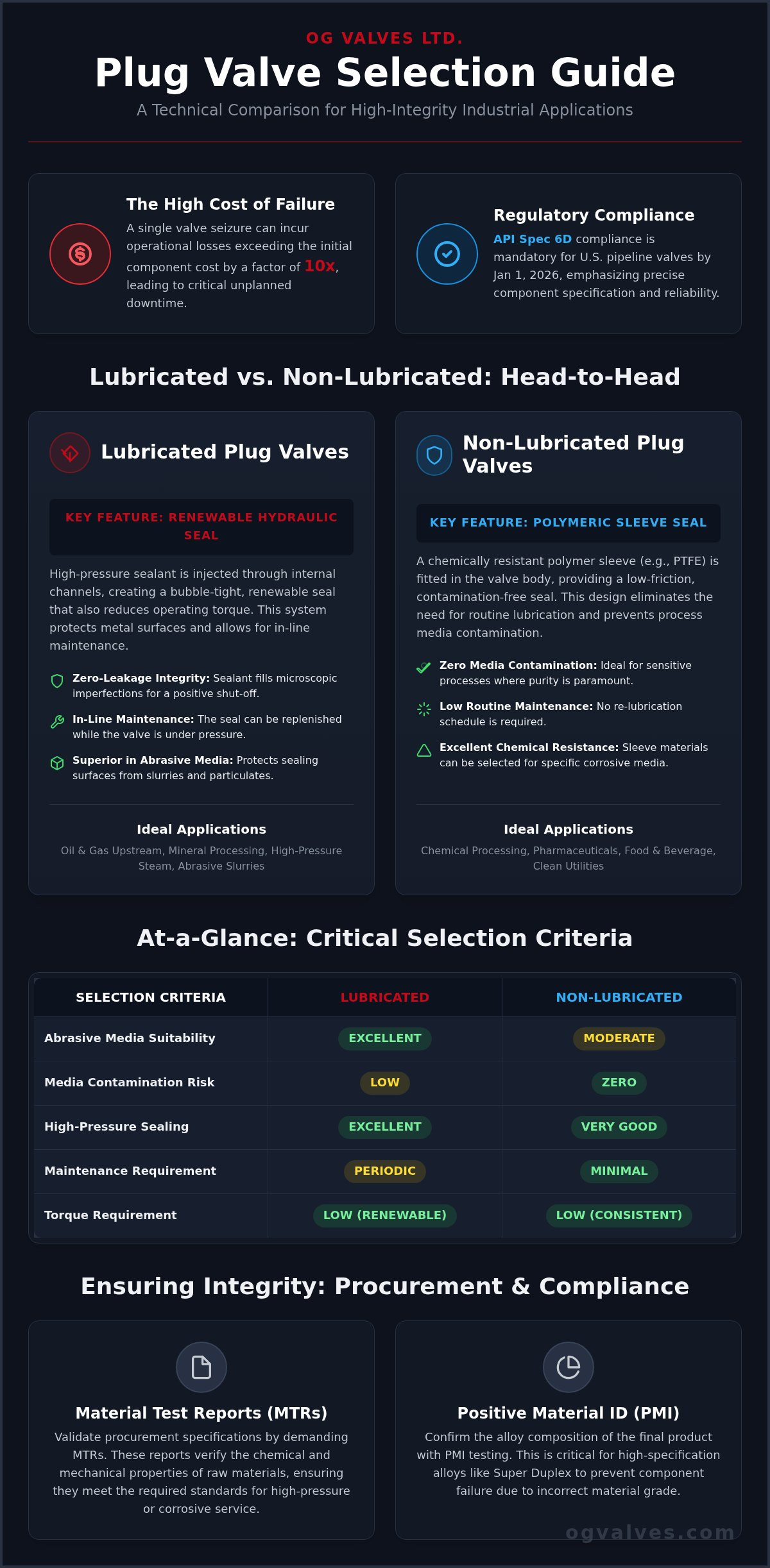
A single valve seizure in a high-pressure slurry line often incurs operational losses exceeding the initial component cost by a factor of ten. As of January 1, 2026, compliance with the 25th edition of API Spec 6D is mandatory for pipeline valves in U.S. oil and gas infrastructure. This regulatory shift emphasizes the necessity of precise component specification. Engineers frequently face the critical decision of lubricated vs non-lubricated plug valves when balancing the requirement for zero-leakage performance against the risk of process media contamination.
You understand that unplanned downtime and high maintenance costs in remote locations are unacceptable risks to critical infrastructure. This article provides a comprehensive technical analysis of plug valve lubrication designs to assist you in selecting the optimal component for corrosive and high-pressure applications. We will evaluate how specific designs meet API safety standards, maximize valve lifespan in abrasive environments, and ensure long-term operational integrity. This comparison details the mechanical trade-offs between pressure-balanced lubricated systems and polymeric-sleeved non-lubricated alternatives for 2026 industrial requirements.
Key Takeaways
- Evaluate the mechanical advantages of the tapered plug interface for high-frequency isolation and operational efficiency in heavy industrial environments.
- Analyze how renewable sealant injection systems in lubricated designs maintain zero-leakage integrity within high-pressure and abrasive media applications.
- Determine the optimal selection between lubricated vs non-lubricated plug valves based on media contamination sensitivity and specific chemical compatibility requirements.
- Quantify torque requirements and pressure rating differentials to ensure precise actuator sizing and structural soundness across varying temperature ranges.
- Validate procurement specifications through rigorous Material Test Reports (MTRs) and Positive Material Identification (PMI) for high-specification alloys like Super Duplex.
The Engineering Fundamentals of Plug Valve Design
Plug valves represent one of the most resilient isolation components in modern piping systems. These devices utilize a tapered or cylindrical plug to control flow, operating on a quarter-turn principle that provides rapid shut-off capabilities. Understanding plug valve design fundamentals is essential for engineers managing high-cycle applications where gate valves might fail due to seat wear. The primary technical decision during specification involves the trade-offs between lubricated vs non-lubricated plug valves, as this choice dictates the valve’s maintenance cycle and sealing reliability.
Port geometry significantly influences system pressure drop and volumetric flow. Regular port designs provide a reduced flow area, suitable for general isolation tasks where a minor pressure drop is acceptable. Venturi ports utilize a reduced opening with a gradual transition to the pipe diameter, optimizing weight and cost in large-diameter pipelines. Full bore designs are critical for pigging operations and applications requiring minimal turbulence or maximum flow capacity.
The critical differentiator in industrial performance is the method used to achieve a bubble-tight seal. In lubricated models, a high-pressure sealant is injected into the interface between the plug and the body. This hydraulic sealant serves as the core differentiator when comparing lubricated vs non-lubricated plug valves. It doesn’t just reduce operating torque; it acts as a renewable seat that can be replenished while the system remains under pressure.
The Tapered Plug Mechanism
The tapered plug design is the industrial standard for high-pressure service. Unlike cylindrical plugs, the tapered geometry allows for axial adjustment to compensate for seat wear, ensuring a tight seal under high differential pressure. The wedge effect is a critical mechanical advantage. As the plug is seated, the downward force creates a metal-to-metal contact that displaces debris and protects the sealing surfaces from high-velocity erosion. This geometry ensures that the plug doesn’t seize during thermal cycling.
Primary Applications in Heavy Industry
Heavy industrial sectors rely on these valves for their robust construction and simplified maintenance. In oil and gas upstream operations, they manage wellhead fluids containing abrasive sand. Mineral processing plants utilize them for coal slurries, where the plug’s wiping action clears the seat during every cycle. High-pressure steam and vapor services also benefit from the plug valve’s ability to maintain a reliable seal despite significant temperature fluctuations. These applications demand components that adhere to API and ISO standards to prevent catastrophic failure.
Lubricated plug valves utilize a sophisticated internal distribution network to maintain operational integrity in the most demanding industrial environments. This architecture consists of radial and longitudinal grooves machined into the plug surface, connected to a central reservoir via internal ports. High-pressure check valves prevent the process media from entering the lubrication system, ensuring that the sealant remains uncontaminated. This mechanical configuration is the primary reason why lubricated vs non-lubricated plug valves are specified for high-pressure oil and gas infrastructure where metal-to-metal contact is unavoidable.
The sealant does more than reduce friction. It functions as a renewable hydraulic seat. When a technician applies pressure through the injection fitting, the sealant fills microscopic surface imperfections between the plug and the valve body. This creates a bubble-tight seal that can be restored without removing the valve from the line. For engineers managing abrasive slurries or mineral processing, this capability ensures sustained API 6D compliance and prevents the seat erosion common in non-lubricated designs.
Sealant Injection and Pressure Balancing
Sealant is injected through the stem, traveling through internal channels to reach the seating surfaces. In pressure-balanced designs, this lubricant film allows the plug to “float” within the body. This prevents the plug from sticking or seizing under extreme differential pressures. You must select a sealant based on precise chemical compatibility and temperature ratings. Incorrect sealant selection leads to washout or chemical degradation, which compromises the valve’s sealing capacity. If you’re managing complex procurement requirements, the technical specialists at OG Valves provide expert guidance on material and sealant specifications for critical infrastructure.
Performance in High-Cycle Environments
Frequent operation in heavy industry increases the risk of galling and accelerated wear. Lubrication significantly reduces the operating torque required for the quarter-turn movement, which often allows for the use of smaller and more economical actuators. This reduction in friction is a decisive factor in the lubricated vs non-lubricated plug valves selection process for high-cycle isolation tasks. API 599 serves as the governing standard for steel plug valves, defining the rigorous design and testing criteria necessary for both lubricated and non-lubricated configurations in industrial service. Reliability in these environments depends on a structured maintenance schedule. Regular sealant replenishment is mandatory to ensure the valve remains functional in remote locations where failure isn’t an option.
Non-Lubricated Plug Valves: Sleeve-Lined Solutions for Chemical Processing
Non-lubricated plug valves utilize a stationary, non-metallic sleeve to provide a low-friction interface. This design eliminates the need for sealant injection, which is a primary consideration in the lubricated vs non-lubricated plug valves debate. For pharmaceutical, semiconductor, and specialty chemical sectors, the absence of grease ensures zero media contamination, protecting batch integrity and preventing catalyst poisoning. These valves are the standard for clean-service applications where the introduction of hydrocarbons or synthetic sealants would compromise the final product quality.
The “fit and forget” approach appeals to operators in high-purity environments where maintenance access is restricted. However, torque requirements differ significantly. Without hydraulic sealant, torque is generally higher due to the constant interference fit between the plug and the sleeve. It’s essential that actuator sizing reflects these specific mechanical loads to prevent operational failure. Engineers must account for the breakaway torque, which is often higher in non-lubricated designs compared to their lubricated counterparts after periods of inactivity.
Sleeve Material Specifications
PTFE and PFA are the most common liners. PTFE offers excellent chemical inertness but has a temperature ceiling around 204°C (400°F). PFA-lined valves, which are projected to grow at a CAGR of 6.2% between 2026 and 2033, provide improved melt strength and thermal stability. Thermal expansion is a critical constraint. Polymeric liners expand at rates significantly higher than the metallic valve body. This can lead to increased operating torque or sleeve deformation if not managed through precise engineering tolerances. The sleeve’s self-cleaning property is a functional advantage. As the plug rotates, the edge of the port wipes the sleeve surface, preventing solids from accumulating on the sealing face.
Structural Integrity and Leak Prevention
Mechanical retention is vital for long-term reliability. High-performance non-lubricated valves use internal ribs or body machining to lock the sleeve into the housing. This prevents the sleeve from rotating or collapsing under vacuum or high-velocity flow conditions. The interference fit ensures bubble-tight shut-off across a range of pressures. Unlike lubricated designs that rely on renewable sealant, the non-lubricated valve maintains its seal through the resilience of the polymer liner. This design is particularly effective in preventing the accumulation of trapped media in the valve cavity. For a broader overview of material selection and global standards, consult the Industrial Valves: The Engineer’s Comprehensive Guide.
Lubricated vs. Non-Lubricated: Critical Selection Criteria
Selecting between lubricated vs non-lubricated plug valves requires a granular analysis of mechanical loads and lifecycle costs. Lubricated designs generally exhibit lower operating torque because the injected sealant creates a low-friction hydraulic film between the plug and the body. This efficiency often allows for more compact and cost-effective actuator packages. Conversely, non-lubricated sleeve valves rely on a constant interference fit, which increases breakaway torque, particularly after extended periods of static closure. If you’re designing systems with limited space or weight constraints, the torque efficiency of lubricated models is a decisive factor.
Pressure ratings further differentiate these technologies. Lubricated plug valves typically outperform sleeve-lined designs in high-pressure services exceeding Class 600. The metal-to-metal seat, reinforced by renewable sealant, maintains structural integrity under extreme differential pressure. Non-lubricated sleeves, while excellent for chemical resistance, are susceptible to deformation or “cold flow” when subjected to excessive pressure or thermal cycling. For engineers transitioning between different valve types, understanding these limitations is as critical as reviewing A Technical Guide to Industrial Gate Valves for comparative isolation performance.
Maintenance and Operational Lifespan
The Total Cost of Ownership (TCO) is a balance between initial CAPEX and long-term OPEX. Non-lubricated valves represent a higher initial investment due to specialized liner materials and larger actuators, yet they offer a maintenance-free operational profile. The decision between lubricated vs non-lubricated plug valves in these scenarios depends on whether the facility prioritizes lower initial costs or reduced intervention frequency. In remote offshore environments, the man-hours and logistics required for regular sealant injection can significantly inflate OPEX. However, in abrasive slurry services, the ability to renew the seat via lubrication often results in a longer overall lifespan compared to a sleeve that would eventually erode and require a full valve overhaul.
Environmental and Safety Compliance
Fugitive emission control is a mandatory requirement for modern industrial infrastructure. Lubricated designs provide an additional layer of protection, as the pressurized sealant acts as a secondary barrier against stem leaks. For fire-safe applications, lubricated valves are inherently robust due to their metal-to-metal primary seals. Both types must undergo rigorous testing to meet API 607 or ISO 10497 standards to ensure performance during a thermal event. Media compatibility remains the ultimate deciding factor; clean, corrosive fluids are best handled by non-lubricated sleeves to avoid product contamination, while abrasive slurries necessitate the wiping action of a lubricated valve. To secure high-specification components that meet these global safety benchmarks, contact OG Valves for technical procurement support and fast-track delivery options.
Procurement and Compliance: Ensuring Standards in Plug Valve Selection
Procurement of high-specification flow control components requires more than a simple comparison of lubricated vs non-lubricated plug valves. It demands rigorous verification of material integrity and adherence to global engineering benchmarks. Selecting the correct metallurgy is the first step in ensuring long-term reliability in aggressive industrial environments. While carbon steel remains the baseline for many applications, the presence of corrosive agents necessitates the use of specialized alloys to prevent premature failure.
Material verification is achieved through comprehensive testing protocols. Material Test Reports (MTRs) provide a documented history of the heat lot, chemical composition, and mechanical properties. For high-stakes projects, Positive Material Identification (PMI) testing provides an additional layer of certainty, confirming that the delivered component matches the precise alloy specification required for the process conditions.
Material Selection for Corrosive Environments
In acidic or sour gas services, specifying high-alloy plugs is essential to prevent sulphide stress cracking and hydrogen-induced cracking. Components must comply with NACE MR0175/ISO 15156 standards to ensure structural soundness in environments containing hydrogen sulphide. Engineers often specify Super Duplex for its superior pitting resistance equivalent number (PREN), which is vital in offshore and desalination applications. For those comparing different quarter-turn technologies, reviewing Industrial Ball Valves: A Technical Guide provides further insights into material performance across various valve architectures. Corrosion allowances must be calculated based on the expected erosion rates of the process media, especially in the abrasive slurries where lubricated vs non-lubricated plug valves are evaluated for their wiping and sealing capabilities.
Global Supply and Technical Support
Fast-track procurement capabilities are vital for minimizing downtime during unplanned maintenance or scheduled shutdowns. Technical expertise is required to match valve specifications precisely to complex process conditions, ensuring that the selected component can withstand the operational pressures and temperatures of the system. OG VALVES leverages its extensive inventory and global logistics networks to facilitate the rapid delivery of plug and needle valves to heavy industrial sites. OG VALVES maintains a rigorous commitment to quality assurance protocols, ensuring that every component undergoes exhaustive pressure testing and verification against international standards prior to dispatch. This methodical approach to supply chain management ensures that technical experts and procurement specialists receive components that meet the highest standards of industrial precision and safety.
Optimizing Flow Control Integrity for High-Stakes Industrial Infrastructure
Determining the correct specification between lubricated vs non-lubricated plug valves is a decision that impacts the entire lifecycle of a piping system. Lubricated designs offer the mechanical resilience and renewable sealing capacity required for high-pressure abrasive slurries. Conversely, non-lubricated sleeves provide the maintenance-free, zero-contamination performance essential for specialty chemical and pharmaceutical sectors. Every selection must be anchored in rigorous adherence to API 599 and the updated API 6D standards to ensure regulatory compliance and operational safety.
OG VALVES acts as a dependable partner by offering an extensive inventory of API-compliant plug valves alongside fast-track global logistics. Our technical experts provide the specialized support necessary to navigate complex material classifications and selection criteria. By prioritizing industrial precision and structural soundness, you protect your critical infrastructure against the high costs of failure and ensure your facility operates with unwavering reliability.
Request a Technical Quote for Industrial Plug Valves
Frequently Asked Questions
Is a lubricated plug valve better for high-pressure applications?
Yes, lubricated designs are generally superior for high-pressure service exceeding Class 600. The metal-to-metal seating interface, supported by pressurized hydraulic sealant, maintains a bubble-tight seal under extreme differential pressures. This configuration prevents the plug from seizing and allows for renewable sealing without disassembly. Non-lubricated sleeves are often limited by the structural strength of the polymer liner, which may deform or “cold flow” under excessive mechanical loads.
Can non-lubricated plug valves handle abrasive slurries?
Non-lubricated plug valves aren’t recommended for abrasive slurries or fluids containing high solids. The interference fit between the plug and the sleeve traps particles, leading to accelerated liner erosion and potential seizure. Lubricated plug valves are the preferred choice for these environments. The wiping action of the plug combined with the renewable sealant film protects the seating surfaces and flushes out contaminants during every operational cycle.
What is the typical maintenance frequency for a lubricated plug valve?
Maintenance intervals for lubricated plug valves depend on the cycle frequency and the severity of the process media. In high-cycle or abrasive services, sealant replenishment may be required monthly or quarterly to ensure operational integrity. For general isolation tasks in clean services, annual lubrication is often sufficient. Adhering to a structured schedule is essential to prevent the plug from sticking and to maintain the secondary hydraulic seal.
Are non-lubricated plug valves fire-safe?
Lubricated plug valves are inherently fire-safe due to their metal-to-metal primary sealing surfaces. In the event of a fire, the absence of soft seats ensures that the valve maintains its structural seal. Non-lubricated designs require specific fire-safe testing, such as API 607 or ISO 10497, because the primary seal relies on a polymer sleeve. If the sleeve melts, the valve must have a secondary metal-to-metal backup to prevent catastrophic external leakage.
How do I choose between a plug valve and a ball valve for isolation?
The choice between a plug valve and a ball valve depends on the requirement for seat protection and media type. Plug valves offer a larger seating area and a wiping action, making them superior for abrasive slurries and high-frequency isolation. Ball valves are often lighter and require lower torque for clean, high-velocity services. When evaluating lubricated vs non-lubricated plug valves, consider that plug designs provide a more robust mechanical seal in severe service conditions.
What sealant should be used for high-temperature plug valves?
High-temperature plug valves require synthetic, non-melting sealants typically based on silicone or fluorinated hydrocarbons. These sealants must maintain their viscosity and chemical stability at temperatures exceeding 260°C (500°F). You must verify that the selected lubricant is compatible with the process media to prevent washout or hardening. Standard hydrocarbon-based greases are unsuitable for these applications as they degrade rapidly, leading to seat failure and increased operating torque.
What are the common failure modes for sleeve-lined plug valves?
Common failure modes for sleeve-lined plug valves include “cold flow” deformation, chemical degradation of the polymer, and sleeve collapse under vacuum conditions. If the operating temperature exceeds the liner’s thermal limit, the sleeve may expand and increase the torque required for operation. Abrasive particles can also embed into the soft sleeve material, causing scoring on the plug surface and compromising the valve’s bubble-tight shut-off capability over time.
Does API 6D apply to both lubricated and non-lubricated plug valves?
API 6D applies to both lubricated and non-lubricated configurations when they are used in pipeline service. This standard defines the requirements for design, manufacturing, and testing to ensure safety in oil and gas infrastructure. While API 599 is the specific standard for steel plug valves, compliance with the updated 25th edition of API 6D is often a mandatory procurement requirement. This ensures that the lubricated vs non-lubricated plug valves meet the same rigorous pressure and leakage criteria.
 Responsive Menu