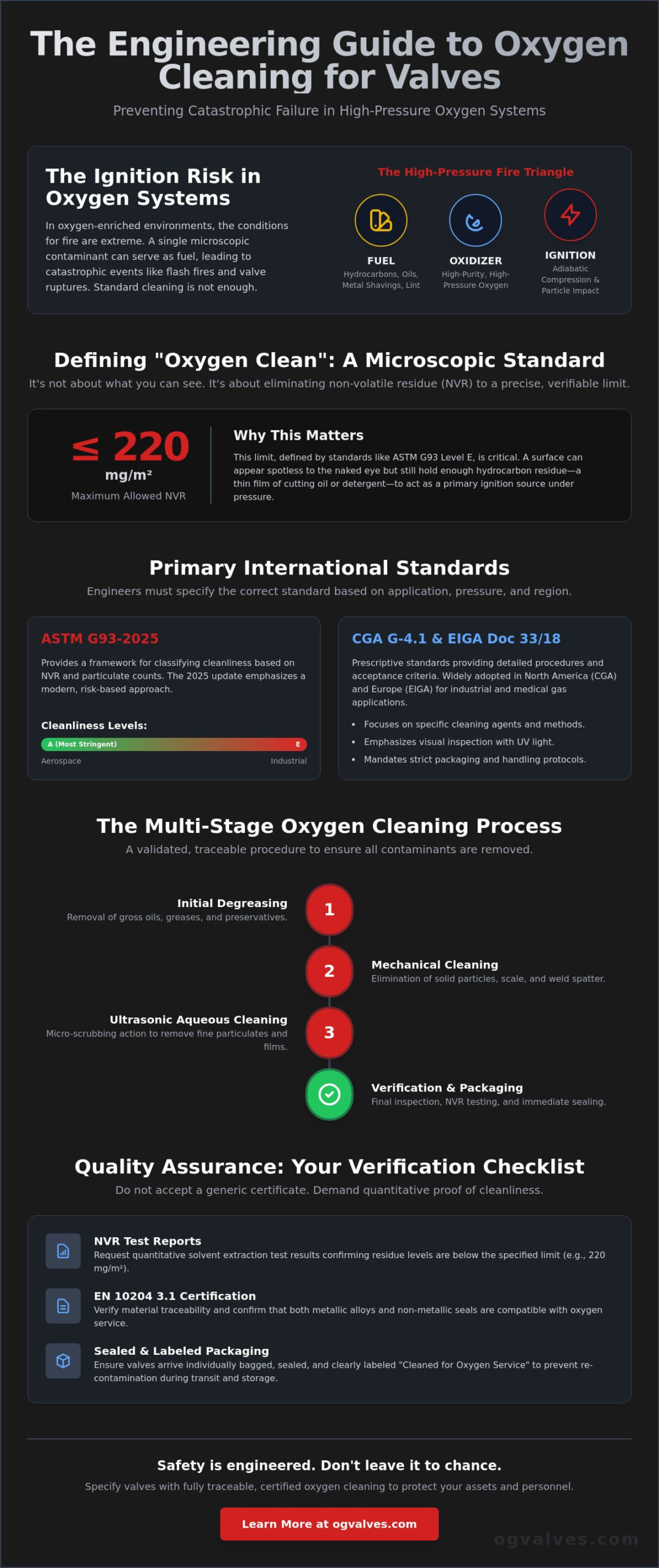
A single microscopic hydrocarbon residue on a high-pressure valve seat is not merely a contaminant; it is a primary ignition source for a catastrophic flash fire in oxygen-enriched environments. Technical experts understand that adhering to a precise oxygen cleaning for valves standard is a critical safety engineering protocol rather than a simple maintenance task. You likely recognize the difficulty in verifying if a supplier has truly achieved the required non-volatile residue level of 220 mg/m2 or if they’re merely providing a generic certificate of conformance.
This article serves as a comprehensive technical reference for engineers and procurement specialists. It clarifies the distinctions between the prescriptive CGA G-4.1-2018 and the major October 2025 update to ASTM G93-2025. You’ll gain a clear understanding of material compatibility, the shift toward risk-based cleanliness assessments, and a structured checklist for verifying oxygen-clean certification across gate, ball, and globe valve configurations. We provide the data necessary to ensure your fluid control systems meet the highest benchmarks for industrial safety and regulatory adherence.
Key Takeaways
- Understand the engineering necessity of removing combustible hydrocarbons to prevent adiabatic compression ignition in high-pressure oxygen systems.
- Distinguish between the technical requirements of the current oxygen cleaning for valves standard protocols, specifically ASTM G93 and CGA G-4.1.
- Evaluate the efficacy of multi-stage cleaning procedures, including ultrasonic aqueous degreasing and mechanical scale removal, for internal valve surfaces.
- Assess the material compatibility of metallic alloys and non-metallic seals to ensure structural integrity and fire resistance under oxygen-enriched conditions.
- Verify process traceability and cleanliness levels through mandatory documentation such as EN 10204 3.1 certification and NVR test reports.
The Engineering Necessity of Oxygen Cleaning for Industrial Valves
Oxygen cleaning is a specialized decontamination process designed to eliminate combustible substances from the internal wetted surfaces of gas handling equipment. In high-purity oxygen systems, the typical fire triangle—comprising fuel, an oxidizer, and an ignition source—operates under extreme conditions. Oxygen isn’t flammable itself, but it acts as a powerful oxidizer that drastically lowers the ignition temperature of surrounding materials. Contaminants like hydrocarbons, metal shavings, or lint serve as the fuel. High-performance industrial valves are critical pressure-containing components where these elements often converge. Adhering to a rigorous oxygen cleaning for valves standard ensures that the fuel component is removed, effectively neutralizing the risk of spontaneous combustion.
The Risk of Adiabatic Compression and Particle Impact
Adiabatic compression occurs when a gas is rapidly compressed, resulting in a localized temperature spike without heat transfer to the surrounding environment. In oxygen systems, this happens when a valve is opened quickly, allowing high-pressure gas to slam into a dead-end or a restricted orifice. If the internal surfaces are contaminated, this heat can ignite the residues. Microscopic particulates also pose a threat through particle impact. When high-velocity oxygen carries metal chips or silica, the kinetic energy converted upon impact provides sufficient heat to ignite the valve body or trim. This process, often referred to as “kindling chain” ignition, can lead to catastrophic structural failure. For a deeper understanding of how materials react in these environments, Oxygen Compatibility Explained provides essential data on ignition sensitivity and material thresholds.
Defining “Oxygen Clean” Beyond Visual Inspection
The term “oxygen clean” describes a state of cleanliness that far exceeds standard industrial degreasing. Visual inspection isn’t enough to guarantee safety. While a component may appear clean to the naked eye, microscopic non-volatile residues (NVR) can still trigger a fire. An established oxygen cleaning for valves standard typically mandates NVR limits as low as 220 mg/m2 or 47.5 mg/ft2, depending on the specific application and pressure rating. Standard commercial cleaning doesn’t remove the thin films of cutting oils or detergents that are highly reactive in oxygen-rich streams. Professional oxygen cleaning employs validated chemical and mechanical methods to ensure these trace elements are eradicated, maintaining the safety of medical gas and industrial high-pressure pipelines. Failure to meet these specific thresholds can result in catastrophic valve body rupture and system-wide fire events.
Primary International Standards for Oxygen Service Valves
The selection of an appropriate oxygen cleaning for valves standard is determined by the specific gas state, operating pressure, and regional regulatory requirements. While various organizations provide guidelines, four primary documents govern the industry: ASTM G93, CGA G-4.1, ISO 15001, and EIGA Doc 33/18. These standards aren’t interchangeable; they offer different levels of granularity regarding cleaning agents, inspection methods, and quantitative residue limits. Engineers must specify the correct standard during the procurement phase to ensure the valve’s wetted surfaces are chemically compatible with high-pressure oxygen streams.
ASTM G93 Cleanliness Levels and Classifications
ASTM G93-2025 provides a structured framework for classifying cleanliness based on non-volatile residue (NVR) and particulate counts. The standard defines five distinct levels, ranging from Level A (the most stringent) to Level E. For high-pressure industrial applications, Level C or Level D is frequently specified, while Level A is typically reserved for critical aerospace or semiconductor environments. Quantitative limits are precise. For instance, Level E allows for up to 220 mg/m2 of NVR. Engineers must select the level based on the maximum operating pressure of the system, as higher pressures increase the risk of adiabatic ignition. The 2025 update has transitioned this document from a practice to a guide, emphasizing a risk-based approach to cleanliness verification.
CGA G-4.1 vs. EIGA Guidelines
The CGA G-4.1 Standard represents the primary industry practice in North America for industrial gas components. In contrast, EIGA Doc 33/18 serves as the European counterpart. Both standards emphasize that valves must be completely disassembled before cleaning to ensure that internal cavities, stem packings, and seat interfaces are reached. A common benchmark for NVR under CGA G-4.1 is 220 mg/m2, though specific projects may require more rigorous thresholds depending on the fluid state and temperature. These standards also dictate the use of approved, residue-free cleaning agents that won’t react with oxygen. When procuring certified industrial valves, verifying which of these international standards was applied during the manufacturing phase is a non-negotiable step for safety compliance.
ISO 15001 focuses specifically on medical applications, such as anaesthetic and respiratory equipment. It shares many technical similarities with ASTM G93 but includes additional requirements for biocompatibility and odor testing. Regardless of the specific oxygen cleaning for valves standard utilized, the objective remains the same: ensuring that every component, from the valve body to the smallest seal, is free of reactive contaminants. This rigorous adherence to global benchmarks ensures that valve performance remains reliable in the most demanding industrial environments.
Technical Procedure: The Multi-Stage Oxygen Cleaning Process
The execution of a rigorous oxygen cleaning for valves standard requires a methodical, multi-stage protocol to ensure the total removal of organic and inorganic contaminants. This isn’t a singular event but a sequence of chemical and mechanical operations. The process begins with pre-cleaning to remove gross contaminants such as weld slag, scale, and heavy shop soils. Mechanical methods, including wire brushing or abrasive blasting, are employed when necessary to achieve a base-metal finish before the component enters the precision cleaning phase. Every step is documented to maintain traceability and ensure the valve’s wetted surfaces are prepared for high-pressure oxygen exposure.
Aqueous vs. Solvent Cleaning Methods
Modern industrial valve manufacturing has shifted toward aqueous alkaline detergents for primary decontamination. These cleaners are effective at emulsifying oils while reducing the environmental risks associated with chlorinated solvents. Solvent cleaning remains a specialized option for specific non-metallic components or complex internal geometries where water entrapment is a concern. The choice of agent must align with the ASTM G93/G93M-19 Standard to ensure material compatibility and residue-free results. Using the wrong solvent can lead to the degradation of soft goods or the introduction of new reactive residues, compromising system safety.
Following the primary cleaning stage, components undergo multi-stage rinsing using deionized or demineralized water. This step is critical to prevent the deposition of mineral salts or detergent residues on wetted surfaces. Drying is the final phase of the cleaning sequence. It must be performed using oil-free nitrogen or high-purity filtered air. This prevents flash rusting on carbon steel components and ensures that no moisture remains trapped in the valve bonnet or seat cavities, which could otherwise facilitate corrosion or secondary contamination.
Inspection and Verification Techniques
Verification is the final gate in the quality control process. Visual inspection under high-intensity white light identifies gross particulate matter and fibers. Black light inspection, utilizing ultraviolet (UV) light, is the primary tool for detecting trace hydrocarbon fluorescence that is invisible to the naked eye. Wipe testing and water-break tests provide additional surface energy verification to confirm the absence of hydrophobic films. These methodical steps ensure that every oxygen cleaning for valves standard requirement is met before the valve is sealed in protective packaging. Only after successful verification is the component considered safe for oxygen service.
Material Compatibility and Valve Design for Oxygen Service
High-pressure oxygen systems demand more than just surface cleanliness; they require inherent material resistance to ignition. Selecting the correct alloy is a foundational requirement of any comprehensive oxygen cleaning for valves standard. While stainless steel is a standard industrial benchmark, nickel-based alloys like Monel 400 and Inconel 600 are prioritized for high-velocity zones or throttling applications. These materials possess higher ignition temperatures and lower heats of combustion, which significantly reduces the probability of a kindling chain reaction if a particle impact occurs. Engineers must evaluate the oxygen index of every wetted material to ensure it can withstand the specific pressure and temperature profiles of the application.
Soft Goods and Lubricant Specifications
Non-metallic components often represent the highest risk of ignition within a valve assembly. Standard petroleum-based greases are strictly prohibited. They react violently with high-purity oxygen and act as a primary fuel source. Only specialized fluorinated lubricants, such as Krytox or Christo-Lube, are permitted for oxygen service. For seals and gaskets, PTFE (Polytetrafluoroethylene) and PCTFE (Polychlorotrifluoroethylene) are the preferred materials due to their chemical inertness and resistance to ignition. Viton (FKM) is frequently utilized but remains subject to specific pressure and temperature thresholds that must be verified against the system’s operational limits.
Design for Cleanliness
Valve geometry directly impacts the long-term efficacy of the oxygen cleaning for valves standard. Engineers should specify designs that eliminate dead spaces, internal threads, or sharp crevices where contaminants or cleaning fluids might accumulate. Full-port industrial ball valves are technically advantageous. They minimize turbulence and the associated risk of particle impact. High-performance butterfly valves used in oxygen isolation must also feature streamlined internal profiles to prevent particulate entrapment. Proper valve orientation during installation is another critical factor. It prevents the gravity-driven accumulation of debris in the bonnet or seal areas, which could otherwise compromise the system over time.
Procuring oxygen-service valves that meet these rigorous design and material specifications is essential for maintaining infrastructure integrity. Every component, from the stem packing to the valve body, must be evaluated for its compatibility with the oxygen-enriched environment. This technical scrutiny ensures that the valve does not become the weak link in a high-pressure gas system. Adherence to these design principles, combined with validated cleaning protocols, provides the necessary safety margins for critical industrial operations.
Quality Assurance, Certification, and Global Procurement
Verification of the oxygen cleaning for valves standard requires comprehensive documentation. It isn’t enough to perform the procedure; the manufacturer must provide objective evidence of cleanliness. This includes cleaning certificates specifying the applied method and quantitative Non-Volatile Residue (NVR) test reports. Material and process traceability are further validated through EN 10204 3.1 certification. This ensures that every valve component meets the chemical and physical specifications required for high-pressure oxygen service. OG VALVES LTD. maintains these rigorous standards through a controlled global supply chain, ensuring that every unit delivered to a project site is accompanied by a full technical data package.
Maintaining Cleanliness During Logistics
Cleanliness is fragile. Once a valve passes inspection, it must be protected from environmental hydrocarbons and particulates during transit. The industry standard involves double-bagging components in oil-free, anti-static polyethylene. Vacuum sealing or nitrogen purging the primary bag prevents moisture ingress and flash rusting. Labels must clearly state “Oxygen Clean” and “Do Not Open Until Point of Use” to prevent accidental contamination by site personnel. In industrial facilities, these valves should be stored in a controlled, oil-free environment, separated from standard inventory to mitigate cross-contamination risks. Maintaining the integrity of the seal is as critical as the cleaning process itself.
Procurement Strategy for Critical Infrastructure
Procurement specialists must prioritize suppliers with demonstrated technical expertise in high-specification testing. In downtime scenarios, the value of fast-track delivery for oxygen-cleaned components is paramount. OG VALVES LTD. manages these requirements by leveraging a robust global inventory. This ensures that specialized gate valves, globe valves, and check valves are available with the necessary certifications on short lead times. Compliance isn’t left to chance; it’s a product of rigorous vendor auditing and adherence to international quality protocols. By utilizing established global logistics, critical infrastructure projects can maintain safety without compromising operational timelines.
Effective procurement for oxygen service involves verifying the supplier’s internal quality control measures. It’s essential to confirm that the cleaning facility is physically separated from standard machining areas to prevent airborne oil mist contamination. A supplier’s ability to provide detailed NVR reports and 3.1 material certificates is the primary indicator of their capability. Adhering to a recognized oxygen cleaning for valves standard throughout the procurement and logistics phases ensures that the valve remains safe for its intended high-pressure application, protecting both personnel and equipment from the risk of ignition.
Securing High-Pressure Infrastructure Through Standardized Compliance
Maintaining the integrity of high-pressure oxygen systems requires unwavering attention to material science and validated decontamination protocols. The transition from visual cleanliness to verified non-volatile residue levels represents the critical difference between operational safety and catastrophic ignition. By integrating the latest ASTM G93-2025 and CGA G-4.1-2018 guidelines, engineers effectively mitigate the risks of adiabatic compression and particle impact within their fluid control systems. These technical benchmarks ensure that wetted surfaces remain free of reactive contaminants throughout the equipment lifecycle.
OG VALVES LTD. provides the technical expertise necessary to navigate these complex industrial requirements. Our commitment to strict adherence to an international oxygen cleaning for valves standard ensures that every gate, ball, or globe valve meets the most rigorous safety benchmarks. With global fast-track delivery capabilities and comprehensive EN 10204 3.1 certification, we serve as a dependable partner for high-specification industrial components in critical infrastructure projects worldwide. Accurate material selection and validated cleaning processes remain the primary defense against the inherent risks of oxygen-enriched environments.
Request a Technical Quote for Oxygen-Cleaned Valves
Ensure your infrastructure is protected by engineering excellence and rigorous quality control protocols.
Frequently Asked Questions
What is the most common standard for oxygen cleaning industrial valves?
ASTM G93 and CGA G-4.1 are the primary international benchmarks utilized across the sector. ASTM G93 provides comprehensive methods for selecting cleaning processes and defining cleanliness levels, while CGA G-4.1 is specifically tailored for industrial gas equipment. Most specifications for high-pressure systems cite an oxygen cleaning for valves standard derived from these two documents to ensure consistent safety protocols and regulatory compliance.
Can any industrial valve be oxygen cleaned for use in oxygen systems?
Not every valve is suitable for oxygen service despite the cleaning process. Material compatibility is the governing factor. Components made from incompatible polymers or certain aluminum alloys may ignite under high-pressure oxygen regardless of their surface cleanliness. The valve design must also facilitate complete drainage and eliminate dead spaces that could trap contaminants or cleaning agents during the multi-stage decontamination cycle.
How long does an oxygen cleaning certification remain valid?
Oxygen cleaning certification remains valid as long as the protective packaging remains intact and the seal is unbroken. Most industrial protocols recommend recertification if the component has been stored for more than one to two years, even in a sealed state. Once the double-bagged seal is compromised, the valve is no longer considered oxygen-clean and must undergo the full procedure again to ensure system integrity.
What is the difference between ASTM G93 Level A and Level B?
Level A and Level B represent different quantitative thresholds for non-volatile residue (NVR) and particulate counts. Level A is the most stringent classification, typically requiring NVR levels below 11 mg/m2, and is reserved for critical aerospace applications. Level B allows for slightly higher residue limits and is frequently applied in high-purity industrial gas distribution where extreme precision is required but aerospace-grade stringency isn’t mandatory.
Why is UV light used to inspect oxygen-cleaned valves?
UV light inspection is utilized because hydrocarbons and organic oils fluoresce when exposed to ultraviolet radiation. This technique identifies trace contaminants that are invisible under standard high-intensity white light. It’s a critical non-destructive verification method that ensures wetted surfaces are free from the microscopic fuel sources that could trigger adiabatic ignition in an oxygen-enriched stream, providing an essential layer of safety verification.
Is it possible to oxygen clean a valve without full disassembly?
It’s technically impossible to guarantee a valve is oxygen-clean without full disassembly. Cleaning agents and deionized rinses cannot effectively reach internal cavities, stem packings, or seat interfaces in an assembled state. Every component, including seals and fasteners, must be cleaned individually to ensure the entire wetted path meets the required oxygen cleaning for valves standard before final assembly in a controlled cleanroom environment.
What are the risks of using standard lubricants in an oxygen-cleaned valve?
Using standard petroleum-based lubricants in oxygen service creates an immediate risk of spontaneous combustion and explosion. These lubricants act as a primary fuel source that can ignite at significantly lower temperatures when exposed to high-purity oxygen. Only specialized, chemically inert fluorinated lubricants are compatible with these environments, as they don’t react with the oxidizer under pressure, preventing catastrophic kindling chain reactions.
Does oxygen cleaning affect the pressure rating of a valve?
The oxygen cleaning process itself doesn’t alter the mechanical pressure rating of a valve body. However, the system’s maximum allowable working pressure may be limited by the material compatibility of the valve wetted parts in oxygen service. Engineers must consult the pressure-temperature ratings specific to oxygen environments, as some materials require derating to maintain a sufficient safety margin against ignition and structural failure.
 Responsive Menu