Petrochemical Plant Valve Material Selection: A Technical Engineering Guide
April 16, 2026
Home+Petrochemical Plant Valve Material Selection: A Technical Engineering Guide
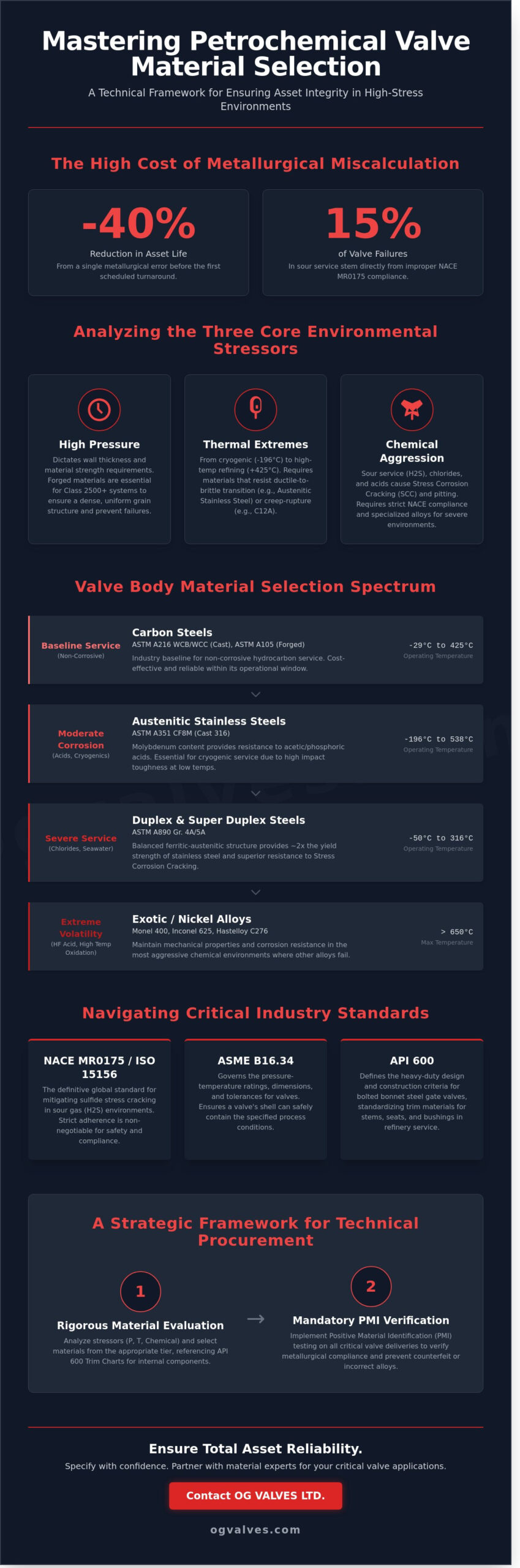
In high-pressure petrochemical environments, a single metallurgical miscalculation can reduce asset life by 40% before the first scheduled turnaround. Precision in petrochemical plant valve material selection isn’t just a procurement checkbox; it’s the primary defense against catastrophic Stress Corrosion Cracking (SCC). Engineers understand that the subtle discrepancies between ASME B16.34 and API 600 material requirements often complicate the specification process. You’re likely managing the reality that 15% of valve failures in sour service stem from improper NACE MR0175 compliance. It’s a risk that professional engineering standards don’t allow.
This technical guide provides a definitive framework to master metallurgical selection, ensuring your assets maintain full integrity under aggressive media conditions. You’ll gain the specific data points needed to reduce maintenance cycles and ensure total compliance with international safety standards. We’ll examine comparative material equivalents, rigorous testing protocols for forged steel, and the exact specifications required to eliminate unplanned downtime in your facility.
Key Takeaways
Identify the critical stressors of pressure, temperature, and chemical aggression to ensure valves function as reliable pressure-containing components in volatile environments.
Develop a rigorous approach to petrochemical plant valve material selection by evaluating the performance of ASTM A216 carbon steel against ASTM A351 stainless steel and exotic alloys.
Utilize API 600 Trim Charts to standardize the selection of internal components, ensuring metallurgical integrity across stems, seats, and bushings.
Mitigate risks associated with H2S and chloride-induced corrosion by strictly adhering to NACE MR0175/ISO 15156 standards for sour gas service and thermal cycling.
Implement a strategic procurement framework that prioritizes Positive Material Identification (PMI) testing to verify metallurgical compliance and ensure long-term asset reliability.
Environmental Challenges in Petrochemical Valve Selection
Petrochemical processing environments demand absolute material integrity. Valves serve as the primary pressure-containing boundary in volatile systems where failure leads to catastrophic safety and financial consequences. Engineers must account for simultaneous stressors: extreme pressure, rapid temperature fluctuations, and aggressive chemical media. While valve fundamentals remain consistent across general industries, the specific petrochemical plant valve material selection process requires adherence to rigorous standards like ASME B16.34, API 6D, and API 600. These frameworks define the minimum requirements for wall thickness, pressure-temperature ratings, and shell strength.
Generic material specifications aren’t sufficient for specialized units. An ammonia plant, for instance, operates with high-pressure hydrogen that causes hydrogen embrittlement in standard carbon steels. Ethylene units require materials that maintain impact toughness at temperatures as low as -196°C. Relying on standard utility-grade valves in these environments ignores the metallurgical nuances required to prevent stress corrosion cracking and localized pitting.
ASME B16.34: Governs the pressure-temperature ratings for cast, forged, and fabricated valves.
API 6D: Specifies requirements for pipeline valves used in midstream petrochemical transport.
API 600: Defines heavy-duty design criteria for bolted bonnet steel gate valves in refinery service.
Thermal Extremes: Cryogenic to High-Temperature Service
Material ductility is the primary concern for cryogenic LNG or ethylene service. Austenitic stainless steels, such as Grade CF8M or 316, are the industry standard because they don’t undergo a ductile-to-brittle transition at cryogenic levels. Conversely, high-temperature refining processes like catalytic cracking demand materials with high creep-rupture strength. Alloys like C12A or 347H stainless steel prevent structural deformation during 100,000-hour service lives. Rapid thermal cycling during startup and shutdown cycles introduces thermal fatigue, which can compromise body integrity and lead to seat sealing failure if the expansion coefficients aren’t matched.
Pressure Ratings and Wall Thickness Requirements
Material strength directly dictates the ASME pressure class and the resulting wall thickness. High-pressure systems often exceeding Class 2500 require forged materials to ensure a dense, uniform grain structure free of the internal voids sometimes found in large castings. Fluid velocity and localized pressure drops significantly accelerate erosion rates in petrochemical plant valve material selection, especially when particulates are present. Material yield strength decreases as operating temperatures rise, necessitating thicker walls or higher-grade alloys to maintain the required pressure-temperature rating. This relationship is a fundamental pillar of pressure vessel design. It’s the reason why a valve rated for 285 psi at 38°C may only be rated for 170 psi at 425°C.
Metallic Body Materials: From Carbon Steel to Exotic Alloys
The foundation of petrochemical plant valve material selection begins with ASTM A216 WCB and WCC carbon steels. These materials serve as the industry baseline for non-corrosive hydrocarbon service at temperatures between -29°C and 425°C. Forged equivalents, such as ASTM A105, are preferred for smaller diameter piping where structural integrity under high pressure is paramount. When process conditions introduce moderate corrosion or require cryogenic capabilities, engineers transition to austenitic stainless steels. ASTM A351 CF8M, the cast version of 316 stainless steel, provides essential resistance to acetic and phosphoric acids due to its 2% to 3% molybdenum content.
Severe service environments characterized by high chloride concentrations or seawater cooling systems necessitate the use of Duplex and Super Duplex steels. ASTM A890 grades, such as 4A or 5A, offer a balanced ferritic-austenitic microstructure that provides twice the yield strength of standard stainless steels and superior resistance to stress corrosion cracking. For extreme chemical volatility involving hydrofluoric acid or high-temperature oxidation, nickel alloys like Monel 400, Inconel 625, and Hastelloy C276 are required. These alloys maintain mechanical properties in environments where standard steels would suffer rapid wall thinning or catastrophic failure.
Low-Alloy Steels for High-Temperature Hydrogen Service
Catalytic reforming and hydrocracking units operate under high-pressure hydrogen at temperatures exceeding 300°C. In these conditions, standard carbon steel is susceptible to High-Temperature Hydrogen Attack (HTHA), where hydrogen reacts with carbon in the steel to form methane bubbles. To prevent this, engineers specify Chrome-Moly steels such as ASTM A217 C5 (5% Cr, 0.5% Mo) or C12 (9% Cr, 1% Mo). These alloys are selected based on the Nelson Curves defined in API RP 941 to ensure long-term metallurgical stability. When designing high-pressure gate valve configurations, forged body materials like ASTM A182 F11 or F22 are often prioritized over castings to eliminate porosity risks in critical hydrogen loops.
Austenitic and Martensitic Stainless Steel Applications
300-series austenitic stainless steels are the standard for general petrochemical corrosion resistance, providing excellent toughness and weldability. However, valve internals such as stems and seats often require the higher hardness levels found in 400-series martensitic steels. ASTM A217 CA15 (Type 410) is frequently specified for trim components to resist erosion and galling. For petrochemical plant valve material selection in chemical processing lines, specifying the correct grade for industrial ball valves ensures that both the pressure-retaining shell and the moving internals withstand the specific velocity and acidity of the media. Engineers must verify that all selected materials meet the NACE MR0175/ISO 15156 standard when sour gas is present. You can review our technical compliance documentation for detailed material performance data across these grades.
Trim and Sealing Materials: Integrity Beyond the Body
Valve trim constitutes the internal components in direct contact with the process fluid, including the stem, seats, gates, and bushings. In the context of petrochemical plant valve material selection, these components must endure higher mechanical stress and fluid velocity than the valve body itself. Engineers rely on API 600 Trim Charts to standardize these selections. These charts assign numerical codes, such as Trim 5 or Trim 8, which define the specific metallurgy for the stem and seating surfaces to ensure performance under defined pressure-temperature ratings.
Hard-facing is a critical requirement for maintaining seat integrity in high-cycle or high-pressure applications. Stellite, a Cobalt-based alloy, is the industry standard for these surfaces. It provides a hardness range of 37 to 45 HRC and maintains its mechanical properties at temperatures exceeding 538°C. This protection is vital for preventing erosion and wire-drawing, which leads to seat leakage and system downtime. We also evaluate elastomeric and thermoplastic seals for their chemical compatibility with hydrocarbons and additives to prevent explosive decompression or chemical swelling.
Soft Seating vs. Metal-to-Metal Seats
Soft seating materials like PTFE, RPTFE, and PEEK are selected for their ability to provide bubble-tight shutoff. PTFE is limited to 200°C, while RPTFE utilizes glass or carbon fillers to improve deformation resistance. PEEK is a superior thermoplastic for high-pressure service, maintaining its structural integrity up to 260°C. When handling abrasive slurries or temperatures exceeding these limits, engineers must specify metal-seated butterfly valves. It’s vital to recognize that trim material choices significantly alter the friction coefficient. Higher friction in metal-to-metal contact increases the breakaway torque, which dictates the technical specifications for actuator sizing and power consumption.
Stem Materials and Packing Integrity
Stem failure often results from galling, which occurs when similar metals rub under high load. We mitigate this risk by selecting dissimilar materials for the stem and the guide bushings, or by applying specialized surface treatments. For fugitive emission control, packing selection is a matter of environmental compliance. Graphite packing is the standard for fire-safe requirements, remaining stable at 450°C. PTFE packing offers superior chemical inertness but doesn’t meet the same thermal thresholds. For high-torque applications, high-strength materials like 17-4 PH stainless steel or XM-19 provide the necessary yield strength to prevent stem twisting or shearing during emergency operations.
Evaluating Degradation Mechanisms: H2S, Chlorides, and Thermal Cycling
The integrity of petrochemical plant valve material selection depends on a precise understanding of electrochemical and mechanical degradation. Corrosion isn’t a uniform process; it often manifests as localized pitting or crevice corrosion where the passive oxide layer on alloys like 316 stainless steel fails. In systems with high-velocity flow exceeding 10 meters per second, erosion-corrosion becomes a primary concern as the physical force of the fluid strips away protective films. Galvanic action also presents a risk when carbon steel and stainless steel components are coupled in the presence of an electrolyte, leading to accelerated failure of the less noble metal.
Pitting Resistance: Engineers calculate the Pitting Resistance Equivalent Number (PREN) using the formula Cr + 3.3(Mo + 0.5W) + 16N. A PREN value above 40 is typically required for aggressive chloride environments.
Crevice Corrosion: This occurs in shielded areas, such as gasket surfaces or threaded joints, where stagnant fluid allows for the accumulation of corrosive ions.
Chloride Stress Corrosion Cracking (CSCC): Standard austenitic stainless steels are highly susceptible to CSCC at temperatures exceeding 60°C. This mechanism causes sudden, brittle failure without prior visible thinning.
Compliance with NACE Standards
Sour gas service involves hydrogen sulfide (H2S), which necessitates adherence to NACE MR0175/ISO 15156 standards. This regulation focuses on preventing Sulfide Stress Cracking (SSC) by controlling the metallurgical state of the valve. A material is defined as NACE compliant for industrial valves when it meets the metallurgical requirements of ISO 15156, specifically maintaining a maximum hardness of 22 HRC and utilizing controlled heat treatment to prevent hydrogen embrittlement. Controlled Yield Strength is vital; materials with excessively high yield strengths are more prone to hydrogen-induced cracking in sour environments. Forged F6a or 410 stainless steel must undergo double tempering to ensure the final microstructure remains stable and within hardness limits.
Material Selection for Oxidising and Reducing Environments
The chemical nature of the process fluid dictates the petrochemical plant valve material selection strategy. In oxidising environments, such as those containing nitric acid or concentrated sulphuric acid, materials like Alloy 20 or high-chromium stainless steels are preferred because they maintain a robust protective oxide layer. Reducing environments, characterized by the presence of hydrochloric acid or dilute sulphuric acid, require nickel-molybdenum alloys like Hastelloy B-3, which don’t rely on oxygen for corrosion resistance.
Thermal cycling adds mechanical stress to these chemical challenges. Rapid temperature fluctuations in batch processes can cause thermal fatigue or shock. In these scenarios, materials with lower coefficients of thermal expansion or higher creep-rupture strength, such as 316H or chrome-moly steels (F11, F22), are specified to maintain dimensional stability. It’s essential to match the valve trim and body expansion rates to prevent internal binding or leakage during cycle transitions.
For comprehensive technical support regarding material compatibility and compliance, consult the engineering team at ogvalves.com.
A Strategic Framework for Technical Valve Procurement
Effective petrochemical plant valve material selection begins with a rigorous material selection matrix derived directly from process data sheets (PDS). This matrix maps fluid properties, temperature ranges, and pressure ratings against metallurgical capabilities. Engineers must verify every component against Mill Test Reports (MTRs) to confirm that chemical compositions and mechanical properties meet ASME B16.34 standards. Positive Material Identification (PMI) testing serves as the final barrier against alloy mix-ups, which can lead to catastrophic failure in corrosive environments. OG Valves maintains technical precision by enforcing these protocols across all global supply chain nodes, ensuring that every valve delivered complies with the exact project specifications.
The procurement process isn’t just about sourcing components; it’s about verifying the integrity of the pressure-containing envelope. It’s critical to ensure that the MTRs provided match the heat numbers stamped on the valve bodies. Discrepancies in chemical trace elements, such as carbon equivalent values in welding-grade steels, can compromise the structural integrity of the entire piping system. OG Valves prioritizes this level of clinical detail to build high-stakes trust with engineering teams.
Quality Assurance and Non-Destructive Testing (NDT)
Integrity verification requires a combination of NDT methods tailored to the valve’s manufacturing process. Dye Penetrant (DP) and Magnetic Particle (MP) testing identify surface defects, while Radiographic Testing (RT) detects internal casting flaws. For high-pressure forged valve bodies, ultrasonic testing (UT) is mandatory to ensure volumetric integrity. OG Valves manages technical documentation through a centralized system, providing full traceability for international projects. This documentation includes NDT reports and pressure test certificates that satisfy ISO 10474 or EN 10204 Type 3.1 requirements.
Lifecycle Costing and Material Availability
Procurement teams must balance the initial capital expenditure of exotic alloys like Monel or Inconel against the long-term lifecycle costs of premature failure. Using standard carbon steel in high-hydrogen service might save costs initially but risks high-temperature hydrogen attack (HTHA). Strategic stockholding of specialized materials reduces lead times, which often exceed 26 weeks for nickel-based alloys. A final checklist for petrochemical plant valve material selection includes:
Verification of NACE MR0175/ISO 15156 compliance for sour service.
Confirmation of minimum wall thickness requirements per ASME B16.34.
Alignment of elastomer sealing materials with maximum operating temperatures.
Validation of fire-safe certification according to API 607 or API 6FA standards.
This structured approach minimizes technical risk and ensures the operational longevity of critical infrastructure. By focusing on quantifiable data and international standards, OG Valves acts as a dependable partner in complex global supply chains.
Advancing Operational Safety Through Precise Metallurgical Specification
Achieving long-term system integrity requires a rigorous approach to petrochemical plant valve material selection. Engineers must evaluate how specific alloys react to H2S exposure and chloride-induced stress corrosion cracking under ASME B16.34 parameters. Technical success depends on matching trim materials to the thermal cycling demands of the process flow. It’s essential to verify that every component adheres to API 600 or API 6D standards to prevent premature mechanical failure. OG Valves provides specialized technical support for high-specification industrial applications, ensuring full compliance with NACE MR0175 and ISO 15156 requirements. Our comprehensive inventory of API and ASME compliant valves supports critical infrastructure projects across the globe. We leverage established global logistics networks to facilitate fast-track delivery options when project timelines are compressed. Relying on verified technical data and established engineering benchmarks eliminates the ambiguity often found in complex procurement cycles. Consult with OG Valves for technical material specifications on your next project. We’re ready to assist with your most demanding engineering specifications.
Frequently Asked Questions
What is the most common valve material used in petrochemical plants?
ASTM A216 WCB carbon steel is the most common valve material used in petrochemical plants. It accounts for approximately 65% of valve body specifications in non-corrosive hydrocarbon services. This material provides a cost-effective solution for temperatures ranging from -29°C to 427°C. It’s the standard for general-purpose applications where chemical resistance isn’t the primary engineering concern during the design phase.
How does NACE MR0175 affect valve material selection?
NACE MR0175 mandates specific metallurgical requirements to prevent Sulfide Stress Cracking in sour service environments containing H2S. This standard restricts the hardness of valve components to a maximum of 22 HRC. It requires controlled heat treatments and specific chemistry to ensure petrochemical plant valve material selection meets the safety demands of ISO 15156. Compliance is mandatory for processing units handling wet acid gas to prevent catastrophic brittle failures.
Why is 316L stainless steel preferred over 316 for welded valve components?
316L stainless steel is preferred for welded components because its maximum carbon content is limited to 0.03%. Standard 316 allows up to 0.08% carbon, which leads to chromium carbide precipitation at grain boundaries during the welding process. This phenomenon, known as sensitization, reduces corrosion resistance in the heat-affected zone. Using 316L eliminates the need for post-weld heat treatment in most petrochemical piping systems and maintains joint integrity.
What is the difference between ASTM A216 WCB and LCC materials?
The primary difference between ASTM A216 WCB and LCC is their minimum design metal temperature rating. WCB is rated for service down to -29°C, while LCC undergoes Charpy V-notch impact testing to ensure toughness at -46°C. Engineers specify LCC for outdoor installations in cold climates or for processes involving rapid depressurization. Both materials share similar chemical compositions, but LCC’s refined grain structure prevents brittle failure in sub-zero conditions.
Can I use carbon steel valves for hydrogen service?
You can use carbon steel for hydrogen service only if the operating conditions fall below the relevant Nelson curves defined in API 941. At temperatures exceeding 200°C, hydrogen molecules dissociate and react with carbon in the steel to form methane gas. This internal decarburization leads to fissuring and sudden failure. For high-pressure hydrogen above these limits, engineers must select 1.25Cr-0.5Mo or 2.25Cr-1Mo alloy steels to maintain structural integrity.
What is PMI testing and why is it necessary for petrochemical valves?
Positive Material Identification (PMI) is a non-destructive analysis used to verify that the chemical composition of a valve component matches the Material Test Report. It’s necessary because material mix-ups during manufacturing can lead to rapid corrosion or mechanical failure in the field. Using X-ray fluorescence (XRF), technicians confirm the presence of critical alloying elements like Chromium and Nickel. This protocol ensures petrochemical plant valve material selection adheres to the project’s piping class.
How does temperature affect the pressure rating of valve materials?
Temperature affects the pressure rating according to the pressure-temperature tables found in ASME B16.34. As the operating temperature increases, the allowable working pressure of the valve body decreases because the material’s yield strength drops. For example, a Class 300 WCB valve rated at 51.1 bar at 38°C drops to only 28.3 bar at 400°C. Engineers must verify these derating factors to prevent overpressurization during thermal excursions in the refinery.
When should I specify Stellite hard-facing for valve seats?
Specify Stellite hard-facing when valve seats encounter high-velocity flow, abrasive media, or temperatures above 315°C. This cobalt-chromium alloy provides a hardness of 37 to 45 HRC, which resists galling and wire-drawing. It’s essential in high-cycle control valves and steam isolation valves where metal-to-metal contact would otherwise degrade standard stainless steel surfaces. Most API 600 gate valves require Stellite Trim 5 as a standard for durability in severe service.
 Responsive Menu