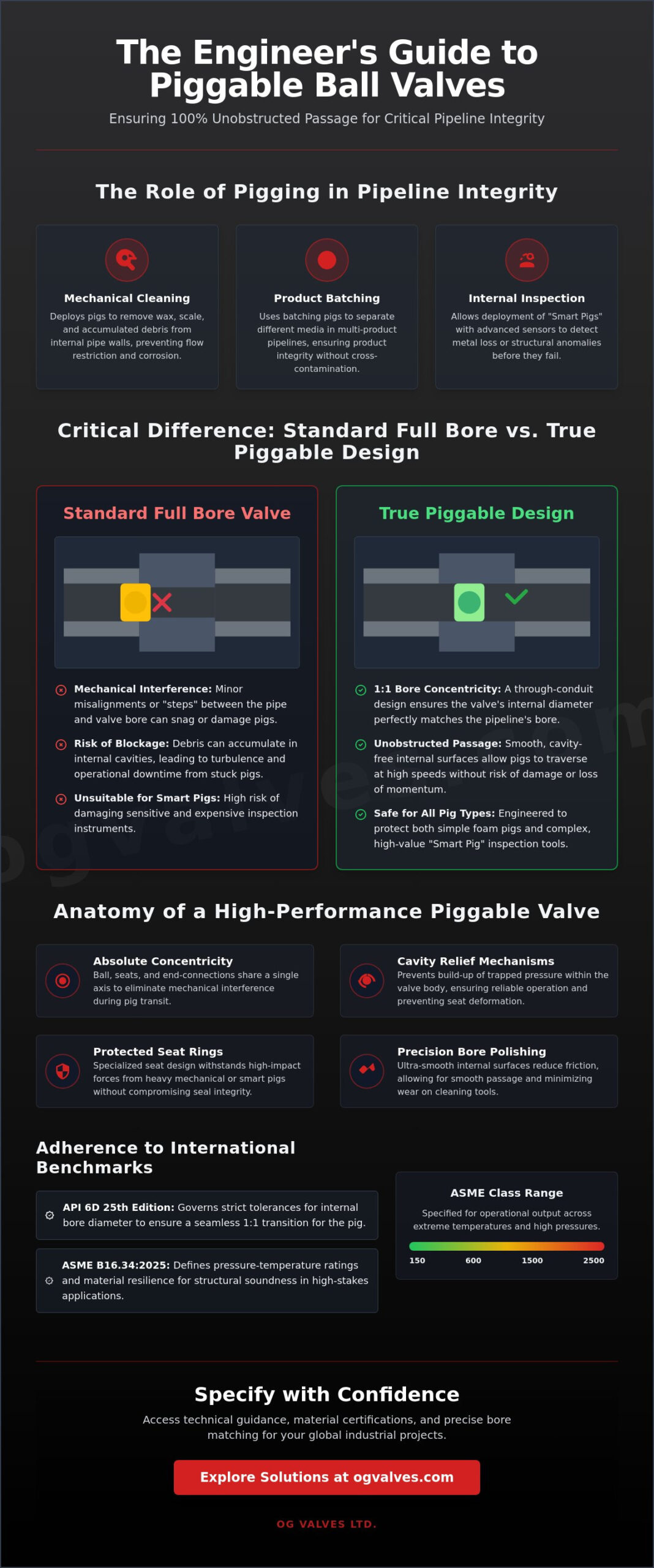
A full-bore designation alone doesn’t guarantee a piggable valve. True operational success depends on exact internal concentricity and specialized seat protection to prevent mechanical interference. Pipeline engineers recognize that even minor misalignments between the valve bore and pipeline diameter lead to pigs getting stuck or causing internal valve damage. Achieving a reliable piggable ball valve design requires a clinical focus on geometric precision and material resilience to withstand repeated cleaning cycles without compromising seal integrity.
You’re likely aware that adhering to international regulatory benchmarks is non-negotiable for critical infrastructure. This guide provides an authoritative technical analysis of engineering specifications for ball valves, focusing on the requirements of the API 6D 25th Edition and ASME B16.34:2025. We’ll examine how to specify a valve that ensures 100% unobstructed pig passage while maintaining the structural soundness required for high-stakes industrial applications. We’ll also cover the impact of recent regulatory shifts, such as the 3-A Sanitary Standard 68-01 update, to ensure your procurement decisions meet current global safety and performance standards.
Key Takeaways
- Define the engineering requirements for internal diameter matching to ensure unobstructed pig passage and prevent mechanical damage.
- Identify the critical structural features, including concentricity and cavity relief mechanisms, that constitute a high-performance piggable ball valve design.
- Evaluate adherence to international benchmarks such as API 6D 25th Edition and ASME B16.34:2025 for pressure-temperature ratings and material resilience.
- Specify selection criteria for ASME classes ranging from 150 to 2500 to maintain operational output across temperature extremes and high-pressure applications.
- Access technical guidance for procurement protocols, focusing on material certification and precise bore matching for global industrial projects.
Defining Piggable Ball Valve Design and Engineering Requirements
A piggable ball valve serves as a critical isolation component within a pipeline system, specifically engineered to facilitate the unobstructed passage of a Pipeline Inspection Gauge (PIG). Unlike standard valves that may restrict flow or present internal obstacles, a specialized piggable ball valve design ensures that the valve’s internal flow path aligns with the pipeline’s bore. This alignment is vital in high-stakes environments such as oil and gas transmission, chemical processing, and multi-product pipelines where maintenance and product purity are paramount. The primary engineering objective is to eliminate internal cavities or sharp edges that could trap debris or cause mechanical damage to the pig as it traverses the valve body. Engineers must prioritize a 1:1 ratio between the valve’s internal diameter and the pipe’s bore to maintain the structural integrity of both the cleaning tool and the valve seats.
The Role of Pigging in Pipeline Integrity
Pipeline pigging is essential for maintaining operational efficiency and ensuring long-term structural soundness. Mechanical cleaning involves deploying pigs to remove wax, scale, and accumulated debris from internal pipe walls, which prevents flow restriction and localized corrosion. In multi-product pipelines, batching pigs separate different media during a single run, ensuring product integrity without cross-contamination. This process requires a valve that doesn’t create turbulence or pressure drops. Additionally, piggable systems allow for the deployment of “Smart Pigs.” These advanced tools utilize ultrasonic or magnetic flux leakage testing to perform rigorous internal inspections, identifying metal loss or structural anomalies before they lead to catastrophic failure. Without a precise valve bore, these sensitive instruments face high risks of impact damage or becoming lodged mid-stream.
Distinguishing Full Bore from Piggable Designs
Technical experts must distinguish between a standard full bore ball valve and a truly piggable through-conduit design. While many full-bore valves provide a clear path, they don’t always maintain the exact internal concentricity required for high-speed pigging operations or the use of fragile inspection sensors. A piggable ball valve design utilizes through-conduit architecture to maintain constant flow velocity and prevent the pig from losing momentum or sustaining damage at seat interfaces. Precision is governed by strict regulatory benchmarks to ensure interoperability across global infrastructure. Per API 6D 25th Edition, the internal diameter of the valve’s bore must be within the specified tolerances of the nominal pipe size to ensure a seamless 1:1 transition for the pig. This clinical focus on geometry prevents the operational downtime associated with stuck pigs and ensures the valve remains a dependable partner in critical infrastructure maintenance.
Critical Structural Features of Piggable Ball Valves
Superior piggable ball valve design mandates absolute concentricity across the ball, seats, and end-connections. When these components don’t share a single axis, the resulting misalignment creates mechanical interference during pig transit. This can lead to pig degradation or catastrophic blockage. Cavity relief mechanisms are equally critical. They prevent the build-up of trapped pressure within the valve body, which can otherwise impede ball rotation or cause seat deformation. These features ensure the valve operates reliably under high-pressure conditions while maintaining a clear, unobstructed flow path. Engineering precision here is the difference between seamless maintenance and operational failure.
Seal protection remains a primary engineering challenge in these systems. Seat rings must be designed to withstand the high-impact forces generated by moving pigs, particularly heavy mechanical or “smart” variants. Bore polishing is utilized to reduce friction, allowing for the smooth passage of foam pigs and minimizing wear on the cleaning tool’s surface. High-quality ball valves for industrial applications incorporate these structural refinements to extend service life and reduce maintenance intervals. A clinical focus on these internal surfaces prevents the accumulation of scale and wax during standard production cycles.
Internal Alignment and Tolerance Management
Precision at the valve-to-pipe interface is vital for pig longevity. Any “steps” or “lips” caused by bore diameter discrepancies will lead to pig degradation or entrapment. Engineers must match the valve’s internal diameter to the specific Schedule of the connecting pipeline precisely. Adherence to Engineering Standards and Material Specifications ensures that these tolerances remain within safe operational limits. Pre-installation verification protocols, such as drift tests, confirm that internal clearances meet the project’s technical requirements. This validation process is a mandatory step in high-stakes infrastructure projects.
Seat Design and Debris Management
The choice between hard-seated and soft-seated designs depends on the abrasiveness of the pigging environment. Hard-seated valves offer superior resistance to the mechanical impact of heavy cleaning pigs. Self-cleaning seat designs are engineered to prevent particulate accumulation within the valve cavity, which is a common cause of operational failure. In high-frequency cleaning operations, the use of seat pocket protectors prevents debris from entering the area behind the seat rings. This maintains the valve’s sealing integrity over long-term cleaning cycles. Reliable piggable ball valve design prioritizes these debris management features to ensure the valve remains fully functional after multiple pigging runs.
Engineering Standards and Material Specifications
Adherence to international benchmarks is the only way to ensure safety and interoperability in high-stakes pipeline environments. The piggable ball valve design is primarily governed by the API 6D 25th Edition, which became effective in November 2022. This standard specifies the full-opening requirements necessary to allow the unobstructed passage of pigs. Complementing this, ASME B16.34:2025, published on May 30, 2025, provides the essential pressure-temperature ratings and material thickness requirements for high-pressure applications. These standards work in tandem to define the structural boundaries within which a valve must operate to prevent catastrophic failure under load.
Materials must be selected based on their ability to withstand both the media and the mechanical impact of cleaning tools. ASTM material classifications for valve bodies often include carbon steel (A105 or WCB) for standard service, while internal trim components require more resilient alloys. In sour gas environments, NACE MR0175/ISO 15156 compliance is mandatory to prevent sulfide stress cracking. When evaluating Piggable Valve Solutions, engineers must account for the environmental impact of emissions and the rigorous structural demands placed on the valve during frequent maintenance cycles.
Material Selection for Dynamic Pigging Loads
Pigs exert significant mechanical force on valve seats and the ball surface during transit. To mitigate this, engineers specify Tungsten Carbide or Chrome Carbide coatings for balls subjected to abrasive pigging environments. These hard-facings prevent the surface scoring that leads to seat leakage. Internal trim often utilizes Corrosion-Resistant Alloys (CRA) to prevent pitting, which can create micro-obstructions for the pig. Elastomer selection for seals is equally critical, particularly in high-pressure gas lines where Rapid Gas Decompression (RGD) can destroy standard seals. Using high-grade FKM or HNBR materials ensures the seal remains intact after the pressure fluctuations typical of a pigging run.
Standardized Bore Dimensions Table
Specifying the correct bore size is the most frequent point of failure in procurement. A valve marked “full bore” may still have a bore diameter slightly smaller than the pipeline’s internal diameter if the pipe schedule isn’t correctly matched. Referencing industrial valves selection standards is a prerequisite for ensuring regulatory compliance and achieving a 1:1 bore match. The table below outlines the minimum bore requirements per API 6D for common nominal sizes.
| Nominal Pipe Size (NPS) | Minimum Bore Diameter (mm) | Minimum Bore Diameter (in) |
|---|
| 2 | 49 | 1.93 |
| 4 | 100 | 3.94 |
| 6 | 151 | 5.94 |
| 8 | 201 | 7.91 |
| 12 | 303 | 11.93 |
Engineers must specify whether the valve is intended for Schedule 40 or Schedule 80 pipelines. A Schedule 80 pipe has a thicker wall and a smaller internal diameter than Schedule 40. Failing to account for this difference results in a “step” at the valve interface, which will damage or lodge a mechanical pig during high-velocity cleaning operations.
Selecting a piggable ball valve design requires a clinical assessment of the pipeline’s operational envelope. Engineers must define the appropriate ASME class, ranging from 150 to 2500, to ensure the valve body and bolting withstand maximum operating pressures. Temperature extremes also dictate material selection. Cryogenic applications or high-heat media require specialized alloys and seal configurations to maintain dimensional stability. If the valve’s internal components expand or contract unevenly, the resulting bore misalignment will obstruct the pig. Additionally, the frequency of pigging operations determines the necessity for enhanced trim durability. High-frequency cleaning cycles demand hardened seat surfaces to prevent the erosion and scoring that lead to seal failure.
Actuation precision is a critical performance metric. A piggable valve must reach the 100% fully open position every time it’s cycled. Even a slight protrusion of the ball into the flow path creates a mechanical strike point for the pig. Automated systems should incorporate high-torque actuators and precise limit switches to verify full-bore alignment before the pig is launched. Failure to achieve this alignment leads to immediate operational downtime. For technical specifications on standard configurations, consult our ball valves product range.
Floating vs. Trunnion Mounted for Pigging
The distinction between floating and trunnion-mounted architectures is fundamental to pigging success. In a floating design, the ball is supported by the seats and shifts downstream under pressure to create a seal. This movement can create a “step” or “lip” at the upstream interface, which increases the risk of pig damage or entrapment. Trunnion-mounted designs are the preferred choice for larger diameters and higher-pressure systems. Because the ball is fixed on an axis, it remains centered regardless of pressure differentials. This maintains the concentricity required for safe pig passage. You can find more detail in this technical guide on industrial ball valves.
Addressing Potential Objections: Costs and Maintenance
While the initial procurement cost of a piggable ball valve design is higher than standard full-bore options, the long-term ROI is significant. Using non-piggable valves in a line that requires cleaning leads to hidden costs, including pig retrieval, line cutting, and extended outages. A single stuck pig can cost hundreds of thousands of dollars in lost production and emergency repairs. Preventative maintenance for these valves focuses on seat lubrication and cavity flushing to ensure debris doesn’t accumulate behind the seat rings. These protocols preserve the valve’s through-conduit integrity, ensuring it remains a dependable partner in critical infrastructure.
Procurement and Technical Support for Piggable Valve Solutions
OG VALVES LTD. supplies high-specification piggable ball valves for global industrial projects, acting as a dependable partner in critical infrastructure maintenance. Procurement specialists and project engineers receive comprehensive technical support to ensure that the chosen piggable ball valve design meets the exact hydraulic and mechanical requirements of the pipeline. This support extends to assisting with bore matching and material certification, ensuring that the internal diameter of the valve is a perfect 1:1 match with the connecting pipe. We prioritize industrial precision to build high-stakes trust with our technical partners and procurement experts across the heavy industrial sector.
Our quality assurance protocols are designed to eliminate the possibility of material non-compliance. Positive Material Identification (PMI) verifies that the alloy composition matches the technical specification guide exactly, preventing the use of substandard materials in corrosive environments. Pressure testing is conducted in accordance with API 6D 25th Edition standards, encompassing both hydrostatic and pneumatic evaluations to confirm seat and shell integrity. Global logistics operations utilize established supply chains to facilitate rapid transit, focusing on the logistical precision required for large-scale industrial demands. This steady, information-dense approach ensures that every technical detail is accounted for before the valve enters service.
Specifying Your Requirements
Providing exact pipeline schedules during the Request for Quotation (RFQ) process is mandatory for project success. Without precise data on pipe wall thickness, achieving a 1:1 bore match is impossible, which leads to the mechanical strike points that damage pigs. Engineers should also specify the need for specialized testing, such as high-pressure gas testing, for units destined for volatile media. For urgent replacements where downtime must be minimized, consult with OG VALVES for fast-track valve delivery to maintain project timelines and operational output.
Conclusion and Contact
Precision engineering is the only way to ensure the long-term durability of valve seats and the safe passage of cleaning pigs. A clinical focus on piggable ball valve design prevents the mechanical failures that lead to costly pig retrieval operations and line cutting. Adhering to API 6D and ASME B16.34:2025 standards is the benchmark for industrial safety in modern pipeline management. To secure your pipeline integrity, review our current inventory or contact our technical team for a comprehensive specification review. You can request an industrial valve quote to begin the technical evaluation of your specific project requirements.
Securing Pipeline Integrity Through Precision Specification
Achieving 100% unobstructed pig passage requires more than a standard full-bore label. It demands a clinical focus on internal concentricity and exact 1:1 bore matching to eliminate mechanical strike points. This technical analysis has demonstrated how a robust piggable ball valve design integrates through-conduit architecture with advanced material resilience to withstand the dynamic loads of frequent cleaning cycles. By prioritizing adherence to current standards like API 6D 25th Edition and ASME B16.34:2025, engineers ensure their infrastructure remains both compliant and operationally efficient over its entire service life.
OG VALVES LTD. supports these high-stakes requirements with an API 6D compliant inventory and comprehensive technical documentation for every component. Our global fast-track logistics are engineered to minimize operational downtime in critical industrial sectors. If you’re ready to specify components that guarantee unwavering reliability and long-term performance, Request a Technical Quote for Piggable Ball Valves. We look forward to serving as your dependable partner in achieving industrial infrastructure excellence.
Frequently Asked Questions
Is every full-bore ball valve considered piggable?
No, a standard full-bore designation doesn’t automatically ensure suitability for pigging operations. A true piggable ball valve design must maintain exact internal concentricity and a precise 1:1 bore match with the specific pipeline schedule. Standard full-bore valves may still have internal cavities or slight misalignments that can damage mechanical pigs or trap debris during cleaning cycles.
What is the maximum allowable bore misalignment for a piggable valve?
API 6D 25th Edition specifies that the internal bore must remain within strict dimensional tolerances to prevent mechanical interference. Any misalignment that creates an internal “lip” or “step” exceeding 1.6 mm is generally considered a failure point for pigging. These transitions must be tapered or machined to ensure the pig doesn’t lose momentum or sustain surface damage during transit.
Can a reduced-bore ball valve ever be used in a pigged pipeline?
Reduced-bore ball valves are fundamentally incompatible with pigging because they create a physical obstruction within the flow path. The reduced internal diameter will stop the pig entirely, leading to a blocked pipeline. Retrieval usually requires cutting the pipe section, resulting in significant operational downtime and high emergency repair costs that far outweigh the initial savings of a reduced-bore valve.
How does a trunnion-mounted ball valve improve pigging safety?
Trunnion-mounted designs improve safety by securing the ball on a fixed vertical axis, which prevents it from shifting downstream under pressure. This mechanical stability ensures the valve bore remains perfectly centered with the pipeline at all times. Unlike floating designs, trunnion valves eliminate the risk of seat deformation or “ball drift” that can catch the edge of a high-velocity pig.
What are the risks of using a non-piggable valve in a cleaning operation?
The primary risks include stuck pigs, catastrophic damage to valve seats, and the destruction of expensive “smart” inspection sensors. Non-piggable valves often feature internal gaps where a pig can become lodged, necessitating a complete line shutdown. Impact forces from a moving pig can also strip the soft seals from a standard valve, leading to immediate leakage and loss of isolation capability.
Does a piggable ball valve require special maintenance compared to standard valves?
Yes, these valves require specialized maintenance protocols focusing on seat lubrication and regular cavity flushing. It’s essential to remove accumulated wax and scale from the area behind the seat rings to ensure they remain flexible. Regular maintenance preserves the through-conduit integrity required for unobstructed passage and extends the valve’s service life in high-frequency cleaning environments.
Which API standards are most critical for piggable valve design?
API 6D is the most critical standard as it governs the design, manufacture, and testing of pipeline valves. It specifically defines the full-opening requirements and internal diameter tolerances necessary for pigging. Engineers also rely on API 6FA or API 607 for fire-safe testing and API 598 for supplemental pressure testing to ensure the valve meets global safety benchmarks.
Can smart pigs pass through all piggable ball valves?
Smart pigs can traverse any valve that meets through-conduit specifications, provided the bore matches the pipeline’s internal diameter exactly. Because smart pigs carry sensitive magnetic flux or ultrasonic sensors, they’re more vulnerable to damage from internal obstructions than foam pigs. Precise bore alignment is the only way to protect these high-value tools from impact during inspection runs.
 Responsive Menu