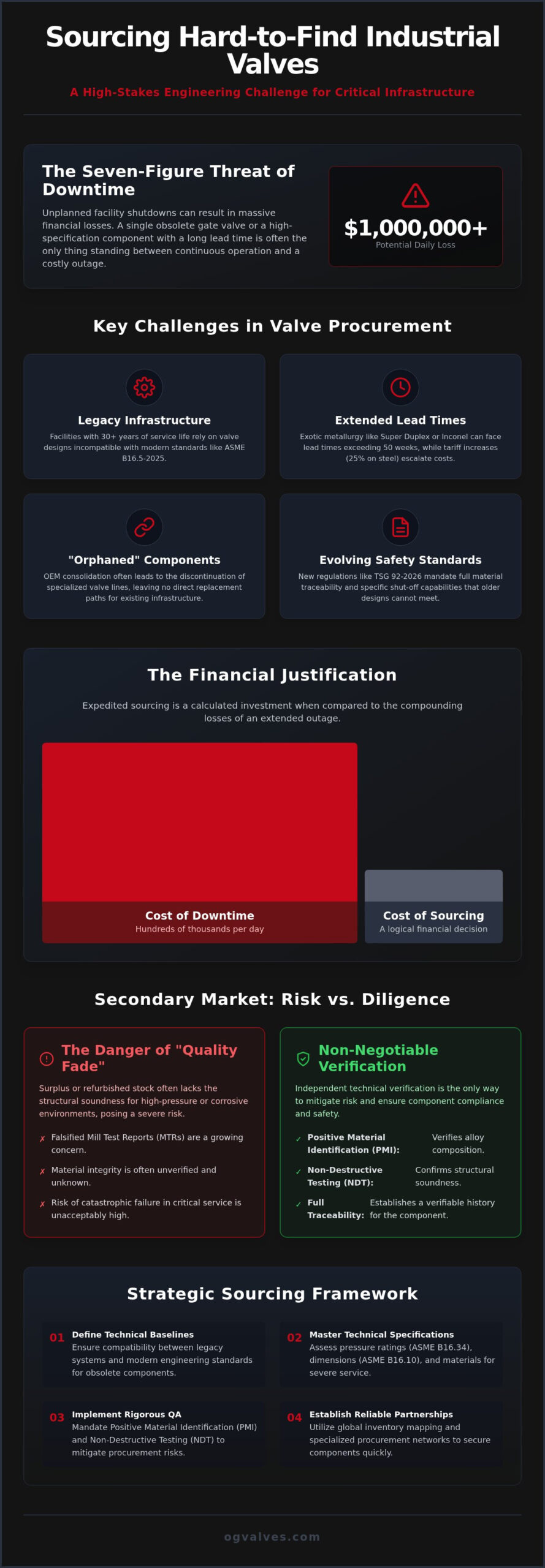
Unplanned facility downtime can result in seven-figure losses, yet procurement teams often find themselves stalled by a single obsolete gate valve or a high-specification super duplex component with an 18-month lead time. You understand that in 2026, the margin for error in critical infrastructure is non-existent. The escalating risks of “quality fade” from unverified secondary markets and the 25% tariff increases on steel components make sourcing hard to find industrial valves a high-stakes engineering challenge rather than a simple purchasing task.
This guide provides the technical framework required to secure compliant, high-performance valves for legacy systems while mitigating the risks of non-conformance. We’ll examine the implications of the TSG 92-2026 safety regulations, the latest ASME B16.5-2025 material standards, and the rigorous PMI testing protocols required to verify material integrity. You’ll gain the strategies needed to establish a reliable global supply partnership and maintain operational output without compromising on safety or regulatory adherence.
Key Takeaways
- Define technical baselines for obsolete components to ensure compatibility between legacy infrastructure and modern engineering standards.
- Mitigate procurement risks through rigorous quality assurance protocols, including Positive Material Identification (PMI) and Non-Destructive Testing (NDT).
- Master the complexities of sourcing hard to find industrial valves by utilizing global inventory mapping and specialized procurement networks.
- Assess the intersection of pressure ratings, temperature limits, and specialized trim materials to select components for severe service environments.
- Establish reliable supply partnerships to secure high-specification valves quickly, minimizing the operational impact of unplanned infrastructure failure.
The Challenges of Sourcing Obsolete and Hard-to-Find Industrial Valves
In the context of modern industrial procurement, a “hard to find” valve is defined as a component no longer in active production or one that requires non-standard metallurgy, such as Super Duplex or Titanium. This scarcity is often the direct result of industry consolidation. As major OEMs acquire smaller manufacturers, they frequently discontinue specialized product lines to streamline operations, leaving legacy infrastructure with “orphaned” industrial valves that have no direct replacement paths. For procurement specialists, sourcing hard to find industrial valves becomes a race against the clock to prevent catastrophic plant downtime.
Legacy plants with over 30 years of service life face the highest degree of risk. These facilities often rely on valve designs that were engineered to historical standards that are now incompatible with modern regulatory frameworks. For example, the ASME B16.5-2025 standard, which became mandatory on January 1, 2026, includes new material grades and tighter sealing tolerances. This creates a technical gap where modern off-the-shelf components can’t be integrated into legacy piping without significant modifications or custom engineering.
The economic reality of these challenges is reflected in the “Cost of Downtime” versus the “Cost of Expedited Sourcing.” In the oil and gas sector, the daily loss from a non-operational line can reach hundreds of thousands of dollars. Spending a premium on fast-track procurement for a rare alloy valve is a logical financial decision when compared to the compounding losses of an extended outage. Effective management of these high-stakes demands requires a partner who understands that functional reality and long-term performance are paramount.
Common Reasons for Valve Scarcity
- Discontinued OEM Lines: Rationalization of product portfolios by large conglomerates often eliminates niche gate or globe valve designs that don’t meet high-volume sales targets.
- Exotic Metallurgy: High-demand materials like Monel, Inconel, and Super Duplex often have extended foundry lead times, sometimes exceeding 50 weeks in the 2026 market.
- Regulatory Shifts: New safety regulations, such as TSG 92-2026, mandate full traceability and specific shut-off capabilities that older valve designs can’t provide.
The Risk of Secondary Market Procurement
While the secondary market offers a solution for sourcing hard to find industrial valves, it introduces the danger of “quality fade.” Surplus or refurbished stock may appear compliant but often lacks the structural soundness required for high-pressure or corrosive environments. Falsified Mill Test Reports (MTRs) are a growing concern in the global supply chain, making independent technical verification non-negotiable. Without Positive Material Identification (PMI) and Non-Destructive Testing (NDT), the risk of catastrophic failure in critical service valves remains unacceptably high.
Technical Specifications That Complicate Valve Procurement
Procurement of high-specification components isn’t merely a logistics exercise; it’s a material science challenge. The intersection of pressure ratings and temperature limits dictates the functional envelope of any valve. A component rated for Class 1500 at 100°F will experience significant derating as temperatures climb, necessitating a deep understanding of the pressure-temperature curves defined in ASME B16.34. Inaccurate specification at this stage is a primary cause of premature failure in critical infrastructure, making technical precision the first priority when sourcing hard to find industrial valves.
Physical constraints further complicate the replacement process. Face-to-face dimensions, standardized under ASME B16.10, must be exact to ensure interchangeability within existing pipelines. Any deviation requires costly piping modifications that extend downtime and increase project risk. Adherence to federal safety standards for pipeline valves ensures that replacement components meet the rigorous design and shell testing requirements necessary for high-pressure gas transmission. Navigating the discrepancies between API 600, which governs heavy-wall steel gate valves, and international ISO or DIN standards requires a seasoned technical perspective to ensure global benchmark adherence.
Material Science in Rare Valve Sourcing
Sour service environments require strict compliance with NACE MR0175/ISO 15156 to prevent sulfide stress cracking and hydrogen-induced cracking. ASTM A351 is essential for defining the chemical composition and mechanical property requirements of austenitic stainless steel castings used in high-pressure, corrosion-resistant service. When an original material is obsolete, specifying an equivalent alloy requires a clinical focus on chemical compatibility and structural soundness. It’s vital to verify that modern substitutes don’t introduce galvanic corrosion risks when integrated into legacy systems.
Custom Modifications and Fast-Track Engineering
Specialists often bypass standard lead times, which can exceed 20 weeks for exotic alloys, by retrofitting actuators to existing valve bodies held in global inventory. This fast-track engineering approach allows for rapid deployment without sacrificing the precision of the original engineering intent. Reviewing a technical guide to industrial gate valves helps procurement teams understand how modern modifications align with historical design standards. For complex projects, partnering with an entity that understands the necessity of quality and maintains an extensive inventory of high-spec components is the most reliable path to maintaining operational output.
Strategic Sourcing Framework for Critical Infrastructure
Procurement of high-specification components requires a methodical progression from technical validation to global logistics execution. The objective is to move from an identified infrastructure gap to a verified, compliant component without the delays associated with standard manufacturing cycles. This framework prioritizes the establishment of a rigid technical baseline before initiating any market engagement. By defining exact parameters early, procurement specialists avoid the risk of acquiring technically non-compliant units that could compromise plant safety. Sourcing hard to find industrial valves is a structured engineering process that relies on data-driven decision-making rather than simple vendor inquiries.
A critical phase of this framework involves global inventory mapping. Standard B2B platforms frequently lack the depth required to locate obsolete or exotic alloy valves. Success depends on accessing specialist networks and distributors, particularly those located in Northern Ireland and the UK, who maintain inventories of high-spec components for the energy and power sectors. This mapping must be paired with a rigorous audit of supplier certifications and historical performance data to ensure that the source meets international quality benchmarks. Finally, logistics planning for the cross-border transit of heavy industrial goods must account for specialized handling and customs compliance to maintain the project timeline.
Step 1: Technical Requirement Validation
Engineers must confirm the precise media composition, operating pressure, and temperature extremes before the search begins. It’s essential to distinguish between “must-have” specifications, such as NACE compliance or specific pressure ratings, and “nice-to-have” features that might be flexible to facilitate faster sourcing. Utilizing an Industrial Valves selection guide provides the necessary criteria to establish these technical baselines. This validation ensures that any identified replacement valve will integrate seamlessly with existing legacy infrastructure without requiring extensive on-site modifications.
Step 2: Global Supply Chain Navigation
Navigating the global supply chain in 2026 requires leveraging networks that extend beyond traditional manufacturer catalogs. Specialist distributors often hold stock of discontinued gate, ball, or globe valves that are no longer in active production. While standard lead times for custom super duplex components often exceed 40 weeks, a strategic search of global inventories can reduce this to less than 12 weeks. Managing these lead time expectations requires constant communication with logistical partners to ensure that heavy components move through the supply chain with minimal friction. This proactive approach is the only reliable way to mitigate the high cost of facility downtime during critical outages.
Mitigating Risk: Quality Assurance and Material Verification Protocols
Verification serves as the final technical barrier against the integration of substandard components into critical infrastructure. When sourcing hard to find industrial valves, procurement teams can’t rely solely on visual inspections or standard paper trails. Material integrity must be confirmed through Positive Material Identification (PMI), which provides a non-destructive chemical analysis of the alloy. This process is essential for verifying that exotic materials, such as Super Duplex or Inconel, meet the exact metallurgical requirements specified in the design phase. Without this clinical focus on material verification, the risk of “quality fade” remains a persistent threat to operational safety.
Non-Destructive Testing (NDT) protocols further ensure the structural soundness of the valve body and internal components. Radiography (RT) is utilized to detect internal casting defects, while Ultrasonic Testing (UT) identifies subsurface flaws in forged materials. For surface integrity, Dye Penetrant Testing (PT) is applied to locate cracks or porosities that could lead to leakage under high-pressure conditions. All testing must culminate in hydrostatic and pneumatic pressure trials conducted to API 598 standards. These trials confirm the shell and seat integrity, ensuring the valve performs reliably at its maximum rated pressure without deformation or failure.
Traceability is the foundation of industrial reliability. Every component must be traceable from the foundry to the final installation site through unique heat numbers and comprehensive documentation. This chain of custody ensures that the material properties documented in the foundry match the physical component delivered to the facility. For high-stakes applications in the oil, gas, and power sectors, this level of technical oversight is the only way to mitigate the cost of failure and ensure long-term performance.
Verifying Documentation and Certification
Authenticating Mill Test Reports (MTRs) is a critical step in the quality control process. Procurement specialists must review EN 10204 3.1 or 3.2 certificates to ensure they are original, unaltered, and issued by a certified foundry. Cross-referencing heat numbers stamped on the valve body with the physical documentation prevents the use of surplus or unverified stock. PMI testing serves as a critical verification step that identifies the exact chemical composition of the alloy, effectively preventing catastrophic material failure caused by the installation of incorrect or substandard metals in high-stress environments.
Third-Party Inspection (TPI) Management
Coordinating with independent agencies like Lloyd’s Register or DNV adds an essential layer of technical validation. These inspectors establish hold points during the manufacturing or testing phases to witness critical trials and verify adherence to global benchmarks. Reviewing an Industrial Ball Valves guide ensures that testing standards align with the specific requirements of high-pressure seating and shell integrity. For projects requiring absolute material certainty, contact OG VALVES LTD. for technical procurement support and comprehensive quality assurance oversight.
OG VALVES LTD.: Global Procurement Specialist for High-Specification Components
OG VALVES LTD. operates as an established global entity that prioritizes industrial precision and safety. We maintain a specialist inventory of high-specification gate, ball, globe, and butterfly valves designed for severe service environments. Our engineers understand that in 2026, sourcing hard to find industrial valves requires more than a simple search; it demands a clinical focus on material integrity and regulatory adherence. We’ve built a proven track record in fast-track delivery to international industrial sites, ensuring that critical infrastructure remains operational despite the volatility of the global supply chain. Our role extends beyond that of a mere vendor; we act as a dependable partner in maintaining the structural soundness of heavy industrial systems.
Technical support is the cornerstone of our procurement process. Every inquiry is managed by experienced industrial valve engineers who evaluate specifications against global benchmarks like API, ASME, and the new TSG 92-2026 regulations. This ensures that every component, whether it’s a super duplex ball valve or a high-pressure globe valve, meets the necessary safety standards for its specific environmental application. OG VALVES LTD. prioritizes functional reality and long-term performance, anchoring all claims in rigorous testing and quality control processes that mitigate the high cost of facility failure.
Why Partner with a Specialist Supplier?
Partnering with a specialist allows procurement teams to bypass the limitations of generalist distributors. OG VALVES LTD. provides access to a global logistics network specifically engineered for the movement of heavy industrial goods. This technical consolidation reduces procurement overhead and ensures that all components in a project meet a unified standard of engineering excellence. For high-stakes environments like petrochemical refineries and power generation plants, this reliability is non-negotiable. Our expertise includes:
- Extensive Inventory Management: Immediate access to high-spec gate, globe, and check valves that are often unavailable through standard channels.
- Material Testing Oversight: Comprehensive coordination of PMI and NDT protocols to verify material integrity before dispatch.
- Global Regulatory Knowledge: Deep understanding of international certifications, including the latest ASME B16.5-2025 updates and ISO 15848 low-leakage standards.
- Fast-Track Project Management: Capability to manage complex demands and deliver components within compressed timelines to minimize plant downtime.
Secure Your Supply Chain Today
Initiating a Request for Quotation (RFQ) for rare components requires a detailed technical consultation. The OG VALVES LTD. approach begins with a thorough review of your media, pressure, and temperature parameters to ensure the proposed solution is technically compliant. We don’t just find valves; we engineer procurement paths that solve the challenges of obsolescence and material scarcity. It’s a methodical process that prioritizes safety and operational output above all else. To maintain the integrity of your critical infrastructure, Request a Quote for Your Industrial Valve Needs and leverage our global procurement expertise.
Securing Infrastructure Reliability through Technical Procurement
Managing the complexities of 2026 industrial infrastructure requires a transition from reactive purchasing to a technically-driven procurement strategy. Success depends on the clinical validation of material specifications and the utilization of established global networks to overcome obsolescence. By implementing the rigorous testing and validation protocols discussed throughout this guide, procurement specialists eliminate the risks associated with unverified secondary markets. Sourcing hard to find industrial valves is a critical engineering task that dictates the long-term safety and operational output of heavy industrial facilities.
Reliability in high-stakes sectors is achieved through unwavering adherence to global benchmarks and material traceability. You don’t have to tolerate the financial impact of extended downtime or the technical uncertainty of unverified components. Partner with OG VALVES LTD. for high-specification industrial procurement to utilize our global fast-track delivery capabilities, expert technical support for heavy industry, and rigorous quality assurance protocols. We provide the material certainty required to maintain critical infrastructure with industrial precision.
Frequently Asked Questions
What defines a valve as ‘hard to find’ in the industrial sector?
A valve is classified as hard to find when it’s no longer in active OEM production or requires non-standard metallurgy with extended foundry lead times. This often occurs in legacy plants where historical design standards differ from modern API or ASME codes. Procurement challenges also arise from industry consolidation, where specialized product lines are discontinued to streamline manufacturer portfolios.
How do I verify the material of a valve if the mill certificate is missing?
Material verification must be conducted through Positive Material Identification (PMI) using X-ray fluorescence or optical emission spectroscopy when documentation is absent. This non-destructive process provides a clinical chemical analysis of the alloy to ensure it matches the required engineering specification. Independent laboratory testing of a material sample can further confirm mechanical properties and structural soundness.
Can I replace an obsolete gate valve with a different type, like a ball valve?
Replacing an obsolete gate valve with a ball valve is technically possible but requires a comprehensive engineering review of flow characteristics and face-to-face dimensions. Gate valves are typically used for isolation with minimal pressure drop, while ball valves offer faster actuation but different sealing profiles. Any substitution must adhere to ASME B16.10 standards to ensure physical compatibility within the existing pipeline.
What are the typical lead times for sourcing exotic alloy valves in 2026?
Typical lead times for custom-manufactured exotic alloy valves in 2026 often exceed 40 to 50 weeks due to global foundry constraints. However, sourcing hard to find industrial valves through specialist procurement networks can reduce this timeline to under 12 weeks by utilizing existing global inventory. Lead times for super duplex components are particularly volatile and require constant monitoring of international logistics channels.
Is it safe to use refurbished valves in high-pressure oil and gas applications?
Utilizing refurbished valves in high-pressure oil and gas applications is only permissible if the components undergo rigorous testing to API 598 standards. The risk of quality fade and internal erosion makes technical verification non-negotiable for critical service. Every refurbished unit must be accompanied by updated pressure test reports and material verification documents to ensure it meets the original design intent.
What standards should I look for when sourcing valves for sour service?
Sour service applications require strict adherence to NACE MR0175/ISO 15156 standards to prevent sulfide stress cracking. These standards dictate specific metallurgical requirements and hardness limits for valves exposed to hydrogen sulfide. When sourcing hard to find industrial valves for these environments, procurement teams must verify that both the valve body and internal trim materials are fully compliant.
How does OG VALVES ensure the quality of sourced components?
OG VALVES ensures component quality through a multi-layered verification process that includes Positive Material Identification and Non-Destructive Testing. We establish hold points for third-party inspections by agencies such as Lloyd’s Register or DNV to witness critical pressure trials. Every valve in our inventory maintains full traceability from the foundry to the installation site, ensuring adherence to international safety benchmarks.
What is the difference between an EN 10204 3.1 and 3.2 certificate?
An EN 10204 3.1 certificate is issued by the manufacturer’s authorized inspection representative and declares that the products comply with the order requirements. In contrast, an EN 10204 3.2 certificate requires additional validation by either the purchaser’s authorized representative or an independent third-party inspector. The 3.2 certification provides a higher level of material certainty for high-stakes industrial applications.
 Responsive Menu