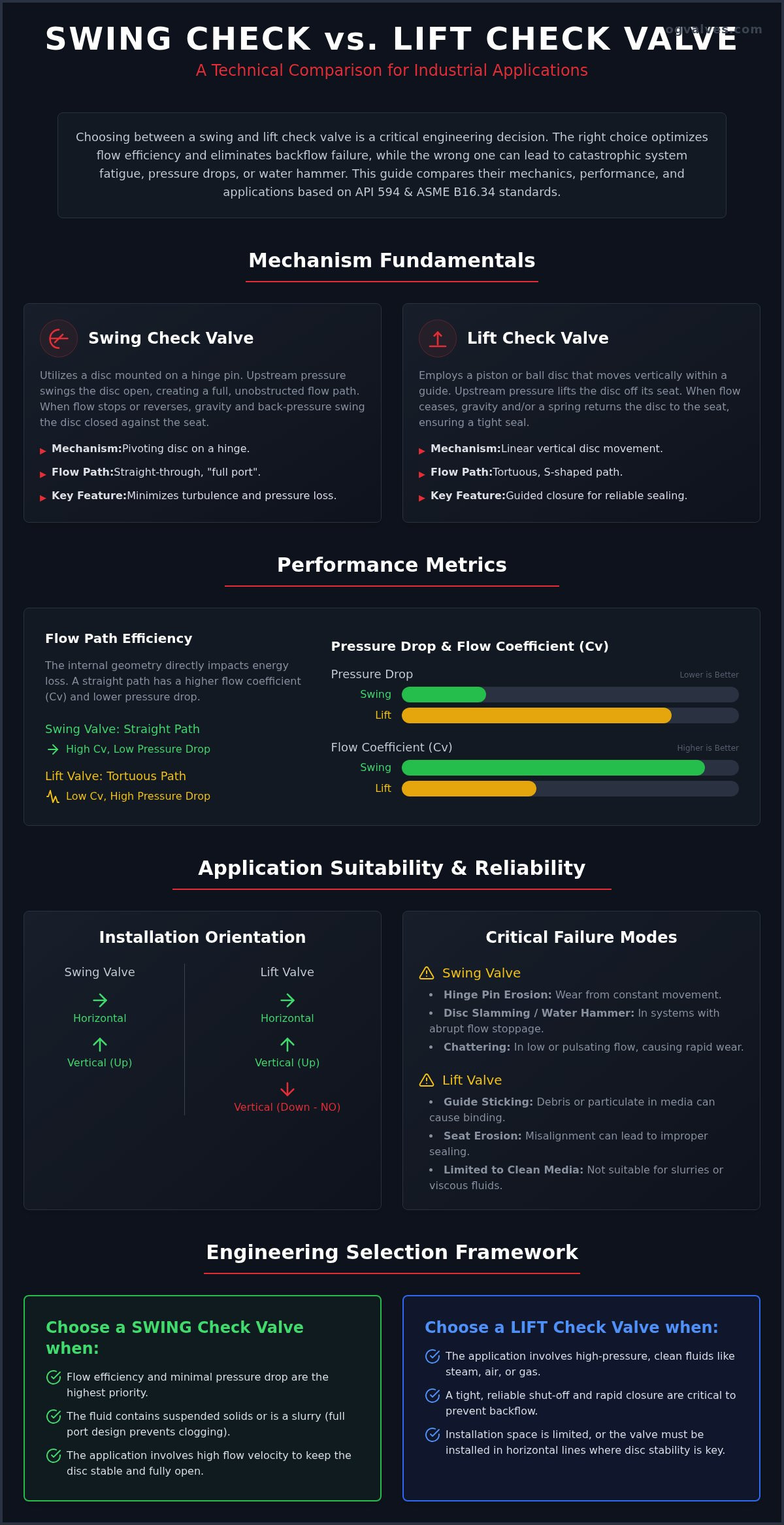
Selecting between a swing check valve and a lift check valve is not a matter of preference; it’s a critical engineering decision where a single miscalculation in flow velocity leads to catastrophic system fatigue. Technical experts recognize that in high-pressure industrial environments, minor oversights in valve specification often result in excessive pressure drops or the destructive force of water hammer. By mastering the technical distinctions in the swing check valve vs lift check valve comparison, procurement specialists can optimize flow efficiency and eliminate the risk of backflow failure in mission-critical infrastructure.
This analysis examines the structural mechanics, gravitational orientation requirements, and performance benchmarks necessary to ensure strict compliance with API 594 and ASME B16.34-2023 standards. We provide a clinical evaluation of disc movement, seat wear patterns, and maintenance cycles to facilitate informed selection for both horizontal and vertical process lines. The focus remains on functional reality and long-term operational output, ensuring that every component meets the rigorous testing protocols required for heavy industrial applications in the 2026 landscape. This technical guide serves as a blueprint for minimizing facility downtime through precise component integration and adherence to global engineering benchmarks.
Key Takeaways
- Evaluate internal mechanical distinctions to determine the optimal swing check valve vs lift check valve configuration for specific fluid dynamics.
- Analyze how the tortuous flow path of lift designs impacts pressure drop compared to the higher flow coefficient (Cv) of swing architectures.
- Specify correct valve types based on gravitational orientation to prevent disc slamming and ensure reliable sealing in horizontal and vertical lines.
- Identify critical failure modes, including hinge pin erosion and guide sticking, to establish effective preventative maintenance cycles.
- Align procurement decisions with API 594 and ASME B16.34-2023 standards to guarantee structural soundness in high-stakes infrastructure.
Mechanism Fundamentals: Defining Swing and Lift Check Valves
Industrial fluid control systems rely on non-return mechanisms to maintain directional integrity. The distinction in a swing check valve vs lift check valve evaluation begins with the internal geometry and the physical path the media must traverse. While both serve the primary function of preventing backflow, their mechanical execution differs significantly to accommodate varying pressure ratings and flow velocities. Both architectures rely on the pressure differential and the force of gravity to achieve a positive seal when forward flow ceases. The choice between them dictates the efficiency of the entire pipeline.
The Swing Check Design: Pivot and Disc
A swing check valve is a non-return valve that utilizes a hinged disc to permit unidirectional flow. The assembly consists of a disc attached to an arm, which is secured to a hinge pin located at the top of the valve body. When upstream pressure exceeds the cracking pressure, the disc swings upward, creating a relatively unobstructed “full port” flow path. This configuration minimizes turbulence and maintains a high flow coefficient (Cv). During operation, the disc remains suspended in the flow stream, requiring sufficient velocity to prevent chattering or premature wear on the hinge pin. Understanding these Check Valve Fundamentals is essential for selecting components that resist mechanical fatigue in high-flow applications.
The Lift Check Design: Piston and Guide
The lift check valve is an industrial design where the disc moves vertically from the seat to allow or obstruct flow. This mechanism operates with a motion similar to that of a globe valve, where the disc moves in a linear direction relative to the seat. It frequently employs a piston or ball disc that is precisely aligned by a guide structure within the valve bonnet. Because the media must travel through a 90-degree turn and then back again, the flow path is considered “tortuous,” resulting in a higher pressure drop compared to swing designs.
This design is often specified for high-pressure steam or air services where tight shut-off is paramount. The guide ensures that the disc maintains exact alignment with the seat during every cycle, reducing the risk of seat erosion. For systems requiring comprehensive flow control, engineers often integrate these units with Industrial Gate Valves to provide both isolation and backflow prevention. The linear movement makes the lift check highly reliable in high-pressure environments where the mechanical simplicity of a pivot might fail.
Hydraulic efficiency in high-stakes piping systems is quantified by the pressure drop across internal components. When evaluating a swing check valve vs lift check valve, the primary performance differentiator is the Flow Coefficient (Cv). Swing check valves feature a straight-through body design that minimizes fluid resistance, resulting in a significantly higher Cv compared to lift-type counterparts. This streamlined path reduces energy consumption across long-distance pumping stations where cumulative head loss is a critical operational cost.
Flow Efficiency and Cv Values
The internal geometry of the valve body dictates the degree of turbulence and energy loss. Swing check valves offer a “full port” flow, where the disc swings completely out of the flow stream, allowing for a path that mirrors a standard pipe section. Conversely, lift check valves utilize a globe-style body where the media must navigate an S-shaped flow path. This tortuous route induces turbulence and substantial pressure drops, which engineers must account for during system design. According to the Valve Selection Handbook, this higher resistance is often a deliberate trade-off for the superior sealing capabilities and rapid closure speeds required in high-pressure steam or air lines. While the pressure drop is higher, the stability provided by the guided disc assembly prevents the mechanical fatigue often seen in swinging mechanisms during pulsating flow conditions.
Cracking Pressure Requirements
Cracking pressure is the minimum upstream pressure at which the valve begins to permit flow. In standard swing check valves, this value is typically low, as the mechanism only needs to overcome the weight of the disc and arm. Lift check valves, particularly those utilized in vertical orientations, may require higher cracking pressures to initiate movement. Integrating spring-loaded discs into lift designs further increases this threshold, allowing for precise control in specialized process environments. For procurement teams requiring specific Cv data for large-scale projects, reviewing the technical specifications of API-certified check valves ensures that the selected component aligns with hydraulic requirements.
Flow velocity remains a decisive factor in valve longevity. Swing check valves require a minimum flow velocity to maintain the disc in a fully open position; insufficient velocity causes the disc to oscillate or “chatter” against the stop, leading to rapid hinge pin failure. Lift check valves demonstrate greater resilience in variable flow conditions. Their guided piston design absorbs kinetic energy more effectively, making them the preferred choice for systems with frequent flow fluctuations where disc stability is essential for preventing seat erosion.

Pipeline geometry dictates the mechanical feasibility of non-return valves within an industrial circuit. When performing a swing check valve vs lift check valve suitability analysis, the gravitational vector is the primary constraint. Incorrect orientation leads to premature component fatigue or total backflow failure. Engineers must align valve selection with the specific physical properties of the process media, including viscosity and the presence of suspended solids, to ensure structural soundness and operational output.
Installation Orientation Constraints
Swing check valves offer greater versatility for diverse pipeline layouts. They’re the standard specification for horizontal lines and are capable of vertical installation provided the flow direction is upward. In vertical configurations, the force of gravity aids the disc in returning to the seat upon flow cessation. Downward vertical flow is prohibited for swing designs, as gravity maintains the disc in an open position, rendering the valve ineffective. For a broader analysis of these parameters and their impact on system design, refer to Understanding Industrial Check Valves (2026).
Standard lift check valves are strictly limited to horizontal pipeline installations. The internal piston or ball relies on a vertical stroke to clear the seat; any deviation from a horizontal body orientation prevents the closure member from seating correctly under the influence of gravity. While spring-loaded variations exist to permit vertical mounting, the mechanical simplicity of the standard lift design remains the benchmark for horizontal high-pressure service. Failure to adhere to these orientation rules results in disc slamming and seat erosion, which compromises the integrity of the entire high-stakes system.
Media Compatibility: Steam vs. Slurry
The internal flow path of each valve type determines its resilience against specific media types. Lift check valves are the preferred choice for high-pressure steam, air, and gas applications. Their guided piston mechanism ensures a tight shut-off and handles the rapid pressure fluctuations common in gaseous systems. The globe-style body provides superior sealing surface contact, which is essential for preventing leaks in volatile environments. However, the S-shaped path acts as a trap for debris, making lift checks unsuitable for systems with significant particulate matter.
Swing check valves excel in handling liquids, viscous fluids, and slurries. The “full port” design allows larger particulates to pass through without obstructing the mechanism or causing sediment buildup. This makes them ideal for wastewater treatment and heavy industrial process lines where media cleanliness isn’t guaranteed. When specifying for corrosive environments, procurement specialists must prioritize material classifications that resist pitting and stress corrosion cracking. Choosing the correct valve based on flow reversal frequency is equally vital; lift checks are better suited for systems with frequent cycles due to their shorter stroke, which reduces kinetic impact and minimizes wear on the seating surfaces.
Reliability and Maintenance: Identifying Critical Failure Modes
Operational reliability in heavy industrial sectors depends on identifying the specific mechanical degradation patterns associated with valve architecture. In a swing check valve vs lift check valve comparison, failure modes are dictated by the movement of the closure member and the complexity of the internal assembly. While swing designs are susceptible to pivot-related fatigue, lift designs face risks associated with guided stroke precision. Understanding these vectors is essential for maintaining safety in power generation and petrochemical infrastructure where the cost of component failure is measured in significant facility downtime.
Hinge and Pin Integrity in Swing Checks
The primary failure mode for swing check valves involves the erosion of the hinge pin and arm assembly. Turbulent flow conditions often induce disc “flutter,” where the disc oscillates rapidly without reaching the full-open stop. This constant motion causes abrasive wear on the pin, eventually leading to misalignment. If unaddressed, the hinge pin can shear, resulting in the disc detaching and migrating into downstream equipment like turbines or pumps. Predictive maintenance strategies should include ultrasonic testing of the hinge area and periodic measurement of pin clearance to ensure structural soundness. The relatively slow closing speed of the swing disc increases the risk of water hammer. When flow reverses, the disc must travel a wide arc to reach the seat, often slamming with enough kinetic force to cause pipeline rupture.
Guide Fouling and Sticking in Lift Checks
Lift check valves are vulnerable to failures caused by media contamination and mineral deposition. The piston or ball relies on a guided structure to maintain vertical alignment with the seat. In systems with poor media cleanliness, particulates can lodge between the guide and the disc, causing the valve to seize in either the open or closed position. This guide sticking prevents a bubble-tight shut-off and leads to seat erosion due to high-velocity “wire-drawing” across the partially open gap. Misalignment of only a few millimeters is sufficient to compromise the seal integrity in high-pressure steam applications.
Maintenance access is a significant differentiator. Most lift designs feature a top-entry bonnet, allowing technicians to inspect and replace the disc or guide assembly without removing the valve body from the pipeline. This is more efficient than the maintenance protocols for many swing check valves, which may require more extensive disassembly. To mitigate these risks, procurement specialists should source API-certified check valves that utilize high-grade alloys and precision-machined guides to resist fouling. Regular flushing of the guide area and inspection of the seating surfaces are mandatory protocols for ensuring long-term operational output in severe service environments.
Engineering Selection Framework: Swing vs. Lift
Engineering selection in 2026 requires a multi-parameter optimization approach that prioritizes structural soundness over initial procurement costs. The decision between a swing check valve vs lift check valve must be anchored in quantifiable data, including flow velocity, pressure class, and media phase. In critical infrastructure, these non-return valves are frequently integrated with Industrial Gate Valves to facilitate safe maintenance isolation and redundant backflow protection. Adherence to global benchmarks such as API 594 and ASME B16.34-2023 is mandatory to ensure the component survives the intended operational lifecycle without premature fatigue.
The Selection Decision Matrix
Specifying the correct valve architecture depends on the physical constraints of the pipeline and the kinetic energy of the process media. Procurement specialists should utilize the following criteria for technical validation:
- Swing Check Specification: Optimal for large diameter pipelines (typically DN 150 and above) where minimizing pressure drop is the primary objective. These are the preferred choice for liquid service and viscous media due to the full-port flow path.
- Lift Check Specification: Required for small diameter, high-pressure applications (Class 600 through Class 2500) where bubble-tight shut-off is essential. They’re the standard for high-velocity gas, air, and steam services where the guided disc provides superior stability.
- Material Validation: All units must undergo rigorous Positive Material Identification (PMI) testing. This ensures that the alloy composition matches the design specifications for corrosive or high-temperature environments, preventing stress corrosion cracking.
Procurement and Global Supply Chain
OG VALVES LTD. acts as a technical authority in the global supply chain, maintaining an extensive inventory of API-certified check valves for fast-track delivery to heavy industrial projects. Incorrect valve specification is a leading cause of facility downtime; therefore, our technical support teams provide clinical evaluations of system requirements to prevent mechanical mismatch. We prioritize functional reality, ensuring that every component meets the precision requirements of modern engineering standards. By leveraging our global logistics network, we minimize lead times for critical infrastructure repairs and new project commissions. For expert technical support and global procurement, contact OG VALVES LTD. to ensure your facility maintains the highest safety and performance standards.
Optimizing Industrial Flow Integrity
Achieving operational excellence in high-stakes infrastructure requires a rigorous approach to component specification. The technical evaluation of a swing check valve vs lift check valve underscores that performance is a function of precise mechanical alignment with system dynamics. While swing designs provide superior flow coefficients for large-scale liquid transport, lift architectures offer the sealing precision necessary for high-pressure gaseous environments. Adherence to API 594 and ASME B16.34-2023 remains the primary benchmark for ensuring long-term durability and safety in 2026.
OG VALVES LTD. provides the technical expertise and global supply chain capabilities required to navigate complex procurement demands. Our extensive inventory of API and ASME compliant valves ensures that your facility maintains structural soundness while minimizing the risk of catastrophic backflow failure. For expert guidance and competitive lead times on high-specification hardware, Request a Technical Quote from OG VALVES LTD. to secure the reliability of your critical infrastructure. Selecting the right valve today prevents the costly mechanical fatigue of tomorrow.
Frequently Asked Questions
Can a swing check valve be installed in a vertical pipeline?
Yes, a swing check valve is suitable for vertical pipelines provided the flow direction is upward. In this orientation, gravity assists the disc in returning to the seat when flow ceases, ensuring a positive seal. It’s critical to avoid vertical installations with downward flow, as gravity will pull the disc away from the seat, rendering the backflow prevention mechanism ineffective and compromising the structural integrity of the process line in high-stakes environments.
What is the main advantage of a lift check valve over a swing check?
The primary advantage of a lift check valve is its superior sealing capability and stability in high-pressure gaseous or steam services. The guided piston or ball mechanism ensures precise disc-to-seat alignment, which minimizes leakage and prevents the mechanical chatter often observed in swing designs under pulsating flow. This makes them the benchmark for applications requiring bubble-tight shut-off and high-cycle reliability where mechanical simplicity must yield to precision.
Which valve type is more susceptible to water hammer?
Swing check valves demonstrate a higher susceptibility to water hammer due to the wider arc the disc must travel to reach the seat. During flow reversal, this delay allows the backflow velocity to increase significantly before the disc slams closed. In contrast, the shorter stroke of a lift check valve permits more rapid closure, effectively mitigating the kinetic impact and protecting downstream infrastructure from the destructive pressure surges associated with fluid deceleration.
Is a lift check valve suitable for slurry or dirty media?
No, lift check valves are generally unsuitable for slurry or media containing suspended solids. The globe-style body creates a tortuous flow path where particulates can accumulate, leading to guide fouling or seat erosion. In a swing check valve vs lift check valve assessment for dirty media, the swing design is preferred because its full-port architecture allows larger particulates to pass through the valve body without obstructing the internal moving components.
How does cracking pressure affect the choice between swing and lift checks?
Cracking pressure is the minimum upstream pressure required to initiate flow, and it’s typically lower in swing check valves because they only need to overcome the weight of the hinged disc. Lift check valves often require higher cracking pressures, especially when configured with internal springs. Engineers must specify the correct valve based on these thresholds to ensure the system doesn’t experience unnecessary pressure drops or failure to open during low-flow conditions in industrial circuits.
What are the typical size limitations for lift check valves in industrial use?
Lift check valves are predominantly specified for smaller pipeline diameters, typically ranging from DN 15 to DN 200. As size increases, the weight of the piston and the substantial pressure drop caused by the S-shaped flow path become technically prohibitive. For larger diameters, swing check valves are the industry standard, offering a more efficient flow coefficient (Cv) and reduced mechanical strain on the supporting pipeline architecture in high-capacity infrastructure projects.
Can lift check valves be spring-loaded for better performance?
Yes, lift check valves are frequently equipped with internal springs to enhance closure speed and permit installation in various orientations. Spring-loading ensures the disc returns to the seat immediately when forward flow velocity drops, which is essential for preventing backflow in systems with rapid pressure fluctuations. This modification improves the swing check valve vs lift check valve performance profile by reducing the risk of disc slamming and ensuring a reliable seal even in low-pressure applications.
 Responsive Menu