The assumption that an industrial valve remains operational until visible leakage occurs is a high-stakes engineering fallacy that compromises both process safety and fiscal responsibility. For technical experts in heavy industry, the decision of when to replace industrial valves isn’t a matter of intuition but a rigorous assessment of metallurgical integrity and mechanical tolerances. You understand that the cost of an unplanned shutdown far exceeds the procurement price of a high-specification gate or ball valve.
This guide provides a clinical framework for identifying critical failure points and navigating the technical triggers that mandate replacement over repair. We’ll examine the specific impact of recent regulatory updates, including ISO 22109:2026 for gearboxes and the July 2026 enforcement of TSG 92-2026 standards. By analyzing material fatigue, seat leakage rates, and compliance with API and ASME benchmarks, this technical overview ensures your infrastructure maintains operational excellence and adheres to global safety certifications.
Key Takeaways
- Identify how operational variables such as media corrosivity and thermal cycling accelerate component degradation beyond theoretical design life.
- Establish objective technical criteria for when to replace industrial valves by measuring internal seat leakage against API 598 and ISO 5208 standards.
- Utilize a Total Cost of Ownership (TCO) framework to determine the economic threshold where procurement of new components outweighs the cost of specialized repairs.
- Align maintenance protocols with 2026 regulatory updates, including ISO 15848-1 fugitive emission requirements and new TSG safety regulations.
- Implement strategic procurement and fast-track delivery models to secure high-specification valves and mitigate the risk of extended facility outages.
Understanding the Service Life of Industrial Valves
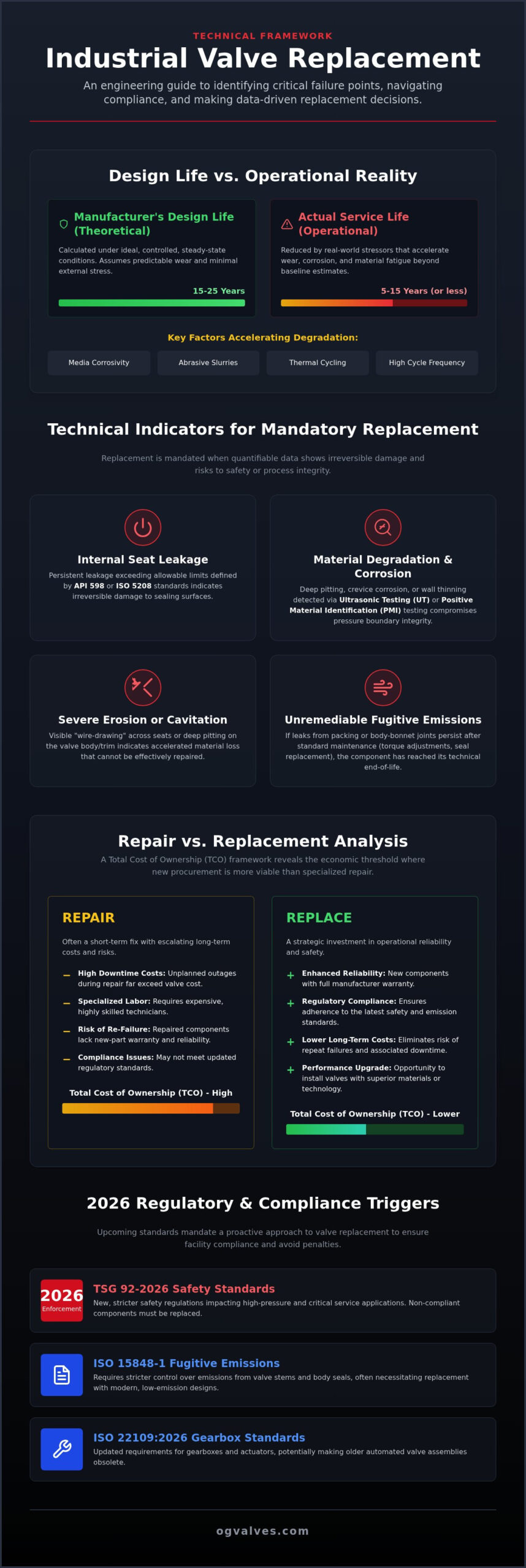
The assumption that a standard gate valve possesses a fixed 15 to 25 year lifespan is a common oversimplification that ignores the variables of heavy industrial processing. While basic manufacturing data might suggest these timelines, they rarely account for the high-pressure transients and chemical stressors found in sectors like petrochemical or power generation. Determining when to replace industrial valves requires a shift from calendar-based maintenance to a technical assessment of metallurgical and mechanical degradation. A foundational understanding of industrial valves and their specific design parameters is the first step in establishing a reliable replacement framework.
Design Life vs. Operational Reality
Manufacturer design life is typically calculated under controlled, steady-state conditions that do not mirror the volatility of real-world infrastructure. In high-pressure environments, the discrepancy between theoretical longevity and operational reality can be substantial. Stagnant valves, which remain in the open or closed position for extended periods, are prone to “stiction” or seizing due to mineral buildup and corrosion. Conversely, high-cycle valves face constant mechanical fatigue on the stem and seating surfaces. For a deeper technical analysis of these performance benchmarks, consult our comprehensive guide to industrial valves. It details how design standards like API 600 establish the baseline for structural integrity before environmental stressors are introduced.
Environmental Factors Accelerating Component Wear
Media characteristics serve as the primary drivers of accelerated wear. Corrosive chemicals, abrasive slurries, and extreme thermal cycling can reduce the service life of a component to a fraction of its design estimate. Offshore applications introduce additional risks through external salt spray, which can lead to rapid atmospheric corrosion of the valve body and bolting. Sizing errors also contribute to premature failure. A valve that is too large for the required flow rate will often “hunt,” leading to seat chattering and accelerated trim erosion. This is particularly evident in industrial butterfly valves, where abrasive media can quickly compromise the integrity of the resilient seat or the disc edge. 2026 maintenance guidelines emphasize that “average lifespan” figures are misleading. Safety-critical applications require a clinical focus on actual wall thickness and seat tightness rather than the age of the installation.
Mechanical integrity is also compromised by cycle frequency. Each operation of a valve induces stress on the packing and seals. In high-temperature steam services, even minor thermal fluctuations can cause differential expansion between the body and the internal trim, leading to binding or permanent deformation. Technical experts must prioritize quantifiable data over historical estimates to mitigate the risk of catastrophic failure.
Technical Indicators for Mandatory Industrial Valve Replacement
Quantifiable data must drive the decision of when to replace industrial valves, specifically when internal seat leakage rates exceed the maximum allowable limits defined by API 598 or ISO 5208. While minor seepage might be addressed through maintenance, persistent leakage in high-pressure systems indicates irreversible damage to the sealing surfaces. Severe cavitation or erosion on the valve body or internal trim often presents as deep pitting or “wire-drawing” across the seat. These conditions create turbulent flow patterns that further accelerate material loss. If fugitive emissions from the packing or body-bonnet joints cannot be remediated through standard torque adjustments or seal replacements, the component has reached its technical end-of-life.
Material Degradation and Internal Corrosion
Identifying material degradation requires more than a visual assessment. Stainless and duplex steel valves are particularly vulnerable to pitting and crevice corrosion, which can compromise the pressure-containing boundary without presenting obvious external symptoms. Positive Material Identification (PMI) testing serves as a critical tool for verifying alloy integrity after long-term service in corrosive media. Ultrasonic testing is also necessary to detect wall thinning in high-velocity applications where erosion is a primary concern. Visual inspection alone cannot quantify the remaining strength of the valve casting. Adhering to Valve maintenance regulations ensures that these non-destructive testing protocols are implemented before a catastrophic failure occurs.
Mechanical Fatigue and Structural Integrity
Mechanical fatigue often manifests as stem galling or seat deformation, conditions that preclude a reliable gas-tight seal. In high-cycle applications, the repetitive stress on moving components can lead to microscopic fractures. Technical experts must recognize that repeated welding or structural repair of valve bodies can compromise the material’s pressure-retaining capability by altering the heat-affected zone of the alloy. For specific indicators related to gate assemblies, reference our guide on common failure modes in gate valves. When structural integrity is in question, the risk of explosive decompression or environmental contamination necessitates a full component replacement. Procurement of high-specification replacement valves with verified material certifications is the only method to restore system safety to baseline standards.
The technical framework for replacement must also account for the limits of modern repair techniques. Once the base metal of a valve body has lost its specified thickness or has undergone significant metallurgical changes due to extreme thermal exposure, it can no longer be certified for high-pressure service. In these instances, the engineering consensus favors replacement to maintain compliance with international safety benchmarks.
The Engineering Framework: Repair vs. Replacement Analysis
Engineering teams must apply a standardized framework to determine when to replace industrial valves rather than relying on subjective maintenance reports. The decision-making process hinges on the “50% Rule.” When the projected cost of specialized repair, including labor, machining, and seat lapping, exceeds half the procurement cost of a new unit, replacement is the preferred engineering outcome. This threshold accounts for the diminishing returns of refurbishing aged components that have already undergone significant thermal or mechanical stress. Unlike surface-level assessments that prioritize immediate repair speed, a clinical analysis must evaluate the risk of “repair cycles.” This phenomenon involves a refurbished valve failing shortly after re-commissioning, leading to compounded labor costs and extended facility outages.
Total Cost of Ownership (TCO) serves as the primary metric for this analysis. TCO extends beyond the immediate invoice to include the cost of future maintenance and the probability of unplanned downtime. In 2026, lead times for standard carbon-steel catalog items typically range from 6 to 10 weeks. While specialized repairs might appear faster on paper, the uncertainty of material integrity after machining often makes fast-track procurement of a new, certified component the more reliable path. For critical infrastructure, the risk of re-using an older valve in a modernized control system is often unacceptable, as legacy mechanical tolerances may not align with the precision required by new digital actuators.
Assessing Component Obsolescence
Sourcing original equipment manufacturer (OEM) parts for valves exceeding 15 to 20 years in service is increasingly difficult. Technical experts must avoid “Frankenstein” repairs that utilize non-OEM or cannibalized components, as these introduce unquantified risks into the pressure-retaining system. Integrating a modern ball valve into existing infrastructure often provides superior flow coefficients and tighter shut-off capabilities compared to a refurbished legacy component. Modernizing the valve fleet ensures that all components are compatible with 2026 Industrial IoT monitoring platforms for real-time performance tracking.
Reliability and Warranty Considerations
Warranty structures provide a clear indicator of the expected reliability difference between repaired and new units. Repairs typically carry limited warranties that cover only the specific parts serviced, often for a duration of six months or less. In contrast, new valves come with comprehensive manufacturer warranties and updated certifications, including Material Test Reports (MTRs) and Positive Material Identification (PMI) data. Safety-critical check valves are frequently replaced in 2026 because the mechanical integrity of the internal hinge pins and discs is paramount for preventing backflow. Relying on a new, factory-tested component provides a level of quality assurance that a field repair cannot replicate.
Regulatory Standards and Compliance Triggers
Regulatory compliance serves as the final arbiter of when to replace industrial valves, often overriding purely mechanical assessments. While a component might appear functional under steady-state conditions, any deviation from the pressure-temperature ratings specified in ASME B16.34 or the pipeline requirements of API 6D mandates immediate decommissioning. In 2026, the enforcement of the Safety Technical Regulation for Safety Accessories of Pressure-bearing Special Equipment (TSG 92-2026) has further formalized the necessity for replacing components that fail to meet updated structural benchmarks. Periodic hydrostatic testing and seat leakage evaluations are no longer merely maintenance suggestions; they are legal requirements for maintaining a facility’s operating license.
Environmental mandates regarding fugitive emissions provide another critical trigger for replacement. ISO 15848-1 dictates strict tightness classes for valves in hazardous chemical service. If a legacy valve cannot be retrofitted to meet these low-leakage benchmarks, it must be replaced with a certified unit. Compliance with API 624 is the industry standard for verifying that rising stem valves utilize low-leakage packing systems capable of preventing environmental contamination. Failure to adhere to these standards can result in significant financial penalties and the loss of insurance coverage, as underwriters increasingly require proof of adherence to the latest international safety certifications.
API and ASME Inspection Benchmarks
Industry standards establish specific inspection intervals based on service class and media volatility. API 600, for instance, defines the minimum wall thickness and stem diameter for heavy-duty gate valves. If a refurbishment process involves machining that reduces these dimensions below the allowable threshold, the component no longer complies with its original design standard and must be replaced. Non-compliance identified during a repair cycle is a common catalyst for procurement, as a non-certified repair nullifies the original manufacturer’s pressure rating. Technical teams must ensure that all replacement hardware arrives with a full Material Test Report (MTR) to maintain the facility’s compliance registry.
Safety-Critical Failure Consequences
The “Probability of Failure on Demand” (PFD) is a vital metric within Safety Instrumented Systems (SIS). For valves utilized in Emergency Shutdown (ESD) service, the criteria for replacement are significantly more stringent than those for general process valves. If a valve fails a partial stroke test or demonstrates a PFD that exceeds the allowable limit for its Safety Integrity Level (SIL) rating, it must be replaced to restore the safety loop’s integrity. The synchronization between high-specification actuators and the valve body is essential for ensuring rapid response during a critical event. In safety-critical applications, the potential for catastrophic failure far outweighs the cost of a new component. For rapid procurement of certified hardware to meet these regulatory demands, source high-specification valves from our global inventory.
Strategic Procurement: Ensuring Reliable Valve Replacement
Once technical indicators and regulatory benchmarks confirm when to replace industrial valves, the procurement phase must prioritize engineering precision over simple cost comparisons. Vague technical specifications often lead to compatibility issues that extend facility outages and compromise system safety. Ordering a replacement is not merely a logistical task; it’s an engineering opportunity to rectify legacy design inadequacies that contributed to the original component’s failure. Precise specification of pressure-temperature ratings, end connections, and bore diameters ensures that the new hardware integrates seamlessly with existing piping and control systems.
Fast-track delivery serves as the primary defense against the escalating costs of unplanned downtime. In 2026, standard lead times for custom-engineered valves can reach 40 weeks, a duration that is unacceptable for critical path components. OG VALVES LTD. addresses this risk by maintaining an extensive inventory of high-specification gate, ball, and globe valves ready for immediate dispatch. Our global logistics network is structured to minimize the interval between failure identification and component installation, providing the unwavering reliability required by heavy industrial sectors.
Specifying High-Performance Materials
Selecting superior alloys during the replacement process can significantly extend the mean time between failures (MTBF) for safety-critical infrastructure. Upgrading from standard carbon steel to alloys such as Super Duplex or Inconel provides enhanced resistance to the corrosive and abrasive media characteristics discussed in earlier sections. Technical experts should also evaluate upgrading valve trim materials—specifically the disc, seat, and stem—to mitigate the effects of cavitation and erosion. OG VALVES LTD. specializes in sourcing these high-specification materials, ensuring that every replacement component is engineered for long-term durability in extreme environments.
Quality Assurance and Testing Protocols
Every replacement valve must undergo a series of rigorous validation tests before it’s commissioned into service. Essential pre-dispatch protocols include Positive Material Identification (PMI) to verify alloy composition and hydrostatic pressure testing to confirm the integrity of the pressure-retaining boundary. We ensure that all supplied hardware is accompanied by comprehensive Material Test Reports (MTRs) and adheres to global industrial benchmarks, including API and ASME standards. This clinical focus on quality control eliminates the mechanical uncertainties often associated with unverified third-party vendors. For experts seeking to maintain the highest standards of industrial safety, consult with OG VALVES LTD. for technical support on your next replacement project.
Optimizing Infrastructure Integrity Through Technical Replacement Strategies
Establishing a definitive timeline for when to replace industrial valves requires a clinical shift from intuition to quantifiable engineering data. This guide has detailed how seat leakage rates, NDT material verification, and the 50% rule for repair costs serve as critical triggers for new procurement. Adhering to the latest API and ASME benchmarks isn’t merely a compliance exercise; it’s a fundamental requirement for maintaining the pressure-retaining boundary of your facility. By prioritizing certified material integrity over the short-term savings of refurbished legacy components, you ensure the sustained safety of your operations.
OG VALVES LTD. acts as a dependable partner in critical infrastructure, providing an extensive inventory of high-specification valves ready for immediate deployment. Our technical expertise in material selection and commitment to fast-track global delivery ensures your facility experiences minimal downtime while meeting 2026 regulatory standards. Request a Technical Quote for High-Specification Replacement Valves to secure components that meet the highest industrial benchmarks. We look forward to supporting your next infrastructure upgrade.
Frequently Asked Questions
What is the average lifespan of an industrial gate valve?
The average lifespan typically ranges from 15 to 25 years under standard operating conditions. However, this figure is highly dependent on media characteristics and cycle frequency. In abrasive or high-corrosion environments, the functional lifespan may contract to less than five years. Technical experts must prioritize actual wall thickness and seat integrity over chronological age when assessing component health.
How do I know if my valve should be repaired or replaced?
Replacement is mandatory when repair costs exceed 50% of the price of a new unit or when the pressure-retaining boundary shows signs of metallurgical degradation. Engineering teams utilize this threshold to mitigate the risk of repeat failures. Establishing a clear technical framework helps operators determine when to replace industrial valves to ensure long-term system reliability and adherence to safety certifications.
What are the signs of internal valve leakage?
Primary indicators include downstream pressure build-up when the valve is closed and detectable acoustic signatures from turbulent flow. Seat leakage rates exceeding the maximums defined by API 598 or ISO 5208 signify a critical failure of the sealing surfaces. Thermal imaging can also identify passing media in high-temperature systems by revealing localized heat signatures on the downstream piping.
Can I replace a valve while the system is under pressure?
No, a valve must never be replaced while the system is under pressure. Full depressurization and isolation are absolute requirements for safe component removal. Attempting to breach the pressure boundary without proper lockout-tagout (LOTO) protocols risks catastrophic injury and equipment damage. Safety standards mandate that the system reaches a zero-energy state before any mechanical work commences on the valve body.
What technical standards govern industrial valve replacement?
The primary governing standards include API 600, API 6D, and ASME B16.34. These benchmarks define the required material classifications, pressure-temperature ratings, and testing protocols for replacement hardware. In 2026, compliance with ISO 15848-1 for fugitive emissions and the updated ISO 5211 for actuator attachments is also essential for maintaining facility certification and environmental adherence.
Why is PMI testing important for valve replacement?
Positive Material Identification (PMI) verifies that the alloy composition of a replacement valve matches the technical specification exactly. This testing prevents the installation of incorrect materials that could lead to rapid galvanic corrosion or structural failure. Verifying the chemical signature of the valve body and trim is a critical quality assurance step in high-specification industrial procurement.
What is the “50% rule” in industrial valve maintenance?
The 50% rule is an engineering guideline stating that if refurbishing a valve costs more than half the price of a new component, replacement is the more efficient decision. This calculation includes the cost of specialized labor, machining, and updated certifications. Adhering to this rule reduces the Total Cost of Ownership (TCO) by preventing the repeated repair of components nearing their technical end-of-life.
How does media temperature affect valve replacement frequency?
Extreme temperatures accelerate metallurgical fatigue and can induce permanent deformation through thermal cycling or creep. High-temperature applications often necessitate more frequent inspections and earlier replacement to prevent seat seizing or packing failure. Identifying when to replace industrial valves in thermal services requires precise monitoring of the material’s mechanical properties and adherence to the derated pressure limits specified in ASME B16.34.
 Responsive Menu