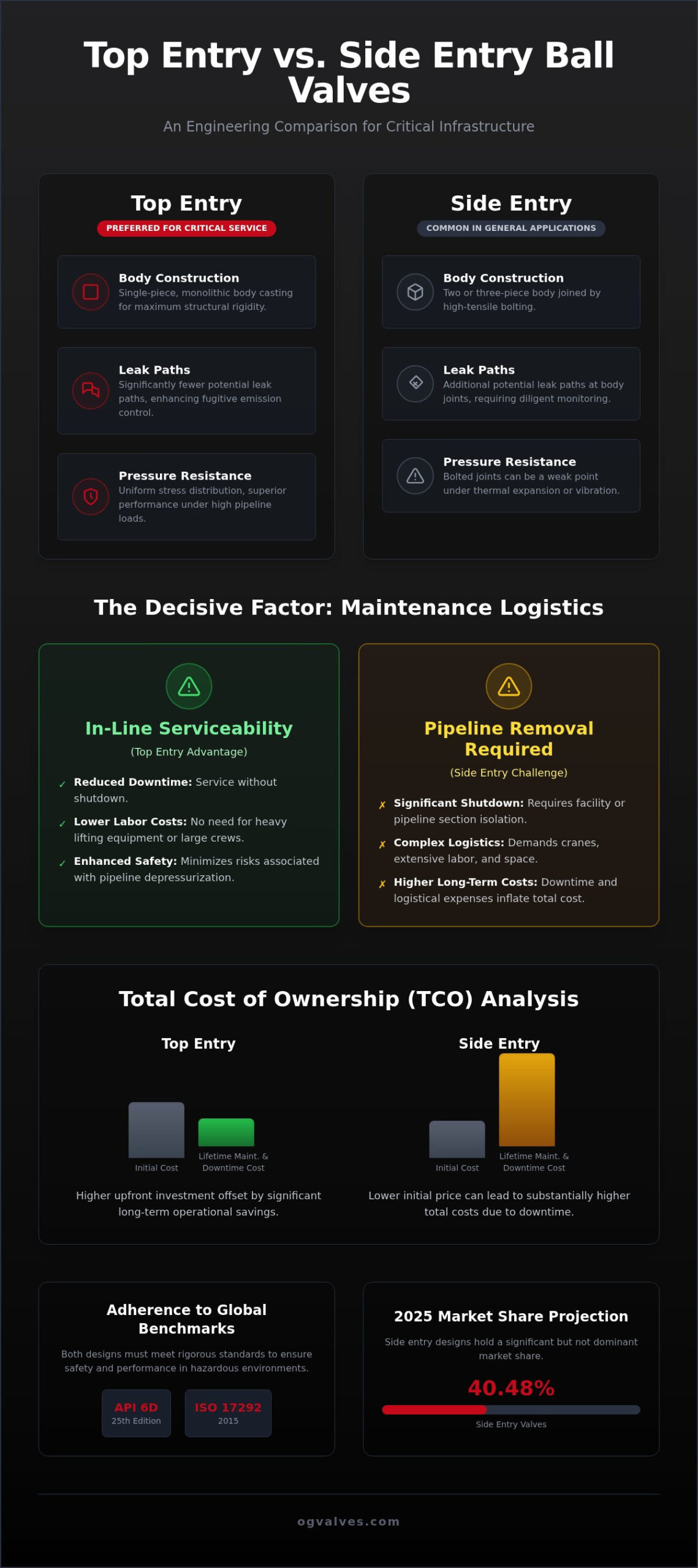
The structural configuration of a pressure-retaining boundary is often the primary factor distinguishing a controlled maintenance window from a catastrophic facility shutdown. For engineers managing high-pressure pipelines, the technical selection of a top entry vs side entry ball valve represents a fundamental trade-off between initial capital expenditure and long-term system availability. While side entry designs accounted for 40.48% of the market share in 2025, they’re often insufficient for critical-path infrastructure where in-line serviceability is a mandatory requirement for safety and operational output.
Experienced procurement specialists recognize that the total cost of ownership is driven by a valve’s performance during unplanned events and its resistance to fugitive emissions. This analysis provides an authoritative engineering comparison of these configurations to help you optimize maintenance schedules and enhance system reliability. We’ll examine how body construction affects structural integrity and leak paths under the latest API 6D 25th Edition and ISO 17292:2015 standards. You’ll receive a clinical framework for selecting valve entry types, ensuring your procurement justifications are anchored in rigorous technical data and global regulatory benchmarks.
Key Takeaways
- Identify the architectural differences between top entry and side entry configurations to determine the most efficient maintenance profile for critical infrastructure.
- Evaluate how body joint design and material selection, including high-spec alloys like Super Duplex, influence structural integrity and maximum allowable working pressure.
- Quantify the operational advantages of in-line seat and seal replacement compared to the logistical complexity of removing multi-piece valve bodies from the pipeline.
- Develop a procurement strategy for a top entry vs side entry ball valve based on a clinical Total Cost of Ownership analysis that accounts for the financial impact of facility downtime.
- Align technical specifications with global benchmarks, including the API 6D 25th Edition and ISO 17292:2015, to ensure regulatory adherence and operational safety.
Fundamental Design Principles of Top Entry and Side Entry Ball Valves
The selection of a top entry vs side entry ball valve is a decision that dictates the long-term operational viability of high-pressure infrastructure. This architectural distinction centers on the body construction and the method required to access internal sealing components. Both configurations utilize the fundamental ball valve design and operation, where a quarter-turn rotating ball controls the flow of media. Under the API 6D 25th Edition standards, these valves must demonstrate rigorous structural integrity to mitigate the risk of catastrophic failure in hazardous environments. The primary engineering trade-off involves balancing the structural simplicity of a multi-piece body against the maintenance accessibility of a single-piece top-loading design.
Anatomy of the Top Entry Configuration
Top entry valves feature a single-piece body casting. This design eliminates the intermediate body joints found in side-loading configurations, significantly reducing potential leak paths to the atmosphere. Internal components, including the ball, seats, and stem, are installed through a top aperture. A heavy-duty removable bonnet secures these parts and provides a pressure-tight seal. This construction allows for full in-line inspection and component replacement without removing the valve from the piping system. It’s the preferred specification for welded-in applications where pipeline disassembly is logistically impossible. The single-body casting must meet stringent volumetric NDE (Non-Destructive Examination) requirements to ensure material soundness across the pressure-retaining boundary.
Anatomy of the Side Entry Configuration
Side entry valves are typically constructed from two or three separate body pieces. These sections are joined using high-tensile bolting or, in smaller diameters, threaded connections. This multi-piece architecture facilitates the use of forged components rather than castings. Forging provides superior material density and grain flow, which is critical for high-pressure cycles and resistance to stress corrosion cracking in aggressive media. The two-piece design contains a single body joint, while three-piece configurations allow the center section to be swung out for seat replacement. However, unlike top-entry designs, side entry valves generally require removal from the pipeline for comprehensive internal maintenance. This configuration is highly adaptable, allowing for the integration of specialized materials like Super Duplex to meet specific chemical compatibility requirements in offshore or petrochemical environments.
Evaluating Structural Integrity and Pressure Resistance
Pressure containment capacity is inextricably linked to the number and orientation of the body joints. In a top entry vs side entry ball valve comparison, the Maximum Allowable Working Pressure (MAWP) is influenced by the structural rigidity of the housing. Top entry valves utilize a single-piece cast body; this provides a uniform stress distribution across the pressure-retaining boundary. Conversely, side entry valves rely on high-tensile bolting to maintain the integrity of two or three separate body sections. Under high-pressure cycles, these bolted joints become critical points of analysis. Engineers must evaluate adherence to ASME B16.34 and API 6A pressure-temperature ratings. It ensures the selected configuration can withstand operational transients without compromising the seal.
Pressure Ratings and Pipeline Stress
Industrial systems operating in Class 600, 900, and 1500 environments demand exceptional resistance to external pipeline loads. In multi-piece side entry valves, pipeline thermal expansion and contraction exert significant shear forces on the body bolts. If these loads exceed design limits, the potential for joint relaxation and subsequent leakage increases. Top entry configurations mitigate this risk through their monolithic body design. They’re the preferred choice for high-vibration or subsea applications where external stresses are unpredictable. The structural soundness of the valve housing remains a primary factor in preventing fugitive emissions. This is especially true under the mandatory API 6D 25th Edition compliance requirements effective January 1, 2026.
Material Specifications for Critical Service
The choice of material directly affects the fatigue life and corrosion resistance of the valve assembly. Side entry designs frequently utilize forged materials. These offer superior grain flow and density compared to standard castings. This makes them highly effective for high-cycle applications. For more aggressive media, selecting the correct Industrial Ball Valves is vital for long-term reliability. High-spec alloys such as Super Duplex and Inconel provide the necessary structural integrity for corrosive environments where carbon steel would suffer premature degradation.
When specifying components for high-stakes infrastructure, you should consult with a technical expert to verify material compatibility with your specific pressure-temperature profile. Forged side entry valves often provide a cost-effective solution for standard high-pressure service. The inherent rigidity of top entry castings remains the benchmark for critical-path safety systems.
Maintenance Logistics: In-Line Service vs. Pipeline Removal
The logistical burden of valve maintenance is exacerbated in remote upstream facilities or congested downstream refineries where space and lifting equipment are limited. When evaluating a top entry vs side entry ball valve, the primary consideration is the method of access to the sealing internals. Side entry valves, particularly those in welded-in configurations, present significant hurdles because they usually require full removal from the pipeline for seat or ball refurbishment. This process necessitates heavy rigging, specialized transport to a repair shop, and the potential for flange misalignment during reinstallation. Top entry designs mitigate these risks by allowing technicians to perform all necessary repairs while the valve body remains fixed in the piping system.
The In-Line Maintenance Framework
In-line servicing of top entry valves follows a structured technical protocol that prioritizes safety and speed. Once the line is depressurized and drained according to established Double Block and Bleed (DBB) procedures, the bonnet bolts are removed to allow access. A specialized lifting tool or overhead crane extracts the bonnet assembly, providing immediate visibility of the ball and seat rings. Technicians can then inspect the pressure-retaining surfaces and replace soft goods or metal seats without disturbing the surrounding pipework. This streamlined approach significantly reduces the time required for seal replacement, often completing in hours what would take days for a side-entry equivalent. It’s an essential strategy for minimizing facility downtime in critical-path systems.
Off-Line Servicing and Valve Replacement
Side entry valves often demand off-line servicing because their multi-piece construction requires the body sections to be separated to release the ball. For large-bore valves exceeding 12 inches in diameter, the weight and dimensions make on-site disassembly hazardous and technically impractical. The logistics involve coordinating heavy-lift cranes and managing the risks associated with transporting ton-scale components to a controlled shop environment. Furthermore, managing spare parts for multi-piece designs is more complex; it requires maintaining an inventory of specific body-to-body gaskets and high-tensile bolting sets that are unique to each manufacturer’s tolerances. While side entry valves are suitable for non-critical applications with planned turnaround cycles, their reliance on pipeline removal remains a significant operational bottleneck in high-output industrial sectors.
Application-Specific Selection Criteria for Engineers
Engineering specifications must align with the thermodynamic and chemical profiles of the process media. The technical decision between a top entry vs side entry ball valve hinges on the presence of particulates and extreme thermal gradients. In high-temperature steam or cryogenic service, the expansion of internal components requires precise tolerance management. Adhering to the latest Industrial Valves standards ensures that procurement specialists satisfy both safety protocols and operational output requirements. Material science is the foundation of this selection process.
Upstream Oil and Gas and Subsea Applications
Top entry configurations are the industry standard for subsea manifolds and wellhead assemblies. This preference is driven by the necessity for in-situ maintenance in environments where pipeline removal is impossible. For production fluids containing abrasive sand or particulates, material selection is critical. Utilizing Super Duplex or Inconel for the valve body and ball provides the necessary erosion resistance. These materials maintain mechanical properties under the high-pressure conditions of deepwater extraction. In Emergency Shutdown Valve (ESDV) applications, the single-piece body offers a robust fail-safe boundary that multi-piece designs can’t replicate. It’s a matter of structural certainty.
Downstream Refining and Chemical Processing
In downstream refining, managing fugitive emissions is a primary regulatory concern. Side entry valves are frequently deployed in utility lines and non-critical process loops where lower initial CAPEX is justifiable. These valves are highly compatible with Industrial Valve Actuators, allowing for automated flow control in complex petrochemical environments. However, engineers must evaluate the risk of media buildup in stagnant valve cavities. In polymerizing services, the top entry design’s accessible cavity simplifies the removal of solidified debris during scheduled maintenance windows. It prevents the buildup that leads to torque increase and actuator failure.
For project-specific material classifications or technical data sheets, contact our engineering team to ensure your selection meets global safety benchmarks and minimizes the risk of industrial failure.
Procurement Strategy: Total Cost of Ownership (TCO) Analysis
Procurement decisions in heavy industry must transcend the initial purchase price to account for the financial burden of maintenance and unplanned outages. In a top entry vs side entry ball valve comparison, the higher initial capital expenditure (CAPEX) of a top-loading configuration is often offset by significantly lower operational expenditure (OPEX) over the asset’s service life. For facilities where a 24-hour shutdown can result in millions of dollars in lost production, technical superiority is a strategic insurance policy. TCO is the only valid metric for critical infrastructure.
The CAPEX vs. OPEX Debate
Quantifying the financial impact of a 24-hour facility shutdown requires a clinical assessment of operational output and labor costs. If a side entry valve fails in a welded pipeline, the time required for removal, transport, and re-welding can easily exceed 48 hours. A top entry valve allows for internal component replacement within a single shift. Evaluating the long-term viability of a top entry vs side entry ball valve requires a granular look at maintenance frequency and spare parts logistics. Life-cycle analysis demonstrates that top entry valves reduce the frequency of full pipeline depressurization and rigging requirements.
Insurance premiums for high-risk facilities often reflect the integrity of the valve housing; the single-piece body provides a lower risk of joint failure compared to multi-piece designs. This structural certainty reduces the likelihood of fugitive emissions and environmental non-compliance. While the upfront cost of a cast top entry body is higher, the reduction in lifetime maintenance hours provides a clear justification to stakeholders focused on long-term asset reliability.
Global Supply and Technical Support
Navigating international logistics for large-scale projects requires a partner who understands the cost of failure. Lead times vary significantly between cast and forged bodies. Forged side entry valves are often sourced with 30% to 50% lower unit costs from regions with integrated supply chains, yet the risk of material non-compliance can’t be ignored. Ensuring adherence to the API 6D 25th Edition and ISO 17292:2015 standards is a prerequisite for any procurement strategy. By specializing in high-specification materials like Super Duplex and providing technical expertise in valve sizing, OG VALVES LTD. acts as a dependable partner in critical infrastructure. Their fast-track delivery model is designed to minimize facility downtime during both planned turnarounds and emergency repairs. It’s a commitment to functional reality and long-term performance.
Optimising System Reliability Through Technical Selection
The technical selection between a top entry vs side entry ball valve is a strategic determination that dictates the operational efficiency of critical infrastructure. While side entry configurations offer superior material density through forged construction for standard high-pressure applications, top entry designs remain the industry benchmark for in-line serviceability in welded-in systems. Engineers must prioritize long-term Total Cost of Ownership over initial capital expenditure to mitigate the extreme financial risks associated with unplanned facility downtime. It’s a matter of safety and regulatory adherence as these are non-negotiable requirements for sustainable output.
OG VALVES LTD. maintains an extensive inventory of API 6D and ASME B16.34 compliant components to ensure your facility meets global safety benchmarks. Our global fast-track delivery capabilities and expert technical support for high-pressure material selection provide the reliability required for high-stakes projects. Request a Technical Quote for Industrial Ball Valves to secure your supply chain and optimize your maintenance schedule. Proper valve specification today ensures the long-term integrity of your critical assets.
Frequently Asked Questions
What is the primary difference between top entry and side entry ball valves?
The primary distinction between a top entry vs side entry ball valve lies in the method of internal component access and the body architecture. Top entry valves utilize a single-piece body casting with a removable top bonnet, allowing for in-line maintenance. Side entry valves typically feature a two-piece or three-piece bolted or threaded construction. This architectural difference dictates whether the valve must be removed from the pipeline, directly impacting facility downtime and logistical complexity.
Which valve type is better for high-pressure applications?
Both configurations are engineered for high-pressure service, but their suitability depends on the specific pressure-temperature profile. Forged side entry valves offer superior material density, making them effective for Class 1500 and 2500 applications. However, top entry designs are often preferred for critical-path high-pressure systems where the single-piece body minimizes leak paths. Selection should be based on the required Maximum Allowable Working Pressure and the necessity for in-situ repair capabilities.
Can a side entry ball valve be serviced while still in the pipeline?
Standard two-piece side entry ball valves cannot be serviced while remaining in the pipeline. These designs require full removal to separate the body sections and access the ball and seats. While some three-piece designs permit limited seat replacement in-situ, they’re generally restricted to smaller diameters and lower pressure classes. For large-bore industrial applications, a top entry vs side entry ball valve comparison highlights the clear maintenance advantage of top-loading architecture.
Why are top entry ball valves more expensive than side entry models?
The higher cost of top entry models is attributed to the complexity of the single-piece body casting and the additional material required for the top aperture. These valves require a larger body to facilitate the internal removal of the ball and seats through the bonnet. This leads to increased weight and higher manufacturing costs compared to the streamlined multi-piece forging process used for side entry valves. The price premium reflects the technical benefit of in-line serviceability.
What industries typically specify top entry ball valves?
Top entry valves are standard specifications in sectors where pipeline removal is logistically impossible or financially prohibitive. This includes subsea oil and gas manifolds, offshore platforms, and high-temperature steam systems in power generation. The LNG industry also utilizes these valves for cryogenic service due to their ability to handle thermal expansion while allowing for seat maintenance. These sectors prioritize long-term system availability and safety over the initial purchase price of the component.
How does body construction affect the risk of fugitive emissions?
Body construction directly influences the number of potential leak paths to the atmosphere. A top entry valve features a single-piece body with only one primary seal at the bonnet. Side entry designs have multiple body-to-body joints, each representing a potential failure point for fugitive emissions under thermal cycling or pipeline stress. Regulatory adherence to updated environmental standards often necessitates the selection of single-piece housings for hazardous media to ensure superior pressure containment.
Which configuration is preferred for subsea oil and gas applications?
The top entry configuration is the technical preference for subsea applications. Manifolds and wellhead assemblies are often welded into the pipeline, making the removal of a side entry valve for maintenance practically impossible without heavy offshore intervention vessels. Top entry designs allow for ROV-assisted or diver-assisted internal component replacement while the valve remains submerged. This minimizes the risk of environmental contamination and reduces the astronomical costs associated with subsea pipeline disassembly and re-welding.
Are top entry ball valves available in forged materials?
While top entry ball valves are predominantly manufactured as cast components, forged versions are technically possible for specific high-pressure or small-bore requirements. However, the complex internal geometry required for top-loading access is difficult to achieve through standard forging techniques. Most manufacturers utilize high-quality castings that undergo rigorous volumetric NDE to ensure structural soundness. For applications requiring the grain flow benefits of forging, side entry configurations remain the primary industrial standard for heavy-duty service.
 Responsive Menu