Selecting a concentric valve for a high-pressure isolation point isn’t just a budget error; it’s a calculated risk that leads to catastrophic seal deformation. Most procurement specialists understand the need for cost-effective solutions in utility water systems. However, applying those same standards to critical petrochemical process loops often results in fugitive emissions and unplanned downtime. This technical guide provides a rigorous analysis of triple offset vs concentric butterfly valve geometries to ensure your infrastructure achieves zero-leakage performance.
Engineers frequently face the challenge of balancing initial capital expenditure with the long-term cost of maintenance and seat replacement. This guide details how torque-seated sealing mechanisms provide a superior alternative to standard interference-fit designs in high-cycle environments. We’ll examine the structural requirements for ASME Class 150 through Class 900 applications, focusing on the performance of triple offset geometries during extreme thermal cycling. This comparison provides the technical data required to maintain regulatory adherence and operational safety across global industrial projects. We’ll conclude by evaluating material classifications to ensure compliance with international safety standards.
Key Takeaways
- Quantify the geometric distinctions within the triple offset vs concentric butterfly valve selection process to mitigate the risk of seal deformation in high-cycle applications.
- Differentiate between the pressure rating capabilities of Class 150 resilient-seated designs and Class 1500+ metal-to-metal configurations.
- Analyze the impact of cam-action closing mechanisms on reducing mechanical friction and extending the operational lifecycle of critical isolation components.
- Identify the regulatory and safety requirements that dictate the use of triple offset valves for fire-safe performance in petrochemical environments.
- Implement quality assurance protocols, including Positive Material Identification, to verify compliance with global engineering standards like API 609 and ASME B16.34.
Fundamental Design Principles: Concentric vs. Triple Offset
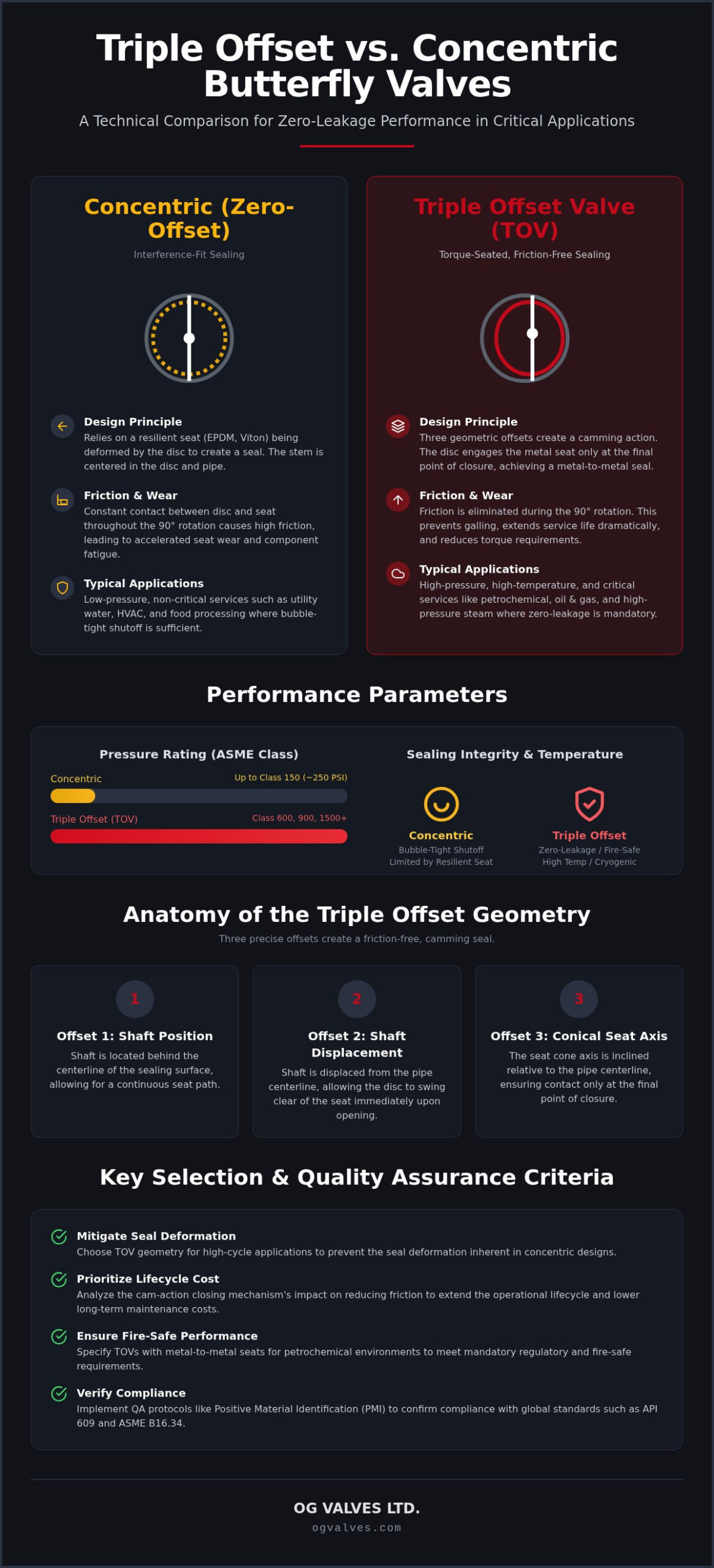
The engineering distinction in a triple offset vs concentric butterfly valve selection begins with the geometric relationship between the stem, disc, and seat centerlines. Concentric designs represent the foundational iteration of this technology, relying on a centered shaft and resilient seat materials to achieve a seal through interference. As industrial requirements evolved to demand higher pressure classes and thermal resistance, the geometry shifted toward the triple-offset configuration. This evolution is a fundamental restructuring of the sealing path designed to eliminate mechanical wear during operation.
The Concentric (Zero-Offset) Configuration
In a concentric valve, the stem passes directly through the centerline of both the disc and the seat. These valves typically utilize ductile iron bodies paired with resilient seats made of EPDM or Viton. While efficient for low-pressure utility services, the design has a significant mechanical limitation. The disc remains in constant contact with the seat throughout the entire 90-degree rotation. This interference-fit sealing method causes localized seat deformation and friction, which accelerates component fatigue in high-cycle applications. It’s a design primarily suited for non-critical water treatment and HVAC systems where bubble-tight shutoff is required at lower pressures.
The Triple Offset Valve (TOV) Geometry
The TOV architecture employs three distinct offsets to transform the sealing motion from a sliding action to a camming action. This geometry allows the disc to seal against the seat only at the final point of closure, effectively eliminating friction during the stroke. Understanding these Butterfly valve design principles is critical for engineers specifying equipment for high-specification process loops.
- Offset 1: The shaft is positioned behind the centerline of the sealing surface. This allows for a continuous sealing path around the entire circumference of the seat, facilitating a complete seal.
- Offset 2: The shaft is displaced to one side of the pipe and valve centerline. This eccentricity allows the disc to swing clear of the seat immediately upon opening, which significantly reduces seat wear and extends the service life of the component.
- Offset 3: The axis of the seat cone is inclined relative to the valve centerline. This creates a right-angled conical sealing profile. It ensures that the disc contacts the seat only at the final degree of closure, achieving a torque-seated seal.
The interaction of these three offsets creates a unique sealing path that enables metal-to-metal contact without the galling typical of traditional designs. By moving the stem away from the disc and seat centerlines, the TOV achieves a seal that maintains integrity under extreme pressure differentials and thermal cycling. This precise engineering ensures that critical infrastructure meets the rigorous safety demands of the oil, gas, and petrochemical sectors.
Performance benchmarks define the operational boundary between utility-grade components and high-specification process equipment. In the technical evaluation of triple offset vs concentric butterfly valve performance, pressure and temperature thresholds serve as the primary deciders for system safety. While concentric designs provide reliable service in low-pressure environments, they can’t match the structural integrity required for extreme industrial process loops.
Pressure Class and Structural Integrity
Concentric butterfly valves are structurally limited to low-pressure applications, typically not exceeding 250 PSI according to standard industrial benchmarks. This limitation stems from the resilient seat’s inability to withstand high differential pressures without risking blowout or permanent deformation. Most concentric designs are confined to ASME Class 150 specifications. Conversely, Triple Offset Valves (TOVs) are engineered for high-pressure environments, maintaining bi-directional sealing in Class 600, 900, and even Class 1500+ services. The torque-seated mechanism ensures that the seal tightens as pressure increases, making them indispensable for high-pressure steam and volatile hydrocarbon service. Adherence to the API 609 industry standard ensures that both valve types meet specific pressure-temperature ratings, yet their functional ceilings differ vastly.
Thermal Stability and Seat Material
Temperature thresholds represent a critical failure point for resilient-seated valves. Soft seats made of EPDM, BUNA-N, or PTFE typically face failure modes like melting or loss of elasticity when temperatures exceed 200°C. This restricts their use to ambient water systems or low-heat HVAC applications. TOVs utilize metal-to-metal sealing, often employing Stellite or laminated stainless steel and graphite seats. This construction allows for safe operation in cryogenic conditions or extreme heat reaching up to 800°C. Thermal expansion is a significant factor in these environments; however, the conical geometry of the triple offset design compensates for material expansion. The torque-seated closing action maintains seal integrity even as the valve body and disc undergo thermal cycling. For projects requiring such robust specifications, sourcing high-performance butterfly valves from a verified technical partner is essential for maintaining operational safety.
Media compatibility further dictates the selection process. Concentric valves excel in handling abrasive slurries or clean water where the resilient seat can absorb small particles. However, high-velocity steam or aggressive chemical catalysts will quickly erode soft materials. The zero-leakage performance of a triple offset vs concentric butterfly valve comparison becomes clear in these critical isolation points. TOVs provide fire-safe certification and zero-leakage according to API 598 standards, ensuring that aggressive media remains contained even during catastrophic system failures. This level of reliability is non-negotiable in the petrochemical and power generation sectors where the cost of a leak is measured in both safety risks and significant financial loss.
Analyzing Wear Mechanisms and Service Life Cycles
Mechanical degradation in valve assemblies is a direct function of the sealing geometry’s interaction with the process media. In a technical evaluation of a triple offset vs concentric butterfly valve, the primary wear mechanism shifts from mechanical friction to fluid erosion. Concentric designs rely on constant disc-to-seat interference throughout the 90-degree stroke. This repetitive contact causes localized seat thinning and rubber tearing, particularly in high-velocity flows. While the initial capital expenditure (CAPEX) for concentric valves is lower, the long-term operational expenditure (OPEX) often increases due to frequent seal replacements and unplanned system outages.
Frictionless Closing in Triple Offset Valves
The third offset in a TOV configuration facilitates a specialized cam-action closing mechanism. This geometry ensures the disc remains clear of the seat until the final degree of closure. By eliminating the sliding friction inherent in concentric designs, the TOV prevents the mechanical galling of sealing surfaces. This lack of friction reduces the break-to-open torque and the running torque throughout the stroke. Consequently, engineers can specify smaller, more precise actuators for high-cycle automation environments. This reduction in mechanical stress directly translates to extended seal longevity and consistent zero-leakage performance over thousands of cycles.
Maintenance and Operational Reliability
Service life cycles are dictated by the durability of the seat material against the specific process media. Concentric valves frequently fail when abrasive particles become embedded in the resilient seat, leading to scoring on the disc edge. In contrast, the metal-to-metal or laminated seats found in TOVs are resilient against abrasive media and high-pressure steam. Maintenance protocols for these two designs differ significantly:
- Concentric Valves: These units feature replaceable resilient seats that are cost-effective but prone to tearing. Frequent maintenance intervals are necessary to prevent leakage across the seat.
- Triple Offset Valves: These are engineered for long-term isolation. While on-site seat replacement is more complex and often requires factory-level precision, the frequency of such interventions is substantially lower.
The selection of robust, metal-seated components is a strategic decision to minimize downtime in critical infrastructure. In sectors like oil and gas, the reliability of the valve’s “cam-action” provides a level of operational security that justifies the higher initial investment. By preventing seat erosion and maintaining structural integrity under load, triple offset valves provide a predictable service life that aligns with major plant turnaround schedules. This clinical focus on durability ensures that critical isolation points don’t become the weakest link in the process chain.
Application-Specific Selection: When to Specify Each Design
The technical selection of a triple offset vs concentric butterfly valve depends on the criticality of the process loop and the specific properties of the media. Engineers must evaluate whether a system requires a resilient barrier for low-pressure utilities or a high-integrity metal seal for hazardous environments. Defining these operational boundaries is essential for maintaining safety and preventing premature component failure.
General Service and Low-Pressure Utility
Concentric butterfly valves remain the industry standard for non-critical, low-temperature water lines. In water treatment facilities and HVAC installations, the resilient seat provides a cost-effective, bubble-tight shutoff at pressures typically below Class 150. These valves often utilize “sleeve-style” seats that fully isolate the valve body from the media. This design eliminates the need for high-alloy body materials in mildly corrosive utility systems. For these applications, the lower initial capital expenditure aligns with the manageable maintenance requirements of utility infrastructure.
Critical Isolation and Extreme Environments
The oil, gas, and petrochemical sectors require valves that maintain integrity during catastrophic events. Triple Offset Valves (TOVs) are the mandated choice for fire-safe isolation, adhering to API 607 or ISO 10497 standards. In refinery operations, the metal-to-metal sealing of a TOV ensures zero-leakage performance even when exposed to intense heat that would incinerate resilient materials. These valves are frequently specified for Emergency Shutdown Valves (ESDV) and critical process paths where the cost of failure is unacceptable. To ensure your project meets these rigorous benchmarks, you can request technical specifications for high-performance butterfly valves from our engineering team.
Power generation facilities rely on TOVs to handle high-pressure steam and condensate return lines. The ability of the triple-offset geometry to withstand thermal cycling without seat deformation prevents steam wiredrawing, a common failure mode in lower-specification designs. In the pulp and paper industry, TOVs manage fibrous media and abrasive slurries that would quickly erode soft-seated concentric valves. The torque-seated mechanism provides the necessary force to cut through media build-up, ensuring a positive seal in every cycle. For a deeper analysis of these mechanisms, technical professionals should consult our industrial butterfly valves guide.
Procuring critical infrastructure components requires more than a simple comparison of a triple offset vs concentric butterfly valve. It demands rigorous verification of metallurgical integrity and strict adherence to global benchmarks. High-stakes industrial sectors don’t rely on unverified claims. They require documented compliance with API 609, ASME B16.34, and MSS SP-67 to ensure that every component functions within its specified safety margin. This focus on regulatory adherence is what separates reliable process loops from systems prone to catastrophic failure.
Compliance with API 609 and ASME B16.34
The API 609 standard categorizes valves based on their design and performance capabilities. Category A refers to concentric, resilient-seated valves, while Category B covers high-performance designs, including triple offset configurations. Adherence to API 609 provides the necessary assurance that a high-performance butterfly valve meets the rigorous structural and testing requirements for critical industrial service. Beyond design categories, ASME B16.34 governs the pressure-temperature ratings and minimum wall thickness requirements. Engineers must verify these data points during the procurement phase to ensure the valve body can withstand the maximum allowable working pressure (MAWP) of the system. Verification of these standards ensures that the selected geometry isn’t just theoretically correct but is structurally sound for its intended environment.
Strategic Sourcing with OG VALVES LTD.
Operational continuity depends on the availability of high-specification inventory and the ability to verify material classifications. Positive Material Identification (PMI) is essential when sourcing valves for corrosive petrochemical environments. This process confirms the alloy composition of the disc and seat, preventing the installation of sub-standard materials that could lead to rapid erosion. OG VALVES LTD. prioritizes this level of technical precision, offering global fast-track delivery capabilities to minimize project downtime. Technical support is a critical component of our service. Our experts provide consultation for selecting between gate, globe, and other industrial valves, ensuring that the chosen geometry aligns with the project’s pressure class and media requirements.
Successful project management in heavy industry relies on a dependable supply chain. By maintaining a clinical focus on engineering excellence and international certifications, OG VALVES LTD. acts as a technical partner rather than a mere vendor. We understand the cost of failure in critical infrastructure. Our quality assurance protocols include rigorous testing and comprehensive documentation, providing the reliability required for large-scale industrial demands. This systematic approach to procurement ensures that every valve, whether concentric or triple offset, meets the highest benchmarks for industrial safety and performance.
Optimizing Infrastructure Reliability Through Precise Valve Selection
The technical decision between a triple offset vs concentric butterfly valve dictates the long-term integrity of critical process loops. While concentric designs provide cost-effective service for low-pressure utility lines, triple offset valves are essential for high-pressure, high-temperature isolation in hazardous environments. Implementing torque-seated, cam-action geometry eliminates the mechanical friction that leads to premature seal failure in standard interference-fit designs. This transition ensures that your facility achieves zero-leakage performance and maintains compliance with rigorous API 598 testing standards.
OG Valves functions as a specialist partner for the global oil, gas, and power industries. We maintain a comprehensive inventory of API-compliant industrial valves and offer global fast-track delivery to minimize facility downtime during critical turnarounds. Our technical experts are available to assist with detailed material specifications and pressure-temperature rating verifications for your next project. Contact OG Valves for technical specifications and quotes on high-performance butterfly valves to ensure your infrastructure meets the highest benchmarks for industrial safety and engineering excellence.
Frequently Asked Questions
Is a triple offset butterfly valve always better than a concentric one?
No, selection is strictly application-specific. Concentric designs are the optimal choice for low-pressure utility water and HVAC systems due to their cost-efficiency and bubble-tight performance in non-critical loops. Triple offset valves are reserved for high-pressure, hazardous process environments where metal-to-metal sealing is mandatory. Using a high-specification valve in a basic utility line leads to unnecessary capital expenditure without providing functional benefits to the system’s operational parameters.
What are the main causes of seat failure in concentric butterfly valves?
Seat failure in concentric designs typically stems from mechanical interference and abrasive wear. Because the disc remains in contact with the resilient seat throughout the 90-degree stroke, the material undergoes constant deformation and friction. This leads to localized thinning or tearing of the elastomer. Additionally, high-velocity media can cause seat blowout if the differential pressure exceeds the resilient material’s structural limits, resulting in a total loss of seal integrity.
Can a triple offset butterfly valve be used for throttling service?
Triple offset valves are primarily engineered for isolation but can perform limited throttling services. The cam-action geometry allows for precise control without the seat friction found in other designs. However, engineers must verify the flow coefficient and cavitation potential. Prolonged throttling near the seat can lead to erosion of the metal seal rings, potentially compromising the valve’s ability to achieve a zero-leakage shutoff during subsequent isolation cycles.
How does the cost of a triple offset valve compare to a concentric valve?
The initial capital expenditure for a triple offset valve is substantially higher than a concentric design. This price difference reflects the complex machining required for the three offsets and the use of high-alloy materials like Stellite. However, when evaluating the triple offset vs concentric butterfly valve over a long-term service lifecycle, TOVs often prove more economical in critical services. Reduced maintenance intervals and the prevention of unplanned downtime offset the higher procurement cost.
What does “zero-leakage” mean in the context of triple offset valves?
Zero-leakage indicates that the valve meets API 598 or ISO 5208 Rate A testing criteria. During high-pressure hydrostatic testing, no visible bubbles or drops are observed across the sealing surface. This performance level is achieved through torque-seating, where the actuator provides enough force to create a metal-to-metal seal. It is a critical requirement for volatile hydrocarbons and high-pressure steam where any leakage poses significant safety and environmental risks.
Are concentric butterfly valves suitable for high-temperature steam?
Concentric valves are unsuitable for high-temperature steam applications. The elastomer seats, such as EPDM or Viton, typically degrade or melt when temperatures exceed 200°C. High-velocity steam causes rapid erosion of the soft materials, leading to wiredrawing across the seat. For steam service, the metal-to-metal sealing and thermal expansion compensation of a triple offset design are required to maintain structural integrity and operational safety.
What international standards govern the design of triple offset butterfly valves?
Design and manufacturing are governed by API 609 Category B and ASME B16.34. These standards define the minimum wall thickness, pressure-temperature ratings, and testing protocols required for industrial service. Additionally, fire-safe certifications like API 607 or ISO 10497 are often required for refinery applications. Compliance with these international benchmarks ensures that the valve can withstand the maximum allowable working pressure and maintain isolation during catastrophic events.
Why is torque-seating important in triple offset valve designs?
Torque-seating is the mechanism that ensures seal integrity in triple offset configurations. Unlike concentric valves that rely on interference, a TOV uses the actuator’s torque to compress the seal ring against the seat. This creates a positive, mechanical seal that becomes tighter as the applied torque or process pressure increases. This design is essential for achieving zero-leakage in high-pressure systems where resilient materials would fail to provide a reliable barrier.
 Responsive Menu