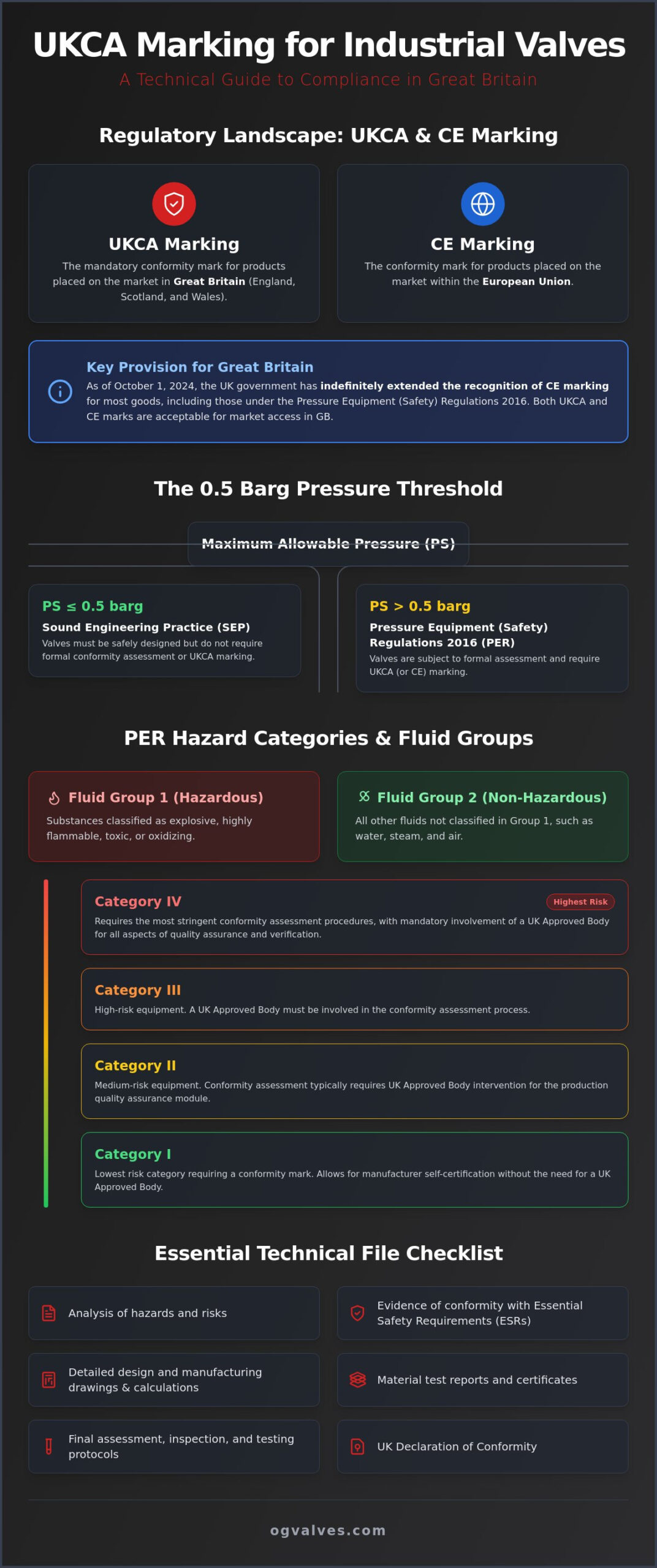
The assumption that UKCA marking is currently the sole mandatory requirement for industrial valves within Great Britain is technically inaccurate. Under legislation effective as of October 1, 2024, the UK government indefinitely extended the recognition of CE marking for equipment falling under the Pressure Equipment (Safety) Regulations 2016. This article provides the UKCA marking for valves explained with the technical rigour required by procurement specialists and safety engineers. It focuses on the 0.5 barg pressure threshold that dictates regulatory scope and the precise documentation needed to ensure structural soundness and safety.
Navigating the transition between regulatory frameworks often results in project delays and documentation discrepancies. We recognize that adherence to British Standards is a matter of operational integrity rather than mere administrative compliance. This technical briefing outlines the essential requirements for gate, globe, and check valves, providing a clinical analysis of the current legal landscape. You’ll find a definitive checklist for technical file construction and a clear roadmap for differentiating between UKCA and CE obligations to maintain unwavering project continuity and engineering excellence.
Key Takeaways
- Define the classification of industrial valves into Categories I through IV based on hazard levels to determine if third-party Approved Body intervention is mandatory.
- Navigate the distinct regulatory requirements for Great Britain and Northern Ireland, ensuring compliance with the Windsor Framework and relevant UK Statutory Instruments.
- Review the essential technical documentation requirements, including the specific conformity assessment modules necessitated by the Pressure Equipment (Safety) Regulations 2016.
- Obtain a technical breakdown of the UKCA marking for valves explained to mitigate the risk of project delays and non-compliant equipment procurement in heavy industrial sectors.
- Establish a protocol for sourcing fully certified gate, ball, globe, and check valves that meet rigorous engineering standards and global safety certifications.
What is UKCA Marking for Industrial Valves?
UKCA is the conformity assessment mark for Great Britain. It verifies that industrial valves meet statutory safety standards. For a comprehensive UKCA marking overview, it’s understood that this system replaces the European CE mark for products entering the market in England, Scotland, and Wales. This transition is a critical component of the UKCA marking for valves explained, as it enforces compliance with specific UK legislation to ensure mechanical integrity and operational safety in high-pressure environments. While CE marking currently remains accepted under extended recognition, the shift toward UKCA represents the formalization of the UK’s independent regulatory policy for industrial infrastructure.
The marking applies specifically to pressure equipment with a maximum allowable pressure (PS) exceeding 0.5 barg. Valves falling below this threshold aren’t subject to the same formal conformity assessment procedures, though they must still adhere to safe design principles. For engineers and procurement specialists, the presence of the UKCA mark serves as a declaration that the component satisfies the essential safety requirements (ESRs) mandated by the UK’s legal framework.
The Legal Framework: PER vs PED
The Pressure Equipment (Safety) Regulations 2016, commonly referred to as PER, serve as the statutory instrument governing pressure equipment in the UK. This framework transitioned the UK away from the European Union’s Pressure Equipment Directive (PED), establishing a localized set of standards for domestic industrial infrastructure. Manufacturers must ensure their valves are assessed against the essential safety requirements detailed in PER Schedule 2. These requirements cover material selection, design calculations, manufacturing processes, and final testing protocols to mitigate the risk of catastrophic failure under pressure. Documentation must be exhaustive, including material test reports and evidence of specialized manufacturing qualifications where applicable.
Scope of Application for Industrial Components
The scope of PER encompasses standard industrial components, including gate, ball, globe, check, and butterfly valves. Equipment with a PS below 0.5 barg is classified under Sound Engineering Practice (SEP). SEP items don’t carry the UKCA mark but must be designed and manufactured to ensure safe use. For valves exceeding the 0.5 barg limit, the specific categorization depends on the fluid group and the pressure-volume product. Categorization criteria include:
- Fluid Group 1: Hazardous substances, including explosive, flammable, toxic, or oxidizing fluids.
- Fluid Group 2: Non-hazardous fluids, such as water, steam, or air.
- PS.DN Product: The product of the maximum allowable pressure and the nominal pipe size (DN).
- Physical State: Whether the fluid is a gas or a liquid at the maximum allowable temperature.
This categorization dictates whether a valve falls into Category I, II, III, or IV. Each increase in category level requires more stringent quality assurance, technical documentation, and, in many cases, the involvement of a UK Approved Body to verify compliance.
Pressure Equipment Regulations (PER) Categories for Valves
The UKCA marking for valves explained involves a systematic assessment of risk. Under the Pressure Equipment (Safety) Regulations 2016, valves are classified into four distinct categories, I through IV, based on the potential hazard they pose during operation. This classification determines the level of technical oversight required for compliance. While Category I equipment allows for manufacturer self-certification, higher categories necessitate the intervention of a UK Approved Body. This assessment ensures that critical components, such as high-pressure gate and ball valves, meet the structural requirements necessary for hazardous environments.
Hazard classification relies heavily on the fluid group handled by the valve. Group 1 consists of hazardous substances, including explosive, flammable, toxic, or oxidizing fluids. Group 2 encompasses non-hazardous fluids such as water or steam. A valve’s category increases as the fluid’s volatility and the system’s operational pressure rise. Manufacturers must consult the Official UK Government Guidance to confirm the specific statutory instruments applicable to their equipment. The transition from the European Union also shifted the terminology; the ‘Notified Body’ used in the EU PED framework is replaced by the ‘Approved Body’ within the UK PER framework.
Determining Your Valve’s Hazard Category
Classification is a mathematical function of the valve’s Nominal Size (DN) and its Maximum Allowable Pressure (PS). The physical state of the fluid—whether it’s a gas or a liquid—significantly alters the classification matrix. Gases and unstable liquids generally trigger higher hazard categories than stable liquids at the same pressure and size. This distinction is critical for high-specification petrochemical valves, which often fall into Categories III or IV. These categories require exhaustive design examination and rigorous manufacturing surveillance to prevent catastrophic containment failure in volatile systems.
The Role of UK Approved Bodies
For valves classified as Category II, III, or IV, the involvement of a UK Approved Body is a mandatory legal requirement. These bodies are independent entities authorized by the UK government to verify that products meet the essential safety requirements of the PER. They must be physically based in the UK and listed on the UK Market Conformity Assessment Bodies (UKMCAB) database. During the assessment process, the Approved Body performs several critical functions:
- Verification of technical documentation and design calculations.
- Surveillance of the manufacturer’s quality management system.
- Witnessing of final pressure tests and non-destructive examination (NDE).
- Validation of material certificates, specifically ensuring compliance with EN 10204 3.1 or 3.2 standards.
This technical breakdown ensures that the UKCA marking for valves explained aligns with the operational realities of high-pressure systems. Failure to engage an Approved Body for eligible equipment renders the UKCA mark invalid and the equipment non-compliant for the Great Britain market.
UKCA vs CE Marking: Northern Ireland and Global Trade
The regulatory landscape for pressure equipment requires a precise understanding of jurisdictional boundaries. While Great Britain enforces the UKCA mark, the European Union maintains the CE marking mandate. A significant technical misconception persists that the UKCA marking is a direct administrative duplicate of the CE process. While the underlying engineering standards often align, the legal declarations differ fundamentally. The UKCA marking for valves explained necessitates a Declaration of Conformity that specifically cites UK Statutory Instruments, such as the Pressure Equipment (Safety) Regulations 2016, rather than European Union Directives. Failure to reference the correct legislative framework renders the documentation non-compliant, regardless of the valve’s physical integrity.
Dual-marking has emerged as a standard practice for manufacturers targeting global distribution. By applying both UKCA and CE marks to a single valve body or identification plate, suppliers ensure the component is legally marketable in both Great Britain and the European Economic Area. This approach mitigates the need for separate inventory streams for identical technical specifications, provided the technical file satisfies the rigorous requirements of both regulatory regimes.
The Northern Ireland Protocol and UKNI Marking
Northern Ireland occupies a unique regulatory position under the Windsor Framework. CE marking remains the mandatory requirement for industrial valves placed on the market in Northern Ireland to ensure unfettered access to the EU single market. However, if a manufacturer utilizes a UK-based Approved Body for a mandatory third-party conformity assessment, the UKNI mark must be applied alongside the CE mark. It’s critical to note that the UKNI mark is never used in isolation; it always accompanies the CE mark. Goods carrying the CE + UKNI marking are valid for the Northern Ireland market but are not recognized within the European Union, where an EU-based Notified Body must be used for the CE mark to stand alone.
Managing International Supply Chains
Global procurement teams must maintain strict oversight of marking requirements to prevent project delays during customs clearance or site inspections. Engineering specifications must clearly define the required marking based on the final installation site. This is particularly vital for high-stakes infrastructure involving gate, ball, and check valves where regulatory adherence is a primary safety metric. The UKCA marking for valves explained in the context of international trade emphasizes that clear, permanent marking on the valve body is essential for traceability. Procurement specialists should verify that all technical documentation, including material certificates and test reports, aligns with the specific markings on the physical hardware to ensure seamless integration into global industrial projects.
Checklist for UKCA Technical Documentation and Compliance
Compliance with the Pressure Equipment (Safety) Regulations 2016 requires a structured verification process. The UKCA marking for valves explained emphasizes that physical hardware must be accompanied by a comprehensive evidence package. Engineering departments must adhere to a rigid five-step compliance sequence to mitigate the risk of legal non-conformity and project delays. This methodical approach ensures that every valve, whether a standard gate valve or a high-specification needle valve, meets the required safety benchmarks.
- Step 1: Regulatory Identification: Confirm the valve’s specific scope and requirements under the Pressure Equipment (Safety) Regulations 2016 (PER).
- Step 2: Module Selection: Determine the conformity assessment module, such as A2, B, D, or H, as dictated by the valve’s hazard category.
- Step 3: Technical File Assembly: Consolidate all design calculations, material specifications, and manufacturing records into a centralized file.
- Step 4: Third-Party Verification: Engage a UK Approved Body for mandatory surveillance and assessment if the valve exceeds Category I classification.
- Step 5: Final Declaration: Issue the formal UK Declaration of Conformity and permanently affix the UKCA mark to the valve body or identification plate.
Essential Components of the Technical File
The technical file acts as the definitive engineering record for the valve. It must contain precise design and manufacturing drawings for the valve body, stem, and seals, ensuring that wall thicknesses and joint configurations meet statutory safety factors. A formal risk assessment is mandatory to identify potential failure modes, such as fatigue or environmental stress corrosion, and the specific measures taken to eliminate these risks. The UKCA marking for valves explained within the technical file context ensures that every component is documented for safety. Additionally, the file must house original material test reports (MTRs) that verify metallurgical properties against international standards like ASTM or EN. For procurement specialists seeking pre-verified solutions, it’s advisable to source valves from certified global suppliers who maintain these rigorous documentation standards.
Drafting the UK Declaration of Conformity (DoC)
The DoC is the manufacturer’s formal assertion that the equipment complies with all relevant UK legislation. It’s a technical failure to reference European Union directives like the PED on a UKCA declaration; only UK Statutory Instruments, specifically PER 2016, are legally valid. The document must include the manufacturer’s registered address, the valve’s unique serial number, and the identification number of the UK Approved Body responsible for the assessment. Manufacturers and importers must ensure this documentation remains accessible for 10 years after the valve is placed on the market. This retention policy ensures that technical data is available for forensic review in the event of an operational failure or regulatory audit, maintaining the integrity of the industrial infrastructure.
Procuring Compliant Valves with OG VALVES LTD.
Reliability in high-pressure environments is non-negotiable. Our quality control processes involve comprehensive pressure testing and non-destructive examination (NDE) to verify metallurgical integrity before shipment. By providing pre-verified documentation packages, OG VALVES LTD. ensures that site-specific audits and regulatory inspections proceed without technical discrepancies. Fast-track delivery options are available to minimize operational downtime in critical infrastructure projects. We don’t just supply hardware; we provide the engineering assurance required for high-stakes industrial applications.
Technical Support for Engineering Specifications
Our engineering team assists clients in identifying the correct PER category for their specific application, whether it involves Group 1 hazardous fluids or Group 2 non-hazardous substances. We specialize in components that adhere to API 600 standards while simultaneously meeting UKCA requirements for the British market. This dual-verification approach is essential for large-scale projects where material selection must withstand corrosive media and high-pressure differentials. We provide expert guidance on alloy selection and trim configurations to ensure long-term performance and regulatory adherence.
Reliable Global Logistics and Certification
Managing international supply chains requires a clinical focus on certification and logistics. OG VALVES LTD. has extensive experience providing the necessary evidence packages for complex infrastructure projects across various jurisdictions, including those requiring CE, UKCA, or UKNI markings. We prioritize industrial safety by anchoring every claim in rigorous testing and verified quality control data. Our logistical network is structured to handle the demands of global energy and manufacturing sectors with precision. For detailed technical specifications or a project-specific quote, contact our technical team regarding UKCA-marked industrial valves to ensure your assets meet the highest engineering standards.
Standardizing Compliance for Future Industrial Infrastructure
Adherence to the Pressure Equipment (Safety) Regulations 2016 ensures the structural soundness and legal compliance of critical industrial infrastructure. This technical overview of the UKCA marking for valves explained the necessity of precise hazard categorization and the rigorous documentation required for technical files. Maintaining a clinical distinction between GB, NI, and EU marking requirements is vital for seamless global project management. Engineering excellence depends on the accurate verification of material certificates and the engagement of UK Approved Bodies when mandated by specific hazard levels.
OG VALVES LTD. provides the technical expertise required to navigate these regulatory frameworks without compromising project timelines. Our extensive inventory of API and ASME certified valves is supported by specialist guidance for PER and UKCA compliance. We utilize global logistics networks to facilitate fast-track delivery for high-stakes industrial demands. Establishing a robust compliance protocol today secures the long-term reliability and safety of your industrial assets. Request a Technical Quote for UKCA-Compliant Industrial Valves to begin your procurement process.
Frequently Asked Questions
Do all industrial valves require UKCA marking?
No, only valves with a maximum allowable pressure (PS) exceeding 0.5 barg fall within the scope of the Pressure Equipment (Safety) Regulations 2016. Equipment operating at or below this pressure threshold is classified under Sound Engineering Practice (SEP). SEP components must be designed for safety but are legally prohibited from carrying the UKCA mark.
Can a valve carry both CE and UKCA markings simultaneously?
Yes, dual-marking is a standard industry practice for equipment destined for global markets. A valve can carry both marks provided it satisfies the essential safety requirements of both the UK PER and the EU PED. This approach allows manufacturers to maintain a single inventory for distribution across both Great Britain and the European Economic Area.
What is the pressure threshold for UKCA marking under PER?
The mandatory threshold for conformity assessment is 0.5 barg. Any industrial valve designed to operate above this maximum allowable pressure must meet the statutory requirements of the Pressure Equipment (Safety) Regulations 2016. This technical breakdown is a core component of the UKCA marking for valves explained for engineering and procurement teams.
Is UKCA marking required for valves sold in Northern Ireland?
No, the UKCA mark alone is not valid for the Northern Ireland market. Under the Windsor Framework, Northern Ireland continues to align with EU single market rules, necessitating the CE mark. If a UK-based Approved Body performs the mandatory third-party assessment, the UKNI mark must be affixed alongside the CE mark.
Who is responsible for affixing the UKCA mark on an industrial valve?
The manufacturer or their authorized representative holds the legal responsibility for affixing the UKCA mark. By applying the mark, the manufacturer declares that the valve conforms to all relevant UK safety legislation. Importers must also verify that the manufacturer has completed the correct assessment before placing the product on the market.
Does a UKCA mark expire or require renewal?
The mark itself does not have an expiration date, but the underlying technical documentation and certificates may. If the valve design, manufacturing process, or the applicable British Standards change, the manufacturer must update the conformity assessment. Certificates issued by UK Approved Bodies typically have a set validity period, often 10 years, depending on the assessment module.
What happens if a valve is installed without the correct UKCA marking?
Installation of non-compliant pressure equipment is a violation of UK statutory law. This can result in immediate project suspension, mandatory equipment removal, and significant legal penalties for the operator. Furthermore, using unmarked valves in high-pressure systems introduces unquantified liability risks and potential insurance invalidation in the event of a mechanical failure.
How do UKCA requirements affect valves imported from outside the UK?
Importers are legally classified as the entity placing the product on the GB market and must ensure full compliance. They must verify that the manufacturer has compiled a technical file and issued a UK Declaration of Conformity. This ensures the UKCA marking for valves explained in the regulatory framework is correctly applied to imported gate, ball, or check valves.
 Responsive Menu