Valve Material Chemical Compatibility Chart: A Technical Specification Guide (2026)
April 26, 2026
Home+Valve Material Chemical Compatibility Chart: A Technical Specification Guide (2026)
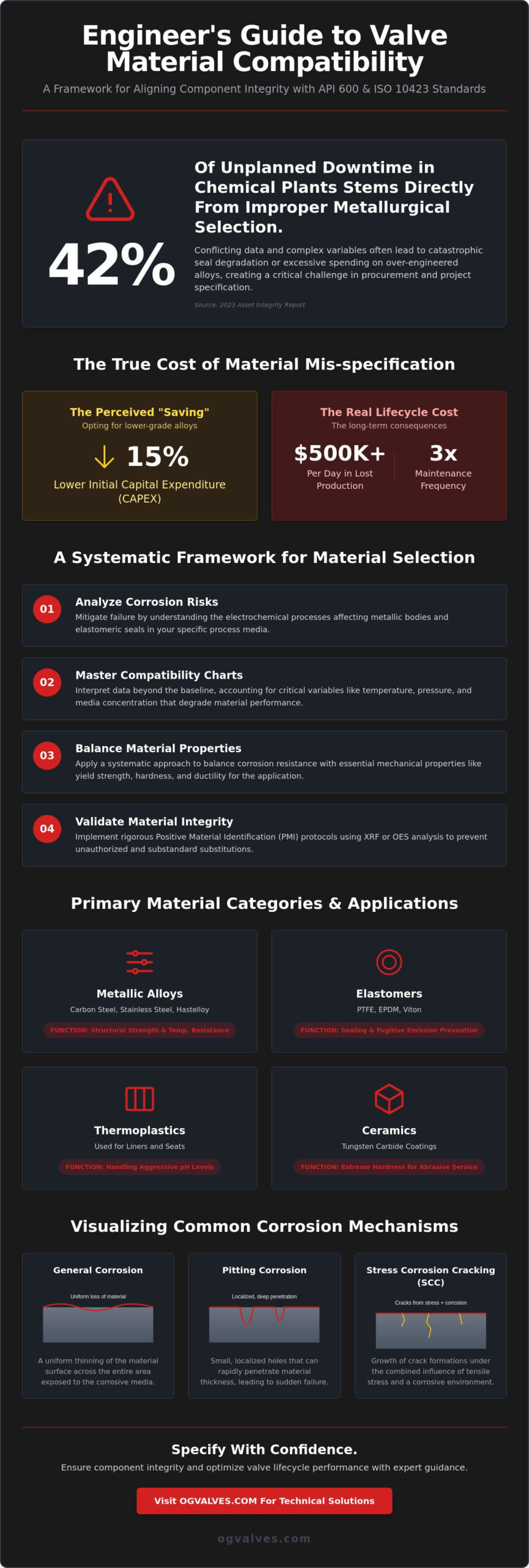
Industry data from the 2023 Asset Integrity Report confirms that 42% of unplanned downtime in chemical processing plants stems directly from improper metallurgical selection. Engineers recognize that the intersection of chemical volatility and mechanical stress leaves zero margin for error. Conflicting data sheets often complicate the procurement process, making it difficult to utilize a reliable valve material chemical compatibility chart effectively. It’s a challenge that leads to either excessive expenditure on over-engineered alloys or catastrophic seal degradation.
This technical guide provides a definitive specification framework designed to align component integrity with API 600 and ISO 10423 standards. You’ll master the technical complexities of material selection through our comprehensive compatibility analysis. We examine the corrosion resistance profiles of forged steel, duplex stainless, and specialized elastomers to establish a rigorous framework for 2026 project specifications. This analysis ensures compliance with international safety protocols while optimizing valve lifecycle performance across high-stakes industrial applications.
Key Takeaways
Mitigate the risk of catastrophic valve failure by analyzing the electrochemical corrosion processes that affect metallic bodies and elastomeric seals.
Master the interpretation of a valve material chemical compatibility chart to account for critical temperature variables that can degrade material performance ratings.
Apply a systematic 5-step framework to balance corrosion resistance with essential mechanical properties like yield strength and hardness in new project specifications.
Validate material integrity and prevent unauthorized substitutions by implementing rigorous Positive Material Identification (PMI) protocols using XRF or OES analysis.
Understanding Chemical Compatibility in Industrial Valve Specification
Chemical compatibility signifies the inherent capacity of a material to resist structural or surface degradation when exposed to specific process media. In high-pressure environments, maintaining material integrity is the primary defense against catastrophic valve failure and uncontrolled environmental leaks. Engineers must differentiate between distinct modes of failure to ensure long-term reliability. General corrosion involves a uniform loss of material across the surface. Pitting represents localized, deep penetration that can breach pressure boundaries rapidly. Stress corrosion cracking (SCC) involves the growth of cracks under combined tensile stress and corrosive environments, often occurring without visible warning or significant metal loss.
When selecting Valve materials of construction, technical teams must recognize that a standard valve material chemical compatibility chart serves only as a foundational reference. Industrial systems often involve complex fluid dynamics, temperature fluctuations, and varying concentrations that static charts don’t fully capture. For instance, a material rated as compatible at 25°C may suffer rapid degradation when temperatures reach 100°C. Total system chemistry, including trace contaminants, often dictates the final specification requirements beyond what a simplified chart provides.
The Economic Impact of Material Mis-specification
Premature valve failure generates costs that extend far beyond the price of a replacement unit. Unscheduled downtime in a mid-sized refinery can exceed $500,000 per day in lost production. Material selection directly dictates the Total Cost of Ownership (TCO) over a 20-year lifecycle. Opting for lower-grade alloys might reduce initial capital expenditure by 15%, yet it frequently triples the frequency of maintenance interventions. Insurance providers in heavy industry now mandate rigorous material documentation and compliance with API and ASME standards to mitigate liability risks associated with hazardous fluid containment.
Primary Material Categories in Industrial Valves
Valve bodies primarily utilize metallic materials like carbon steel for non-corrosive service, stainless steel (316/316L) for general corrosion resistance, and high-nickel alloys like Hastelloy or Inconel for extreme acid exposure. Internal sealing relies on elastomers and thermoplastics to maintain bubble-tight shutoff. PTFE offers near-universal chemical inertness, while EPDM and Viton provide specific resilience against steam or hydrocarbons respectively. For highly abrasive slurries, ceramic components or specialty tungsten carbide coatings are required to maintain seat tightness and prevent erosive wear. Utilizing a valve material chemical compatibility chart helps narrow these choices before applying specific mechanical stress calculations.
Metallic Alloys: Provide structural strength and resistance to high-temperature oxidation.
Elastomers: Critical for seal recovery and preventing fugitive emissions.
Thermoplastics: Used for liners and seats to handle aggressive pH levels.
Ceramics: Essential for extreme hardness in abrasive or high-velocity flows.
Material Science: How Industrial Media Affect Metallic and Elastomeric Components
Selecting appropriate materials depends on the kinetic interaction between the process fluid and the valve’s internal surfaces. Engineers utilize a valve material chemical compatibility chart to predict these interactions, ensuring the structural integrity of the pressure boundary. Metallic degradation typically occurs through electrochemical oxidation. For austenitic stainless steels like Grade 316L, the integrity of the passive chromium oxide layer is critical. When exposed to chlorides exceeding 1,000 ppm or concentrated hydrochloric acid, this layer undergoes localized breakdown, leading to pitting or crevice corrosion. Media concentration significantly influences these rates; a 5% increase in sulfuric acid concentration can increase the corrosion rate of cast iron by a factor of three at temperatures above 40°C.
Corrosion Mechanisms in Metallic Valves
Galvanic corrosion occurs when two dissimilar metals, such as a 410 stainless steel stem and a carbon steel body, contact each other within a conductive electrolyte. This creates a potential difference that accelerates the oxidation of the more anodic material. Erosion-corrosion represents a synergistic failure mode where high-velocity fluid flow, often exceeding 20 meters per second, physically strips away the protective oxide film; this exposes fresh metal to immediate chemical attack. Intergranular corrosion in austenitic stainless steels involves the precipitation of chromium carbides at grain boundaries during improper heat treatment, which depletes the surrounding areas of chromium and facilitates localized failure.
Chemical Degradation of Soft Seats and Seals
Elastomeric components often fail before metallic bodies because of their permeable molecular structures. Polymer chain scission occurs when aggressive media, such as concentrated nitric acid, breaks the primary covalent bonds within the elastomer. This results in a total loss of tensile strength and elasticity. In high-pressure gas applications reaching 15,000 PSI, explosive decompression poses a risk; gas permeates the seal at high pressure and expands rapidly during depressurization, causing internal ruptures. Selecting seat materials requires balancing thermal and chemical limits. While PTFE offers near-universal resistance up to 200°C, cryogenic services below -196°C require specialized polymers like PCTFE to maintain sealing integrity without becoming brittle. You can review our technical specifications for high-performance seals to ensure compliance with API 6D standards.
The performance of any industrial valve is tethered to the chemical stability of its smallest components. It’s essential to cross-reference your specific media concentration and operating temperature against a valve material chemical compatibility chart before finalizing a specification. This methodical approach prevents premature seal swelling, where the elastomer absorbs the process fluid and increases in volume, often leading to increased operating torque or total valve seizure.
Interpreting the Valve Material Chemical Compatibility Chart: Key Variables
Reading a valve material chemical compatibility chart requires an understanding of the standardized rating system. Most industrial matrices utilize a four-tier scale to define material degradation. An “A” rating signifies excellent compatibility with negligible corrosion rates, typically less than 0.05 mm per year. A “B” rating indicates minor effects where slight corrosion occurs; this often necessitates more frequent inspection intervals. A “C” represents a fair rating with moderate effects, while a “D” rating denotes severe effects, rendering the material unsuitable for the specified media. Using a “C” rated material in a critical high-pressure line is an engineering risk that often leads to premature component failure.
Engineers must recognize the temperature trap. Chemical reactions accelerate as thermal energy increases; a material that’s stable at 20°C may suffer catastrophic failure at 150°C. For example, 316 Stainless Steel maintains an “A” rating for 10% nitric acid at ambient temperatures but degrades rapidly as temperatures exceed 80°C. Synergistic effects also complicate selection. The presence of just 50 ppm of hydrogen sulphide (H2S) in a hydrocarbon stream can initiate sulfide stress cracking in standard carbon steels that otherwise handle the primary fluid without issue. High system pressure further compounds these risks by increasing the solubility of corrosive gases, forcing them into the material’s molecular structure and accelerating internal decay.
Temperature-Pressure De-rating in Material Selection
Material selection isn’t static. It follows the de-rating curves established in ASME B16.34. This standard dictates the maximum allowable working pressure (MAWP) as temperatures rise. A Class 300 valve made of Group 2.2 materials, such as 316 Stainless Steel, has a pressure rating of 49.6 bar at 38°C; this rating drops to 33.3 bar at 250°C. Engineers must also calculate thermal expansion coefficients. In high-precision components like needle valves, the 16.0 µm/m·K expansion rate of austenitic steels can lead to mechanical binding if tolerances don’t account for the critical temperature of the process fluid. Ignoring these variables during the design phase compromises the entire valve material chemical compatibility chart assessment.
Common Media and Their Material Matchings
Specific industrial environments demand specialized alloys to ensure system integrity. Seawater applications, characterized by chloride concentrations near 19,000 mg/L, require Duplex or Super Duplex steels with a Pitting Resistance Equivalent Number (PREN) exceeding 40. For sulphuric acid service, the concentration dictates the choice. Alloy 20 is the industry benchmark for mid-range concentrations where standard steels fail. In hydrocarbon service, standard A105 carbon steel is sufficient for “sweet” service. “Sour” environments containing H2S require materials compliant with NACE MR0175/ISO 15156. These standards ensure that forged steel and cast components are hardness-controlled below 22 HRC to prevent brittle fracture in high-stakes oil and gas operations.
Strategic Selection: Matching Valve Materials to Corrosive Environments
Specifying materials for industrial fluid control requires a structured technical framework to prevent catastrophic failure. Engineers shouldn’t rely on intuition; they must consult a valve material chemical compatibility chart to cross-reference fluid properties against specific alloy grades. A rigorous 5-step framework for project specification includes identifying media concentration, determining peak operating temperatures, calculating pressure velocity (PV) limits, assessing erosion potential, and verifying compliance with international standards. This methodical approach ensures that the chosen material maintains structural integrity throughout its design life.
Selecting a material involves balancing corrosion resistance with mechanical properties like yield strength and hardness. While a polymer might offer superior resistance to a specific acid, it’ll lack the tensile strength required for high-pressure ASME Class 900 service. In oil and gas applications, NACE MR0175/ISO 15156 compliance is a non-negotiable requirement for sour service. This standard dictates strict limits on material hardness and heat treatment to prevent Sulfide Stress Cracking (SSC). When standard 316 stainless steel or carbon steel cannot withstand the environment, exotic alloys become necessary. Inconel 625, Monel 400, and Hastelloy C276 are specified for extreme service involving high chloride concentrations or severe oxidizing agents where standard alloys would suffer from pitting or crevice corrosion.
Regulatory Compliance and Industry Standards
Adherence to API 600, 602, and 603 standards is essential for defining the wall thickness and shell design of steel gate valves. These standards ensure that the pressure-containing envelope meets safety factors required for industrial use. Fire Safe certification, specifically API 607, is another critical benchmark. It verifies that a valve’s material selection and seal design can withstand temperatures up to 980°C without significant leakage. ASTM specifications provide the foundational chemistry and mechanical limits that manufacturers must follow to ensure consistency across global supply chains.
Optimising Valve Trim Selection
The valve trim, which includes the stem, disc, and seat, typically requires higher specification materials than the body. This is because the trim is subject to localized high-velocity flow and mechanical wear. API trim charts provide standardized pairings for industrial ball valves to ensure compatibility between moving parts. To further enhance durability, engineers specify hard-facing techniques. Applying Stellite, a cobalt-chromium alloy, to seating surfaces provides a hardness level that resists galling and erosion in high-cycle or high-temperature applications.
Ensuring Material Integrity: Quality Assurance and PMI Testing Protocols
The integrity of industrial systems hinges on the absolute exactness of metallurgical composition. Material substitution remains a persistent risk in global procurement, where lower-grade alloys are mistakenly or intentionally introduced into the supply chain. While a valve material chemical compatibility chart provides the theoretical framework for selection, physical verification ensures those specifications are met in practice. OG VALVES LTD. implements rigorous protocols to eliminate the risk of premature component failure caused by metallurgical non-compliance, ensuring that every valve performs to its design limit. It’s the difference between a system that lasts thirty years and one that fails in three months.
The Role of PMI in Risk Mitigation
Positive Material Identification (PMI) acts as a critical fail-safe for high-stakes infrastructure projects. Engineers mandate 100% PMI testing for valves intended for sour service, cryogenic applications, or high-pressure steam environments where alloy integrity is non-negotiable. This process identifies non-compliant alloys before they reach the installation site, preventing potential loss of containment or catastrophic rupture. X-ray Fluorescence (XRF) technology works by measuring the secondary fluorescent X-rays emitted from a sample when it’s excited by a primary X-ray source to determine the elemental composition without damaging the component. When carbon content verification is required, such as distinguishing between Grade 316 and 316L, Optical Emission Spectroscopy (OES) is utilized to confirm the precise percentage of carbon present in the alloy.
Global Supply Chain and Quality Control
Procurement specialists must partner with valve suppliers UK who possess a deep understanding of international logistics and compliance frameworks. OG VALVES LTD. maintains comprehensive material traceability through the strict review of Mill Test Reports (MTRs) according to EN 10204 3.1 or 3.2 standards. These documents provide a verified chemical and physical history of the heat lot used in manufacturing, including tensile strength and hardness values. Third-party inspection (TPI) protocols are standard for over 80% of high-specification orders, involving agencies like Bureau Veritas or DNV to witness testing phases. This level of oversight ensures that every component aligns with the data found in the valve material chemical compatibility chart and meets API 6D or ASME B16.34 requirements. Fast-track delivery of correctly specified components reduces facility downtime, ensuring that engineering excellence isn’t sacrificed for project speed. By adhering to ISO 9001:2015 quality management systems, the risk of receiving sub-standard materials is effectively neutralized.
Optimizing Infrastructure Integrity Through Precise Material Specification
Industrial infrastructure demands absolute precision in material selection to prevent catastrophic failure and ensure long-term operational safety. Utilizing a comprehensive valve material chemical compatibility chart is the first step in aligning specific alloy or elastomer properties with the corrosive profiles of industrial media. Engineers must prioritize rigorous Positive Material Identification (PMI) testing to verify that every component meets the exact metallurgical requirements of the 2026 technical specifications. This methodical approach reduces the risk of stress corrosion cracking and localized pitting in critical flow control systems.
Every specification decision carries significant weight in high-pressure environments. By integrating validated data from the latest technical guides, procurement teams can mitigate the financial impact of premature valve failure. OG Valves maintains an ISO 9001:2015 certified quality management system to ensure every unit adheres to the strictest API and ASME standards. Our technical specialists provide the engineering depth required for complex installations in the oil, gas, and water treatment sectors. We leverage a global logistics network to facilitate fast-track delivery of high-performance hardware to any project site worldwide. You’ll find that our commitment to engineering excellence provides the durability your infrastructure requires.
What is the most common material for valves in corrosive environments?
Austenitic stainless steels, specifically Grade 316 and 316L, are the industry standard for general corrosive service. These alloys contain 16% to 18% chromium and 10% to 14% nickel, providing a stable passive layer that resists oxidation. For applications involving chlorides or acidic media, consult a valve material chemical compatibility chart to ensure the 2% to 3% molybdenum content in 316 provides sufficient pitting resistance.
How does temperature affect the chemical compatibility of valve seals?
Thermal fluctuations directly impact the molecular integrity and permeability of elastomeric and thermoplastic seals. As temperatures exceed 200°C, most elastomers experience accelerated degradation or hardening, which compromises the seal’s pressure-containing capacity. Conversely, cryogenic temperatures below -196°C require specialized polymers like PCTFE to prevent brittle failure and maintain seat tightness. You’ve got to match the seal’s thermal rating with the fluid’s peak operating temperature to avoid catastrophic leakage.
What is NACE MR0175 and why is it important for valve material selection?
NACE MR0175, also known as ISO 15156, defines the material requirements for equipment used in H2S-containing environments in oil and gas production. It’s critical because it establishes strict hardness limits, such as a maximum of 22 HRC for carbon steels, to prevent Sulfide Stress Cracking (SSC). Adherence to this standard ensures the structural integrity of the valve body and internal components during sour service operations where hydrogen embrittlement is a constant risk.
Can I use a stainless steel valve for seawater applications?
Standard 316 stainless steel isn’t recommended for stagnant or high-temperature seawater due to its susceptibility to crevice corrosion and pitting. Engineers should specify materials with a Pitting Resistance Equivalent Number (PREN) greater than 40, such as Super Duplex Grade 2507 or Nickel Aluminum Bronze (ASTM B148). These alloys resist the 19,000 mg/L chloride concentration typically found in open-ocean environments, ensuring a service life that exceeds 20 years in offshore conditions.
What is the difference between PTFE and Viton in terms of chemical resistance?
PTFE offers near-universal chemical resistance across a pH range of 0 to 14, making it suitable for almost all industrial solvents and acids. Viton, a fluoroelastomer, provides superior mechanical memory for bubble-tight sealing but fails when exposed to ketones, esters, or nitro compounds. Referencing a valve material chemical compatibility chart confirms that PTFE remains stable up to 260°C, while Viton is generally limited to 204°C for continuous service.
How do I verify that the valve material delivered matches the specification?
Material verification requires a technical review of the Mill Test Report (MTR) according to EN 10204 3.1 or 3.2 standards. For critical installations, perform Positive Material Identification (PMI) using X-ray Fluorescence (XRF) spectroscopy to confirm the elemental composition of the alloy. This process ensures the chromium, nickel, and molybdenum percentages align with the ASTM or ASME specifications cited in the purchase order, preventing the installation of sub-standard components.
What is a valve trim and does it need to be the same material as the body?
Valve trim consists of the removable internal parts that contact the flow medium, including the seat, disc, and stem. It doesn’t need to match the body material; in fact, trim components are often upgraded to harder or more corrosion-resistant alloys like Stellite or 17-4 PH stainless steel. API 600 and API 6D standards provide specific trim configurations to handle the higher mechanical wear and erosive forces focused on these internal surfaces during high-velocity flow.
When should I consider using exotic alloys like Hastelloy or Inconel?
Exotic alloys are necessary when process conditions exceed the performance limits of 300-series stainless steels or duplex alloys. Hastelloy C276 is the primary choice for high concentrations of wet chlorine gas or aggressive reducing acids like hydrochloric acid. Inconel 625 is required for high-pressure oxygen service or extreme thermal environments where temperatures exceed 540°C and oxidation resistance is paramount. These alloys prevent rapid wall thinning in the most aggressive industrial chemical processes.
 Responsive Menu