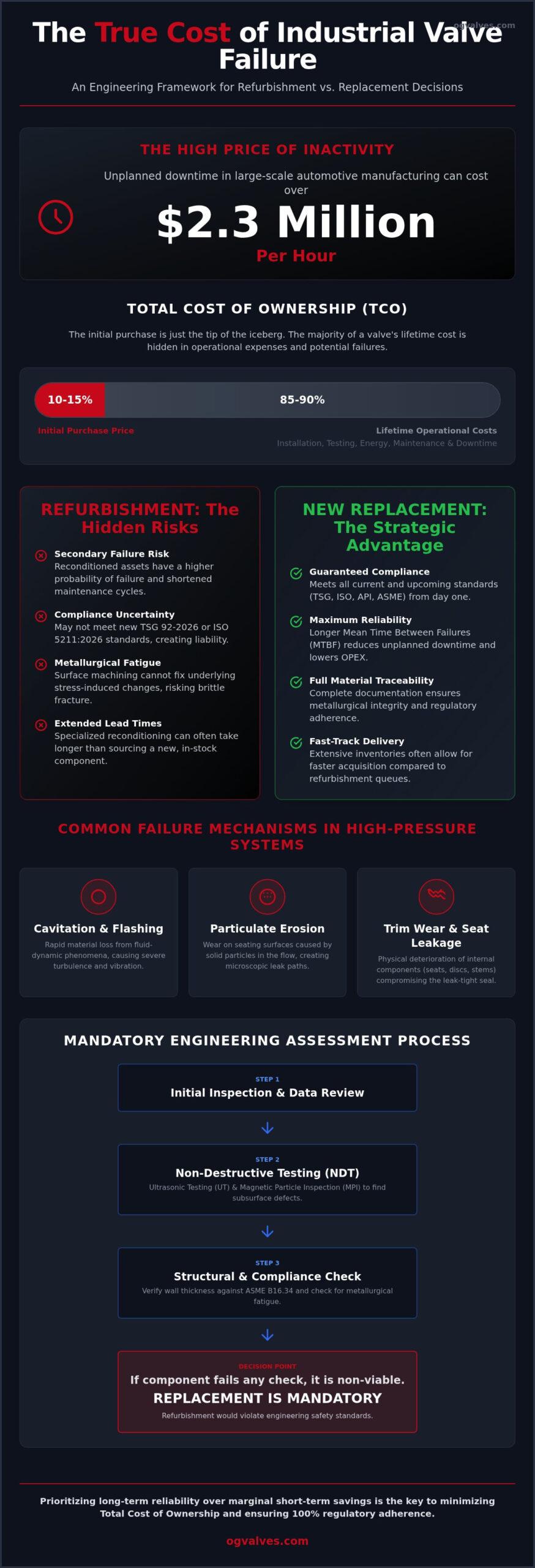
In large-scale automotive manufacturing, the cost of unplanned downtime can exceed $2.3 million per hour. For technical experts in heavy industry, this figure isn’t just a statistic; it’s a direct threat to operational viability. You’re likely aware that the initial purchase price of a valve represents only 10% to 15% of its total lifetime expenditure. The true cost of industrial valve failure extends far beyond the component itself, encompassing lost production, potential environmental breaches, and the risk of non-compliance with the TSG 92-2026 safety regulations effective July 1, 2026.
Deciding between refurbishment and replacement requires a clinical assessment of metallurgical integrity and long-term reliability. This article provides an authoritative engineering framework to evaluate when to restore existing assets and when to procure new, high-specification gate, ball, or globe valves. We’ll examine the impact of updated ISO 5211:2026 standards, the necessity of full material traceability, and strategies to minimize Total Cost of Ownership while maintaining 100% regulatory adherence.
Key Takeaways
- Analyze primary degradation modes, such as erosion and seat leakage, to accurately quantify the total cost of industrial valve failure across the asset lifecycle.
- Implement Non-Destructive Testing (NDT) and Positive Material Identification (PMI) as mandatory engineering benchmarks before authorizing any refurbishment project.
- Utilize a strategic decision matrix based on Safety Integrity Level (SIL) ratings to determine when application criticality necessitates new high-specification components.
- Evaluate the performance gap between new and reconditioned units by comparing Mean Time Between Failures (MTBF) and long-term operational expenditure (OPEX).
- Mitigate the lead-time penalty of new asset acquisition by leveraging technical procurement experts with extensive inventory and fast-track delivery capabilities.
The Economics of Valve Degradation in Critical Infrastructure
Industrial valve degradation represents a significant financial liability within high-pressure processing environments. The aggregate cost of industrial valve failure is rarely limited to the price of a replacement component; instead, it encompasses the cumulative impact of systemic inefficiency and catastrophic operational disruptions. Primary industrial failure modes, including localized erosion, chemical corrosion, and seat leakage, compromise the structural integrity of the pressure boundary. While many procurement specialists view refurbishment as a cost-effective alternative, this approach often introduces secondary failure risks. Reconditioned assets frequently exhibit shortened maintenance cycles and may fail to meet the rigorous performance benchmarks required for modern industrial applications.
Establishing a baseline for Total Cost of Ownership (TCO) is essential for effective asset management. Current industry data indicates that the initial purchase price of an industrial valve accounts for only 10% to 15% of its total lifetime cost. The remaining 85% to 90% is consumed by installation, testing, energy consumption, and the financial ramifications of unplanned downtime. Aging assets also pose significant regulatory stakes, as they may no longer comply with evolving API and ASME standards or the stringent requirements of the TSG 92-2026 safety regulations, which mandate comprehensive traceability for all pressure-bearing equipment.
Common Failure Mechanisms in High-Pressure Systems
Cavitation and flashing represent the most destructive phenomena in industrial flow control valves, particularly within globe and butterfly valve configurations. These processes cause rapid material loss on internal surfaces, leading to severe turbulence and mechanical vibration. In gate valves, particulate erosion often targets the seating surfaces, creating microscopic leak paths that expand under high-pressure differentials. Valve trim wear refers to the physical deterioration of internal components, such as seats, discs, and stems, which directly compromises the component’s ability to maintain a leak-tight seal. This wear pattern eventually leads to seat leakage, which can result in product contamination or hazardous environmental releases.
The True Cost of Unplanned Industrial Downtime
Unplanned downtime remains the single most expensive consequence of component failure. In manufacturing operations, hourly losses range from $25,000 to $125,000, while chemical processing facilities face costs between $50,000 and $150,000 per hour. Large-scale automotive plants report downtime figures exceeding $2.3 million per hour. These statistics highlight why the cost of industrial valve failure is a critical metric for procurement strategy. Refurbishment projects can inadvertently extend these periods of inactivity, as the lead-time for specialized reconditioning often exceeds the delivery timeframe of new, high-specification valves from established inventories. Using refurbished valves in critical isolation points introduces significant liability, as the reliability of a reconditioned seal cannot always be guaranteed under extreme operating conditions.
Engineering Assessment: Evaluating Structural Integrity and Compliance
The decision to restore a valve must be predicated on empirical data rather than visual inspection. Non-Destructive Testing (NDT) serves as the primary technical gatekeeper in this process. Techniques such as Ultrasonic Testing (UT) and Magnetic Particle Inspection (MPI) are mandatory to identify subsurface defects that compromise the pressure-retaining boundary. If the component’s wall thickness has eroded below the minimum thresholds specified in ASME B16.34, the asset is technically non-viable. In these instances, any attempt at refurbishment represents a violation of engineering safety standards and significantly increases the cost of industrial valve failure through potential catastrophic rupture.
Metallurgical fatigue often renders refurbishment impossible in high-cycle or high-temperature applications. Over time, the crystalline structure of the valve body undergoes stress-induced changes that no amount of surface machining can rectify. When fatigue limits are reached, the risk of brittle fracture becomes a statistical certainty. Engineers must prioritize structural soundness over marginal cost savings, especially when dealing with critical isolation points in high-pressure steam or volatile chemical lines.
Metallurgical Analysis and Material Integrity
Positive Material Identification (PMI) is a critical diagnostic tool used to verify that the alloy composition matches the original design specifications. In corrosive environments, utilizing PMI testing protocols ensures that a valve hasn’t been compromised by carbon migration or unintended material substitutions during previous maintenance cycles. Standard refurbishment often fails to address intergranular corrosion, a localized attack at grain boundaries that can lead to rapid failure. If PMI reveals significant alloy depletion, the only reliable path is the procurement of a new, certified component.
Verifying Compliance with API and ASME Standards
A refurbished valve frequently loses its original API 600 or API 6D certification once the factory seals are broken and internal dimensions are altered through machining. Maintaining compliance in 2026 requires rigorous adherence to the TSG 92-2026 safety regulations, which mandate full traceability of all inspection documents and material certificates. Post-refurbishment hydro-testing and seat leakage tests must be performed to the same rigorous standards as new factory units. If a reconditioned valve cannot provide documented proof of meeting these benchmarks, it shouldn’t be returned to service. For projects requiring immediate adherence to these stringent global standards, OG VALVES provides fully certified technical support and a comprehensive inventory of new gate, ball, and check valves to eliminate regulatory uncertainty.

Choosing between reconditioning and replacement requires a rigorous comparison of performance metrics and long-term financial liabilities. While the initial capital expenditure (CAPEX) for refurbishment is typically lower, the operational expenditure (OPEX) often escalates due to decreased reliability. Mean Time Between Failures (MTBF) data consistently indicates that new, high-specification valves outperform reconditioned units by a factor of two to three. This reliability gap directly influences the cost of industrial valve failure, as unpredictable maintenance intervals disrupt production schedules and increase safety risks. Procurement decisions must account for the fact that third-party repair warranties won’t match the comprehensive manufacturer guarantees provided with new equipment.
CAPEX vs. OPEX: The Long-Term Financial Outlook
The financial break-even point for refurbishment generally occurs when repair costs reach 50% to 60% of the price of a new valve. Beyond this threshold, the investment fails to yield a justifiable return, especially considering that new valves provide a significantly longer service life. Economic obsolescence in industrial valve assets occurs when the cost of maintaining an aging component exceeds the total value derived from its continued operation, including the risks associated with potential failure. Factoring in the 2-3x longer service life of new assets reveals that the higher initial cost is often the most stable financial path for critical infrastructure.
Performance Benchmarking: New vs. Refurbished
Technical performance often degrades after multiple refurbishment cycles. Sealing integrity is a primary concern; new metal-seated ball valves are engineered to meet zero-leakage standards that reconditioned seats struggle to maintain under high-pressure differentials. Precision-engineered actuators exhibit superior torque transmission and control accuracy when paired with new stems rather than worn surfaces that have been polished or plated. Flow characteristics also differ significantly. New globe valves maintain their designed flow coefficients (Cv), whereas refurbished units may suffer from altered internal geometries that increase turbulence and pressure drop.
Energy efficiency is an increasingly critical factor in modern plant design. Modern butterfly valve designs utilize optimized disc profiles to minimize flow resistance, reducing the parasitic power load on pumping systems. These technical advancements contribute to a lower cost of industrial valve failure by ensuring optimal process efficiency and reducing the likelihood of cavitation-induced damage that frequently plagues older, reconditioned models.
Strategic Decision Matrix: When to Procure New Valve Components
A structured decision matrix is essential for mitigating the financial and safety risks associated with aging infrastructure. This four-step engineering evaluation prioritizes functional reality over surface-level cost comparisons. Engineers must first assess the criticality of the application using Safety Integrity Level (SIL) ratings. When an asset operates within a high-stakes environment, the cost of industrial valve failure is too significant to justify the inherent uncertainties of a reconditioned seal. Following this, the availability of original equipment manufacturer (OEM) spare parts must be verified, as the absence of certified internals often necessitates total replacement.
Lead-time analysis represents the third critical step. While refurbishment is often perceived as a faster alternative, the duration required for a comprehensive metallurgical assessment and precision machining can frequently exceed the delivery timeframe of a new gate valve from specialized global inventories. The final step involves determining if modern process conditions, such as increased hydrogen concentrations or higher pressures, require material upgrades. Utilizing modern alloys like Duplex stainless steel, which now accounts for 42.7% of material selection in high-specification markets, ensures the asset is compatible with 2026 safety standards.
Criticality and Safety Integrity Levels (SIL)
Safety is non-negotiable. Emergency Shutdown Valves (ESDVs) serve as the final pressure barrier in critical systems and should almost always be replaced rather than repaired. The integration of these components into a broader Safety Instrumented System (SIS) ensures that the probability of failure on demand remains within calculated SIL parameters. While non-critical utility lines may allow for ‘fit-for-purpose’ refurbishment, any valve designated as a safety-critical element requires the documented reliability that only new, factory-tested units can provide. Relying on refurbished assets in these positions compromises the entire safety architecture of the facility.
Obsolescence and Spare Part Availability
Using non-OEM parts in reconditioned high-pressure valves introduces unacceptable failure risks. When manufacturers discontinue specific models, repair facilities often resort to reverse engineering internal components. This practice frequently results in dimensional variances or material mismatches that lead to premature seat leakage or stem binding. Leveraging global supply chains to source new, high-specification components is a more reliable strategy than attempting custom repairs on obsolete hardware. For organizations facing urgent compliance deadlines or critical outages, utilizing fast-track valve procurement services eliminates the technical and logistical risks associated with reverse-engineered components.
Optimising Lifecycle Costs with OG VALVES’ Technical Procurement
OG VALVES LTD. provides a technical interface between rigorous engineering requirements and global logistics. We recognize that the true cost of industrial valve failure is often amplified by procurement delays and supply chain fragmentation. While refurbishment is frequently chosen to avoid perceived long lead times, our extensive inventory of high-specification gate, ball, and globe valves eliminates this lead-time penalty. By maintaining a global supply chain focused on technical compliance, we ensure that critical infrastructure operators don’t have to choose between speed and structural integrity.
Our technical support team assists in material specification to prevent recurrent failure modes identified during the engineering assessment phase. Selecting the correct alloy, such as 316L stainless steel for corrosive chemical lines, is a fundamental step in lifecycle optimization. We provide quantifiable data and specific material classifications that align with the specialized environmental applications of your facility, ensuring that every component is fit for its intended service from the point of installation.
Fast-Track Delivery for Critical Infrastructure
Reducing downtime requires more than just local stock; it requires a distribution network capable of rapid response and technical accuracy. OG VALVES LTD. utilizes a global logistics framework to deliver needle, plug, and butterfly valves to site precisely when they’re needed. Our technical expertise allows us to identify direct-replacement alternatives that meet or exceed original design specifications, which is vital during major plant turnarounds. Any delay in component arrival during these windows can result in millions of dollars in lost production. We focus on minimizing operational disruption by providing ready-to-install, factory-tested assets that bypass the uncertainties of custom repair schedules.
Quality Assurance and International Certification
Every component supplied by OG VALVES LTD. undergoes rigorous quality control to ensure 100% compliance with international standards. We adhere strictly to API 6D for pipeline valves and the updated ISO 5211:2026 standards for actuator attachments. Our documentation packages include full material traceability and inspection reports, which are mandatory under the TSG 92-2026 safety regulations effective July 1, 2026. Positioning new procurement as a strategic investment provides the ultimate insurance against the cost of industrial valve failure. We anchor every claim in verifiable testing protocols, ensuring that your facility meets the highest global benchmarks for industrial safety and engineering excellence.
Securing Operational Continuity through Technical Procurement
Mitigating the cost of industrial valve failure requires an engineering-led approach that prioritizes structural integrity and regulatory compliance. The decision to refurbish or replace must be based on clinical data, incorporating Non-Destructive Testing and Positive Material Identification to verify metallurgical soundness. While reconditioning may appear cost-effective initially, the superior Mean Time Between Failures of new, high-specification components often results in a lower Total Cost of Ownership. Modern safety standards, including the TSG 92-2026 regulations, demand the full traceability and documented reliability that only certified new assets can provide.
OG VALVES supports technical experts by maintaining an extensive stock of API-certified gate, ball, and globe valves ready for immediate deployment. Our global fast-track delivery capabilities and deep expertise in heavy industry specifications ensure your facility maintains peak operational uptime while adhering to international safety benchmarks. Transitioning to new, high-performance components eliminates the secondary failure risks associated with aging infrastructure. We invite you to Request a Technical Quote for High-Specification Industrial Valves to optimize your plant’s reliability. Your commitment to engineering excellence ensures a safer, more efficient industrial future.
Frequently Asked Questions
When is valve refurbishment no longer a technically viable option?
Refurbishment becomes non-viable when the component’s wall thickness fails to meet minimum ASME B16.34 requirements or when Non-Destructive Testing (NDT) identifies subsurface metallurgical fatigue. If Positive Material Identification (PMI) reveals significant alloy depletion or intergranular corrosion, the structural integrity is compromised beyond repair. In such cases, restoration attempts are unsafe and technically irresponsible, necessitating the procurement of a new, certified valve to ensure pressure containment.
How do refurbishment costs typically compare to new industrial valve procurement?
Refurbishment is generally considered economically feasible only when the total repair cost remains below 50% to 60% of the price of a new unit. Procurement specialists must account for the fact that new high-specification valves offer a service life two to three times longer than reconditioned assets. When these factors are integrated into a Total Cost of Ownership (TCO) analysis, new procurement often provides superior long-term financial stability compared to repeated repair cycles.
What are the primary risks of using refurbished valves in high-pressure oil and gas applications?
The primary risks include unpredictable sealing performance and the potential for catastrophic pressure boundary failure. In high-pressure oil and gas sectors, where the cost of industrial valve failure can exceed $150,000 per hour in lost production, using reconditioned assets in critical isolation points introduces unacceptable liability. Refurbished valves may also lack the documented reliability needed to maintain specific Safety Integrity Level (SIL) ratings within a facility’s safety instrumented systems.
Does valve refurbishment void the original API or ASME certification?
Valve refurbishment typically voids the original manufacturer’s API 600 or API 6D certification because the factory seals are broken and material states are altered. Any machining of the seating surfaces or stem involves dimensional changes that weren’t part of the initial certification process. To maintain regulatory compliance, especially under new TSG 92-2026 standards, many operators prefer new valves that carry valid, original manufacturer certifications and full material traceability from the outset.
How can lead times for new industrial valves be minimised during an emergency shutdown?
Minimizing lead times during emergency shutdowns is best achieved by partnering with specialist suppliers who maintain extensive inventories of pre-certified gate, ball, and globe valves. Fast-track global delivery networks can often supply a new component faster than the time required for a comprehensive metallurgical assessment and precision repair. This approach reduces the cost of industrial valve failure by restoring operational status significantly quicker than custom refurbishment schedules.
What technical tests are required to certify a valve post-refurbishment?
Post-refurbishment certification requires a suite of rigorous technical evaluations, including high-pressure hydrostatic body tests and seat leakage tests conducted to API 598 standards. Additionally, NDT methods like magnetic particle inspection must verify that no new stress cracks were introduced during the machining process. Documentation must be exhaustive to meet 2026 regulatory requirements, ensuring the valve’s performance matches the original design specifications before it’s returned to high-pressure service.
Can a refurbished valve be upgraded with modern trim materials for better performance?
While it’s technically possible to install modern trim materials during refurbishment, this process often presents significant challenges regarding dimensional compatibility and galvanic corrosion. New valves are engineered from the ground up to utilize advanced alloys like Duplex stainless steel. Upgrading an older valve body often results in suboptimal performance because the original casting wasn’t designed for the mechanical properties or thermal expansion rates of modern high-performance trim materials.
How does the warranty on a new industrial valve compare to a repair warranty?
New industrial valves come with comprehensive manufacturer warranties that cover the entire assembly against defects in materials and workmanship for a specified period. In contrast, repair warranties are typically limited to the specific components replaced or the labor performed during the refurbishment. This limited coverage leaves the operator vulnerable to failures in the original valve body or other unserviced parts, making new procurement the more reliable option for critical infrastructure protection.
 Responsive Menu