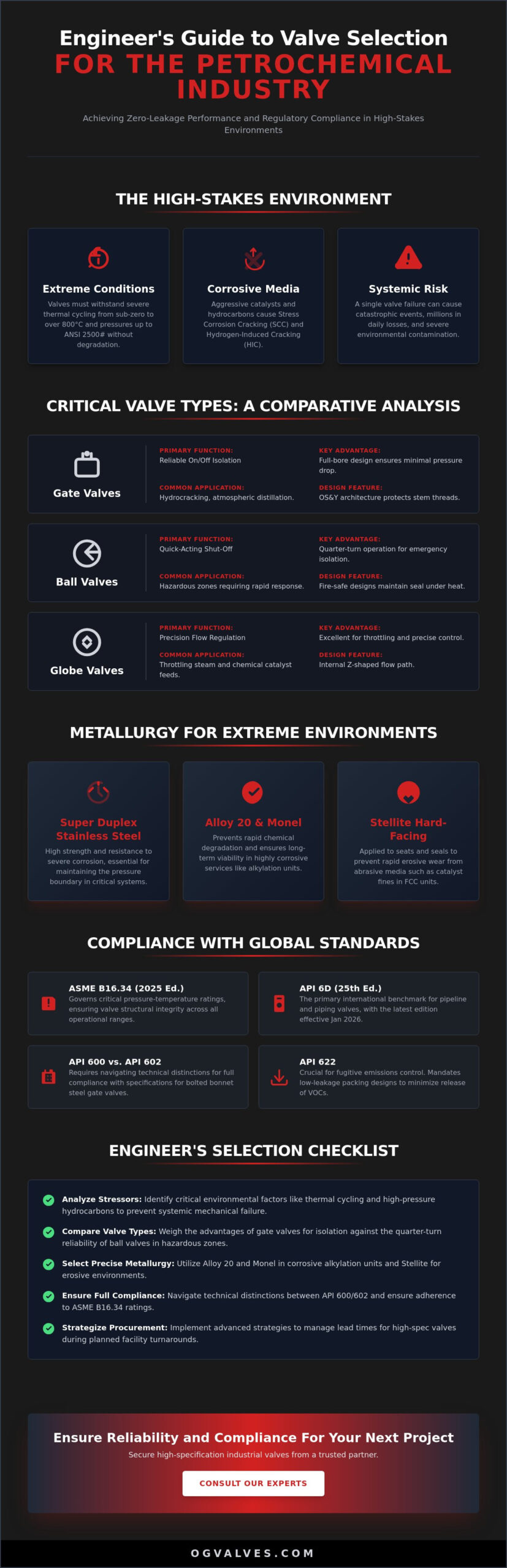
In the high-stakes environment of petrochemical processing, a single valve failure is never just a localized mechanical issue. It represents a systemic risk to operational safety and can lead to millions in lost revenue due to extended downtime. Engineering teams face the constant pressure of selecting valves for petrochemical industry applications that must withstand extreme thermal cycling and corrosive media without structural degradation.
You’re likely dealing with the increasing complexity of ensuring that every component meets the latest international benchmarks, such as the ASME B16.34 2025 Edition or the API 6D 25th Edition that became effective in January 2026. This guide serves as a comprehensive engineering resource to streamline your selection and procurement processes. It provides the technical data necessary to achieve zero-leakage performance and extended maintenance intervals in rigorous industrial environments.
We’ll analyze the specific requirements for gate, ball, and butterfly valves, focusing on critical material metallurgy like super duplex stainless steel. You’ll also find a detailed breakdown of the current API and MSS standards to ensure your next project remains fully compliant with 2026 regulatory frameworks and safety protocols.
Key Takeaways
- Identify critical environmental stressors like thermal cycling and high-pressure hydrocarbons to prevent systemic mechanical failure.
- Compare the mechanical advantages of gate valves for pressure isolation against the quarter-turn reliability of ball valves in hazardous zones.
- Learn precise metallurgy protocols for valves for petrochemical industry use, including the application of Alloy 20 and Monel in corrosive alkylation units.
- Navigate the technical distinctions between API 600 and API 602 standards to ensure full compliance with ASME B16.34 pressure-temperature ratings.
- Implement advanced procurement strategies to manage lead times for high-specification industrial valves during planned facility turnarounds.
Engineering Challenges in Petrochemical Valve Applications
The petrochemical processing environment is defined by its intolerance for mechanical ambiguity. Engineers must specify valves for petrochemical industry applications that maintain structural integrity while handling high-pressure hydrocarbons and aggressive chemical catalysts. These systems operate under extreme thermal cycling conditions where material expansion and contraction are constant variables. If a component fails to account for these shifts, the result is often a loss of containment that threatens the entire facility.
Valve failure in these sectors isn’t merely a maintenance ticket. It often results in catastrophic environmental contamination and severe personnel hazards. The economic repercussions are equally significant; unplanned downtime in a large-scale refinery can result in daily losses exceeding millions of dollars. Reliable isolation and control valves are the primary defense for maintaining system integrity during emergency shutdowns. Without these fail-safes, a minor pressure excursion can escalate into a site-wide event.
Fugitive emissions represent a critical regulatory and environmental challenge for modern infrastructure. Tighter standards for selecting valves for petrochemical industry infrastructure require low-leakage packing designs to minimize the release of volatile organic compounds (VOCs). Adherence to testing protocols like API 622 ensures that stem seals perform consistently over thousands of cycles. This focus on sealing technology reduces the risk of regulatory fines and improves the overall safety profile of the plant.
Thermal and Pressure Stressors in Refining
Refining processes like fluid catalytic cracking (FCC) and steam reforming involve temperature ranges from sub-zero cryogenic levels to over 800°C. Pressure rating requirements typically follow ASME B16.34, spanning from ANSI 150# through 1500# and occasionally reaching 2500# in high-pressure hydroprocessing units. In these volatile hydrocarbon environments, fire-safe designs are mandatory to ensure that Critical Valve Types maintain a seal even if the primary soft seats are destroyed by heat.
Corrosion and Erosion Mechanisms
Chemical degradation takes several forms, most notably stress corrosion cracking (SCC) and hydrogen-induced cracking (HIC). These mechanisms can cause sudden, brittle failure in components that appear visually sound. Abrasive media, such as catalyst fines in FCC units, lead to rapid erosive wear of valve seats and seals, necessitating hard-facing materials like Stellite. Precise material compatibility is the only effective method for preventing intergranular corrosion and ensuring the long-term viability of the pressure boundary.
Critical Valve Types for Downstream Petrochemical Processing
The mechanical configuration of valves for petrochemical industry facilities must align with the specific fluid dynamics of the downstream process stage. Downstream refining involves a sequence of high-pressure and high-temperature operations where the choice of valve type directly affects plant availability. Gate valves serve as the primary isolation solution in hydrocracking and atmospheric distillation units due to their full-bore design, which ensures minimal pressure drop. Ball valves are the preferred choice for quick-acting shut-off in hazardous zones, providing reliable quarter-turn operation for emergency isolation.
Precision flow regulation requires globe valves, which are essential for throttling steam and chemical catalyst feeds. To protect upstream infrastructure, check valves are installed to prevent backflow that could damage expensive compressors or pumps during a trip. For large-diameter applications like cooling water circuits and utility lines, butterfly valves offer a space-saving alternative without compromising structural integrity. Adherence to Global Standards: API, ASME, and MSS ensures that these components maintain their pressure-containing capabilities under cyclic loading.
Gate and Globe Valves for Isolation and Control
Specifying a gate valve for high-temperature service typically requires an Outside Screw and Yoke (OS&Y) design. This architecture keeps the stem threads outside the process media, preventing corrosion and allowing operators to visually confirm the valve’s position. In control applications, globe valve trim selection is a critical engineering decision. Engineers must specify anti-cavitation or noise-reduction trims when handling high-pressure drops to prevent internal erosion. For those managing complex facility upgrades, reviewing our full range of industrial valves provides the technical data needed for precise system integration.
Quarter-Turn Reliability: Ball and Butterfly Valves
High-pressure petrochemical manifolds frequently utilize a trunnion-mounted ball valve to manage high operating torques. Unlike floating designs, trunnion mounting supports the ball on bearings, reducing the load on the seats and ensuring consistent sealing. For extreme temperature ranges, a triple-offset butterfly valve is necessary to achieve bubble-tight shut-off. This design eliminates friction between the seat and seal ring, which extends the component’s service life. Fire-safe certification under API 607 is mandatory for these quarter-turn components to ensure they don’t contribute to fuel loading during a fire event. These valves for petrochemical industry applications represent the benchmark for operational safety in volatile environments.

Material selection is the primary determinant of service life for valves for petrochemical industry applications. While ASTM A216 WCB carbon steel remains the baseline for non-corrosive hydrocarbon service, it’s unsuitable for environments involving high-temperature sulfidation or acidic catalysts. Upgrading to austenitic stainless steels like CF8M (316L) is a standard requirement for oxidative environments. For specialized units such as sulfuric acid or hydrofluoric acid alkylation, metallurgy must transition to exotic alloys like Alloy 20 or Monel. These nickel-based materials provide the necessary resistance to hydrogen blistering and general corrosion that would otherwise compromise a standard valve body within months.
High-strength requirements combined with aggressive corrosion profiles necessitate the use of duplex and super duplex stainless steels. These dual-phase alloys offer higher yield strength than standard stainless steels, allowing for thinner wall sections without sacrificing pressure-containing integrity. In service conditions involving catalyst fines or high-velocity abrasive media, seating surfaces require hard-facing. Stellite, a cobalt-based alloy, is frequently applied to the wedge and seat rings of gate valves or the disc edges of butterfly valves. This creates a high-hardness barrier that prevents erosive wear, ensuring that valves for petrochemical industry service maintain bubble-tight shut-off over extended operational cycles.
Positive Material Identification (PMI) and Traceability
Verification of chemical composition is a non-negotiable step in the quality control process. PMI testing provides a non-destructive analysis of the alloy’s elemental makeup at the point of supply, ensuring the material matches the engineering specification. This data must be cross-referenced with Mill Test Reports (MTRs) to maintain full traceability for every pressure-retaining component within an audited facility. PMI testing serves as a final technical gate that identifies and rejects components with non-compliant chemical compositions before they are integrated into high-risk process lines.
Specialized Coatings and Linings
Severe service ball valves often utilize Tungsten Carbide or Chrome Carbide coatings to withstand the mechanical stresses of high-cycle operation in abrasive media. These coatings are applied via High-Velocity Oxy-Fuel (HVOF) processes to ensure maximum bond strength. For highly aggressive chemical handling where metallic contact is prohibited, PTFE or PFA linings provide a chemically inert barrier. Engineers must evaluate the durability of these coatings in thermal cycling environments, as mismatched coefficients of thermal expansion can lead to delamination or cracking of the protective layer.
Adherence to Global Standards: API, ASME, and MSS
Engineering compliance for valves for petrochemical industry facilities relies on a rigid hierarchy of international standards. API 600 is the benchmark for heavy-duty, bolted bonnet steel gate valves used in refinery services. In contrast, API 602 governs compact, forged steel gate valves typically used in smaller piping systems or auxiliary services. These standards dictate wall thickness, stem diameters, and stuffing box dimensions to ensure mechanical longevity under high-stress conditions.
ASME B16.34 serves as the foundational technical document for pressure-temperature ratings. It establishes the maximum allowable working pressure for various material groups across a range of operational temperatures. For facilities handling sour gas, compliance with NACE MR0175/ISO 15156 is mandatory. This standard specifies material hardness limits and heat treatment processes to prevent sulfide stress cracking in H2S-containing environments. Adhering to these specifications is the only way to mitigate the risk of brittle failure in sour service.
Pressure Testing and Quality Assurance
All valves for petrochemical industry service must undergo validation per API 598. This protocol includes high-pressure hydrostatic shell testing at 1.5 times the pressure rating and low-pressure pneumatic seat testing to identify minute leakage. Achieving a zero-leakage standard is critical when managing hazardous fluids. International projects often require third-party inspection (TPI) to witness these tests and verify that quality assurance documentation aligns with the project’s technical data sheets. This verification process ensures that every component delivered to the site meets the specified safety threshold.
Fugitive Emissions Compliance
Environmental regulatory frameworks have forced an engineering shift toward fugitive emissions compliance. API 622 focuses on the testing of packing materials, while API 624 provides the protocol for the entire valve assembly. For toxic media, bellows-sealed valves offer a hermetic solution that eliminates the leak path through the stem packing. Maintaining comprehensive documentation for these components is essential for demonstrating regulatory compliance during facility audits. If you require components that meet these rigorous benchmarks, request a technical consultation for API-compliant industrial valves.
Procurement Strategies for Petrochemical Infrastructure
Procurement of valves for petrochemical industry infrastructure requires a dual focus on technical precision and logistical timing. During planned turnarounds, the window for component replacement is narrow. Any delay in the arrival of high-specification industrial valves can extend downtime and cause massive financial losses. Managing these lead times requires early engagement with suppliers who possess a robust global supply chain. It’s especially critical when sourcing exotic alloys such as Monel or Alloy 20, which often have limited production runs and specialized casting requirements that differ from standard carbon steel cycles.
Technical support and thorough specification reviews are the primary defenses against procurement errors. An expert review of project data sheets ensures that the selected metallurgy, pressure ratings, and actuator configurations align perfectly with the process environment. This engineering-led approach reduces the likelihood of onsite installation failures or non-compliance with the standards discussed in previous sections. For unplanned shutdowns or emergency maintenance, fast-track delivery models are essential. These models rely on pre-staged inventory of semi-finished bodies and expedited manufacturing protocols to bypass standard lead times. By maintaining a network of approved foundries and specialized machine shops, a partner can reduce the delivery window of a custom-actuated valve from months to weeks.
Inventory Management and Global Logistics
Extensive stockholding of API-certified components is a prerequisite for minimizing industrial downtime. Maintaining a strategic inventory of gate, ball, and globe valves in various pressure classes allows for immediate deployment during critical failures. Logistics coordination for international delivery to remote petrochemical sites involves managing complex customs requirements, hazardous material certifications, and specialized transport for heavy-duty components. Reliability in this area is a hallmark of a seasoned industrial expert who understands that the cost of logistical failure is often higher than the component price itself. Sourcing from global manufacturers who adhere to the 2026 updates of API and ASME standards ensures that the inventory remains technically current and ready for high-stakes installation.
The Value of Technical Valve Partnerships
Transitioning from a transactional vendor relationship to a technical partnership enhances the safety and efficiency of petrochemical operations. A technical partner provides consultation throughout the valve selection process, ensuring every component meets the specific data sheet requirements of the project. This collaborative approach anchors the procurement process in rigorous quality control and engineering excellence. Selecting valves for petrochemical industry applications is a long-term investment in plant reliability and safety. Consult with OG VALVES LTD. for high-specification petrochemical valve supply.
Optimizing Operational Integrity in Petrochemical Infrastructure
The industrial environment of 2026 requires an uncompromising approach to component specification. Achieving zero-leakage safety and maintaining regulatory compliance depends on the precise alignment of metallurgy with process media and the rigorous application of API and ASME standards. This guide has detailed the necessity of moving beyond standard carbon steel to high-performance exotic alloys for corrosive environments. It’s also highlighted the role of strategic procurement and technical partnerships in managing turnaround lead times.
Reliability in selecting valves for petrochemical industry infrastructure is a risk-mitigation strategy that dictates long-term facility output. OG VALVES LTD. maintains an extensive inventory of API and ASME compliant valves, supported by specialist expertise in exotic alloys and corrosive applications. Our global logistics capability ensures fast-track industrial delivery to minimize downtime during critical maintenance windows. These capabilities ensure that your infrastructure remains resilient against the mechanical stressors of downstream processing.
Take the next step in securing your facility’s mechanical integrity. Request a Technical Quote for Petrochemical Valves to consult with our engineering experts on your specific project requirements. We look forward to supporting your high-stakes infrastructure goals.
Frequently Asked Questions
What are the most common materials for valves in the petrochemical industry?
ASTM A216 WCB carbon steel and ASTM A351 CF8M stainless steel serve as the primary material grades for most refinery components. Carbon steel is utilized for non-corrosive hydrocarbon service, while stainless steel is required for oxidative or moderately corrosive process streams. For aggressive chemical service or high-temperature applications, engineers specify duplex stainless steels and nickel-based alloys like Monel or Inconel to prevent premature mechanical failure.
Why is API 600 significant for petrochemical gate valves?
API 600 defines the mandatory design and construction requirements for heavy-duty, bolted bonnet steel gate valves used in refinery isolation services. It’s significant because it specifies thicker wall sections and larger stem diameters than standard commercial valves. This standard ensures that valves for petrochemical industry applications can withstand the mechanical stressors and thermal cycling typical of downstream processing over a long operational life.
How do you prevent fugitive emissions in petrochemical valve installations?
Fugitive emissions are prevented by utilizing low-leakage packing systems that comply with API 622 and API 624 standards. These protocols require stem seals to maintain volatile organic compound (VOC) leakage levels below 100 parts per million during rigorous cycle testing. For toxic or lethal media, bellows-sealed designs provide a hermetic barrier that completely eliminates the potential leak path through the valve stuffing box.
What is the difference between a floating and trunnion ball valve in refining?
Floating ball valves use process pressure to push the ball against the downstream seat, while trunnion-mounted designs support the ball on fixed bearings. Trunnion valves are required for high-pressure or large-diameter refining applications because they significantly reduce operating torque and minimize seat wear. Floating designs are generally restricted to smaller sizes and lower pressure classes where the seat can handle the full load of the ball.
When should Alloy 20 be specified over 316L stainless steel?
Alloy 20 should be specified over 316L stainless steel when the process involves sulfuric acid, particularly in alkylation units. While 316L provides adequate general corrosion resistance, it’s susceptible to rapid degradation in high-concentration acidic environments. Alloy 20 contains higher levels of nickel and copper, which effectively prevent stress corrosion cracking and pitting in these specific and highly aggressive chemical services.
How does PMI testing ensure safety in petrochemical plants?
Positive Material Identification (PMI) testing provides non-destructive chemical analysis to verify that the elemental composition of a valve body matches its engineering specification. In petrochemical plants, this process prevents the accidental installation of incorrect alloys in corrosive lines. Ensuring that every component matches its Mill Test Report (MTR) is a critical safety gate that mitigates the risk of sudden, brittle failure or accelerated corrosion.
What standards govern the fire-safety of industrial valves?
API 607 and API 6FA are the primary standards governing the fire-safety of quarter-turn and gate valves. These protocols involve exposing the component to a high-temperature flame for a specific duration and measuring its ability to maintain a seal during and after the event. Fire-safe certification is mandatory for valves for petrochemical industry hazardous zones to prevent fuel contribution during a fire emergency.
Can butterfly valves be used for high-pressure petrochemical steam lines?
Triple-offset butterfly valves are suitable for high-pressure steam lines due to their metal-to-metal seating and torque-seated design. Unlike standard resilient-seated versions, triple-offset configurations handle high temperatures and pressures without seat degradation. They provide a space-saving alternative to gate valves while maintaining the bubble-tight shut-off required for steam isolation and utility management in modern refineries.
 Responsive Menu