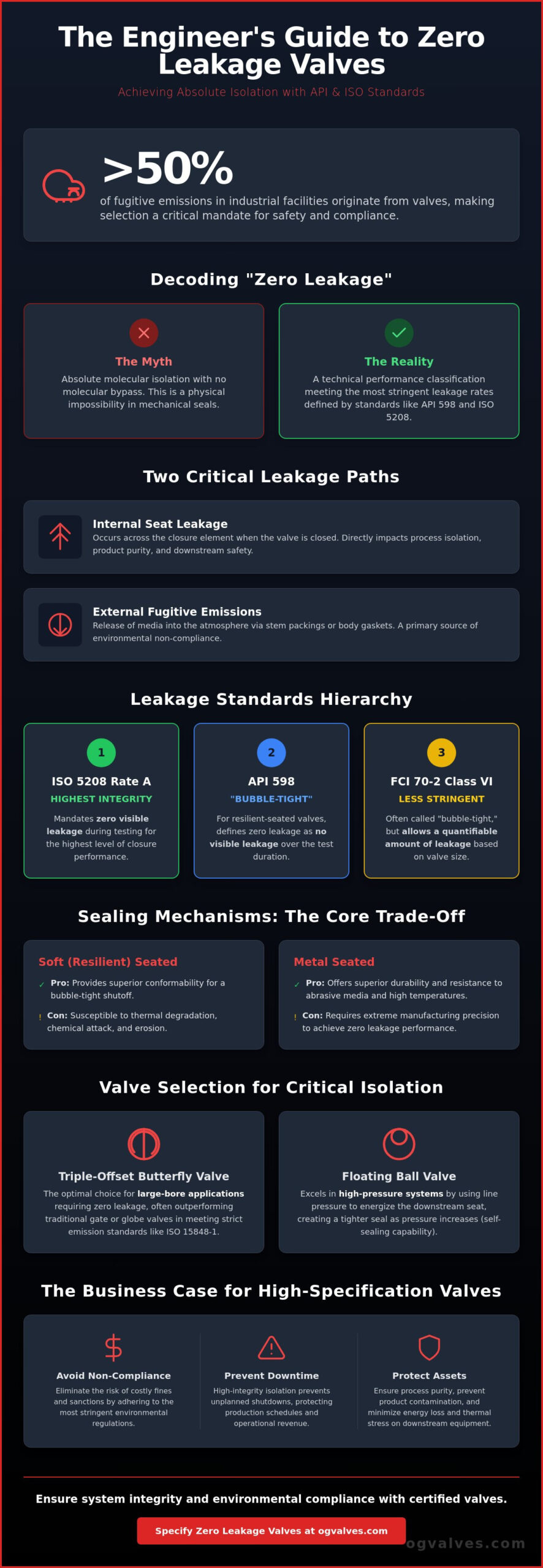
Valves are responsible for over 50% of fugitive emissions in industrial settings, making the selection of zero leakage industrial valves a critical mandate for environmental compliance and process integrity. Engineers often face the challenge of reconciling theoretical performance with the practical realities of seat leakage and external discharge. It’s common to find confusion between Rate A and Rate B classifications, yet these distinctions define the boundary between system safety and operational failure.
This analysis provides a clinical examination of the engineering standards, sealing mechanisms, and material specifications necessary for absolute isolation. We’ll clarify the testing protocols established by the API 598 11th Edition and ISO 5208:2015 to ensure your procurement meets global benchmarks. You’ll gain the technical criteria to distinguish when a triple offset design outperforms a floating ball valve in high-pressure environments, ensuring your infrastructure adheres to the most stringent fugitive emission requirements like API 624 and ISO 15848-1. By focusing on quantifiable data and regulatory adherence, this guide serves as a technical resource for verifying the certifications required for high-stakes industrial isolation.
Key Takeaways
- Differentiate between theoretical absolute isolation and quantifiable performance classifications to ensure adherence to API 598 Rate A standards.
- Evaluate the engineering trade-offs between soft-seated and metal-seated mechanisms, focusing on how seat energisation maintains integrity under high line pressure.
- Identify the optimal configurations for zero leakage industrial valves, specifically comparing triple-offset butterfly and floating ball designs for critical isolation.
- Master the specific parameters for hydrostatic and pneumatic closure testing required to verify bubble-tight performance during factory acceptance tests.
- Justify the procurement of high-specification valves by calculating the long-term operational costs of environmental non-compliance and unplanned process downtime.
Defining Zero Leakage in Industrial Valve Engineering
In industrial engineering, “zero leakage” is a technical performance classification rather than a literal description of absolute molecular isolation. No mechanical seal can achieve a total absence of molecular bypass. Instead, zero leakage industrial valves are defined by their ability to meet the most stringent allowable leakage rates established by international regulatory bodies. Organizations such as the American Petroleum Institute (API), the International Organization for Standardization (ISO), and the Manufacturers Standardization Society (MSS) provide the framework for these technical benchmarks. The Manufacturers Standardization Society also contributes via MSS-SP-61, which specifies pressure testing for steel valves and defines permissible leakage through specific bubble-per-minute metrics for various seat types.
Engineers must distinguish between internal seat leakage and external fugitive emissions. Internal leakage occurs across the valve closure element when the valve is in the fully closed position, directly impacting process isolation and downstream safety. External leakage refers to the release of media into the atmosphere through stem packings or body gaskets. During a Factory Acceptance Test (FAT), a “bubble-tight” seal is verified through visual inspection. This requires that no visible bubbles are detected during a pneumatic test or no liquid drops are observed during a hydrostatic test for a specified duration. Because the cost of failure is high, the deployment of zero leakage industrial valves is essential for maintaining system integrity in critical infrastructure.
The API 598 and ISO 5208 Leakage Classifications
API 598, currently in its 11th Edition (February 2023), serves as the primary standard for inspecting and testing valves. For resilient-seated valves, API 598 mandates “zero leakage,” which is defined as no visible leakage during the minimum test duration. ISO 5208:2015 provides a similar hierarchy, where Rate A represents the highest level of closure integrity, allowing zero visible leakage. In contrast, control valve performance is often measured against FCI 70-2 Class VI. While Class VI is frequently called “bubble-tight,” it technically allows a quantifiable amount of leakage based on the valve’s port diameter and differential pressure, making it less stringent than ISO 5208 Rate A.
Why Absolute Isolation is Critical in Heavy Industry
The requirement for high-integrity isolation is driven by the necessity to prevent product contamination in petrochemical refining, where even minor seat bypass can compromise high-value media. Environmental compliance is equally vital. Valves account for over 50% of fugitive emissions in industrial facilities, and modern regulations like TA Luft (2021) now reference ISO 15848-1 for testing. Implementing advanced Butterfly valve design, specifically triple-offset configurations, allows for zero-leakage performance in large-bore applications where traditional gate or globe valves might fail to meet emission standards. Operational efficiency in power generation depends on minimizing pressure loss. Leakage through isolation valves leads to significant energy waste and increased thermal stress on downstream components.
Achieving the Rate A performance standard requires a clinical evaluation of the sealing interface. The primary engineering trade-off involves balancing absolute sealing integrity with long-term mechanical durability. While resilient materials provide the conformability necessary for bubble-tight shutoff, they’re susceptible to thermal degradation and erosion. Conversely, metal seats offer superior resistance to abrasive media but require extreme manufacturing precision to reach the benchmarks expected of zero leakage industrial valves. The selection process must prioritize the physical properties of the process media and the operational frequency of the valve.
Seat energisation is a core principle in high-performance valve design. This mechanism utilizes the inherent line pressure to enhance the contact force between the closure element and the seat. In floating ball valve configurations, the differential pressure pushes the ball into the downstream seat, creating a tighter seal as the pressure increases. This self-sealing capability is vital for maintaining isolation in high-pressure systems where mechanical torque alone might be insufficient. For systems requiring consistent isolation under fluctuating pressures, verifying the seat energisation profile is a critical step in technical procurement.
Resilient Seating Technology
PTFE and Reinforced PTFE (RPTFE) are the most common materials used for achieving bubble-tight seals in chemical and petrochemical applications. Their low coefficient of friction and high chemical inertness make them ideal for zero leakage industrial valves handling corrosive fluids. However, these materials have defined temperature limits, usually failing to maintain structural integrity beyond 200°C. In high-performance isolation, engineers often utilize primary-seal and secondary-seal configurations, where an elastomeric O-ring or a PEEK insert provides the initial seal, supported by a metallic backup to ensure fire-safe performance.
Advanced Metal-to-Metal Sealing
Metal-seated valves are necessary for severe service conditions involving temperatures exceeding 250°C or media containing abrasive particles. Achieving zero leakage in these scenarios requires “zero-clearance” engineering and advanced surface treatments. Hard-facing materials, such as Stellite or chromium carbide, are applied to the seating surfaces to prevent galling. The mating surfaces then undergo rigorous lapping and polishing protocols. This process ensures the surface finish is smooth enough to prevent the passage of gas molecules during high-pressure pneumatic tests. When specifying industrial ball valves for these conditions, verifying the lapping precision is mandatory for ensuring compliance with API 598 or ISO 5208 Rate A standards.
Valve Type Selection for Critical Isolation
The selection of zero leakage industrial valves demands a clinical assessment of the process conditions, specifically focusing on ASME pressure classes and operational temperature ranges. While quarter-turn designs are the preferred choice for isolation, the specific mechanical configuration determines the valve’s ability to maintain a bubble-tight seal over its service life. Engineers must evaluate whether the application requires bidirectional sealing or if a preferred flow direction is acceptable for maintaining seat integrity. The decision often hinges on the trade-off between the compact footprint of a butterfly design and the robust sealing force of a ball valve.
Gate and globe valves, while traditional staples of industrial infrastructure, often face challenges in meeting ISO 5208 Rate A standards. The sliding action of the wedge or disc against the seat can cause microscopic scoring, which compromises the seal over repeated cycles. However, pressure-seal gate valves with flexible wedges and bellows-sealed globe valves can achieve high-performance isolation in specialized steam and high-pressure water applications. Despite these capabilities, the industry trend favors ball and triple-offset designs for critical isolation due to their superior sealing geometry and reduced wear profiles.
High-Performance Ball Valves
Ball valves are the primary engineering solution for high-pressure isolation in midstream and downstream sectors. Floating ball designs utilize the differential pressure to force the ball into the downstream seat, which is highly effective for smaller bore applications. Trunnion-mounted configurations are necessary for ASME Class 600 and higher, where spring-energized seats maintain constant contact with the ball. For a comprehensive technical breakdown of these systems, refer to the Industrial Ball Valves guide. Advanced seating options include Single Piston Effect (SPE) and Double Piston Effect (DPE) configurations, which offer redundant sealing barriers to ensure isolation even if a primary seat experiences degradation.
Triple-Offset Butterfly Valves (TOV)
Triple-offset geometry provides a unique solution for achieving zero leakage in large-bore, space-constrained environments. By employing three distinct offsets in the stem and seat alignment, the disc follows an elliptical path that eliminates friction until the final point of contact. This camming action ensures that the sealing surfaces don’t rub against each other, significantly reducing seat wear and extending the valve’s operational life. Zero leakage industrial valves utilizing this design are particularly effective in cryogenic and high-temperature services, as their all-metal construction manages thermal expansion without losing seat contact. Further design specifics can be found in the Butterfly Valve engineering guide.
Testing Standards and Quality Assurance Protocols
The verification of zero leakage industrial valves necessitates a multi-stage testing regime that simulates operational stresses. Quality assurance protocols don’t merely check for functional failure; they quantify the precision of the sealing interface under specific pressure differentials. According to API 598 (11th Edition, 2023), testing begins with a hydrostatic shell test, typically conducted at 1.5 times the maximum allowable working pressure. This ensures the structural integrity of the pressure-retaining envelope, including the body and bonnet joints.
Subsequent closure testing determines seat integrity. Low-pressure pneumatic tests use air or nitrogen at approximately 4 to 7 bar to identify leak paths that high-pressure water might bridge due to surface tension. Conversely, high-pressure hydrostatic closure tests at 1.1 times the design pressure evaluate the mechanical strength of the seat and its ability to withstand operational loads. For high-purity or cryogenic applications, helium is often utilized as a tracer gas. Its small molecular size allows for the detection of microscopic leak paths that remain invisible under standard hydrostatic conditions.
Technical procurement specialists must scrutinize the associated documentation to validate these results. Mill Test Reports (MTRs) provide the chemical and mechanical traceability for the metallic components, while the Certificate of Compliance (CoC) serves as the manufacturer’s guarantee that the specific valve unit passed all mandatory FAT protocols.
Factory Acceptance Testing (FAT) Procedures
Shell testing provides the first tier of validation, ensuring the casting or forging is free from porosity and structural defects. Seat leakage testing follows, where the rate is measured in bubbles per minute (BPM) for gas tests or drops per minute (DPM) for liquid tests. Bubble-tight is the absence of visible bubbles over a minimum test duration of 60 seconds. This stringent requirement is the hallmark of Rate A performance, leaving no room for ambiguity during the inspection process.
Fugitive Emission Testing (ISO 15848-1)
While seat leakage focuses on internal isolation, fugitive emission testing addresses external integrity at the stem packing and body gaskets. ISO 15848-1 Class A represents the most rigorous classification for emission tightness, often requiring mass spectrometer detection. Thermal cycling is a critical component of this testing, as it subjects the valve to repeated temperature fluctuations. These cycles simulate the expansion and contraction experienced in refinery or power plant environments, verifying that the valve maintains its zero-leakage performance over its entire lifecycle. Before final project integration, ensure your industrial valve procurement includes verified ISO 15848-1 type-test certification to mitigate environmental non-compliance risks.
Procuring High-Specification Zero Leakage Valves
The financial and safety implications of valve failure necessitate a clinical approach to procurement. When a component fails to meet Rate A performance standards, the resulting process contamination or environmental non-compliance carries costs that far exceed the initial capital expenditure. Procurement specialists must justify the investment in zero leakage industrial valves by analyzing the total cost of ownership. This analysis includes the frequency of maintenance cycles, the potential for unplanned downtime, and the rigorous monitoring requirements associated with fugitive emission regulations. Reliable isolation isn’t a luxury; it’s a fundamental requirement for the structural soundness of critical infrastructure.
Effective inventory management is vital for maintaining operational output during immediate outages. Accessing a verified global supply chain for industrial valves ensures that high-specification components are available for rapid deployment. Technical support from the supplier is indispensable during this process. Collaborating with engineering experts allows for the precise matching of metallurgy to process conditions. Whether the application involves high-pressure steam or corrosive chemical media, selecting the correct alloy, such as Duplex stainless steel or specialized nickel alloys, is mandatory for ensuring long-term seat integrity and functional reality.
Specifying for Critical Service
Technical Request for Quotations (RFQs) must contain exhaustive data to ensure the delivered product meets the project’s engineering excellence. Essential data points include detailed media composition, exact pressure and temperature profiles, and the specific testing standards required for certification. Material traceability remains a cornerstone of industrial safety. Positive Material Identification (PMI) testing provides the necessary verification that the alloy composition aligns with the Mill Test Report. For high-pressure isolation applications, engineers should cross-reference their requirements with Industrial Gate Valve standards to ensure the design effectively manages risks such as thermal binding or pressure locking.
OG VALVES LTD.: Global Supply and Technical Expertise
OG VALVES LTD. maintains a comprehensive inventory of API and ISO compliant valves tailored for the demands of heavy industry. The organization acts as a seasoned partner in critical infrastructure, providing the technical precision and regulatory adherence required for high-stakes isolation. With robust global logistics and project management capabilities, OG VALVES LTD. facilitates the delivery of zero leakage industrial valves to international facilities, ensuring minimal downtime and maximum operational safety. Every component is backed by rigorous testing and quality control processes to serve as a benchmark for engineering standards. Contact OG VALVES LTD. for technical specifications and procurement support to secure high-performance isolation solutions for your industrial projects.
Optimizing Infrastructure Integrity through Certified Isolation
Achieving absolute process isolation requires a methodical approach to material selection and strict adherence to international testing protocols. Zero leakage industrial valves serve as the primary barrier against fugitive emissions and high-value product loss in high-stakes environments. It’s essential to verify that every component meets the Rate A criteria defined by ISO 5208 or the bubble-tight standards of API 598. By prioritizing these clinical benchmarks, engineers ensure the long-term durability and safety of their systems while mitigating the risks associated with environmental non-compliance.
OG VALVES provides the technical expertise in API and ISO standards necessary to support complex procurement requirements. With a comprehensive inventory of high-specification valves and global fast-track delivery for heavy industry, the organization acts as a dependable partner in maintaining critical infrastructure. Precise valve selection today prevents costly operational failure tomorrow. Request a Technical Quote for Zero Leakage Valves to ensure your facility meets the highest engineering standards. Implementing these rigorous specifications is a definitive step toward operational excellence and sustained safety.
Frequently Asked Questions
What is the difference between bubble-tight and zero leakage?
“Bubble-tight” refers to a specific visual result during pneumatic testing, whereas “zero leakage” is a performance classification within broader engineering standards. During a factory acceptance test, a valve is considered bubble-tight if no gas bubbles appear for at least 60 seconds. This is a practical verification method. Zero leakage represents the technical threshold defined by API or ISO benchmarks that the valve must satisfy to be certified for critical service.
Is it possible for a metal-seated valve to achieve zero leakage?
It’s entirely possible for metal-seated valves to achieve zero leakage through advanced manufacturing techniques like precision lapping and hard-facing. By utilizing materials like Stellite or chromium carbide, engineers create a surface finish smooth enough to block gas molecules. These valves are essential for severe service where soft seats would fail. They routinely meet ISO 5208 Rate A requirements in high-temperature or abrasive process conditions.
Which international standard is most commonly used for zero leakage testing?
API 598 and ISO 5208 are the most frequently cited standards for the testing of zero leakage industrial valves. API 598 (11th Edition) focuses on the inspection and pressure testing of various valve types, primarily for the petrochemical sector. ISO 5208 provides the Rate A classification, which is the international baseline for zero visible leakage during the test duration. These standards ensure consistency across global supply chains.
How does temperature affect a valve’s zero-leakage capability?
Temperature affects sealing by inducing thermal expansion or contraction in the valve body and closure elements. Extreme heat can soften resilient seat materials, causing them to extrude or lose their sealing force. In cryogenic applications, materials can become brittle and crack. Selecting a valve with compatible metallurgy and seat design is mandatory to ensure the sealing interface remains intact across the entire operational temperature range.
What is API 598 Rate A?
API 598 doesn’t utilize “Rate A” nomenclature; that specific term is defined within the ISO 5208 standard. For resilient-seated valves, API 598 requires “zero visible leakage” during the minimum specified test duration. When procurement specialists request Rate A performance, they’re typically referencing the ISO 5208 standard’s most stringent leakage class. It’s vital to clarify which standard applies during the RFQ process to avoid technical ambiguity.
Can a gate valve be classified as zero leakage?
Gate valves can achieve zero leakage if they’re designed with resilient seating or high-precision metal-to-metal seals. While traditional wedges may allow minor bypass, flexible wedge designs and those with elastomeric inserts can reach bubble-tight performance. These configurations are often necessary for high-pressure isolation where absolute shutoff is required to prevent downstream contamination or to protect sensitive equipment during maintenance outages.
What materials are best for zero-leakage soft seats?
PTFE, RPTFE, and PEEK are the industry standards for achieving high-performance soft seals. PTFE provides the conformability needed for a bubble-tight seal at lower temperatures and offers broad chemical compatibility. RPTFE adds glass or carbon reinforcement to improve pressure resistance. For higher temperatures or abrasive media, PEEK is the preferred polymer because it maintains its mechanical properties and structural integrity under significant thermal and physical stress.
How often should zero-leakage valves be re-tested in the field?
Field re-testing intervals for zero leakage industrial valves depend on the service’s severity and the facility’s risk-management protocols. Highly critical valves in hazardous or high-pressure environments often undergo annual leakage verification. This ensures they still meet the baseline performance established during factory acceptance testing. Regular monitoring is also a requirement for complying with fugitive emission standards like ISO 15848-2 during active plant operations.
 Responsive Menu