A Technical Guide to Industrial Plug Valves: Design, Standards, and Selection
April 08, 2026
Home+A Technical Guide to Industrial Plug Valves: Design, Standards, and Selection
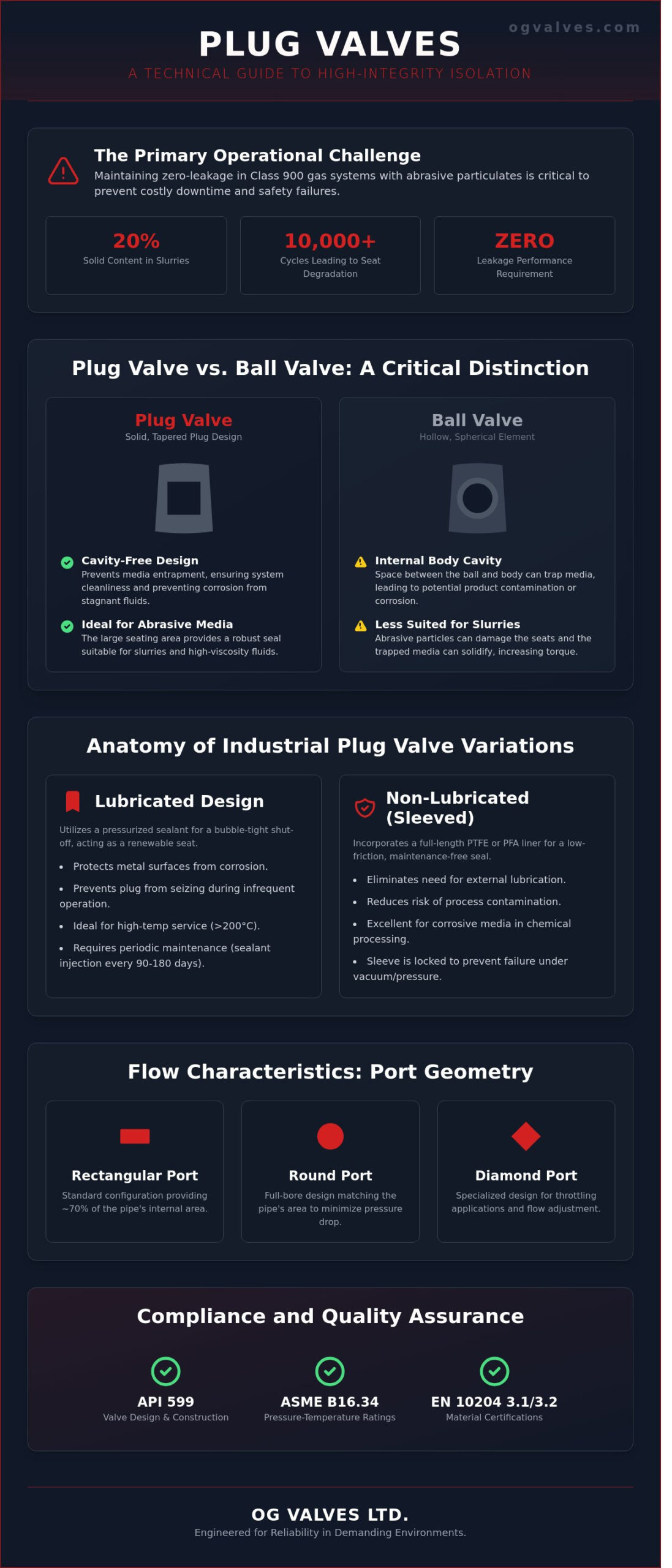
The failure of a quarter-turn isolation component in Class 900 gas systems often stems not from mechanical fatigue, but from the selection of a sealing interface ill-suited for abrasive particulates. Engineers recognize that maintaining zero-leakage performance in slurries with 20% solid content remains a primary operational challenge. When seat degradation occurs in applications exceeding 10,000 cycles, the resulting internal leakage can compromise safety protocols and lead to costly unscheduled downtime. Selecting the correct plug valve configuration is the only way to ensure long-term system integrity in these volatile conditions.
This technical guide provides a rigorous engineering analysis of plug valve mechanics, material specifications, and the critical distinctions between lubricated and sleeved designs. You’ll gain a comprehensive understanding of how specific material grades, such as forged steel or specialized alloys, perform under the stress of high-integrity industrial applications. We examine the structural advantages of the tapered plug design and provide clear criteria for selecting media-specific seals. Finally, the text details compliance with international standards including API 599 and ASME B16.34 to ensure your procurement meets rigorous safety benchmarks. This deep-dive prepares you to specify components that withstand the most demanding oil, gas, and water treatment environments.
Key Takeaways
Analyze the fundamental engineering of quarter-turn motion and the mechanical advantages of tapered versus cylindrical plug configurations for high-integrity isolation.
Compare lubricated and non-lubricated plug valve variations to select the appropriate sealing technology and liner materials for specific industrial media.
Verify adherence to API 599 and ASME B16.34 standards to guarantee rigorous pressure-temperature compliance and material integrity in critical infrastructure.
Determine the operational suitability of specific valve designs for handling abrasive slurries, tailings, and high-pressure upstream gas streams.
Establish robust procurement protocols by defining technical RFQ requirements and mandatory material certifications according to EN 10204 3.1/3.2.
What is a Plug Valve? Mechanics and Fundamental Design
A plug valve is a quarter-turn rotational motion valve that employs a tapered or cylindrical plug to regulate or isolate fluid flow within a piping system. This design is foundational in heavy industrial applications, particularly where high-integrity sealing is a non-negotiable requirement. The assembly consists of three primary components: the valve body, the internal plug, and the seating surface. When the plug is rotated 90 degrees, the through-port aligns with the flow path to allow passage. A subsequent 90-degree turn positions the solid face of the plug against the flow, achieving a positive shut-off.
The mechanical advantage of this valve type lies in its large seating area. Unlike other designs that rely on point or line contact, the plug’s entire circumferential surface engages with the body seat. This creates a robust seal capable of handling high-pressure differentials and abrasive media. Flow characteristics are determined by the port geometry, which typically falls into three categories:
Rectangular Ports: These are the standard configuration, providing approximately 70% of the pipe’s internal diameter area.
Round Ports: This full-bore design minimizes turbulence and pressure drop, matching the pipe’s cross-sectional area.
Diamond Ports: These are specialized for throttling applications, allowing for incremental flow adjustment.
The Quarter-Turn Mechanism
The 90-degree rotation provides a level of operational efficiency that multi-turn gate or globe valves can’t match. This simplicity reduces the time required for manual operation and simplifies the integration of automated actuation systems. Whether utilizing pneumatic, hydraulic, or electric torque, the quarter-turn action ensures rapid response in critical infrastructure. It’s a design that prioritizes durability, as the constant contact between the plug and seat prevents the accumulation of debris that often compromises other valve types.
Plug Valve vs Ball Valve: Primary Distinctions
The fundamental difference between these two quarter-turn components is the internal geometry. A plug valve utilizes a solid, tapered plug, whereas a ball valve uses a hollow spherical element. The solid plug design is inherently cavity-free. This is a critical technical distinction because it prevents media entrapment. In ball valves, the space between the ball and the body shell can harbor stagnant fluid, leading to corrosion or product contamination. Plug valves are the preferred specification for slurries and high-viscosity fluids where internal cleanliness is vital. Consult our Technical Guide to Industrial Gate Valves for low-pressure alternatives.
Anatomy of Industrial Plug Valve Variations
Industrial plug valve selection depends on the specific sealing technology and mechanical configuration required for the process media. Engineers categorize these valves primarily by their lubrication requirements and plug geometry to meet various pressure and temperature thresholds. Each variation addresses specific failure modes, such as seat erosion, high operating torque, or fluid entrapment.
Lubricated vs Non-Lubricated Systems
Lubricated designs utilize a pressurized sealant injected through a series of internal grooves to ensure a bubble-tight shut-off. This sealant acts as a renewable seat and protects internal metal surfaces against corrosion. In high-temperature service exceeding 200°C, maintenance cycles typically occur every 90 to 180 days to replenish the sealant and maintain optimal torque levels. This prevents the plug from seizing within the body during infrequent operation.
Non-lubricated variants, often referred to as sleeved valves, incorporate a full-length PTFE or PFA liner. These materials, specified under standards like ASTM D4894, provide a low-friction interface that eliminates the need for external lubrication in chemical processing. The sleeve is locked into the body by metal ribs, ensuring stability under vacuum or high-pressure conditions. This design reduces the risk of process contamination while maintaining sealing integrity across a range of corrosive media.
Eccentric and Expanding Designs
Eccentric designs utilize a plug valve geometry where the plug is offset from the shaft centerline. During the 90-degree rotation, the plug lifts away from the seat immediately. This action prevents continuous contact and minimizes component wear. This mechanism is critical for handling abrasive slurries or wastewater where suspended solids would otherwise erode a standard metal-to-metal seat. The camming action ensures that the seal is only engaged at the final point of closure. Engineers evaluating high-cycle isolation alternatives for severe service may also consider a triple offset butterfly valve, which eliminates friction-induced seat degradation through its unique geometric design.
Expanding plug valves provide a specialized solution for double block and bleed (DBB) requirements. They use a mechanical wedge action to press two independent seating segments against the valve body. This provides a verifiable seal at both the upstream and downstream ports, allowing operators to bleed the body cavity and confirm isolation. This design is prevalent in fuel loading terminals and custody transfer stations where zero-leakage is a safety mandate.
3-Way Configurations: Used for diverting flow from one inlet to two different outlets.
4-Way Configurations: Designed for bidirectional flow switching in complex piping manifolds.
Multi-port Efficiency: These units replace multiple gate valves and tee fittings, reducing the overall footprint of the piping system.
For projects requiring specific material grades or custom porting, reviewing technical specifications ensures compliance with API 599 and ASME B16.34 standards. Proper configuration selection directly impacts the long-term reliability of the infrastructure and reduces the total cost of ownership through optimized maintenance intervals.
Material Specifications and Compliance Standards
The structural integrity of an industrial plug valve depends on rigorous adherence to international engineering standards. API 599 serves as the primary benchmark for metal plug valves with flanged, threaded, or welding ends. This standard dictates the design requirements for valves up to NPS 24, ensuring that the internal geometry and wall thicknesses accommodate the high torque loads typical of quarter-turn operations. Engineers must also verify that all designs meet ASME B16.34 requirements. This specification defines the pressure-temperature ratings and minimum wall thicknesses across various material groups, from standard carbon steel to specialized alloys.
Operational safety in sour gas environments requires strict compliance with NACE MR0175/ISO 15156. This standard addresses sulfide stress cracking (SSC) and stress corrosion cracking (SCC) in metallic materials. For valves deployed in these conditions, hardness levels are typically restricted to 22 HRC maximum to prevent brittle failure under high H2S concentrations. Every component, including the plug and stem, must undergo metallurgical validation to ensure it’ll withstand the chemical demands of the process media.
Critical API and ASME Standards
Pipeline infrastructure projects rely on API 6D to define the manufacturing and testing protocols for pipeline valves. This standard includes specific requirements for full-bore designs and fire-safe testing. To ensure dimensional interchangeability within a piping system, ASME B16.10 provides the exact face-to-face and end-to-end lengths for all valve classes. Quality assurance protocols conclude with API 598, which mandates shell and seat leakage tests. Shell tests are conducted at 1.5 times the maximum rated pressure, while seat tests verify the sealing performance at 1.1 times the rated pressure to confirm zero-leakage capabilities.
Material Selection for Corrosive Service
Selecting the correct metallurgy is a clinical process based on the chemical composition and temperature of the fluid. ASTM A216 WCB carbon steel is the industry standard for non-corrosive industrial applications up to 427°C. When temperatures drop below -29°C, ASTM A352 LCC is required to maintain impact toughness. For offshore environments or high-chloride processing, designers specify super duplex stainless steels, such as ASTM A890 Grade 5A, which offer a Pitting Resistance Equivalent Number (PREN) above 40.
Positive Material Identification (PMI) is a mandatory step in the OG Valves procurement cycle. We utilize X-ray fluorescence (XRF) analyzers to verify the elemental composition of every casting and forging. This process eliminates the risk of material mix-ups that could lead to premature failure in the field. It’s a fundamental requirement for maintaining the long-term performance and safety of a plug valve in critical infrastructure.
Industrial Applications: Where Plug Valves Excel
The plug valve is a critical component in systems where fluid integrity cannot be compromised. Its primary advantage lies in its ability to provide a bubble-tight seal in high-pressure gas streams, often exceeding 10,000 psi in upstream production environments. Chemical processing facilities rely on sleeved designs to manage volatile and corrosive media. These designs utilize a PTFE sleeve to eliminate metal-to-metal contact, reducing the risk of galling and ensuring long-term reliability. In refining and petrochemical plants, high-cycle service requires hardware that maintains performance under constant thermal fluctuations. The robust construction of the plug valve ensures it remains operational even when exposed to temperatures reaching 400°F or higher.
Slurry and Wastewater Management
Mining operations and municipal treatment plants prioritize the plug valve for its cavity-free architecture. Unlike ball valves, the plug valve doesn’t have a hollow body cavity where solids can settle and solidify. This design prevents seizing during operation with abrasive tailings or thick sludge. Eccentric plug valves are standard in sewage transport because the plug rotates away from the seat immediately upon opening. This action reduces friction and prevents seat wear. Engineers specify resilient seat materials like Buna-N or EPDM to ensure performance in media with 15% to 20% solids content. These materials provide the necessary elasticity to seal around trapped particles without compromising the valve’s integrity.
Oil, Gas, and Petrochemical Isolation
In pipeline manifolds, Double Block and Bleed (DBB) capabilities are mandatory for safety and maintenance protocols. A single plug valve with a dual-sealing mechanism often replaces two gate valves and a spool piece. This configuration reduces the installation footprint by approximately 30%. Lubricated plug valves are frequently deployed for Emergency Shutdown (ESD) service. The sealant injection system provides an immediate secondary seal and eases operation under high torque conditions. For hydrocarbon service reaching temperatures above 400°F, high-temperature designs accommodate thermal expansion. These valves comply with API 6D and API 599 standards to ensure operational safety in critical infrastructure. The use of forged steel or specialized alloys ensures the valve body withstands the rigorous demands of high-cycle petrochemical processing. For applications in high-temperature hydrocarbon environments where bubble-tight isolation and zero seat wear are paramount, a triple offset butterfly valve engineered for severe service conditions may provide a complementary isolation solution.
Ensure your infrastructure meets the highest safety standards with our range of high-performance flow control solutions. Explore our technical specifications and find the right plug valve for your industrial application.
Upstream gas isolation: Handles pressures up to 10,000 psi.
Chemical processing: Sleeved designs manage corrosive media without lubrication.
Petrochemical refining: DBB capabilities and high-temperature resilience.
Procurement and Quality Assurance Protocols
Procuring a high-performance plug valve requires a detailed technical specification within the Request for Quotation (RFQ) to eliminate the risk of operational failure. Engineers must define exact parameters, including pressure-temperature ratings per ASME B16.34, bore dimensions, and specific end-connection types. Quality assurance protocols center on material traceability and compliance. We require EN 10204 3.1 certification as a baseline, which provides a verified record of chemical composition and mechanical properties. For critical infrastructure or high-risk offshore operations, EN 10204 3.2 certification is mandatory. This involves independent third-party inspection to validate that the material meets the specific requirements of the purchase order and international standards. It’s the only way to ensure that the alloys used can withstand the specified corrosive or high-pressure environments without premature degradation.
Rigorous Testing and Inspection
Safety in volatile industrial environments is non-negotiable. We verify fire-safe performance through API 607 standards, ensuring the valve maintains its seal during and after intense thermal exposure. Hydrostatic shell testing is performed at 150% of the maximum allowable working pressure to confirm structural integrity. Pneumatic testing follows to detect even minor seat leakage that could compromise system efficiency. Our quality control includes comprehensive non-destructive testing (NDT) such as radiographic examination for internal casting flaws and ultrasonic testing for forged components. We also employ Dye Penetrant Inspection (DPI) and Magnetic Particle Inspection (MPI) to identify surface-level cracks or irregularities before the units leave the facility. This clinical approach to testing ensures that every plug valve meets the 0% leakage criteria required for hazardous service.
Strategic Sourcing and Logistics
Global logistics for specialized industrial components require precise coordination to prevent project delays. Industrial downtime can cost facilities thousands of dollars per hour, making fast-track delivery a critical procurement factor. We manage a complex global supply chain to ensure that high-grade alloys and specialized trims are available for immediate assembly. Our logistics framework accounts for international customs regulations and transport durations, ensuring that critical components arrive on-site according to the project schedule. OG Valves maintains technical compliance across all international supply lines, acting as a technical partner rather than a simple vendor. Technical compliance isn’t optional; it is the foundation of our supply model. For projects requiring documented engineering excellence and reliable delivery, Contact OG Valves for high-specification plug valve procurement to secure your infrastructure.
Optimizing Fluid Control Through Rigorous Technical Specification
Selecting a high-performance plug valve requires a precise alignment of material metallurgy and mechanical design with specific operational parameters. Engineers must prioritize adherence to API 599 and ASME B16.34 standards to ensure pressure containment and leak prevention in critical infrastructure. Proper specification reduces maintenance cycles and prevents failure in high-pressure oil and gas applications. OG Valves maintains a comprehensive inventory of API and ASME compliant valves ready for immediate deployment across global networks.
Our quality management system operates under strict ISO 9001 standards to verify every component’s integrity before it leaves the facility. We utilize global logistics expertise to facilitate fast-track industrial delivery to project sites in over 50 countries. This technical rigor ensures that your procurement process meets the highest engineering benchmarks for safety and durability. It’s essential to partner with a supplier that understands the cost of downtime and the necessity of precision engineering. Request a Technical Quote for Industrial Plug Valves to secure reliable components for your next project. We’re ready to support your technical requirements with precision and speed.
Frequently Asked Questions
What is the primary difference between a lubricated and a non-lubricated plug valve?
The primary difference lies in the sealing mechanism, where lubricated designs utilize a pressurized sealant injected between the plug and body, while non-lubricated versions employ a polymeric sleeve, typically PTFE. Lubricated models are engineered for high-pressure applications up to 10,000 psi. These units require periodic maintenance to ensure the sealant film remains intact. In contrast, non-lubricated designs provide a bubble-tight shutoff in clean services without the risk of process contamination from lubricants.
Can a plug valve be used for throttling service?
A plug valve isn’t typically recommended for continuous throttling because high-velocity flow causes uneven erosion on the seating surfaces when the valve’s partially open. Using a standard rectangular port for regulation often leads to seat degradation within 500 operating hours in abrasive conditions. For applications requiring flow control, engineers should specify a diamond-ported plug. This modification provides a more linear flow characteristic and maintains seat integrity longer than standard on-off designs. For high-differential pressure systems where precise modulation is critical, globe valve throttling remains the industry standard due to its linear stroke geometry and superior seat-to-disk sealing performance.
Why are plug valves preferred for slurry applications over ball valves?
These units are superior for slurry service because their design eliminates the internal cavities where suspended solids typically accumulate in ball valves. The wiping action of the plug against the seat during operation clears debris, preventing the build-up that causes 40% of valve failures in mining or wastewater. Since there’s no dead space between the plug and the body, the risk of media solidification or clogging is virtually eliminated during standard cycles.
What are the common port shapes for plug valves and how do they affect flow?
The three common port shapes are rectangular, round, and diamond, each offering distinct flow coefficients. Rectangular ports are the industry standard, providing approximately 70% of the pipe’s cross-sectional area. Round ports offer a full-bore design that matches the pipe diameter, reducing pressure drop to near zero. Diamond ports are specialized for throttling, allowing for precise flow regulation through a narrowed, V-shaped opening that minimizes turbulence at low flow rates during the 90-degree stroke.
What standards govern the manufacture of industrial plug valves?
Industrial plug valve manufacturing is governed by API 599, which covers design and face-to-face dimensions, and ASME B16.34, which defines pressure-temperature ratings. For pipeline applications, API 6D provides the specific requirements for testing and quality control. Manufacturers must also adhere to MSS SP-61 for pressure testing protocols. Compliance with these standards ensures that a 600-pound class valve maintains structural integrity and performance under rigorous field conditions and high-stakes industrial environments.
How does an eccentric plug valve reduce operating torque?
An eccentric plug valve reduces operating torque by utilizing an offset shaft that moves the plug into the seat only at the moment of closure. This design ensures that the plug stays clear of the seat during 97% of the rotation, significantly lowering friction. By reducing the contact area during the stroke, the required actuator torque is often 30% lower than that of a standard concentric design, which extends the service life of the internal components.
What maintenance is required for a lubricated plug valve in high-cycle use?
Maintenance for these units in high-cycle service involves the systematic injection of specialized sealant through the fitting located at the top of the stem. In severe applications, technicians should apply sealant every 50 cycles to ensure the metal-to-metal interface remains protected. Failure to maintain this lubricant film can increase operating torque by 50% and lead to galling of the seating surfaces. Proper sealant selection depends on the process temperature and chemical compatibility.
Are plug valves considered fire-safe for oil and gas applications?
These designs are considered fire-safe when they’ve been tested and certified according to API 607 or API 6FA standards. These certifications verify that the valve maintains its pressure-containing integrity even after the primary soft seals are destroyed by 1,200-degree Fahrenheit temperatures. In the oil and gas sector, fire-safe designs utilize a secondary metal-to-metal seal that prevents hazardous leaks during emergency refinery or pipeline events, ensuring compliance with global safety protocols. Engineers specifying quarter-turn isolation components for these environments should also review the engineering design and selection criteria for industrial butterfly valves to evaluate complementary flow control options governed by API 609 and ASME B16.34 standards.
 Responsive Menu