Selecting Valves for Corrosive Fluids: A Technical Engineering Guide
April 18, 2026
Home+Selecting Valves for Corrosive Fluids: A Technical Engineering Guide
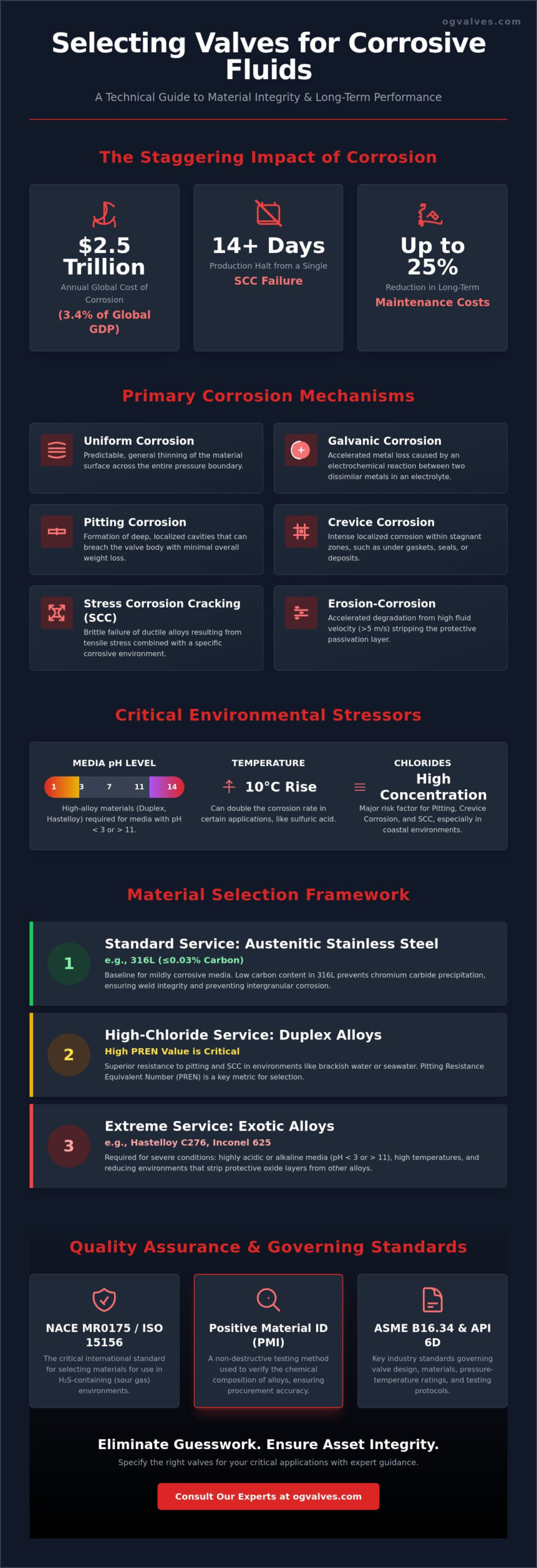
NACE International reports that the global cost of corrosion exceeds $2.5 trillion annually, a figure representing 3.4% of global GDP. You recognize that in high-pressure oil and gas operations, a single instance of stress corrosion cracking (SCC) can halt production for 14 days or longer. This downtime isn’t merely an operational delay; it’s a direct threat to infrastructure integrity and safety compliance. Engineering precision is the only defense against such systemic risks. This selecting valves for corrosive fluids guide delivers a rigorous material selection framework designed to eliminate guesswork in metallurgical specification and ensure long-term performance.
We’ll analyze high-performance alloys such as Hastelloy C276 and Inconel 625, evaluate adherence to API 6D and ISO 15156 standards, and detail the design protocols necessary to reduce long-term maintenance costs by up to 25% over the asset lifecycle. Our technical analysis focuses on the clinical application of ASME B16.34 requirements to mitigate fluid-induced degradation. You’ll gain the technical data required to align valve metallurgy with specific fluid chemistries, ensuring your infrastructure meets the highest global safety benchmarks through disciplined engineering and verified material integrity.
Key Takeaways
Identify the specific electrochemical mechanisms, such as pitting and crevice corrosion, that compromise component integrity in high-pressure industrial systems.
Utilize this selecting valves for corrosive fluids guide to differentiate between austenitic stainless steels and exotic alloys for optimized performance in high-chloride environments.
Evaluate the critical relationship between valve architecture and trim material compatibility to prevent fluid stagnation and localized material degradation.
Establish rigorous quality assurance frameworks through Positive Material Identification (PMI) and adherence to NACE MR0175/ISO 15156 standards for sour gas service.
Formulate comprehensive technical specifications and data sheets to ensure procurement accuracy and long-term reliability in critical infrastructure projects.
Understanding Corrosion Mechanisms in Industrial Valve Systems
Identifying the specific degradation pathways is critical for maintaining valve integrity in high-stakes environments. This selecting valves for corrosive fluids guide prioritizes the technical analysis of electrochemical and mechanical interactions within pressurized systems. Engineers must distinguish between four primary modes to ensure safety and compliance. Uniform corrosion causes a predictable thinning of the pressure boundary across the entire surface. Galvanic corrosion occurs when dissimilar metals contact an electrolyte, creating a potential difference that accelerates metal loss. Pitting corrosion produces deep, localized cavities that can breach a valve body despite minimal overall weight loss. Crevice corrosion targets stagnant zones under seals or gaskets where oxygen levels are depleted.
High-pressure systems experience accelerated degradation when fluid velocity exceeds 5 meters per second. This flow rate often strips the protective passivation layer from the metal surface, leading to erosion-corrosion. Temperature also plays a decisive role; a 10-degree Celsius rise in process temperature can double the corrosion rate in sulfuric acid applications. Internal media corrosion is driven by the chemical properties of the process fluid. External atmospheric corrosion presents equal risks in coastal or offshore environments. Facilities located within 5 kilometers of a coastline face chloride-induced attack from salt spray, requiring specialized coatings or high-grade alloys to prevent external structural failure.
Stress Corrosion Cracking (SCC) is the brittle failure of ductile alloys caused by the combined effects of tensile stress and a specific corrosive environment, most notably chloride-rich media.
Chemical Analysis of Corrosive Media
Evaluating the pH level is the first step in rigorous material selection. Media with a pH below 3 or above 11 necessitates high-alloy valve construction materials such as Duplex or Hastelloy to ensure long-term performance and API compliance. Oxidizing environments support the formation of protective oxide films on stainless steels. Reducing environments actively strip these layers, requiring alloys with high nickel and molybdenum content. Trace contaminants, including hydrogen sulfide at levels as low as 15 parts per million, can trigger localized failures in standard carbon steel through sulfide stress cracking.
Environmental Stressors and Material Fatigue
Thermal cycling between 40 and 400 degrees Celsius induces mechanical fatigue that compromises the integrity of protective chromium oxide layers. This fracturing allows chemical agents to bypass surface defenses and attack the underlying grain structure. In valve stems, the synergy between constant mechanical stress and chemical attack leads to accelerated stem failure and packing leaks. Industrial pollutants and humidity levels exceeding 65% further intensify the rate of external degradation. These environmental factors must be quantified during the specification phase to prevent premature asset replacement in harsh industrial zones.
Material Selection Framework: From Stainless Steels to Exotic Alloys
Engineering a robust selecting valves for corrosive fluids guide starts with a rigorous assessment of metallurgical properties against chemical concentrations. While austenitic stainless steels serve as the baseline for many industrial applications, they often fail in high-chloride or high-temperature acidic environments. Engineers must evaluate the electrochemical compatibility of the valve body and internal trim to prevent localized corrosion mechanisms like pitting or stress corrosion cracking (SCC).
The Performance of Stainless and Alloy Steels
Austenitic stainless steels like 304 and 316 provide adequate resistance for mildly corrosive media. However, 316L is the technical standard for welded valve components. Its low carbon content, restricted to a maximum of 0.03%, prevents chromium carbide precipitation during the welding process. This maintains the integrity of the heat-affected zone and prevents intergranular corrosion. For applications involving brackish water or seawater, the Pitting Resistance Equivalent Number (PREN) serves as a critical selection metric. A PREN value is calculated using the formula %Cr + 3.3(%Mo + 0.5%W) + 16%N. While 316L typically offers a PREN of 24, Duplex 2205 increases this to 35. Super Duplex alloys like 2507 exceed 40, providing the necessary resilience for high-pressure desalination and offshore systems. Detailed material specifications for these environments are available in our Industrial Ball Valves: A Technical Engineering & Specification Guide.
Exotic Alloys for Severe Service
When conventional stainless steels reach their limit, nickel-based alloys become necessary to maintain plant uptime. Hastelloy C276 is a premier choice for environments containing strong oxidizing agents like ferric and cupric chlorides. Its high molybdenum and chromium content provides stability across a wide pH range. Monel 400, a nickel-copper alloy, remains the industry standard for hydrofluoric acid alkylation units and marine hardware due to its resistance to rapidly flowing seawater. In niche chemical processing, titanium and zirconium are utilized when the fluid requires a highly stable protective oxide film that nickel alloys cannot sustain. For example, titanium is frequently specified for wet chlorine gas applications where other metals would suffer rapid degradation.
Justifying the investment in exotic alloys requires a comprehensive lifecycle cost analysis. Although a Hastelloy valve body may cost five times more than 316L, it often extends the Mean Time Between Failure (MTBF) by over 300% in aggressive media. This reduces the total cost of ownership by eliminating frequent replacements and unplanned shutdowns. For procurement teams, selecting valves for corrosive fluids guide metrics should always prioritize long-term mechanical integrity over initial capital expenditure. If you require assistance with complex material grades, consult with our technical team to ensure your specifications meet international compliance standards.
Evaluating Valve Design and Trim for Corrosive Service
Evaluating the integrity of internal components is a critical phase in the selecting valves for corrosive fluids guide. While the valve body provides pressure containment, the trim, comprising the stem, seat, and disc, bears the direct impact of chemical attack. Engineers must specify trim materials that meet NACE MR0175 standards or ISO 15156 for petroleum production. It’s vital to ensure electrochemical compatibility between components to prevent galvanic corrosion. Utilizing Stellite 6 hard-facing on seating surfaces provides a hardness of 40-45 HRC, which is essential for resisting erosion-corrosion in high-velocity streams where abrasive particles are present.
Valve architecture significantly influences the rate of localized degradation. Crevice corrosion often occurs in shielded areas where fluid remains stagnant. This leads to a localized breakdown of the passive oxide layer, particularly in chloride-rich environments. Designing for corrosive service requires a clinical focus on minimizing these dead zones and ensuring that flow paths remain as streamlined as possible to prevent media buildup.
Trim Compatibility: Stems and discs must often be upgraded to Hastelloy C276 or Monel 400 when standard 316 stainless steel fails to provide sufficient pitting resistance.
Seat Material Selection: PTFE and RPTFE offer near-universal chemical inertness for temperatures below 200°C. Metal-to-metal seats are required for higher temperatures or abrasive slurries.
Hard-facing: Cobalt-based alloys like Stellite prevent the mechanical wear that accelerates chemical corrosion in high-pressure drop applications.
Design Considerations for Isolation Valves
Reliable isolation in corrosive environments requires careful attention to internal geometry. Engineers often prioritize gate valve configurations that minimize dead spaces where media can accumulate and acidify. While reduced-bore valves offer cost advantages, full-bore configurations are preferred for corrosive slurries to reduce turbulence and erosion. For critical leak prevention, bellows seals provide a hermetic barrier, surpassing the performance of standard fugitive emission packing. These seals ensure compliance with ISO 15848-1 standards for hazardous chemical service.
Quarter-Turn Solutions for Corrosive Media
The butterfly valve is a primary choice for high-volume corrosive flow when equipped with high-performance linings such as PFA or PTFE. These fluoropolymer coatings provide near-universal chemical resistance. For more demanding conditions, triple-offset designs utilize a metal-to-metal seat to achieve bubble-tight shutoff. This design eliminates friction between the seal and the seat, reducing wear and extending maintenance intervals. For a broader overview of these specifications, refer to Industrial Valves: The Engineer’s Comprehensive Guide. Properly identifying these design variables is a cornerstone of any selecting valves for corrosive fluids guide used in heavy industry.
Quality Assurance and Material Verification Protocols
Positive Material Identification (PMI) serves as the primary safeguard against material mix-ups that lead to catastrophic system failure. In high-pressure corrosive environments, even a minor alloy substitution can trigger rapid pitting or stress corrosion cracking. Engineers use PMI to verify that the delivered hardware matches the metallurgical specifications of the design phase. This process is a foundational element of any comprehensive selecting valves for corrosive fluids guide. Compliance with NACE MR0175/ISO 15156 remains mandatory for sour gas environments, as it defines the hardness limits and heat treatment protocols necessary to resist Sulfide Stress Cracking (SSC).
Non-destructive testing (NDT) provides a window into the internal and surface integrity of the valve without compromising the component. Radiographic testing (RT) uses X-rays to detect volumetric defects in valve castings, while Ultrasonic testing (UT) identifies subsurface flaws through high-frequency sound waves. For surface-level inspection, Dye Penetrant testing (PT) highlights cracks in welds or machined surfaces that are invisible to the naked eye. Material Test Reports (MTRs) are non-negotiable for corrosive service because they provide the only documented audit trail linking a specific heat number to its certified chemical and physical properties.
Verification of Chemical Composition
On-site alloy verification typically involves X-ray Fluorescence (XRF) technology. This hand-held equipment provides a non-destructive elemental analysis of high-nickel and stainless steel alloys within seconds. Verification ensures the valve meets ASME B16.34 requirements for pressure-temperature ratings. Precise trace element control is vital; for example, keeping Carbon levels below 0.03% in 316L stainless steel is essential to prevent intergranular corrosion during the welding process. These checks confirm the material’s ability to withstand aggressive media over its projected service life.
Testing for Structural Integrity
Structural validation requires rigorous pressure testing protocols. Hydrostatic shell testing at 1.5 times the rated working pressure confirms the strength of high-alloy valve bodies. Pneumatic testing at lower pressures is often used to detect microscopic leak paths that liquid molecules might miss. For cryogenic corrosive applications, Charpy V-notch impact testing at -196°C verifies that the material won’t undergo a brittle fracture. These integrity standards are critical for all flow control components, and you can find more detail in our technical overview of Understanding Industrial Check Valves.
Ensure your project adheres to the strictest international safety standards by consulting with our technical team regarding certified valve solutions for corrosive environments.
Procurement and Specification for High-Stakes Environments
Precision in procurement starts with a comprehensive valve data sheet. This document serves as the technical blueprint for integrity in aggressive media. It must detail chemical concentrations, maximum and minimum temperature fluctuations, and precise pressure cycles. A complete selecting valves for corrosive fluids guide requires these data points to prevent premature material failure. Engineers shouldn’t overlook trace contaminants; even a 0.5% increase in chloride levels can accelerate pitting in standard stainless steels. Adherence to NACE MR0175/ISO 15156 is mandatory for sour service to prevent sulfide stress cracking. Technical support during the specification phase ensures that material choices, such as selecting Hastelloy C276 over 316L, are justified by the operational risk profile.
Strategic Sourcing and Lead Times
Managing the supply chain for exotic alloy components requires a proactive approach. Standard lead times for forged Monel or Inconel bodies often exceed 28 weeks in the current industrial market. We mitigate these delays through strategic inventory management, stocking semi-finished components to reduce delivery windows. This readiness is vital for fast-track requirements during unscheduled refinery shutdowns where every hour of downtime costs approximately $20,000 in lost production. Global logistics capabilities must ensure that compliant hardware reaches project sites under DDP (Delivered Duty Paid) terms, maintaining strict adherence to ASME B16.34 and API 6D standards regardless of the geographic location.
The OG Valves Advantage
We leverage deep technical expertise to deliver bespoke industrial valve solutions for the most demanding corrosive environments. Our engineering team doesn’t just supply hardware; we provide a clinical evaluation of your process conditions to ensure long-term performance. Every valve undergoes rigorous quality control protocols, including Positive Material Identification (PMI), ultrasonic testing, and Fugitive Emission Testing according to ISO 15848-1. These steps confirm that the final product meets the exact metallurgical specifications required for high-stakes safety. Our focus remains on industrial precision and the elimination of mechanical ambiguity. To secure your infrastructure, you can request a technical consultation for your corrosive service requirements. We prioritize functional reality and engineering excellence to act as a dependable partner in your critical infrastructure projects.
Securing Critical Infrastructure Through Advanced Valve Specification
The integrity of high-pressure industrial systems hinges on the technical precision applied during the material selection phase. This selecting valves for corrosive fluids guide demonstrates that choosing the correct alloy, such as Duplex stainless steel or Monel, is only the first step. Engineering teams must also evaluate trim designs and seal compatibility to withstand aggressive chemical environments. Adherence to NACE MR0175/ISO 15156 standards remains the benchmark for preventing sulfide stress cracking in upstream and midstream operations.
OG Valves reinforces these engineering principles through a rigorous quality assurance framework. We perform 100% Positive Material Identification (PMI) testing on all pressure-containing components to ensure compliance with API 600 and ASME B16.34 specifications. Our global fast-track delivery system is designed to meet the urgent timelines of critical industrial infrastructure projects without compromising safety protocols. We’ve established these processes to provide a reliable partnership for engineers managing high-stakes fluid control challenges. Consult with our technical experts for your specific valve requirements to ensure your facility maintains peak operational performance. We’re here to help you achieve zero-failure outcomes in your most demanding environments.
Frequently Asked Questions
Which is the best valve material for sulfuric acid?
Alloy 20 is the industry standard for sulfuric acid service, particularly in concentrations between 20% and 40%. This austenitic stainless steel contains 32.5% nickel and 20% chromium to prevent stress corrosion cracking. For concentrations exceeding 98% at temperatures below 50°C, ductile iron remains a viable alternative. It’s essential to match the material’s corrosion rate to the specific acid molarity to ensure a 20 year service life.
Can 316 stainless steel be used for seawater applications?
316 stainless steel isn’t suitable for long term seawater immersion because its Pitting Resistance Equivalent Number (PREN) is only 24. Seawater applications require materials with a PREN exceeding 40 to prevent localized pitting. Engineers should specify Super Duplex Grade 5A or Titanium for these conditions. These alloys resist chloride induced stress corrosion cracking in environments where chloride levels exceed 19,000 mg/L.
What is the difference between NACE MR0175 and MR0103?
NACE MR0175 applies to upstream oil and gas production environments where H2S is present. NACE MR0103 governs downstream refinery processes. While both standards address sulfide stress cracking, MR0175 includes more rigorous testing requirements for pH levels and chloride concentrations. Compliance with the correct standard ensures the valve’s metallic components maintain structural integrity under specific H2S partial pressures.
How does temperature affect valve material selection for corrosive fluids?
Temperature acceleration is a primary factor in chemical degradation. Corrosion rates often double with every 10°C increase in fluid temperature. High temperatures also increase the susceptibility of 300 series stainless steels to chloride stress corrosion cracking. This selecting valves for corrosive fluids guide emphasizes checking ASME B16.34 pressure temperature tables to ensure the material’s yield strength remains sufficient at peak operating thermal loads.
What are the risks of using standard carbon steel in corrosive environments?
Standard carbon steel lacks the 10.5% minimum chromium content required to form a protective oxide layer. In acidic environments, it faces uniform corrosion rates that can exceed 1.5 mm per year. This leads to rapid wall thinning and potential rupture of the pressure boundary. Using carbon steel without internal liners in corrosive service violates API 570 safety protocols and risks catastrophic mechanical failure.
How often should valves in corrosive service be inspected?
Valves in highly corrosive service require ultrasonic thickness testing every 6 to 12 months according to API 570 standards. If the measured corrosion rate exceeds 0.25 mm per year, the inspection interval should be shortened to 3 months. Regular monitoring ensures the remaining wall thickness stays above the minimum required by ASME Section VIII. This rigorous schedule prevents unplanned shutdowns and maintains plant safety.
What is PMI testing and why is it required for high-alloy valves?
Positive Material Identification (PMI) is a non-destructive verification process using X-ray fluorescence to confirm an alloy’s chemical composition. It’s mandatory for high alloy valves to ensure they meet ASTM A351 or A182 specifications. Even a 0.5% deficiency in molybdenum can lead to premature failure in chloride rich environments. PMI testing provides the documented evidence needed for quality assurance and regulatory compliance.
Which valve type is most resistant to crevice corrosion?
Diaphragm valves offer the highest resistance to crevice corrosion because they eliminate the stem packing and bonnet joints where fluids stagnate. In these designs, the diaphragm creates a seamless seal that prevents chemicals from entering 0.1 mm gaps. When following a selecting valves for corrosive fluids guide, engineers also favor top entry ball valves. These designs reduce the number of potential leak paths compared to multi piece bolted bodies.
 Responsive Menu