Industrial Valve Selection Guide for Engineers: A Technical Specification Framework (2026)
April 21, 2026
Home+Industrial Valve Selection Guide for Engineers: A Technical Specification Framework (2026)
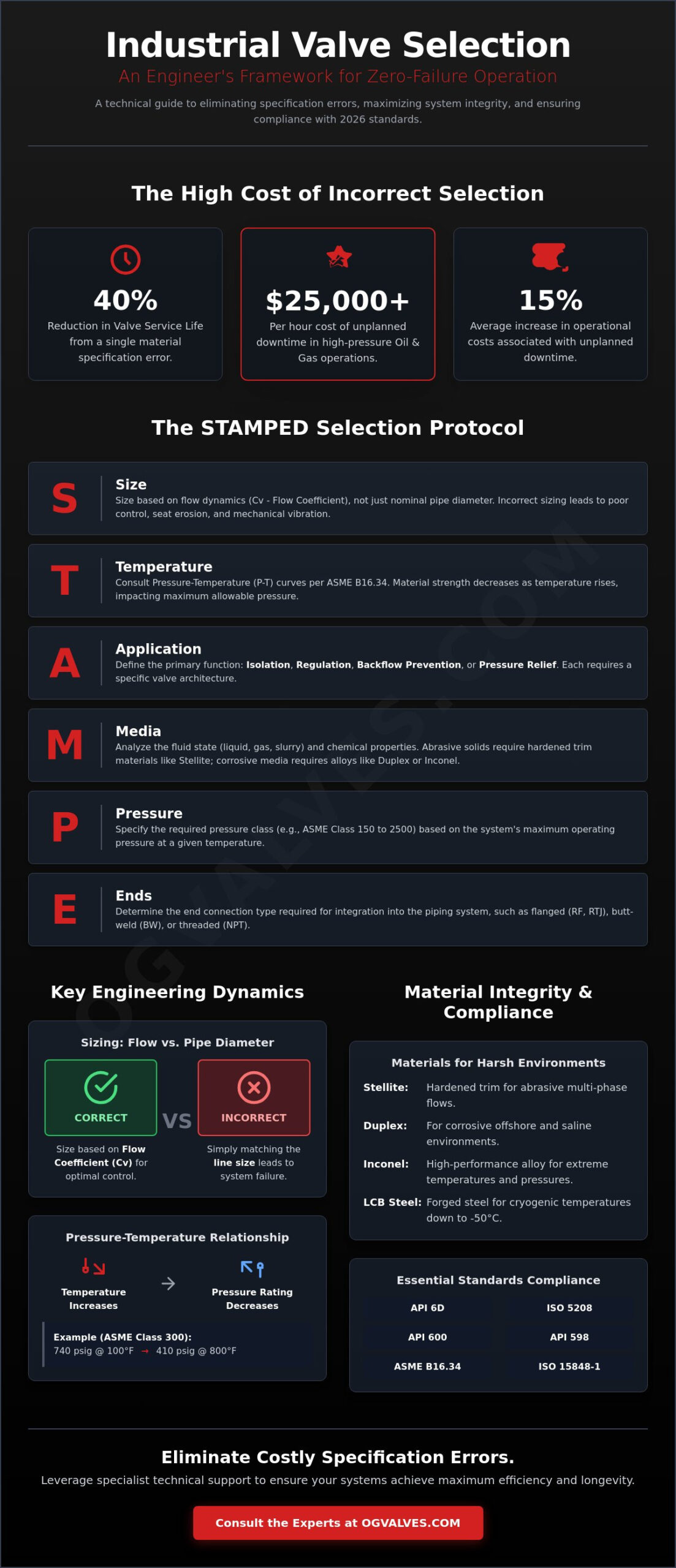
In high-pressure industrial operations, a single material specification error often results in a 40% reduction in valve service life before the first scheduled maintenance cycle. Engineers recognize that improper component selection isn’t merely a procurement delay; it’s a direct threat to system integrity and personnel safety. This industrial valve selection guide for engineers establishes a technical framework for identifying the precise specifications required to maintain zero-failure operation in critical oil, gas, and water treatment systems. Adhering to rigorous engineering benchmarks ensures that every installed unit performs within its design limits without compromising the broader infrastructure.
You’re likely managing projects where non-compliance with API 6D or ISO 5208 standards isn’t an option and project timelines can’t be extended by avoidable errors. We’ll provide a comprehensive analysis of material grades, pressure-temperature ratings, and seat leakage classifications to ensure your systems achieve maximum efficiency. This technical resource examines the 2026 standards for forged steel and cast iron components, offering a methodical approach to optimizing flow control and eliminating the 15% average increase in operational costs associated with unplanned downtime.
Key Takeaways
Understand the multi-variable engineering discipline required to balance traditional mechanical design with modern fugitive emission standards for enhanced environmental compliance.
Learn how to calculate the Flow Coefficient (Cv) and why sizing valves based on flow dynamics rather than pipe diameter is critical for maintaining system integrity.
Utilize this industrial valve selection guide for engineers to accurately match valve architecture, such as gate or high-performance ball designs, to specific process functionality.
Identify essential material grades for corrosive environments, including Duplex and Inconel, while ensuring strict adherence to API 600, 6D, and 598 testing protocols.
Discover strategic procurement methods to mitigate project delays by optimizing lead times and leveraging specialist technical support to eliminate costly specification errors.
The Fundamentals of Industrial Valve Selection in 2026
Industrial valve selection is a multi-variable engineering discipline where technical integrity directly impacts operational safety. Engineers must move beyond basic mechanical design to address 2026 fugitive emission standards such as ISO 15848-1. These regulations mandate leak rates below 50 parts per million for critical gas services. The Fundamentals of Industrial Valve Selection require a precise understanding of four primary functions: isolation, regulation, backflow prevention, and pressure relief. Each function demands a specific internal geometry and sealing mechanism to maintain system pressure and prevent fluid loss.
The cost of incorrect selection is severe. Selecting the wrong specification leads to catastrophic mechanical failure, environmental hazards, or significant unplanned downtime. In high-pressure oil and gas operations, unplanned downtime resulting from valve seat erosion can exceed $25,000 per hour. Compliance with API 6D and ASME B16.34 isn’t optional; it’s the baseline for infrastructure longevity. This industrial valve selection guide for engineers provides the technical framework needed to mitigate these risks through rigorous data-driven specification.
Defining the Process Media and Operating Environment
Engineers must analyze the fluid state, whether liquid, gas, slurry, or multi-phase flow. Multi-phase flows containing abrasive solids require hardened trim materials like stellite to prevent rapid erosion. Chemical compatibility must account for hydrogen embrittlement or chloride stress corrosion cracking in saline environments. External factors also dictate material choice. Arctic temperatures reaching -50°C or corrosive offshore atmospheres demand specific material grades like LCB forged steel or Duplex stainless steel to ensure structural integrity over a 20-year service life.
Core Selection Frameworks: The STAMPED Method
The STAMPED protocol remains the industry standard for heavy industry procurement. This framework includes Size, Temperature, Application, Media, Pressure, Ends, and Delivery. Technical data must precede product browsing to ensure the valve meets the exact duty cycle of the plant. Critical service valves, such as those used in hydrogen production or high-cycle steam, require more rigorous testing and certification than general purpose units. This industrial valve selection guide for engineers emphasizes that application-specific data is the only defense against premature seal failure and costly maintenance cycles. Identifying whether a project requires ASME Class 150 or Class 2500 ratings at the start of the design phase prevents integration errors during the construction of critical infrastructure.
Engineering Parameters: Sizing, Pressure, and Temperature Dynamics
Precision in fluid control begins with accurate sizing rather than matching nominal pipe diameters. This industrial valve selection guide for engineers emphasizes that line-size selection is a frequent point of system failure. Selecting a valve based solely on the pipe’s physical dimensions often results in oversized components, leading to poor control sensitivity, seat erosion, and mechanical vibration. Engineers must size valves based on actual flow requirements to maintain process integrity and extend the service life of the internal trim.
Technical validation requires a deep understanding of the Engineering Parameters for Valve Selection, specifically regarding the relationship between material strength and thermal load. Pressure-Temperature (P-T) curves, governed by ASME B16.34, define the maximum allowable working pressure at specific temperatures. For instance, an ASME Class 300 carbon steel valve rated for 740 psig at 100°F sees its capacity drop to 410 psig when the temperature reaches 800°F. Ignoring these dynamics compromises shell integrity and risks catastrophic containment failure in high-energy piping systems.
Calculating Flow and Pressure Drop
Determining the Flow Coefficient (Cv) is the primary step in predicting pressure drop across the valve body. Flow Coefficient is the volume of water at 60°F that flows through a valve with a 1 psi pressure drop. This metric allows engineers to calculate the required capacity for specific process conditions. In high-velocity systems, calculating Cv is also a safeguard against destructive phenomena.
Cavitation: This occurs when liquid pressure drops below vapor pressure, forming bubbles that implode and damage the downstream trim.
Flashing: When the downstream pressure remains below the vapor pressure, the fluid stays in a gaseous state, causing high-velocity erosion and choked flow conditions.
Pressure Classes and Wall Thickness Standards
ASME pressure classes range from 150 to 4500, with each tier dictating specific wall thickness and flange dimensions. Proper classification ensures the valve shell can withstand internal stresses without deformation. Engineers must evaluate shell thickness against the rigorous criteria of Industrial Valves: The Engineer’s Comprehensive Guide to Selection and Standards (2026) to confirm compliance with safety factors.
While Class 150 is standard for low-pressure water treatment, Class 2500 and 4500 are reserved for critical power generation and high-pressure oil and gas applications. Maintaining a clinical focus on these specifications is vital for long-term performance. Engineers seeking specific material grade data or certification documents can consult the technical library at ogvalves.com for detailed compliance records. This industrial valve selection guide for engineers
Matching Valve Architecture to Process Functionality
Selecting the correct mechanical architecture is the foundation of this industrial valve selection guide for engineers. Engineers must distinguish between quarter-turn designs, which offer rapid 90-degree actuation, and multi-turn designs, which provide gradual closure and superior sealing in high-pressure steam or oil service. The choice between these architectures dictates the system’s response time, sealing integrity, and maintenance frequency over a 20-year operational life.
Isolation and Shut-off Valves
High-cycle applications requiring immediate flow cessation rely on the technical advantages of industrial ball valves. These units minimize pressure drop with full-bore ports and provide bubble-tight shut-off via soft seats like reinforced PTFE or PEEK. For high-temperature isolation exceeding 450°C, industrial gate valves remain the industry standard. They utilize a wedge-style disc to provide a robust metal-to-metal seal according to API 600 standards. While soft seats offer API 598 zero-leakage performance at lower temperatures, metal-seated valves are mandatory for abrasive media or extreme thermal cycles to prevent seat deformation. Engineers should specify Stellite 6 hardfacing on gate valve seats to ensure durability against wire-drawing and erosion.
Regulation and Non-Return Solutions
Globe valves are the primary choice for precise flow modulation. Their tortuous flow path generates a predictable pressure drop, allowing for linear or equal percentage flow characteristics. This design is essential for throttling where a ball valve would suffer from cavitation or seat erosion. In high-pressure instrumentation lines, needle valves provide the necessary control for sampling and calibration. To protect upstream equipment from surge damage, the mechanical necessity of industrial check valves can’t be overstated. These valves prevent backflow automatically. Selection between dual-plate, piston-check, or swing-check designs depends on the specific cracking pressure and the risk of water hammer in the piping system.
In large-bore piping, specifically DN500 and above, triple-offset butterfly valves offer a critical weight reduction of up to 70% compared to equivalent gate valves. The triple-offset geometry eliminates seat friction during the stroke, enabling bi-directional, zero-leakage performance in Class 600 or Class 900 applications. This architecture reduces structural support requirements and lowers the total cost of ownership in offshore or space-constrained facilities. It’s a vital consideration in any comprehensive industrial valve selection guide for engineers focusing on modern infrastructure efficiency.
Multi-turn: Gate, Globe, Needle (Precision and high-pressure sealing).
Automatic: Check valves (Backflow prevention).
Material Integrity and Compliance with International Standards
Material selection dictates the lifecycle and safety of any pressure-containing vessel. For engineers utilizing this industrial valve selection guide for engineers, understanding the metallurgical requirements of corrosive environments is paramount. Duplex (UNS S31803) and Super Duplex (UNS S32750) stainless steels offer Pitting Resistance Equivalent Numbers (PREN) above 40, making them essential for seawater and chloride-rich media. Inconel 625 and 718 provide superior performance in high-pressure sour gas environments where hydrogen-induced cracking is a constant risk.
Compliance with American Petroleum Institute (API) standards ensures component interchangeability and operational safety. API 600 specifies the design criteria for heavy-duty bolted bonnet steel gate valves, while API 6D focuses on pipeline valves for the midstream sector. All valves must undergo rigorous testing per API 598 to verify seat and shell integrity. Choosing between forged and cast bodies depends on the application’s fatigue cycles. Forged components, such as ASTM A105 or A182, offer a refined grain structure and higher structural density. This is necessary for Class 1500 and Class 2500 services. Castings like ASTM A216 WCB remain the standard for larger diameter, lower pressure requirements where cost-efficiency is a primary factor.
Environmental regulations now mandate strict fugitive emission compliance. Standards such as ISO 15848-1 and API 622/641 define the allowable leakage rates for stem seals. Modern valve specifications often require Class AH or BH ratings to minimize the release of volatile organic compounds (VOCs) into the atmosphere. These ratings ensure the valve maintains seal integrity over 1,500 to 2,500 cycles.
Quality Assurance and Testing Protocols
Validation begins with Positive Material Identification (PMI) to confirm alloy chemistry against the Mill Test Report (MTR). Non-Destructive Testing (NDT) identifies internal and surface defects. Radiographic Testing (RT) is the gold standard for verifying casting soundness, while Magnetic Particle (MT) and Dye Penetrant (PT) inspections detect surface fissures. Every unit undergoes hydrostatic shell testing at 150 percent of the rated pressure and pneumatic seat leakage tests to ensure zero-leakage performance before site delivery.
Cryogenic and High-Temperature Specifications
Operating temperatures below -29°C require materials with high impact toughness, often verified through Charpy V-Notch testing. Cryogenic valves for LNG service at -162°C utilize extended bonnets to protect the packing from freezing. In high-temperature power generation reaching 600°C, creep resistance is vital. Engineers specify F11, F22, or F91 chrome-moly steels to manage thermal expansion. Specialized graphite or PTFE-based packing materials are selected based on these thermal cycles to prevent stem binding or seal failure.
Strategic Procurement: Ensuring Quality and Reducing Lead Times
Procurement delays represent a primary risk factor in large-scale infrastructure projects. Industry data from 2024 indicates that logistical bottlenecks can extend project timelines by 15% to 22% if critical components aren’t secured early. This industrial valve selection guide for engineers emphasizes that procurement isn’t merely a commercial transaction; it’s a technical safeguard. Selecting a specialist supplier provides access to engineering expertise that prevents specification errors. These errors cause approximately 30% of premature valve failures during the first year of field operation. Technical support ensures that material grades and pressure ratings align exactly with the intended service environment.
Engineers must evaluate the Total Cost of Ownership (TCO) rather than focusing solely on the initial purchase price. A valve fabricated from high-grade forged steel or specialized alloys may require a higher capital expenditure, yet it often reduces lifecycle maintenance costs by 40% over a ten-year period. Reliability in high-pressure or cryogenic service depends on strict adherence to API 6D and ASME B16.34 standards. Automation remains a central component of modern specification. Integrating industrial valve actuators early in the design phase ensures that torque requirements and fail-safe protocols align with the control system architecture. This proactive approach eliminates the need for expensive field modifications and reduces the risk of control system incompatibility.
Optimizing the Supply Chain for Critical Components
Downtime in oil and gas or chemical processing facilities can cost operators upwards of $50,000 per hour. Fast-track delivery systems are essential for maintaining operational continuity. OG VALVES LTD. maintains technical integrity through rigorous procurement standards and a global logistics network. Every valve undergoes testing to verify compliance with ISO 9001:2015 and specific project requirements. Strategic inventory management allows for the reduction of lead times from industry averages of 16 weeks down to 4 weeks for standard API-certified units. This efficiency ensures that critical infrastructure projects remain on schedule without compromising on material quality or safety certifications.
Conclusion: The Engineer’s Selection Checklist
Before finalizing any procurement order, a final review of the technical specification documents is mandatory. Engineers should verify that every data sheet reflects actual process conditions, including maximum operating pressure and fluid chemistry. Use this checklist as a final validation step:
Confirm material compatibility with the process media to prevent galvanic corrosion or erosion.
Verify that pressure ratings meet or exceed the maximum surge pressure of the system.
Ensure all international certifications, such as ISO, API, and ASME, are documented and verified.
Check that actuator sizing includes a sufficient safety factor for high-cycle applications.
Advancing System Reliability Through Technical Precision
Achieving operational excellence in 2026 requires a rigorous focus on material integrity and dimensional accuracy. Engineers must prioritize components that meet API 6D and ASME B16.34 standards to mitigate the risk of mechanical failure in high-pressure environments. This industrial valve selection guide for engineers establishes the baseline for evaluating valve architecture against specific process functionalities like cryogenic service or high-cycle isolation. Successful procurement depends on a vendor’s ability to provide verifiable documentation and maintain a comprehensive inventory of gate, ball, and check valves for heavy industry. OG Valves supports critical infrastructure projects by ensuring 100% adherence to ISO 9001 quality protocols and providing global fast-track delivery for urgent site requirements. It’s essential to integrate these technical specifications early in the design phase to prevent costly project delays. Selecting the right components ensures the long-term safety and performance of your industrial assets. We’re ready to assist with your next project’s specific engineering demands and provide the durability your sector requires.
What are the most common mistakes engineers make in valve selection?
Approximately 22% of valve failures result from incorrect Cv sizing and disregard for NACE MR0175 material standards. This industrial valve selection guide for engineers highlights that 15% of refinery leaks stem from choosing a valve with an incompatible pressure-temperature rating. Engineers shouldn’t overlook thermal expansion in steam systems, which leads to 12% of documented seat seizures. Every technical parameter must be verified against ASME B16.34 standards to ensure total system integrity.
How do I determine if I need a floating or trunnion-mounted ball valve?
System pressure and bore size dictate the choice between floating and trunnion-mounted ball valves. Floating designs suit applications under Class 300 and sizes below 6 inches where the ball moves toward the downstream seat to seal. For pressures exceeding 2,500 psi or sizes over 8 inches, trunnion-mounted valves are mandatory. These utilize a fixed ball and spring-loaded seats to manage high mechanical loads and prevent stem deformation during 100% duty cycles.
What is the difference between API 600 and API 603 gate valve standards?
API 600 defines specifications for heavy-walled carbon steel gate valves, while API 603 covers corrosion-resistant, thin-walled stainless steel valves. API 600 valves feature a 15% thicker wall to provide a larger corrosion allowance in harsh refinery environments. API 603 is designed for applications where the fluid isn’t corrosive to the alloy, allowing for a lighter construction in 316 or 304 stainless steel. It’s a critical distinction for projects with strict weight requirements.
Can a butterfly valve be used for throttling in high-pressure steam applications?
Standard butterfly valves shouldn’t be used for throttling high-pressure steam due to rapid seat erosion and cavitation risks. High-velocity steam reaching 60 meters per second destroys resilient seats in under 72 hours of operation. If you’re using this industrial valve selection guide for engineers, consider that only triple-offset butterfly valves with metal seats handle steam throttling. Even then, globe valves remain the industry benchmark for precise steam control in 90% of thermal power plants.
What materials are recommended for valves in sour gas (H2S) service?
Valves for sour gas service must strictly adhere to NACE MR0175/ISO 15156 standards to prevent sulfide stress cracking. Recommended materials include 316 stainless steel or carbon steel with a maximum hardness of 22 HRC. For H2S concentrations exceeding 15%, engineers specify Inconel 625 or 718 cladding for critical components. These alloys maintain structural integrity and prevent brittle failure in environments with high partial pressures of hydrogen sulfide, ensuring a 20-year service life.
How does the Flow Coefficient (Cv) impact the sizing of a control valve?
The Flow Coefficient (Cv) determines valve sizing by establishing the flow rate at a 1 psi pressure drop across the valve. Proper sizing requires the calculated Cv to fall between 20% and 80% of the valve’s maximum capacity. If a valve operates at 95% of its Cv, it won’t have the headroom to handle flow surges. Operating below 10% causes “wiredrawing” where high-velocity fluid cuts through seat materials, reducing valve life by 60%.
What is the importance of a Fire-Safe design certification (API 607)?
Fire-safe certification under API 607 validates that a valve maintains its seal during and after a high-temperature event. The test requires the valve to withstand a 760 degree Celsius flame for 30 minutes while maintaining minimal leakage. Internal leakage can’t exceed 400 milliliters per inch of diameter per minute after the burn. This certification is a non-negotiable requirement for 95% of refinery and offshore platform installations to prevent catastrophic fuel feeding during emergencies.
When should I specify a needle valve over a ball valve for instrumentation?
You should specify a needle valve when your application requires precise flow regulation or high-pressure isolation in 0.25 inch to 1 inch lines. Needle valves utilize a tapered stem to provide 0.005 inch increments of flow adjustment. Ball valves don’t offer this granularity and are strictly for quick, quarter-turn on/off service. In 2026 instrumentation setups, needle valves are the standard for gauges and sampling systems where pressure exceeds 6,000 psi and precision is mandatory.
 Responsive Menu