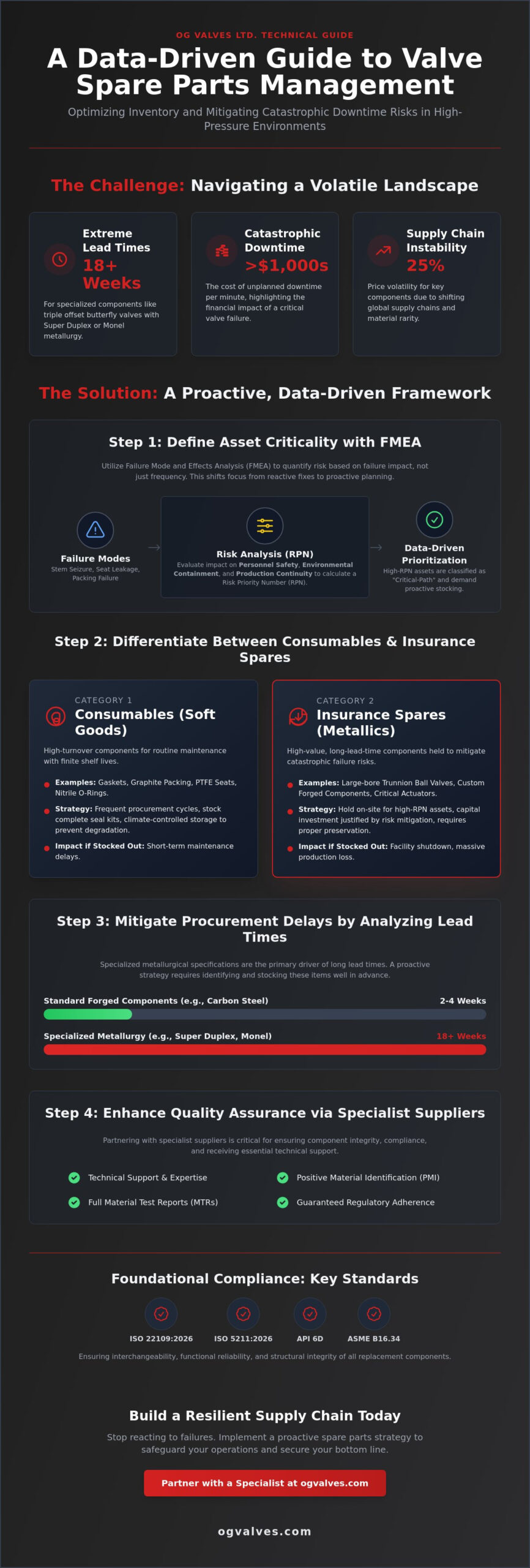
With lead times for specialized triple offset butterfly valves reaching 18 weeks and unplanned downtime costs exceeding thousands of dollars per minute, the margin for error in inventory procurement has vanished. Technical experts recognize that a reactive approach to maintenance is no longer viable when key components face 25% price volatility and shifting global supply chains. It’s a common challenge to justify the high cost of holding insurance spares against the catastrophic risk of a stockout during a scheduled turnaround.
This technical framework provides a comprehensive engineering guide to a spare parts management strategy for valves that prioritizes data-driven classification and risk assessment. We’ll outline a structured methodology for identifying critical spares based on metallurgical rarity and asset criticality rather than simple failure frequency. This article details how to integrate the latest ISO 22109:2026 and ISO 5211:2026 standards into your procurement logistics to ensure full regulatory compliance. By following this framework, you’ll reduce operational downtime and stabilize the supply chain for gate, globe, and check valves in high-pressure environments.
Key Takeaways
- Utilize the Failure Mode and Effects Analysis (FMEA) framework to establish asset criticality based on the environmental and production impact of valve failure.
- Optimize inventory overhead through a spare parts management strategy for valves that differentiates between elastomer consumables and high-value metallic insurance spares.
- Implement a lifecycle-based maintenance model to address distinct component requirements for plant commissioning and long-term operational wear cycles.
- Mitigate procurement delays by analyzing how specialized metallurgical specifications, such as Super Duplex or Monel, influence global lead times for forged components.
- Enhance quality assurance by prioritizing specialist suppliers capable of providing technical support and Positive Material Identification (PMI) testing at the point of supply.
Defining Asset Criticality in Valve Spare Parts Strategy
Asset criticality is not a static designation; it’s a dynamic calculation of operational risk based on the severity of failure consequences. In heavy industrial sectors, this definition encompasses three primary vectors: personnel safety, environmental containment, and production continuity. A robust spare parts management strategy for valves requires a granular assessment of every installed asset to differentiate between “run-to-failure” components and “critical-path” valves. While a non-critical needle valve in a secondary sampling line might be managed through a reactive replacement model, a high-pressure gate valve in a main steam line demands a proactive inventory protocol to prevent systemic collapse.
Reliability engineers utilize the Failure Mode and Effects Analysis (FMEA) framework to quantify these risks. This methodology evaluates specific failure modes, such as stem seizure, seat leakage, or packing failure, against their detectability and impact severity. By assigning a Risk Priority Number (RPN) to each asset, procurement specialists can refine the classification of spare parts based on verifiable engineering data. This data-driven approach ensures that capital is not tied up in redundant inventory for low-impact assets while ensuring that high-RPN components are always available. The financial impact of unplanned downtime in high-pressure environments is severe, with industry data indicating costs can exceed thousands of dollars per minute of lost production.
The Criticality Matrix for Industrial Valves
The criticality matrix maps valve assets according to specific process parameters, including operational pressure, temperature extremes, and media corrosivity. A trunnion-mounted ball valve operating in a sour gas environment carries a significantly higher criticality rating than a standard butterfly valve in a low-pressure cooling water circuit. Engineers must weigh the holding cost of a spare against the cumulative cost of a 24-hour facility shutdown. Identifying Long Lead Time (LLT) components within this matrix is essential for operational stability. For instance, specialized valves with lead times reaching 18 weeks must be stocked as on-site insurance spares if their failure would halt the critical production path.
Regulatory Adherence and Safety Standards
Compliance with global safety standards is a foundational requirement for any industrial maintenance framework. Emergency shutdown valves (ESDVs) must adhere to specific Safety Integrity Level (SIL) requirements to ensure functional reliability during a safety event. Furthermore, adherence to API 6D and ASME B16.34 standards is mandatory to ensure the interchangeability and structural integrity of replacement components. Rigorous documentation is required for all critical spares, including Material Test Reports (MTRs) and Positive Material Identification (PMI) testing records. These documents provide the necessary verification that replacement parts meet the metallurgical specifications required for high-stress applications, ensuring that safety and regulatory benchmarks are maintained throughout the asset lifecycle.
Technical Classification: Consumables vs. Insurance Spares
Effective inventory control depends on a binary classification system. A comprehensive spare parts management strategy for valves must distinguish between high-turnover consumables and long-term insurance spares. This distinction dictates procurement cycles, financial allocation, and physical storage protocols. While gaskets and packing sets require frequent replacement during routine maintenance, insurance spares for high-value assets like large-bore trunnion ball valves are held specifically to mitigate catastrophic lead-time risks. These metallic components are often custom-engineered; their immediate availability is essential for maintaining critical infrastructure uptime.
Soft Goods and Sealing Elements
Elastomeric and soft components possess finite shelf lives. PTFE seats, graphite packing, and nitrile O-rings degrade over time due to UV exposure, ozone, and temperature fluctuations. Storage environments must be climate-controlled to maintain material properties and prevent premature hardening or cracking. Stocking complete seal kits is a technical necessity. It ensures that all required soft goods are available for a rapid field repair, preventing the use of mismatched or aged components that compromise pressure containment during high-pressure operations.
Major Structural Components (Hard Spares)
Hard spares represent major structural components that don’t typically wear during standard operation but are critical for major overhauls. It’s necessary to stock replacement stems, discs, and wedges for gate valves to ensure rapid restoration of service after a mechanical failure. Similarly, identifying wear patterns in check valves allows for the pre-emptive procurement of hinge pins and clappers before they reach their fatigue limit. For automated systems, the strategic value of holding spare actuators cannot be overstated. It prevents a single component failure from disabling an entire control loop and halting production.
Managing these assets requires a sophisticated understanding of supply chain risk management. Procurement specialists must monitor the availability of specialized alloys and forged bodies to anticipate potential stockouts caused by geopolitical or economic shifts. Standardizing parts across a facility reduces the total inventory footprint; it allows for higher stock levels of critical items while simplifying the maintenance training required for site personnel. By reducing the variety of trim materials and pressure classes, facilities can achieve higher reliability with lower capital investment. Professionals seeking to optimize their inventory should consult with technical experts at OG Valves to align their stock with specific operational demands.
Developing a Lifecycle-Based Maintenance Model
Valve maintenance requirements shift significantly across the equipment’s lifespan. A robust spare parts management strategy for valves categorizes these needs into distinct lifecycle phases to optimize capital allocation. Phase 1 focuses on commissioning spares, which include the essential gaskets, bolting, and temporary strainers required for initial plant startup and hydraulic testing. Once the facility enters Phase 2, the focus transitions to operational spares. During the first five years of service, inventory levels prioritize routine wear components like stem packing and soft seats. Phase 3 addresses the complexities of aging assets, where metallurgical fatigue and component obsolescence necessitate a more technical approach to inventory.
Integrating this lifecycle data into a Computerized Maintenance Management System (CMMS) is critical for operational precision. A centralized database allows reliability engineers to track the service history of every gate, ball, and globe valve. By automating reorder points based on historical consumption, facilities can maintain lean inventory levels without risking stockouts during critical intervals. This digital integration ensures that technical specifications and Material Test Reports (MTRs) remain accessible for quality assurance during part replacement. It’s essential that these systems reflect real-time data to prevent the accumulation of dead stock.
Predictive vs. Corrective Spares Planning
Predictive planning utilizes Mean Time Between Failure (MTBF) data to trigger automatic inventory replenishment before a component reaches its fatigue limit. This proactive approach is supplemented by regular visual inspections and Non-Destructive Testing (NDT) to identify early signs of stress or corrosion. Inventory levels must be adjusted dynamically to account for upcoming planned turnarounds (TAR). During these high-intensity maintenance windows, the demand for consumables and major structural components spikes, requiring pre-emptive procurement to avoid logistical bottlenecks that could extend the shutdown duration.
Managing Obsolescence in Legacy Systems
Legacy systems often utilize discontinued valve models that are no longer supported by original equipment manufacturers. Engineers must evaluate the trade-off between custom part fabrication and total valve replacement. While fabrication can extend the life of an existing asset, it requires rigorous material compatibility assessments to ensure that new internal components meet the original pressure-temperature ratings. In cases where metallurgical fatigue has compromised the valve body, total replacement with a modern, standardized unit is often the only reliable path to maintaining safety and regulatory compliance.
Mitigating Supply Chain Risks and Lead-Time Volatility
Lead-time volatility represents the primary risk to operational continuity in heavy industry. A robust spare parts management strategy for valves must account for the extended procurement cycles associated with high-spec metallurgy. Materials like Super Duplex, Monel, or Inconel are not standard stock items; they require specialized raw material sourcing that often extends lead times to 18 weeks. Geopolitical shifts also influence the availability of forged versus cast valve bodies. Foundries in specific regions often face capacity constraints or shifting export regulations, making it necessary to diversify the supply base to avoid single-point failure in the procurement chain.
Utilizing “Fast-Track” procurement protocols is essential for emergency breakdown scenarios. This process bypasses standard administrative delays to prioritize production, machining, and testing for critical components. For more standardized assets, vendor-managed inventory (VMI) offers a viable solution to reduce on-site overhead. Implementing VMI for standard ball valves ensures that high-turnover items are always available without tying up the facility’s capital in excess stock. This strategic partnership shifts the burden of stock maintenance to the supplier while guaranteeing immediate access to verified components that meet site-specific standards.
Strategic Sourcing for High-Spec Materials
Specialized alloys demand rigorous oversight because their production involves complex smelting and forging processes. These materials require longer lead times due to the scarcity of high-purity raw ores and limited foundry slots globally. Every spare component must be accompanied by verified material certificates, specifically EN 10204 3.1 or 3.2, to ensure metallurgical integrity and traceability. Maintenance teams should develop a “Tiered Supplier” list. This list categorizes vendors based on their technical capability to handle exotic materials and their proven delivery speed during historical outages or urgent turnarounds.
Global Logistics as a Strategic Buffer
Global distribution networks serve as a critical buffer against local supply deficits. While sea freight is cost-effective for planned maintenance, air-freight is the standard for mitigating unplanned shutdowns where every hour translates to lost revenue. Rapid delivery protocols have historically prevented multi-million dollar losses in the petrochemical and power sectors by bridging the supply gap during equipment failures. The Lead Time Gap is the difference between the supply chain’s response and the operation’s survival time. To secure your supply chain against these fluctuations, request a technical inventory assessment from OG VALVES LTD.
Strategic Procurement: Partnering with Specialist Valve Suppliers
Generalist MRO suppliers prioritize broad SKU counts over the engineering precision required for high-stakes industrial applications. These vendors often lack the technical depth to interpret complex metallurgical specifications or provide the necessary quality assurance for specialized assemblies. A robust spare parts management strategy for valves relies on a partnership with a specialist who understands the engineering basis of every component. This technical expertise ensures that replacement parts are not just dimensionally correct but are also metallurgically compatible with the specific service environment, preventing premature failure and safety incidents.
Streamlining the RFQ process for complex industrial valves requires a supplier capable of interpreting technical data sheets and international standards without ambiguity. This efficiency reduces the administrative burden on procurement teams and accelerates the delivery of critical components. OG VALVES LTD. utilizes a global logistics network to act as a strategic buffer, providing fast-track delivery options that serve as a viable alternative to maintaining massive on-site inventories. This approach allows facilities to maintain lean stock levels while ensuring that critical-path assets remain operational.
Technical Verification and Quality Assurance
Every spare part must undergo rigorous verification to ensure it meets the original design pressure and temperature ratings. Positive Material Identification (PMI) is a non-negotiable step in this process; it prevents material mix-ups that could lead to catastrophic failure in corrosive or high-pressure service. OG VALVES LTD. maintains strict adherence to international jurisdictions and regulatory benchmarks, providing all necessary certifications, including MTRs and EN 10204 3.1 or 3.2 documentation. This clinical focus on quality assurance eliminates the risks associated with unverified third-party components and ensures compliance with global safety standards.
The OG VALVES LTD. Global Advantage
The organization provides access to a comprehensive global inventory of gate, globe, check, and butterfly valves. This reach allows for the rapid identification of alternative components or equivalent materials when original parts are unavailable due to obsolescence or supply chain disruptions. Technical experts at OG VALVES LTD. possess the engineering knowledge to evaluate these alternatives against the original design basis, ensuring that safety and performance are never compromised. Professionals requiring a clinical assessment of their critical spare requirements should contact OG VALVES LTD. to align their procurement strategy with industrial best practices.
Optimizing Industrial Infrastructure Through Engineering Precision
Operational stability in high-pressure environments depends on the transition from reactive procurement to a data-driven spare parts management strategy for valves. By utilizing the FMEA framework and lifecycle-based maintenance models, reliability engineers effectively balance the high cost of insurance spares against the catastrophic risk of unplanned downtime. Precision in metallurgical classification and adherence to updated ISO standards ensure that every component meets the rigorous safety and performance benchmarks required for critical infrastructure.
Success in this field requires a dependable technical partner rather than a simple vendor. OG VALVES LTD. provides the specialist technical support necessary for heavy industrial sectors, backed by global logistics and fast-track delivery capabilities. Our protocols include rigorous PMI and quality assurance to guarantee that every gate, globe, and check valve complies with global regulatory standards. It’s essential to secure your supply chain before a critical failure occurs. We invite you to consult with OG VALVES LTD. on your technical valve requirements to ensure long-term performance. Achieving engineering excellence in spare parts management is a methodical process that safeguards both personnel safety and production output.
Frequently Asked Questions
What are the most critical spare parts to stock for industrial valves?
Critical spares include soft goods like stem packing, gaskets, and O-rings, alongside high-wear metallic components such as valve stems and seats. These items are the first to fail under high-pressure cycles. A successful spare parts management strategy for valves prioritizes these components to ensure rapid restoration of pressure containment. Stocking complete seal kits is more efficient than individual components to prevent assembly errors during emergency repairs.
How do I determine the optimal inventory level for insurance spares?
Optimal levels are determined by calculating the Lead Time Gap against the Risk Priority Number (RPN) of the asset. You must hold insurance spares for any valve where the procurement lead time exceeds the maximum allowable production downtime. This calculation ensures that capital isn’t wasted on low-risk assets while guaranteeing the availability of specialized components like large-bore trunnion ball valve bodies that may take months to source.
What is the impact of API 600 standards on spare parts management?
API 600 specifies the design requirements for heavy-duty bolted bonnet steel gate valves, including minimum wall thicknesses and stem diameters. This standard ensures that replacement parts meet the structural integrity required for high-stress applications. Compliance with API 600 facilitates easier spare parts management by standardizing the dimensions of critical internal components, though users must still verify material compatibility with the process media.
How should elastomeric valve seals be stored to prevent degradation?
Can spare parts from different manufacturers be interchanged?
Spare parts are rarely interchangeable between different manufacturers due to proprietary trim designs and machining tolerances. While external dimensions may follow standards like ASME B16.34, internal components such as discs, wedges, and stems are often unique to a specific brand’s casting. Attempting to mix parts from different vendors can lead to seal failure or mechanical seizure, compromising the safety and regulatory compliance of the entire system.
How does material selection affect spare parts strategy?
Selecting high-spec materials like Super Duplex over standard Stainless Steel increases the complexity of your spare parts management strategy for valves. While these alloys provide superior corrosion resistance, they often face 25% price volatility and lead times reaching 18 weeks. Maintenance teams must hold higher stock levels of Duplex components on-site to mitigate the risk of extended supply chain disruptions that don’t affect more common materials.
What documentation is required for spare parts in high-pressure applications?
High-pressure applications require Material Test Reports (MTRs) and Positive Material Identification (PMI) records for all pressure-containing spares. These documents verify the chemical composition and mechanical properties of the alloy. Additionally, EN 10204 3.1 or 3.2 certificates are necessary to ensure traceability back to the original melt. Without this documentation, a part can’t be legally installed in many regulated industrial environments due to safety risks.
How can global logistics reduce the cost of on-site valve inventory?
Global logistics reduce on-site inventory costs by providing a “just-in-time” alternative to expensive insurance spares. Leveraging air-freight and fast-track procurement allows facilities to access global stock hubs within days rather than months. This strategy reduces the capital tied up in “just-in-case” hoarding. It shifts the focus from local physical storage to a reliable partnership with suppliers who maintain a robust global distribution network for critical components.
 Responsive Menu