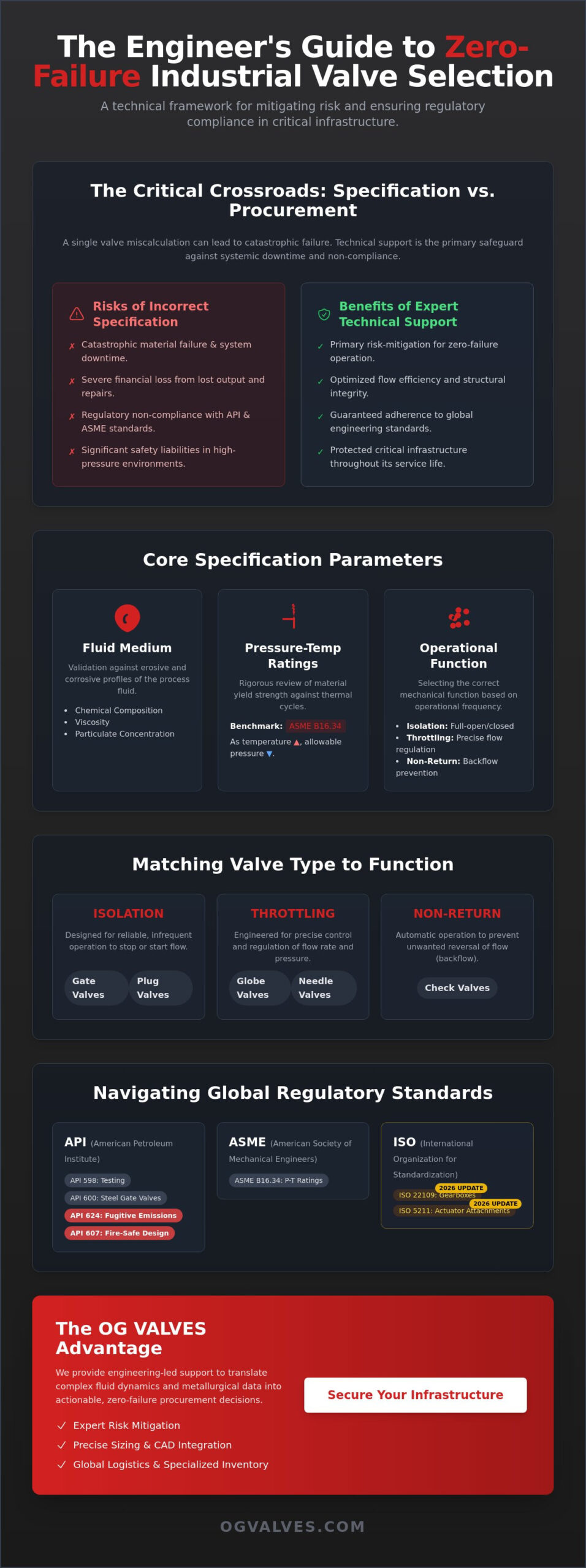
Industrial valve selection isn’t a procurement task; it’s a risk-mitigation engineering process where technical support functions as the primary safeguard against systemic failure. You’ve likely seen how a single miscalculation in pressure-temperature ratings or material compatibility leads to catastrophic operational downtime and regulatory non-compliance. Without precise technical support for valve selection, even high-grade components like globe, plug, or needle valves can fail under the stress of corrosive media or high-temperature environments. Relying on clinical data rather than marketing claims is the only way to protect critical infrastructure.
This guide provides a comprehensive technical framework for specifying industrial valves to ensure zero-failure operation and full adherence to API and ASME standards. We’ll analyze the critical validation protocols required for modern infrastructure, including the 2026 updates to ISO 22109 for gearboxes and ISO 5211 for actuator attachments. You’ll gain the clinical insight necessary to verify compliance with API 624 for fugitive emissions and API 598 for testing, ensuring your system maintains optimized flow efficiency and structural integrity throughout its service life.
Key Takeaways
- Understand how professional technical support for valve selection functions as a primary risk-mitigation strategy to prevent catastrophic material failure and systemic downtime.
- Identify critical specification parameters, including media chemical composition and pressure-temperature ratings, to maintain structural soundness during high-stress thermal cycles.
- Master the hierarchy of global regulatory standards, such as API 600 and ASME B16.34, to ensure full compliance across high-risk refinery and pipeline environments.
- Learn to integrate CAD modeling and precise sizing calculations to guarantee mechanical fit and sufficient torque for automated gate, ball, and globe valve systems.
- Explore how global logistics and a specialized inventory of high-spec industrial valves can optimize supply chains for critical infrastructure projects.
The Role of Technical Support in Industrial Valve Selection
Technical support for valve selection serves as the clinical validation of engineering requirements against harsh operational realities. In heavy industrial sectors, the gap between a design engineer’s theoretical model and the procurement department’s purchase order is often where systemic risk resides. While general procurement focuses on lead times and unit costs, technical specification prioritizes mechanical survival and regulatory adherence. This process ensures that a Gate Valve or a Globe Valve isn’t merely a line item, but a calibrated component capable of withstanding specific pressure-temperature cycles and chemical erosions.
The economic consequences of incorrect specification are severe. With the global industrial valves market valued at USD 101.56 billion in 2025, the financial stakes of hardware failure have never been higher. Beyond the immediate repair costs, operational downtime in a refinery or power plant can result in millions of dollars in lost output. Technical support acts as the bridge between these departments, translating complex fluid dynamics and metallurgical data into actionable procurement decisions. It’s a rigorous safeguard that prevents the installation of incompatible hardware in high-pressure environments.
Mitigating Risk in High-Stakes Industrial Environments
In the oil, gas, and power generation sectors, the cost of failure extends beyond financial loss to include significant safety liabilities. Specifying valves for volatile media requires an expert understanding of how material classifications react to corrosive substances. For instance, a basic Control Valve Overview reveals how positioners and actuators must be precisely matched to the valve body to maintain stability. Technical support ensures that specialized components, such as Needle Valves or Plug Valves, meet the exact sealing requirements of the application. Expert oversight is mandatory when navigating the complexities of API 607 fire-safe designs or API 624 fugitive emission standards, where a single non-compliant seal can compromise an entire facility’s safety certification.
The Evolution of Valve Specification Requirements
Valve specification has transitioned from manual, catalog-based selection to a data-driven engineering discipline. This shift is driven by rapidly advancing global standards. As of February 2026, updated standards like ISO 22109 for gearboxes and ISO 5211 for part-turn actuator attachments have redefined the mechanical interface requirements for industrial valves. Relying on legacy specifications is no longer a viable strategy for modern infrastructure. Modern technical support utilizes real-time performance data and updated mechanical advantage tables to ensure that every Butterfly Valve or Check Valve meets current safety benchmarks. This evolution reflects a broader industry trend where precision and documented compliance are the primary metrics for operational success.
Critical Parameters for Technical Valve Specification
Engineering precision requires a clinical evaluation of the fluid medium’s chemical composition, viscosity, and particulate concentration. In high-risk environments, technical support for valve selection ensures that the chosen hardware can withstand the specific erosive and corrosive profiles of the process fluid. It’s not enough to select a general-purpose alloy; the metallurgy must be validated against the anticipated thermal cycles and pressure transients defined by ASME B16.34. This standard remains the primary benchmark for pressure-temperature ratings as of 2026, and ignoring its limits invites catastrophic structural failure.
Pressure-temperature ratings represent a non-linear relationship. As temperatures increase, the allowable working pressure for a valve body decreases, necessitating a rigorous review of the material’s yield strength. For instance, a Ball Valve rated for high-pressure ambient service may require significant derating when subjected to steam service or cryogenic applications. Technical experts must also define the operational frequency to select the correct mechanical function:
- Isolation: Gate Valves and Plug Valves designed for full-open or full-closed service.
- Throttling: Globe Valves and Needle Valves engineered for precise flow regulation.
- Non-Return: Check Valves utilized to prevent backflow and protect upstream equipment.
- Quarter-Turn Regulation: Butterfly Valves used for high-capacity flow control with minimal footprint.
Medium Analysis and Material Compatibility
Material selection for extreme environments must contrast the cost-effectiveness of carbon steel against the superior corrosion resistance of Super Duplex alloys. Technical support for valve selection identifies the precise threshold where standard materials become a liability. This analysis includes assessing the risks of cavitation and flashing. These phenomena occur when fluid pressure drops below the vapor pressure, creating imploding bubbles that can erode even hardened metal surfaces. Proper material specification is the only defense against this mechanical degradation.
Flow Dynamics and Sizing Calculations
Accurate sizing is the primary defense against premature valve wear. Determining the required Flow Coefficient (Cv) ensures that the valve operates within its optimal efficiency range. If a valve is oversized, the resulting low-lift conditions in Globe Valves or Butterfly Valves lead to seat wire-drawing and vibration. Technical specialists utilize computational modeling to predict these flow behaviors before procurement. For those seeking to validate these complex variables, consulting the technical specifications of industrial valve inventory provides a baseline for proper sizing and system integration.
Navigating Global Standards and Regulatory Compliance
Regulatory adherence is the foundation of industrial safety and mechanical integrity. Technical support for valve selection involves more than catalog matching; it requires a deep understanding of the global regulatory hierarchy. Standards from API, ASME, ISO, and DIN aren’t suggestions. They’re mandatory frameworks that define the structural limits and testing requirements of every component. For engineers and procurement specialists, navigating these standards ensures that a specific Ball Valve or Check Valve is legally and technically fit for its intended environment.
Selecting the correct standard often depends on the specific application within the oil and gas sector. API 600 specifies the heavy-wall design and trim requirements for steel Gate Valves in refinery applications, where durability under high-stress thermal cycles is paramount. In contrast, API 6D serves as the key standard for pipeline valves, particularly for the LNG sector as of 2026. ASME B16.34 remains the authoritative benchmark for pressure-temperature ratings for flanged, threaded, and welding end valves. Technical support ensures that these ratings are strictly applied to prevent the installation of hardware that cannot meet the system’s maximum allowable working pressure.
Material Validation and Testing Protocols
Material integrity must be verified through rigorous validation protocols before any valve enters service. Positive Material Identification (PMI) is a non-negotiable step in preventing material failure, especially when dealing with high-alloy or Super Duplex steels. This process confirms that the chemical composition matches the mill certificate. Non-Destructive Testing (NDT) methods, such as radiographic or ultrasonic inspection, are utilized to detect internal defects in high-pressure valve bodies. Per API 598, which remains the current standard for valve inspection and testing in 2026, all valves must undergo hydrostatic and pneumatic pressure testing to validate seat leakage rates and shell integrity.
Certifications and Documentation for Global Projects
Comprehensive documentation is required to maintain full traceability across global supply chains. Technical support for valve selection includes the verification of Mill Test Reports (MTR), which serve as the “birth certificate” for the valve’s raw materials. For international projects, understanding the distinction between EN 10204 3.1 and 3.2 certification is critical. While a 3.1 certificate is validated by the manufacturer’s authorized representative, a 3.2 certificate requires witnessed testing by an independent third-party inspector. This level of documentation ensures that every Butterfly Valve or Needle Valve meets the stringent transparency requirements of modern industrial infrastructure.
Advanced Engineering Support: Sizing and CAD Integration
Mechanical fitment is only one aspect of the integration process. Sizing calculations must account for the dynamic forces present during high-pressure cycles. Correct sizing ensures that the valve body and internal trim are optimized for the system’s Flow Coefficient (Cv), preventing the turbulence and erosion associated with mismatched hardware. When technical support is integrated into the early project design phase, it creates a seamless transition from theoretical flow requirements to physical hardware specification, maintaining the structural integrity of the entire piping system.
Actuator Sizing and Automation Control
Automated systems require precise calculations of breakaway torque and safety factors to guarantee reliable operation. Technical specialists must evaluate the specific torque requirements of Ball Valves and Butterfly Valves, ensuring that pneumatic or electric actuators provide sufficient thrust under maximum differential pressure. Per the updated ISO 5211:2026 standard, mounting pads and stem interfaces must be standardized to maintain mechanical interchangeability. Technical support also defines fail-safe positions; ensuring a valve defaults to an open, closed, or last position during a power or signal loss is a critical safety protocol for high-risk environments.
Specialty Fabrication and Custom Engineering
Standard off-the-shelf components often require modifications to meet specialized environmental demands. Technical consultation facilitates the development of bespoke solutions, such as stem extensions for buried service or bypass arrangements for pressure equalization. Engineering support is also vital for specifying cryogenic or high-temperature insulation jackets that protect sensitive components in extreme thermal zones. For projects requiring these precise mechanical specifications, you can request a technical consultation for engineered valve solutions to ensure your hardware meets exact operational benchmarks.
The role of technical support in custom engineering ensures that even modified Plug Valves or Needle Valves retain their original pressure ratings and certification compliance. By anchoring these modifications in rigorous testing and CAD validation, industrial facilities can implement specialized hardware without compromising systemic safety or regulatory adherence.
OG VALVES: Global Technical Support and Industrial Supply
Theoretical engineering models must eventually translate into physical assets. OG VALVES bridges this gap by combining technical support for valve selection with a robust global supply chain that emphasizes clinical precision. While some competitors treat procurement as a separate administrative function, we treat it as an extension of the engineering process. This ensures that the clinical specifications defined in the design phase remain intact through delivery. Our approach prioritizes the structural soundness and operational output of critical infrastructure above all else.
Global logistics capabilities are essential for delivering high-spec valves to international facilities. With the industrial valve market projected to reach USD 171.87 billion by 2035, the complexity of global procurement has increased. We utilize fast-track delivery protocols to minimize operational downtime, recognizing that the cost of failure in a refinery or power plant far exceeds the unit price of the hardware. The average price of industrial valve exports from the United States reached $131,367 per ton in 2024, representing a 12% increase. This rising cost environment makes precise technical specification even more critical to avoid the financial waste of incorrect hardware selection.
Strategic Inventory for Heavy Industry
We maintain a strategic inventory of industrial valves to mitigate the risks of extended lead times. Our stock includes specialized gate valve and ball valve configurations designed for the high-pressure transients typical of oil and gas refineries. By providing immediate access to check valves and butterfly valves, we ensure that maintenance schedules are met without compromising on technical benchmarks. This inventory management strategy focuses on specialized Globe, Plug, and Needle valves required for extreme environmental applications, ensuring that every component adheres to the latest 2026 ISO standards.
Consultative Procurement for Critical Infrastructure
Our procurement model is consultative and clinical. We don’t just supply hardware; we validate it against the operational output requirements of the facility. Our technical team works with project engineers to refine specifications for large-scale infrastructure, ensuring that every component meets the exact sealing and throttling requirements of the application. Technical support for valve selection at this level involves a rigorous review of Mill Test Reports and third-party certifications to guarantee reliability in high-stakes environments. Every component undergoes strict quality control to maintain its position as a benchmark for industrial safety. For authoritative technical support for valve selection and global supply solutions, contact OG VALVES to discuss your project’s specific engineering requirements.
Securing Operational Integrity Through Engineering Precision
Industrial valve selection is a rigorous engineering discipline where the cost of inaccuracy is measured in systemic failure and severe financial liability. Successful implementation requires the clinical validation of pressure-temperature ratings, material compatibility, and flow dynamics against established benchmarks. Integrating technical support for valve selection into the project design phase ensures that every Gate, Ball, and Globe valve functions as a calibrated component within the broader infrastructure. This methodical approach eliminates the ambiguity often found in general procurement processes.
OG VALVES maintains an extensive inventory of API and ASME certified valves to support critical operations in the oil, gas, and petrochemical sectors. Our global fast-track delivery capabilities ensure that high-spec hardware reaches international facilities with minimal lead times, maintaining project schedules without compromising quality. Consult with our technical team for expert valve selection and global procurement to secure the structural integrity of your critical systems. We are ready to assist with your technical specification needs.
Frequently Asked Questions
Why is technical support necessary for valve selection in industrial applications?
Technical support is mandatory to mitigate the risk of catastrophic mechanical failure and ensure regulatory compliance in high-pressure environments. It validates engineering requirements against operational realities, such as chemical compatibility and thermal cycling. This specialized oversight prevents the selection of inadequate components that lead to operational downtime and safety liabilities in critical infrastructure.
What technical information is required to size an industrial valve correctly?
Accurate valve sizing requires the maximum and minimum flow rates, upstream and downstream pressures, fluid temperature, and specific gravity. Additionally, the fluid’s viscosity and vapor pressure are critical for identifying potential cavitation or flashing. Comprehensive technical support for valve selection utilizes these parameters to calculate the required Flow Coefficient (Cv) and ensure the valve operates within its optimal efficiency range.
How do API 600 and API 6D standards differ in valve selection?
API 600 specifically governs heavy-wall steel Gate Valves used in refinery services where durability under high-stress conditions is required. API 6D is the specification for pipeline valves, covering Ball, Gate, Check, and Plug valves used in long-distance transport and LNG facilities. Selection depends on whether the application is downstream processing or midstream transportation, as each standard has distinct shell thickness and testing requirements.
What is Positive Material Identification (PMI) and why is it used in valve procurement?
Positive Material Identification (PMI) is a non-destructive analysis used to verify the chemical composition of metallic alloys before installation. It’s a critical procurement step that ensures the valve body and trim match the specified metallurgy, such as Super Duplex or high-carbon steel. This process prevents the accidental use of incorrect materials that could fail under corrosive or high-temperature conditions.
How does the Flow Coefficient (Cv) affect valve performance and selection?
The Flow Coefficient (Cv) measures a valve’s capacity to allow fluid flow at a specific pressure drop. If the Cv is too high for the application, the valve will operate in a near-closed position, causing seat erosion and vibration. Conversely, a Cv that’s too low creates excessive pressure drops and restricts system output. Proper selection ensures the valve is sized for both peak load and throttling stability.
What are the risks of using a valve with an incorrect pressure-temperature rating?
Using a valve with an incorrect pressure-temperature rating according to ASME B16.34 risks immediate structural rupture or chronic fatigue failure. As temperatures increase, the material’s yield strength decreases, reducing the allowable working pressure. Technical support for valve selection ensures that the chosen metallurgy can withstand the maximum anticipated pressure at the peak operating temperature without compromising the shell’s integrity.
Can technical support help with retrofitting valves into existing piping systems?
Technical support provides the 2D and 3D CAD integration necessary to ensure new valves meet the spatial constraints and flange orientations of legacy piping. This includes verifying face-to-face dimensions and ensuring manual or automated operators have sufficient clearance. Engineering consultation identifies potential interference issues before procurement, allowing for custom modifications like stem extensions or specialized bypass arrangements to be engineered.
How do I ensure a valve actuator is sized correctly for a specific valve?
Correct actuator sizing requires calculating the valve’s breakaway torque under maximum differential pressure and applying an appropriate safety factor. Compatibility is ensured by matching the valve stem and mounting pad to ISO 5211 standards. Technical specialists evaluate the required thrust for Globe or Gate valves and the torque for quarter-turn Ball or Butterfly valves to ensure reliable fail-safe operation during power or signal loss.
 Responsive Menu