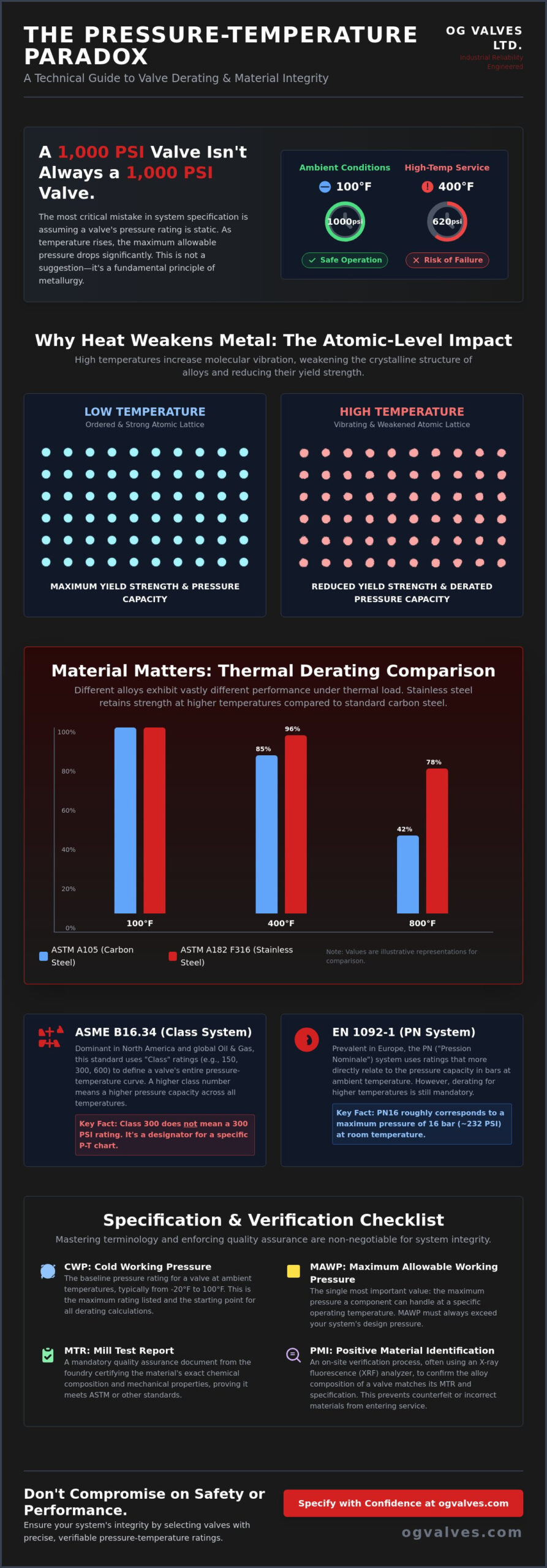
A valve rated for 1,000 PSI at ambient temperature isn’t a 1,000 PSI valve once the process media reaches 400 degrees Fahrenheit; it’s a liability waiting to fail. This fundamental misunderstanding of metallurgy often leads to catastrophic system rupture or premature component fatigue. You likely recognize the complexity of maintaining industrial integrity when thermal loads fluctuate, particularly when managing the discrepancies between ASME Class and PN ratings. Ensuring high-stakes safety requires a clinical approach to material performance data and structural soundness.
Mastering the dynamic relationship between thermal load and pressure capacity is essential for technical experts. This guide provides a definitive framework for understanding valve pressure temperature ratings, focusing on the rigorous requirements of ASME B16.34-2025 and EN 1092-1:2018. You’ll learn to navigate P-T curves with precision to select the correct gate, ball, or globe valves for extreme environments. We’ll analyze how specific material classifications dictate operational limits, allowing you to eliminate confusion and maintain peak system output without the risk of non-compliance or unplanned operational downtime.
Key Takeaways
- Identify how thermal expansion reduces material yield strength, establishing a dynamic functional limit rather than a static pressure constant.
- Navigate the ASME B16.34-2025 and EN 1092-1:2018 frameworks to accurately classify valve pressure capacities across global industrial standards.
- Implement a precise methodology for understanding valve pressure temperature ratings by calculating maximum system excursions against specific metallurgical derating curves.
- Differentiate the thermal performance of ASTM A105 carbon steel and ASTM A182 F316 stainless steel to ensure appropriate material selection for high-temperature media.
- Validate industrial system integrity by utilizing Mill Test Reports and Positive Material Identification as mandatory quality assurance protocols during the procurement process.
The Interdependency of Pressure and Temperature in Industrial Valves
A valve’s pressure rating is not a static value; it is a dynamic limit that fluctuates based on the thermal load of the process media. In the field of mechanical engineering, Industrial Valves are governed by Pressure-Temperature (P-T) ratings, which define the maximum allowable working pressure at a specific temperature. This interdependency exists because the mechanical properties of alloys are temperature-dependent. As the temperature of the media or environment increases, the material yield strength of the valve body and components decreases. Consequently, a valve capable of withstanding high pressures at ambient temperatures must be derated when exposed to elevated thermal conditions to prevent structural deformation or catastrophic rupture.
The physical principle driving this requirement is thermal expansion and its effect on the atomic lattice of the metal. High temperatures increase molecular vibration, which weakens the bonds within the material’s crystalline structure. This reduction in tensile strength means the valve can no longer contain the same internal forces it could at lower temperatures. It’s critical for procurement specialists and engineers to distinguish between different pressure definitions. Operating pressure refers to the actual pressure during normal service, while design pressure includes a margin for process upsets. However, the hydrostatic test pressure, typically conducted at 1.5 times the pressure rating at 100 degrees Fahrenheit, is merely a proof test of structural soundness. It does not indicate a safe continuous service limit at any temperature above ambient.
Fundamental Definitions for Engineering Specification
A precise understanding valve pressure temperature ratings requires mastery of technical terminology used in ASME and EN standards. Safe Working Pressure (SWP) accounts for the stresses encountered in high-velocity environments where erosion and vibration are factors. Manufacturers apply a rigorous safety factor to ensure the valve body maintains integrity under these stresses. Maximum Allowable Working Pressure (MAWP) is defined as the maximum pressure at a specific temperature for a specific material. Engineers must verify that the MAWP of the selected gate valves or globe valves exceeds both the design pressure and any potential pressure excursions at the maximum operating temperature.
The Relationship Between Heat and Tensile Strength
Heat directly impacts the mechanical reliability of valve assemblies by affecting stem sealing and bolt tensioning in flanged connections. As temperature rises, the differential expansion between the valve body and the bolting materials can lead to a loss of preload, resulting in fugitive emissions or flange leaks. Cold Working Pressure (CWP) serves as the baseline for all calculations, representing the maximum pressure rating for temperatures between -20 and 100 degrees Fahrenheit. Beyond this range, the atomic lattice weakens, and the valve must be derated according to the specific metallurgy of the alloy. Failure to account for this derating in high-stakes industrial systems compromises both safety and operational longevity.
Standardization Frameworks: ASME B16.34 and EN 1092-1 Classifications
Engineering precision in heavy industrial sectors relies on strict adherence to established regulatory benchmarks. The primary global authority for defining the structural limits of flanged, threaded, and welding end valves is ASME B16.34. This standard provides the empirical data required for understanding valve pressure temperature ratings across various metallurgical groups. By categorizing valves into specific pressure classes, the standard ensures that technical experts can predict material behavior under extreme thermal loads. While the ASME system dominates North American and global oil and gas markets, the European EN 1092-1 standard utilizes the PN (Nominal Pressure) system, which requires a separate technical interpretation to ensure system compatibility.
ASME B16.34 Pressure Classes Explained
The ASME class system, ranging from Class 150 to Class 4500, designates the maximum allowable working pressure at ambient temperatures. For instance, a Class 150 valve is generally rated for 285 PSI at 100 degrees Fahrenheit when manufactured from Group 1.1 materials like ASTM A105 carbon steel. However, these ratings are not uniform across all alloys. Group 1.1 carbon steels exhibit different derating curves compared to Group 2.2 stainless steels such as ASTM A182 F316. For a broader analysis of these benchmarks, engineers should consult the Industrial Valves: The Engineer’s Comprehensive Guide to Selection and Standards (2026). Selecting high-performance gate valves or globe valves requires precise cross-referencing of these material groups against the intended thermal excursion limits.
Global Equivalency: PN vs. ASME Class
Navigating the transition between ASME and EN standards involves identifying non-linear equivalencies. The PN system in EN 1092-1:2018 defines pressure in bars, where the number following the PN designation represents the pressure ceiling at ambient temperature. While PN20 is frequently cited as the equivalent to Class 150, and PN50 matches Class 300, these correlations are not always exact due to differing safety factors and metallurgical testing requirements. Furthermore, testing protocols vary; API 598 is the standard for ASME valves, whereas EN 12266-1 governs European valve testing. The following list outlines common industrial equivalencies used in global procurement:
- Class 150: Roughly equivalent to PN20
- Class 300: Roughly equivalent to PN50
- Class 600: Roughly equivalent to PN110
- Class 900: Roughly equivalent to PN150
- Class 1500: Roughly equivalent to PN260
- Class 2500: Roughly equivalent to PN420
Procurement specialists must account for these discrepancies to avoid catastrophic mismatching in flanged connections. Accurate specification ensures that the structural soundness of the pressure boundary remains intact throughout the lifecycle of the installation.
Metallurgy serves as the physiological foundation of the Pressure-Temperature curve. Selecting the appropriate alloy requires a clinical evaluation of material yield strength across the entire projected thermal range. Understanding valve pressure temperature ratings necessitates a granular analysis of these material-specific derating characteristics to prevent system failure. The following materials define the standard operational envelopes in heavy industry:
- Carbon Steel (ASTM A105): Optimized for high mechanical strength at ambient temperatures but suffers rapid derating above 425°C due to graphitization risks.
- Stainless Steel (ASTM A182 F316): Provides superior corrosion resistance in aggressive media, though it possesses lower initial pressure capacity at ambient conditions compared to carbon steel.
- Alloy Steels (F11, F22): Engineered for high-temperature steam and power generation, these alloys maintain structural soundness where standard steels would succumb to creep.
Technical specifications often focus on the valve body, but the internal trim and sealing materials frequently dictate the actual operational ceiling. While the shell might meet EN 1092-1 Classifications, the soft components within the assembly might fail long before the metal reaches its yield point. This distinction is critical for maintaining high-stakes system integrity.
Thermal Derating Curves for Common Alloys
The “knee” in a derating curve identifies the critical temperature threshold where pressure capacity begins a sharp, non-linear decline. Engineers must identify this point to avoid operating in zones where material safety factors are compromised. For extreme environments, duplex and super-duplex steels are preferred due to their high mechanical strength and resistance to stress corrosion cracking in subsea applications. At 500°C, a Class 300 carbon steel valve may have less capacity than a Class 150 stainless valve at 20°C. This counterintuitive reality underscores the necessity of referencing exact metallurgical tables rather than assuming linear performance.
Soft-Seated vs. Metal-Seated Valve Constraints
The “weakest link” principle is most evident when evaluating ball valves equipped with PTFE or elastomer seals. These soft materials have significantly lower thermal limits than the metal housing, often capping the P-T envelope regardless of the ASME class. Conversely, metal-to-metal seating in gate valves allows the assembly to track the full metallurgical derating curve of the body material. Frequent thermal cycling also impacts seat integrity. Differential expansion between dissimilar materials can cause permanent deformation and loss of leak tightness. Accurate understanding valve pressure temperature ratings ensures that both the shell and the seat are appropriately matched to the process conditions.
Methodology for Interpreting Pressure-Temperature Rating Charts
Engineering a safe industrial system requires a repeatable, clinical process for understanding valve pressure temperature ratings. It’s insufficient to select a valve based on nominal ambient ratings alone. Technical experts must follow a structured methodology to ensure the pressure boundary remains intact during both normal operation and process excursions. This procedure involves five critical steps:
- Step 1: Identify the maximum system operating temperature. This calculation must include potential thermal excursions, steam-out conditions, or solar gain on outdoor piping.
- Step 2: Determine the required material. Fluid chemistry, concentration, and corrosion allowance dictate the specific metallurgical group.
- Step 3: Locate the specific ASME B16.34 table. Each material group, such as Group 1.1 or 2.2, has a dedicated table in the 2025 standard.
- Step 4: Plot the intersection. Find the point where the maximum pressure and temperature meet on the chart to identify the minimum required Class rating.
- Step 5: Validate auxiliary components. Ensure gaskets, packing, and actuators match or exceed the body’s thermal capabilities.
For technical assistance in selecting the correct specification for your project, consult our engineering team for high-performance valve solutions.
Reading the ASME B16.34 Tables Correctly
ASME B16.34 tables provide discrete data points at specific temperature intervals. When a process temperature falls between these listed intervals, linear interpolation is the standard requirement to determine the precise allowable pressure. Technical experts must also distinguish between Standard Class and Special Class valves. Special Class valves undergo additional non-destructive examination (NDE), such as radiography or ultrasonic testing, which permits higher pressure ratings for the same material and temperature. Additionally, pressure surges like water hammer must be factored into the selection. If a system is prone to rapid valve closure, the surge pressure shouldn’t exceed the rated pressure at the operating temperature to prevent permanent shell deformation.
Accounting for Environmental Factors
External factors impose significant stress on the valve body beyond the internal media. In extreme climates, high ambient temperatures contribute to the overall thermal load, while cryogenic service introduces the risk of brittle fracture. Materials used in temperatures below -29°C often require Charpy V-notch impact testing to ensure structural toughness. Furthermore, check valves require specific P-T consideration to maintain non-slam performance. Thermal changes in the media affect fluid density and viscosity, which impacts the dynamic response of the disc and the integrity of the seat during closure. Precise selection ensures these environmental variables don’t lead to premature component fatigue.
Critical Specification Protocols and Quality Assurance
Ensuring the structural soundness of high-pressure infrastructure requires more than theoretical calculation; it demands rigorous physical verification. Proper understanding valve pressure temperature ratings is only effective when the material in the field matches the engineering specification. Mill Test Reports (MTRs) are the primary instrument for this verification, providing a documented trail of the chemical composition and mechanical strength for every heat of steel. For high-stakes installations where the cost of failure is catastrophic, Positive Material Identification (PMI) testing provides an additional layer of security. This non-destructive process confirms that the alloy delivered possesses the metallurgical properties required to withstand the calculated thermal derating.
Adherence to API 6D and API 600 benchmarks ensures that heavy industrial gate and ball valves meet the dimensional and structural requirements for severe service. OG VALVES LTD. employs a clinical approach to technical verification, ensuring every component complies with the necessary P-T ratings for global projects. This commitment to quality assurance eliminates the ambiguity often associated with international procurement, positioning our organization as a dependable partner in critical infrastructure.
Verification and Certification Standards
Procurement specialists must specify the level of certification required, typically EN 10204 3.1 or 3.2. A 3.1 certificate is issued by the manufacturer’s authorized representative, while a 3.2 certificate requires independent third-party verification, offering the highest level of trust for critical applications. Firesafe testing under API 607 represents a specialized P-T scenario where the valve must maintain sealing integrity during and after exposure to extreme heat. Additionally, actuator selection must account for the increased torque required at high-temperature pressure loads. As materials expand and lubricants degrade under heat, the force required to operate the valve increases, necessitating a robust safety margin in automation sizing.
Global Logistics and Technical Support
Operational downtime is a significant economic risk in heavy industry. OG VALVES LTD. addresses this through fast-track delivery of correctly rated valves, ensuring that projects remain on schedule without compromising safety. Technical expertise is the most effective tool for preventing material-mismatch failures that stem from incorrect specification. Our team provides comprehensive project management, anchoring every claim in rigorous testing and global regulatory adherence. Contact OG VALVES LTD. for detailed technical support and project specification to ensure your infrastructure meets the highest engineering standards.
Standardizing Safety in High-Pressure Infrastructure
Industrial system integrity depends on the precise alignment of metallurgical properties with thermal and pressure loads. Mastery of understanding valve pressure temperature ratings ensures that the selection of gate, globe, or ball valves remains rooted in functional reality rather than theoretical ambient limits. Adherence to ASME B16.34-2025 and rigorous verification through MTRs and PMI testing are the only reliable methods to mitigate the risk of catastrophic failure. As a specialist supplier for the oil, gas, and power generation sectors, OG VALVES LTD maintains a comprehensive global inventory of API and ASME compliant valves. Our technical expertise in high-pressure material selection provides the clinical precision required for complex infrastructure projects.
It’s essential to leverage these engineering resources to secure your system’s long-term performance and minimize unplanned downtime. Request a Technical Specification Quote from OG VALVES LTD. to ensure your next installation meets the most stringent global benchmarks for safety and durability. Implementing these rigorous standards today safeguards your operational output for years to come. We look forward to supporting your high-stakes engineering requirements with unwavering reliability and technical excellence.
Frequently Asked Questions
What is the difference between a valve pressure class and its actual PSI rating?
A pressure class is a standardized designation, such as Class 150 or Class 300, while the actual PSI rating is the Maximum Allowable Working Pressure at a specific temperature. For example, a Class 150 carbon steel valve is rated for 285 PSI at 100 degrees Fahrenheit, but this capacity decreases as the process temperature rises. The class serves as a category for grouping valves with similar structural capabilities across different materials.
How does temperature affect the pressure rating of a stainless steel valve versus carbon steel?
Carbon steel typically offers higher mechanical strength at ambient temperatures but undergoes rapid derating once temperatures exceed 425 degrees Celsius due to graphitization risks. Stainless steel, specifically Grade 316, starts with a lower initial pressure capacity at ambient conditions but maintains its structural integrity more effectively in high-temperature or corrosive environments. Understanding valve pressure temperature ratings requires a precise comparison of these specific metallurgical derating curves to ensure system safety.
Can I use a Class 150 valve in a system that operates at 300 PSI?
No, a Class 150 valve is unsuitable for a 300 PSI system because its maximum pressure ceiling at ambient temperature is approximately 285 PSI for Group 1.1 materials. Operating beyond this limit violates ASME B16.34 standards and compromises the safety factor of the pressure boundary. You must specify a Class 300 valve, which provides a higher pressure ceiling to accommodate the 300 PSI requirement with the necessary safety margin.
What is the Cold Working Pressure (CWP) on a valve nameplate?
Cold Working Pressure represents the maximum allowable pressure for a valve operating at ambient temperatures, typically defined between -20 and 100 degrees Fahrenheit. It serves as the baseline rating for the valve before any thermal derating is applied. CWP is a critical data point for engineers when calculating the initial structural soundness of piping systems before process heat is introduced.
Why do valves have lower pressure ratings at higher temperatures?
Elevated temperatures increase molecular vibration within the metal, which weakens the atomic lattice and reduces the material yield strength. This physical change makes the valve body and components more susceptible to deformation under internal pressure. Consequently, the pressure ceiling must be lowered to account for the reduced tensile strength of the alloy as it expands and softens under thermal load.
What happens if a valve exceeds its pressure-temperature rating?
Exceeding the rated P-T limit can result in permanent shell deformation, gasket blowout, or catastrophic rupture of the pressure boundary. Beyond immediate failure, it can cause internal components to misalign, leading to seat leakage or stem seizure. These failures often result in unplanned operational downtime and significant safety hazards for personnel in the vicinity of the high-pressure line.
Are ASME and PN ratings interchangeable in industrial piping?
ASME and PN ratings aren’t strictly interchangeable because they’re governed by different safety factors, testing protocols, and dimensional standards. While PN20 is roughly equivalent to Class 150, the exact pressure limits at elevated temperatures and the flange bolt patterns often differ. Technical experts must perform a detailed engineering review before attempting to join components from different standardization frameworks.
How do I find the P-T rating for a specific valve material?
You must consult the specific tables within ASME B16.34-2025 or EN 1092-1:2018 based on the valve’s material group. Identify the exact metallurgical grade, such as ASTM A105 or A182 F316, and locate the corresponding table to plot the intersection of your system’s maximum operating temperature and pressure. This process ensures the selected valve is compliant with international safety and engineering benchmarks.
 Responsive Menu