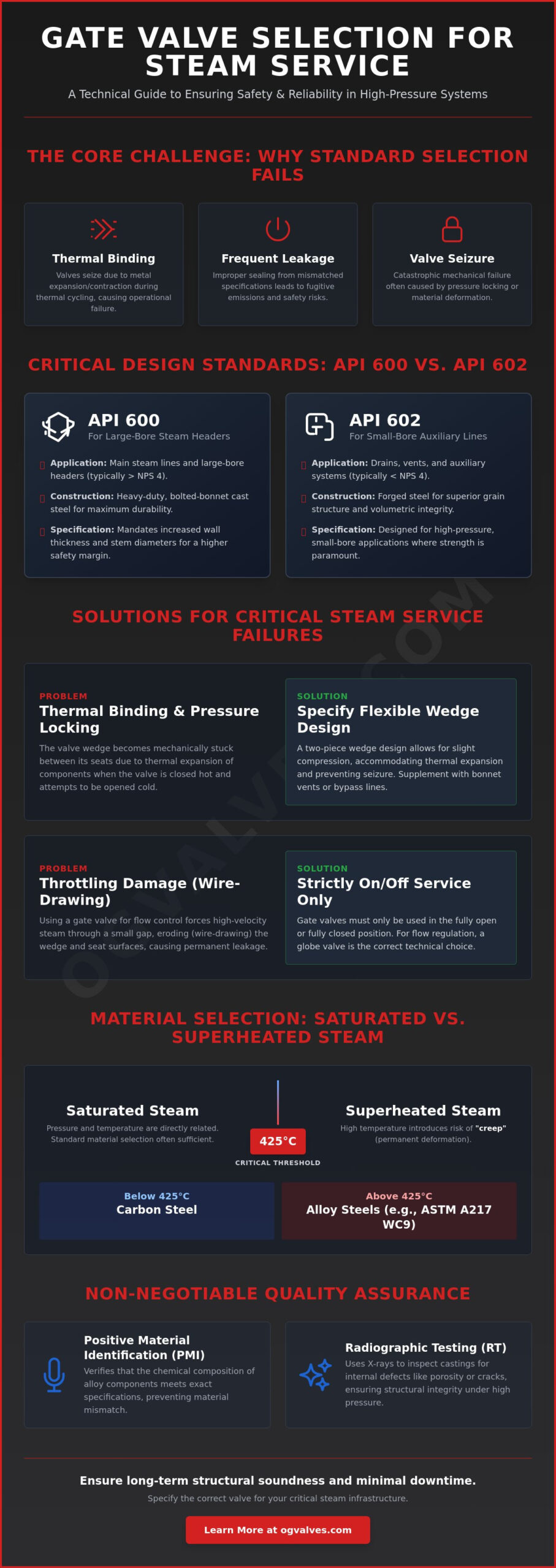
A single instance of thermal binding in a high-pressure steam line can result in catastrophic operational delays and significant safety risks. Proper gate valve selection for steam service requires more than matching nominal pressure ratings; it demands a precise understanding of metallurgical stability and mechanical design under extreme thermal cycling. You likely recognize that frequent leakage and valve seizures in high-temperature lines are often symptoms of mismatched specifications, particularly regarding the distinct applications of API 600 and API 602 standards.
This technical guide provides the engineering framework necessary to achieve zero-leakage isolation and ensure full compliance with the ASME B16.34 2025 Edition and current API benchmarks. We will examine critical selection criteria, including material classifications such as ASTM A217 WC9, the implementation of flexible graphite packing for fugitive emissions control, and the mechanical advantages of flexible wedge designs in mitigating thermal binding. By mastering these specifications, procurement and engineering teams can ensure long-term structural soundness and minimal maintenance downtime in critical steam infrastructure.
Key Takeaways
- Differentiate between API 600 and API 602 standards to ensure appropriate valve construction for large-bore headers versus small-bore auxiliary steam lines.
- Refine your gate valve selection for steam service by prioritizing flexible wedge designs that accommodate thermal expansion and prevent mechanical seizure during cooling cycles.
- Implement rigorous quality assurance protocols, including Positive Material Identification (PMI) and Radiographic Testing (RT), to verify the metallurgical integrity of high-pressure castings.
- Assess the physics of pressure locking and thermal binding to specify appropriate bonnet venting or bypass configurations for high-temperature isolation.
- Evaluate the performance characteristics of gate valves against globe and ball valves to optimize for full-bore flow and long-term seat tightness in steam manifolds.
Understanding Gate Valve Suitability for Saturated and Superheated Steam
The gate valve serves as the primary mechanical component for isolation within industrial steam headers and distribution manifolds. Its design provides a straight-through flow path, which is essential for minimizing parasitic pressure losses in high-velocity steam systems. Unlike other valve types that introduce tortuous paths, a fully retracted gate valve provides a clear orifice. This structural advantage ensures that steam velocity remains consistent, preventing the energy dissipation that occurs with high turbulence.
Precise gate valve selection for steam service must account for the unique phase-change characteristics of the medium. Steam service involves aggressive thermal cycling and the potential for condensate-induced erosion. When a system cools, condensate can accumulate in low points or within the valve body. Upon restart, high-velocity steam can carry these water droplets, leading to water hammer or localized erosion of the seating surfaces. Reliable isolation depends on a valve’s ability to maintain seat integrity despite these recurring mechanical stresses.
Saturated vs. Superheated Steam: Pressure-Temperature Dynamics
Saturated steam operates on a direct pressure-temperature curve. Any increase in pressure results in a corresponding rise in temperature, allowing for standardized seal and gasket selection. Superheated steam exists at temperatures far above the saturation point at a given pressure, which introduces the risk of creep. Creep is a phenomenon where metal components undergo slow, permanent deformation under high stress at elevated temperatures. Carbon steel is generally restricted to applications below 425°C in steam service, beyond which alloy steels such as ASTM A217 WC6 or WC9 are mandatory to ensure metallurgical stability.
The Limitations of Gate Valves in Steam Throttling
Gate valves are engineered strictly for on/off service and shouldn’t be used for throttling or flow regulation. When a wedge is held in a partially open position, high-velocity steam is forced through a narrow aperture. This creates a phenomenon known as wire-drawing. This concentrated flow erodes the seating surfaces and the bottom of the wedge, rendering the valve incapable of achieving a bubble-tight seal when closed. It’s a common cause of premature failure in steam lines.
Beyond physical erosion, throttling causes severe vibration and acoustic noise. The high-velocity steam creates turbulent eddies behind the partially lowered wedge, leading to mechanical chatter that can damage the stem and internal guides. For applications requiring precise flow modulation, globe valves remain the technically superior choice. Effective gate valve selection for steam service prioritizes the valve’s role as a robust, low-pressure-drop isolation point rather than a control device.
Material Specifications and Design Standards: API 600 and API 602
Technical gate valve selection for steam service requires strict adherence to established design standards to ensure pressure containment and operational safety. API 600, currently in its 14th Edition, serves as the primary standard for heavy-duty, bolted-bonnet cast steel gate valves utilized in large-bore steam headers. This standard mandates specific wall thicknesses and stem diameters that exceed general-purpose valve requirements, providing a necessary safety margin for high-temperature service. For auxiliary systems and small-bore piping under NPS 4, API 602 (11th Edition) specifies forged steel construction, which offers superior grain structure and volumetric integrity for high-pressure applications.
The pressure-temperature ratings for these assemblies are governed by the ASME B16.34 2025 edition. This standard defines the maximum allowable working pressure based on the material group and operating temperature. Engineers should consult the UFGS 23 22 25.00 40 Steam Valves specification for detailed procurement requirements that align with these industrial benchmarks. Selecting between flanged and butt-weld connections also impacts long-term integrity; while flanged ends allow for easier maintenance access, butt-weld ends eliminate potential leak paths at the gasket interface, which is a critical consideration in high-pressure steam environments.
Selecting Body and Trim Materials for Thermal Resistance
ASTM A216 WCB is the standard material for saturated steam applications up to 425°C. Beyond this temperature, carbon steel is susceptible to graphitization, a metallurgical failure where the carbide phase decomposes into graphite, severely weakening the structure. For superheated steam service, alloy steels such as ASTM A217 WC6 and WC9 are required. These chrome-moly steels provide the necessary creep resistance and structural stability at elevated temperatures. All seating surfaces must utilize Stellite Grade 6 hardfacing. This cobalt-chromium alloy prevents the “wire-drawing” erosion described in the previous section, ensuring the valve maintains a tight shut-off throughout its service life.
Compliance with Global Standards: BS EN ISO 10434
In international projects, BS EN ISO 10434 acts as the European equivalent to API 600. It establishes rigorous criteria for shell thickness and stem diameter to ensure the valve can withstand the combined stresses of internal pressure and thermal expansion. These specifications are vital for maintaining structural soundness in critical infrastructure. For a detailed analysis of how these benchmarks apply to project procurement, refer to our Industrial Valves: The Engineer’s Comprehensive Guide to Selection and Standards (2026). Utilizing certified gate valves that meet these global standards is the only way to ensure the reliability of high-stakes steam distribution systems.
Mitigating Thermal Binding and Pressure Locking in Steam Service
Mechanical failure in steam isolation often stems from two distinct physical phenomena: thermal binding and pressure locking. These issues aren’t merely operational inconveniences; they represent significant safety hazards that can immobilize critical infrastructure during emergency shutdowns or system restarts. Technical gate valve selection for steam service must account for the volumetric changes that occur when high-pressure steam interacts with the valve’s internal geometry. Failure to specify the correct wedge design or pressure relief mechanism leads to seized stems and compromised seat integrity.
Thermal binding occurs when a valve is closed at peak operating temperature. As the system cools, the valve body and seats contract at a different rate than the wedge. This differential contraction pinches the wedge between the seats with such force that the actuator or manual handwheel cannot provide sufficient torque to reopen the valve. Similarly, pressure locking happens when condensate becomes trapped in the bonnet cavity. Upon reheating, this liquid expands or flashes into steam, creating an internal pressure that exceeds the line pressure and forces the wedge faces against the seats. Proper engineering specifications are the only reliable defense against these failure modes.
The Mechanics of Thermal Binding in Wedge Gate Valves
Solid wedge gate valves are particularly susceptible to sticking in high-temperature steam headers because their rigid construction offers no room for contraction. When the valve body cools and shrinks, the solid wedge remains immovable, effectively welding itself into the seat. In contrast, a flexible wedge features a machined groove or “cutout” around its circumference. A flexible wedge compensates for seat misalignment caused by thermal stress by allowing the seating faces to flex independently of the central hub. This elasticity ensures that the valve remains operable even after significant temperature drops, maintaining the reliability of the steam manifold.
Engineering Solutions: Pressure Relief and Bonnet Design
To prevent pressure locking in the bonnet, engineers often specify a small pressure relief hole drilled into the upstream side of the wedge. This allows trapped condensate to vent back into the main line as it expands, equalizing the pressure between the bonnet cavity and the steam header. Furthermore, an Outside Screw and Yoke (OS&Y) design is mandatory for steam service. This configuration keeps the stem threads outside the flow medium, protecting them from heat and corrosion while providing clear visual indication of the valve position. For more detailed design benchmarks, consult A Technical Guide to Industrial Gate Valves: Design, Standards, and Selection (2026). Adhering to these specifications is vital for gate valve selection for steam service in high-pressure environments where the cost of mechanical failure is prohibitive.
Comparative Analysis: Selecting the Correct Valve for Steam Applications
Effective gate valve selection for steam service requires a rigorous comparison of valve geometries against the specific demands of the steam manifold. While globe valves are essential for flow regulation, their high-resistance flow path makes them inefficient for primary isolation in main steam headers. Ball valves, conversely, are frequently cited for their rapid quarter-turn operation. However, in steam service exceeding 200°C, the soft-seated materials used in standard ball valves, such as PTFE or RPTFE, undergo rapid thermal degradation. Metal-to-metal seating is a non-negotiable requirement for high-temperature steam to ensure the valve body maintains its pressure-containing integrity over long-term service.
When evaluating large-scale piping arrays, the physical footprint and weight of the valve become critical design factors. Gate valves typically have a larger vertical profile due to the rising stem and bonnet assembly, which must be accounted for in pipe rack spacing. Despite this larger footprint, the mechanical reliability they offer in high-pressure steam environments often outweighs the space-saving benefits of lighter alternatives. Engineers must prioritize the valve’s ability to withstand sustained thermal stress and high-velocity steam impingement over simple installation convenience.
Why Gate Valves Prevail in High-Pressure Isolation
Gate valves are the preferred selection for high-pressure isolation because they provide a clear, unobstructed flow path. This feature minimizes the pressure drop, which is a critical metric in large-scale piping arrays where energy efficiency is paramount. Unlike globe valves, which force the medium through a 90-degree turn, the gate valve allows steam to move at design velocity without generating excessive turbulence. Standard wedge designs also provide bidirectional sealing, allowing the valve to isolate pressure from either direction, a necessity in complex steam distribution networks. To complement these isolation points and prevent damaging backflow during system fluctuations, engineers should refer to our guide on Understanding Industrial Check Valves: Design, Function, and Critical Selection (2026).
The Risk of Soft-Seated Valves in Steam Service
The primary risk of utilizing ball or butterfly valves in steam service lies in the temperature limitations of their sealing components. Even high-performance polymers eventually succumb to the abrasive nature of high-velocity steam and the constant expansion-contraction cycles. While triple-offset butterfly valves are gaining ground in space-constrained applications due to their reduced weight and footprint, they often lack the heavy-duty wall thickness mandated by API 600. Gate valves remain the industry gold standard for robust, long-term steam isolation because their design prioritizes structural soundness and wedge-driven mechanical sealing over operational speed. For procurement specialists managing critical infrastructure, sourcing heavy-duty gate valves ensures compliance with the most stringent industrial safety benchmarks.
Specifying Industrial Gate Valves for Critical Steam Infrastructure
The final phase of gate valve selection for steam service involves the rigorous verification of metallurgical integrity and structural soundness. In high-pressure steam environments, the cost of a material mix-up or a casting defect is catastrophic. Positive Material Identification (PMI) is a mandatory requirement for high-alloy valves, such as those manufactured from ASTM A217 WC9, to confirm the precise chemical composition of chromium and molybdenum. This non-destructive process ensures the valve will maintain its creep resistance and structural stability at temperatures exceeding 425°C, where standard carbon steel would fail.
Casting quality is equally critical for long-term operational safety. For valves operating in high-pressure steam headers, engineers must specify Non-Destructive Testing (NDT) protocols. Radiographic Testing (RT) remains the gold standard for identifying internal shrinkage, porosity, or inclusions within the valve body casting that could lead to through-wall leakage. By utilizing RT in accordance with ASME B16.34 requirements, procurement teams can eliminate the risk of catastrophic failure in high-velocity steam lines. Accurate technical specification at this level prevents unplanned shutdowns and ensures the reliability of the entire steam distribution network.
Quality Assurance and Material Traceability
Full material traceability is achieved through EN 10204 3.1 certification. This documentation provides a verified link between the physical valve and its original melt shop heat number, ensuring that the metallurgy meets the design intent. Stringent fugitive emission testing per API 622 and API 624 is also a standard requirement for modern steam systems to mitigate environmental impact and energy loss. OG VALVES LTD. maintains strict compliance with these high-stakes industrial specifications, ensuring every valve meets the rigorous demands of global regulatory bodies and international safety benchmarks.
Logistics and Global Supply for Shutdown Maintenance
Successful shutdown management depends on the immediate availability of high-specification components. Managing lead times for API 600 cast steel or API 602 forged steel valves requires a partner with a robust global supply chain and established project management capabilities. Global stockholding allows for a rapid response to emergency steam system failures, significantly reducing the financial impact of production downtime. Technical accuracy during the ordering process is the most effective way to avoid installation delays and ensure system compatibility. You can Request a technical consultation for your steam valve requirements from OG VALVES LTD. to ensure your project meets all engineering benchmarks and safety standards.
Optimizing Industrial Steam System Integrity
Precision in gate valve selection for steam service remains the cornerstone of operational safety and infrastructure longevity. By prioritizing flexible wedge designs and high-performance alloys like ASTM A217 WC9, engineers effectively mitigate the risks of thermal binding and metallurgical degradation. Rigorous quality control through Positive Material Identification and Radiographic Testing ensures that every component adheres to the strict pressure-temperature ratings defined by ASME B16.34 and API standards. These protocols are essential for maintaining structural soundness in environments characterized by extreme thermal cycling. High-velocity flow demands uncompromising material integrity.
We maintain an extensive inventory of API 600 and API 602 compliant valves, backed by specialist expertise in high-temperature metallurgy and NDT protocols. Our global supply chain is structured to support fast-track delivery for critical industrial shutdowns, ensuring your project remains on schedule without compromising technical standards. Achieving zero-leakage isolation in high-pressure headers starts with accurate specification and reliable material traceability. Consult with our technical experts for your steam gate valve specifications to secure the long-term reliability of your critical infrastructure.
Frequently Asked Questions
Can I use a standard gate valve for steam throttling?
No, gate valves are engineered strictly for on/off isolation and aren’t suitable for throttling. Operating a gate valve in a partially open position subjects the seating surfaces to high-velocity steam, leading to “wire-drawing” erosion. This permanent damage compromises the wedge’s ability to achieve a bubble-tight seal. For flow regulation, you should specify globe valves instead.
What is the best seat material for high-pressure steam gate valves?
Metal-to-metal seating with Stellite Grade 6 hardfacing is the technically superior choice for high-pressure steam. This cobalt-chromium alloy provides the hardness and thermal stability required to resist the abrasive nature of steam at temperatures exceeding 425°C. Soft-seated materials like PTFE or RPTFE are unsuitable for these environments as they undergo rapid thermal degradation and mechanical failure.
How do I prevent thermal binding in my steam isolation valves?
Preventing thermal binding requires a flexible wedge design during the gate valve selection for steam service process. A flexible wedge allows the seating faces to move independently, accommodating the contraction of the valve body as it cools without seizing the wedge. Implementing bypass lines to equalize temperature across the valve before operation also maintains mechanical mobility in high-temperature headers.
What is the difference between API 600 and API 603 gate valves for steam?
API 600 specifies heavy-duty cast steel valves with robust wall thicknesses required for high-pressure steam containment. API 603 covers corrosion-resistant, lighter-walled valves typically used in chemical processing rather than high-pressure utility steam. For critical steam infrastructure, API 600 is the mandatory standard to ensure compliance with the necessary pressure-temperature ratings and safety benchmarks.
Should I use a flanged or butt-weld gate valve for high-temperature steam?
Butt-weld connections are preferred for high-temperature steam because they eliminate potential leak paths associated with flanged gaskets. While flanged valves allow for easier maintenance access during routine inspections, the constant thermal expansion and contraction cycles can compromise flange bolt tension over time. Butt-weld ends provide a permanent, hermetic seal that is vital for long-term system integrity in high-pressure lines.
Why is OS&Y design preferred for steam service gate valves?
The Outside Screw and Yoke (OS&Y) design isolates the critical stem threads from the high-temperature steam medium. This configuration prevents thread corrosion and lubricant breakdown, ensuring the valve remains operable throughout its service life. Additionally, the rising stem provides operators with an immediate and unambiguous visual indication of the valve’s position within the steam manifold.
How often should steam gate valves be cycled to prevent sticking?
Steam gate valves should be cycled during scheduled plant outages or quarterly maintenance intervals to prevent the accumulation of scale and corrosion products. Regular movement ensures the stem remains free and the wedge doesn’t become immobilized due to prolonged inactivity. It’s vital to ensure the system is at a stable temperature before cycling to avoid mechanical stress from rapid thermal shifts.
What causes wire-drawing in steam valves and how can it be avoided?
Wire-drawing is caused by high-velocity steam eroding narrow flow paths across the seating surfaces when a valve is held in a partially open position. This creates deep grooves that make a tight shut-off impossible to achieve. To avoid this, ensure gate valve selection for steam service is limited to isolation roles where the valve is operated strictly in the fully open or fully closed position.
 Responsive Menu