In high-cycle slurry applications, the true cost of a valve is rarely found on the initial purchase order; it’s calculated in the cumulative hours of unplanned downtime and the rapid erosion of critical sealing surfaces. Technical experts recognize that standard isolation components often fail prematurely when exposed to abrasive media, resulting in persistent packing leaks and structural degradation that can exceed the original equipment’s value in a single quarter. Finding a solution that balances material hardness with mechanical integrity is essential for maintaining process stability.
This technical guide provides a rigorous analysis of abrasive resistant knife gate valves, focusing on the material science and design standards required to achieve operational longevity in the most demanding environments. You’ll gain a comprehensive understanding of the procurement criteria necessary to ensure compliance with international safety protocols. We’ll examine the latest regulatory updates, including the revised MSS SP-146-2024 and ANSI/MSS SP-135-2021 standards, while evaluating how specific gate geometries and sacrificial linings determine service life in high-pressure industrial applications.
Key Takeaways
- Analyze the mechanical challenges of abrasive media and how specialized gate geometry prevents premature seat erosion and wire-drawing.
- Evaluate material specifications, including hardfacing with Stellite or Tungsten Carbide, to enhance the durability of abrasive resistant knife gate valves in slurry applications.
- Identify critical design features like self-cleaning chest areas and transverse seals that maintain zero-leakage performance during high-cycle operations.
- Utilize industrial selection criteria, such as media solid percentage and ASME pressure class requirements, to ensure precise component matching.
- Implement strategic procurement and quality assurance protocols to secure high-specification valves and streamline global delivery timelines.
Understanding Abrasive Resistant Knife Gate Valve Design
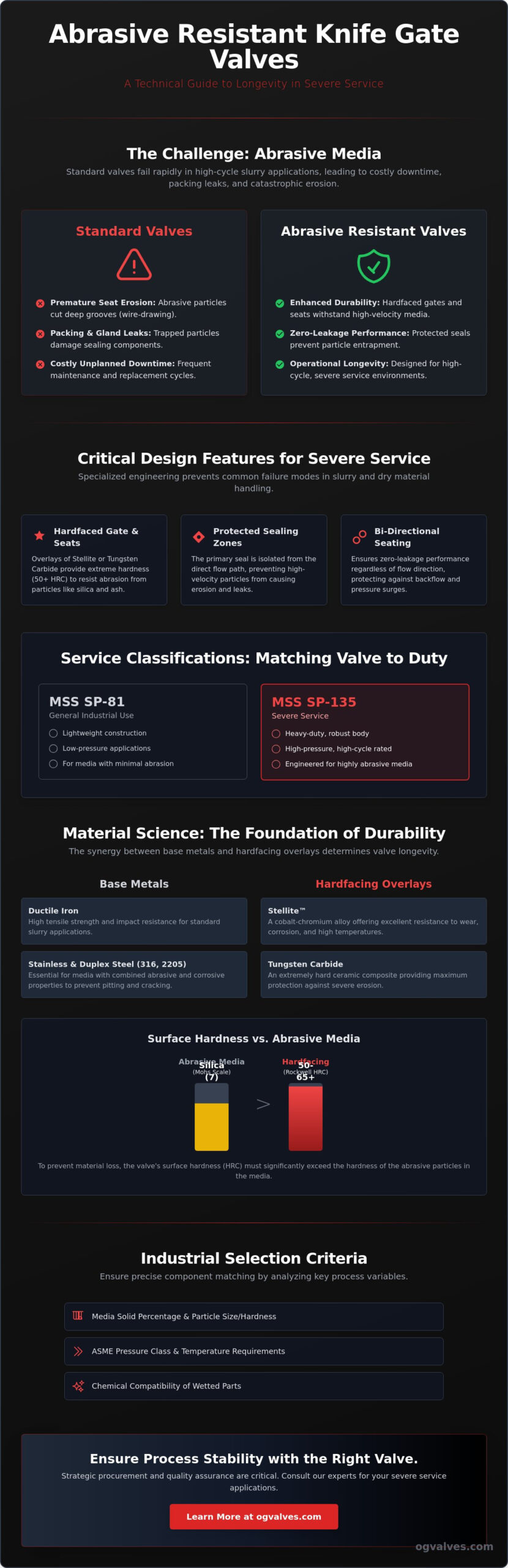
Abrasive resistant knife gate valves are specialized isolation components engineered to manage media with high solid concentrations, including slurries, dry powders, and tailings. Standard valves frequently fail in these environments because abrasive particles act as grinding agents against the gate and seat. This leads to wire-drawing, where high-pressure fluid forces particles through microscopic gaps, cutting deep grooves into the metal surfaces. These valves are critical in mining, cement processing, and power generation where unplanned downtime is prohibitively expensive.
The primary distinction between standard models and abrasive resistant knife gate valves lies in the structural reinforcement of the gate edge and the strategic protection of sealing zones. While a standard valve might rely on a simple elastomer seat, an abrasive-resistant model often features hardened metal inserts or sacrificial liners that can be replaced without discarding the entire valve body. This design philosophy prioritizes component longevity and maintenance efficiency in high-wear zones.
The Role of Knife Gate Valves in Slurry Isolation
The fundamental Knife Gate Valve Design utilizes a sharpened bottom edge on the gate to physically shear through settled solids or thick slurries during the closure cycle. In heavy industrial sectors such as mining tailings management and coal-fired power ash handling, the transition from general-purpose valves to abrasive resistant knife gate valves is a technical necessity. Standard valves often trap particles in the seat area, which leads to packing leaks and gate deformation. Specialized models incorporate protected sealing zones that isolate the primary seal from the direct flow path, significantly reducing the impact of particle size and velocity on internal components.
Standard vs. Severe Service Classifications
Specifying the correct valve requires a clear distinction between standard and severe service classifications. Engineers should consider the following standards and design requirements:
- MSS SP-81: Governs lightweight, low-pressure knife gate valves intended for general industrial use where abrasion is minimal.
- MSS SP-135: Provides the framework for severe service valves designed for high-pressure, high-cycle, and abrasive environments.
- Bi-directional Seating: Essential in systems where backflow or pressure surges could force abrasive media against the downstream side of the gate, preventing seal failure.
Adopting a structured industrial valves selection framework ensures that the metallurgy and sealing architecture are compatible with the specific angularity and hardness of the processed media. This methodical approach to specification reduces the risk of premature erosion and ensures compliance with international safety protocols.
The selection of base metals for abrasive resistant knife gate valves is the primary step in ensuring structural soundness under high-pressure loads. Ductile iron provides high tensile strength and impact resistance, making it suitable for standard slurry applications. However, when the media involves both abrasive solids and corrosive chemicals, stainless steel alloys like 316 or 2205 Duplex become necessary to prevent pitting and stress corrosion cracking. These materials serve as the foundation upon which specialized wear-resistant layers are applied. It’s essential to match the base metallurgy to the specific chemical profile of the slurry to avoid catastrophic body wall thinning.
Engineering precision dictates that base metallurgy alone is insufficient for severe service. Detailed Material Specifications for Erosive Media indicate that the synergy between the gate substrate and its surface treatment determines the valve failure point. Hardness ratings, typically measured on the Rockwell C (HRC) scale, must be matched to the Mohs hardness of the process solids. For instance, silica-heavy slurries require surface hardness exceeding 50 HRC to prevent rapid material loss. Engineers don’t overlook these variables when designing for critical infrastructure. To achieve these benchmarks, technicians utilize hardfacing techniques and sacrificial components that absorb kinetic energy from high-velocity particles.
Elastomer and Polymer Linings
Sacrificial linings are employed to isolate the valve body from direct abrasive contact. Urethane remains the industry standard for fine slurry and high-velocity flows due to its exceptional rebound properties and abrasion resistance. Natural rubber is preferred for larger, more angular particles because its elasticity allows it to deform and recover without tearing. While bonded linings offer superior vacuum resistance, replaceable sleeve designs allow for field maintenance without specialized equipment. EPDM is specified when temperature constraints or chemical compatibility requirements exceed the limits of standard urethane. Selecting the correct elastomer matrix is a critical variable that technical teams at OG VALVES LTD. evaluate during the procurement phase.
Advanced Hardfacing and Coatings
For extreme erosion where polymer linings are insufficient, advanced coatings and hardfacing are applied to the gate and seat surfaces. High-Velocity Oxy-Fuel (HVOF) Tungsten Carbide coatings provide a dense, ultra-hard barrier that excels in high-pressure slurry isolation, often reaching hardness levels of 65 to 70 HRC. In high-temperature environments, Stellite 6 overlays are utilized for their ability to maintain hardness at elevated thermal levels. Hardening the gate through chrome plating or nitriding reduces friction during the stroke, which minimizes packing wear and lowers actuation torque requirements. These specifications ensure that the valve maintains a bubble-tight seal even after thousands of cycles in erosive media like iron ore or fly ash.
Critical Design Features for Slurry and Dry Material Handling
The mechanical reliability of abrasive resistant knife gate valves is fundamentally tied to their internal geometry. While material hardness prevents surface wear, the valve’s design must prevent the accumulation of solids that leads to mechanical seizure. Self-cleaning gate geometry utilizes a precision-beveled edge to displace settled particles during the closing stroke. This action prevents the compression of solids into the chest area, which is a primary cause of gate deformation in standard models. By ensuring that the gate can fully travel through the media, the system maintains its ability to achieve a complete shut-off without manual intervention.
To complement this geometry, engineers integrate purge ports into the valve body. These ports facilitate the injection of pressurized air, steam, or water to clear the chest and seat areas of residual media. This is especially critical in applications involving dry powders or slurries that tend to dehydrate and harden over time. By maintaining a clear travel path for the gate, these features extend service intervals and ensure consistent isolation performance in high-cycle environments. Strategic placement of these ports allows for cleaning without necessitating a full process shutdown.
Seat Integrity and Protection
Effective sealing in abrasive environments requires a departure from standard gate valve configurations. Metal-to-metal seats are specified for high-temperature dry materials where elastomers would undergo thermal degradation. For slurry applications, resilient seats are often reinforced with protective metal rings. These rings act as a primary barrier, preventing elastomer washout caused by high-velocity particle impingement. Deflection cones are also utilized to divert the flow stream away from the sealing faces, ensuring that the kinetic energy of the media is absorbed by replaceable sacrificial components rather than the primary valve structure.
Packing Gland and Stem Engineering
The packing gland is frequently the first point of failure in severe service due to the ingress of fines. To counter this, technical specifications often call for multi-layer packing systems that utilize scrape-rings to exclude abrasive particles from the stem area. Live-loaded packing systems, which use disc springs to maintain constant pressure on the seal, compensate for packing consolidation and thermal cycling. For continuous flow requirements, O-port gate designs provide a full-bore opening that eliminates the turbulence and “dead zones” where abrasive particles typically settle. This design ensures that the gate remains protected within the body during the open position, minimizing erosion of the gate surface itself.
Selection Criteria: Matching Valve Specifications to Industrial Demands
Selecting abrasive resistant knife gate valves requires a rigorous assessment of the processed media. Engineers must quantify the percentage of suspended solids, the angularity of the particles, and the nominal flow velocity. High velocity acts as a force multiplier for erosion; increasing the flow speed can exponentially accelerate material loss in standard metallurgical configurations. Media with high angularity, such as crushed quartz or mineral tailings, necessitates a higher service factor to account for the mechanical impact on the gate. These variables dictate whether a standard design is sufficient or if a severe service model is required for long-term operational stability.
Pressure class requirements are defined by ASME B16.34, with Class 150 being standard for low-pressure slurries, while Class 300 and 600 are mandatory for high-head tailings lines. The choice between wafer and lug patterns depends on the requirement for downstream pipe maintenance; lugged valves allow for dead-end service, which is a critical safety consideration in pressurized systems. For high-torque demands in abrasive service, selecting the correct actuator is vital to overcome the increased friction of solids trapped in the seal area. Technical specialists can consult with OG VALVES LTD. to verify torque calculations for severe service applications.
The Impact of Slurry Concentration
Slurry concentration significantly dictates the internal architecture of the valve. Low-concentration slurries might permit the use of standard stainless steel gates, but high-density tailings require the reinforced designs and sacrificial linings discussed in earlier sections. The “sand-paper” effect occurs when fine particles migrate into the packing area, creating a constant abrasive interface between the gate and the seal. Service life is prolonged by calculating a service factor based on cycle frequency and particle hardness, ensuring the valve isn’t underspecified for its operational reality. Velocity management remains the most effective way to mitigate this wear pattern in critical pipework.
Compliance and Testing Standards
A critical distinction exists between MSS SP-81 and MSS SP-135. While MSS SP-81 is suitable for standard industrial use, MSS SP-135 is the definitive standard for severe service and abrasive resistant knife gate valves. This standard mandates more rigorous testing protocols to ensure the valve can handle the mechanical stresses of high-solids media without structural failure. API 598 pressure testing ensures zero-leakage performance, while Positive Material Identification (PMI) verifies that the alloy composition matches the design specification. These protocols provide the verification necessary for infrastructure projects where component failure leads to significant financial loss.
Strategic Procurement and Quality Assurance in Valve Supply
The successful implementation of high-specification isolation solutions concludes with a rigorous procurement strategy. Even when abrasive resistant knife gate valves are correctly specified, procurement errors, such as incorrect alloy substitutions or inadequate testing documentation, can compromise system integrity. OG VALVES LTD. manages this risk by providing a technical procurement framework that prioritizes material traceability and adherence to project-specific data sheets. This approach ensures that the physical component delivered to the site precisely matches the engineering requirements established during the design phase.
Technical teams provide oversight throughout the procurement cycle, from initial material verification to final inspection. This vigilance prevents the common pitfalls of bulk purchasing where subtle differences in seat metallurgy or coating thickness might be overlooked. By documenting every hydrostatic test and material certification, procurement specialists ensure that the infrastructure is built on a foundation of verified performance rather than vendor assumptions. This clinical focus on documentation is what separates industrial-grade supply from standard commercial vending.
Minimizing Downtime through Global Logistics
Industrial downtime costs often dwarf the capital expenditure of the valves themselves. OG VALVES LTD. addresses this by maintaining a strategic inventory of high-specification components ready for rapid international deployment. This proactive logistics model is essential for emergency replacements or fast-track projects where standard lead times are unacceptable. Technical oversight ensures that these rapid deployments remain compliant with broader system standards, including those for check valves and other critical isolation points. This coordination eliminates the risk of mismatched flange ratings or incompatible face-to-face dimensions during field installation.
Rigorous Testing and Certification
Final quality assurance protocols serve as the ultimate verification of a valve’s readiness for severe service. Every abrasive resistant knife gate valve undergoes a series of standardized tests, including API 598 pressure testing and dimensional verification, to ensure zero-leakage performance. We provide comprehensive documentation packages, including Positive Material Identification (PMI) reports and coating thickness logs, to satisfy the most stringent regulatory audits. For procurement specialists requiring detailed technical support and competitive industrial valve quotes, our engineering department provides the data necessary to justify high-spec investments in critical infrastructure.
Optimizing Infrastructure Reliability through Severe Service Engineering
Achieving operational stability in high-abrasion environments requires a clinical focus on the synergy between material science and mechanical design. Success is defined by the integration of hardened gate surfaces with self-cleaning geometries that prevent solids accumulation in the chest area. Adherence to rigorous benchmarks like MSS SP-135 and ANSI/MSS SP-135-2021 remains the most reliable method for ensuring component integrity during high-cycle slurry isolation. These standards provide the technical framework necessary to prevent premature erosion and packing failure.
OG Valves acts as a dependable partner in critical infrastructure, offering an extensive inventory of high-specification components and deep technical expertise in API and MSS standards. Our global fast-track delivery capabilities ensure that abrasive resistant knife gate valves reach your facility precisely when needed, minimizing the risk of costly unplanned downtime. Every component is backed by rigorous hydrostatic testing and material certification to guarantee performance in the most demanding industrial applications. We look forward to supporting your next high-stakes procurement requirement with precision and reliability.
Request a Technical Quote for Abrasive Resistant Valves
Frequently Asked Questions
What is the difference between a standard knife gate valve and an abrasive resistant model?
Standard knife gate valves are engineered for general-purpose fluid isolation, whereas abrasive resistant knife gate valves incorporate reinforced gates and sacrificial linings. These severe service models utilize hardened metallurgy and specialized sealing architectures to resist the wire-drawing and seat erosion common in high-solids media. While standard models follow MSS SP-81, abrasive-resistant designs adhere to the more rigorous MSS SP-135 requirements for durability.
Which lining material is best for high-velocity slurries?
Urethane is the superior lining material for high-velocity, fine-particle slurries due to its exceptional rebound characteristics and abrasion resistance. Its ability to absorb kinetic energy from high-velocity impingement prevents the rapid wall thinning that occurs in unlined metal bodies. For larger, more angular particles, natural rubber is often preferred because its elasticity allows it to deform and recover without tearing under heavy impact.
Can abrasive resistant knife gate valves be used for dry material handling?
These valves are highly effective for dry material handling, including powders, cement, and bulk solids. In these applications, metal-to-metal seats are frequently specified to prevent the mechanical tearing or thermal degradation that elastomer seats might experience. The sharpened gate edge is particularly useful for shearing through columns of dry material to ensure a positive shut-off in silos and hoppers.
What are the common failure modes of knife gate valves in abrasive service?
Failure modes typically include wire-drawing of the gate, packing gland contamination, and seat washout. Wire-drawing occurs when abrasive particles are forced through microscopic gaps at high pressure, cutting deep grooves into the metal. Packing failure is caused by solids migrating into the seal area and scoring the stem, while seat washout involves the total erosion of the primary sealing surface by high-velocity media.
How do purge ports improve the lifespan of a knife gate valve?
Purge ports allow for the injection of pressurized air or water to clear settled solids from the valve chest and seat area. This prevents material compaction, ensuring the gate achieves full travel during every cycle. By keeping the travel path clear, purge ports reduce the mechanical stress that leads to gate deformation and prevent abrasive particles from being ground into the seals.
What industry standards govern abrasive resistant knife gate valves?
Severe service applications are primarily governed by MSS SP-135 and ANSI/MSS SP-135-2021, which define the construction requirements for high-pressure abrasive resistant knife gate valves. For high-pressure iron configurations, the recently revised MSS SP-146-2024 standard provides the current benchmarks for construction and testing. Compliance with these standards ensures that the valve can handle the mechanical stresses of high-solids media.
Is bi-directional sealing necessary for slurry applications?
Bi-directional sealing is essential in slurry systems where backflow or pressure reversals are possible. Without a bi-directional seal, a pressure surge from the downstream side can force abrasive media against the back of the gate, leading to catastrophic seal failure. Specifying bi-directional capability ensures that the valve maintains its isolation integrity regardless of the pressure direction within the piping system.
How does hardfacing with Tungsten Carbide compare to Stellite?
Tungsten Carbide applied via High-Velocity Oxy-Fuel (HVOF) provides maximum hardness, often reaching 70 HRC, making it ideal for extreme erosion. Stellite 6 is a cobalt-based alloy that is preferred for high-temperature applications where the material must maintain its hardness under thermal stress. While Tungsten Carbide offers superior wear resistance, Stellite provides a better balance of corrosion resistance and thermal stability in severe environments.
 Responsive Menu