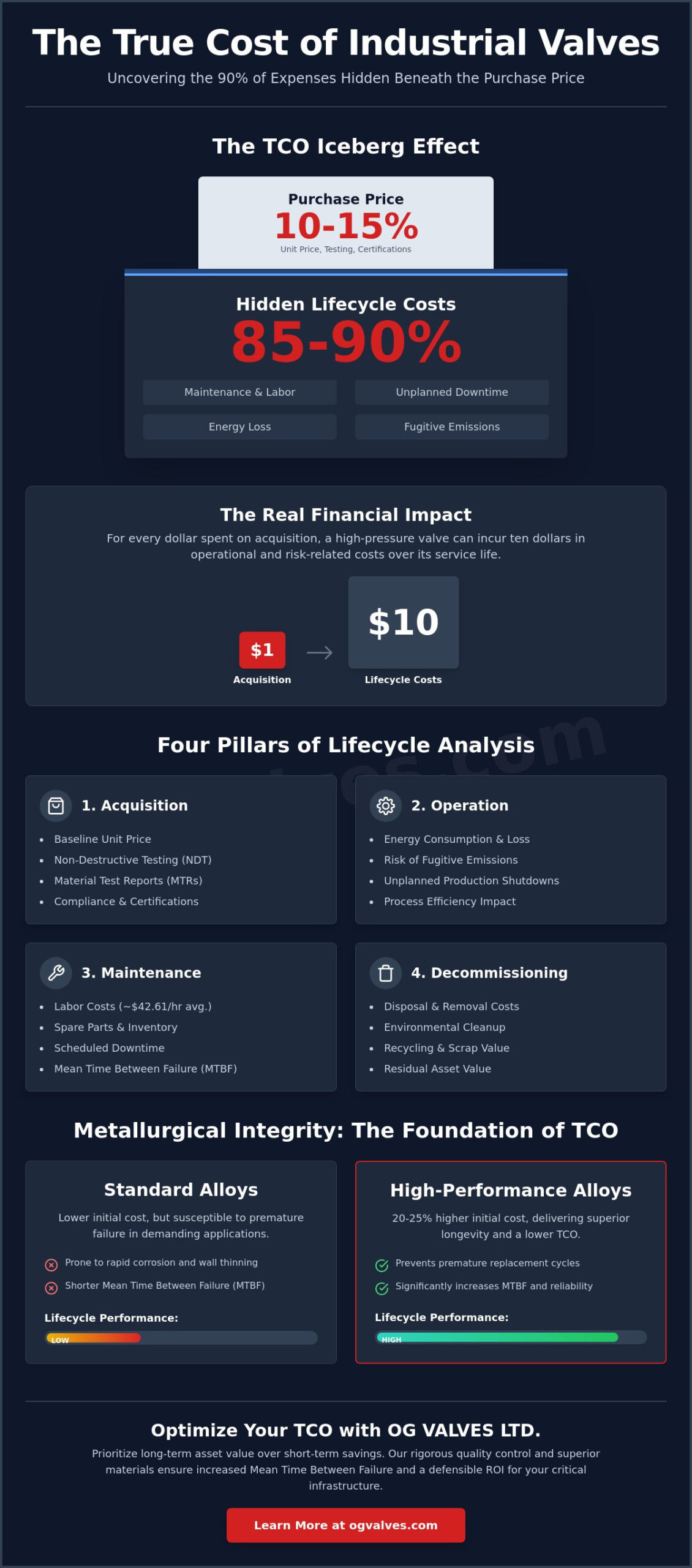
The initial purchase price of an industrial valve represents only a fraction of the total cost of ownership industrial valves incur; the majority of financial liability is realized during the operational lifecycle through maintenance, unplanned downtime, and energy loss. It’s a reality that procurement specialists often face intense budget pressure to select low-cost vendors, even when technical data suggests these assets will fail prematurely. You’ve likely seen how a minor saving on the front end results in a catastrophic expenditure when a critical process goes offline due to material fatigue or seal failure.
This article provides a rigorous technical framework to master the hidden drivers that determine true asset value and return on investment. We’ll establish a defensible formula for internal stakeholders that accounts for maintenance labor rates, which currently average $42.61 per hour in the United States, and the 20% to 25% price premium associated with high-performance alloys. By analyzing ISO 15848-1:2015 fugitive emission standards and material integrity, you’ll learn how to reduce lifecycle expenditure and significantly increase Mean Time Between Failure across your infrastructure.
- Identify the four critical pillars of lifecycle analysis: acquisition, operation, maintenance, and decommissioning.
- Evaluate how precise metallurgical selection, such as utilizing exotic alloys over standard carbon steel, prevents premature replacement cycles.
- Quantify the financial impact of unplanned production shutdowns and energy loss caused by fugitive emissions in high-pressure systems.
- Analyze the direct correlation between procurement lead times and the total cost of ownership industrial valves during active asset failures.
- Establish a defensible ROI for premium valve assets by prioritizing rigorous quality control and increased Mean Time Between Failure (MTBF).
A comprehensive analysis of Total Cost of Ownership (TCO) defines it as the aggregate of acquisition, operation, maintenance, and decommissioning costs. Analyzing the total cost of ownership industrial valves requires a departure from simple procurement metrics toward a clinical evaluation of long-term asset reliability. In high-stakes infrastructure, the initial purchase price is often a deceptive metric, representing only a minor fraction of the total financial commitment.
The “Iceberg Effect” describes this phenomenon in critical flow control. While the purchase price is visible, it typically accounts for only 10% to 15% of the TCO. The remaining 85% to 90% remains submerged, manifesting as seal degradation, fugitive emissions, and unplanned process interruptions. In the petrochemical and power generation sectors, these hidden variables are amplified by extreme pressure and temperature cycles that accelerate mechanical wear. Industry benchmarks suggest that for every dollar spent on acquisition, a high-pressure valve may incur ten dollars in operational and risk-related costs over its service life.
To quantify these variables, engineers utilize a primary TCO formula:
TCO = Acquisition + (Annual Maintenance Cost × Expected Service Years) + (Downtime Risk Value) – Residual Asset Value
This calculation allows procurement specialists to move beyond the invoice and model the financial impact of Mean Time Between Failure (MTBF) over a 20 or 30 year operational horizon.
Acquisition Costs vs. Lifecycle Reality
The acquisition phase includes the baseline unit price, yet it’s the secondary requirements that dictate the starting capital expenditure. These include:
- Non-Destructive Testing (NDT) protocols: Radiographic or ultrasonic testing to ensure casting integrity.
- Material traceability: Comprehensive Material Test Reports (MTRs) to verify alloy composition.
- Documentation and compliance: Fees associated with third-party inspections and international standard certifications.
Relying on a low-bid procurement model in high-stakes infrastructure is a flawed strategy. It prioritizes immediate savings over the structural soundness required for decades of service. TCO is a holistic financial assessment of asset performance over its entire service life.
The Role of Technical Specifications in Cost Baselining
Design standards like API 6D for pipeline valves or ASME B16.34 for pressure-temperature ratings provide the technical baseline for TCO calculations. These standards ensure the valve meets minimum safety thresholds, but specialized certifications often drive initial costs higher. For instance, adherence to ISO 15848-1 for fugitive emissions control increases upfront costs but drastically reduces the risk of environmental fines and product loss. Aligning valve selection with the intended design life of the facility prevents the financial inefficiency of over-specification or the operational hazard of under-specification.
The total cost of ownership industrial valves is fundamentally rooted in metallurgical integrity. Selecting the correct alloy for a specific process medium determines whether an asset reaches its intended design life or fails prematurely due to localized corrosion. While carbon steel remains a standard for non-corrosive utilities, its application in aggressive environments often leads to rapid wall thinning. This necessitates a “corrosion allowance” that may not suffice over a 20 year operational window, eventually leading to structural compromise and emergency replacement.
Positive Material Identification (PMI) and non-destructive testing (NDT) serve as critical verification protocols during the procurement phase. These processes ensure that the chemical composition of the valve body and trim matches the specification exactly. Without rigorous NDT, sub-surface casting defects can remain undetected until the valve is subjected to high-pressure thermal cycling. Investing in these quality control measures during acquisition eliminates the risk of catastrophic failure, which carries a financial impact far exceeding the cost of the testing itself.
Material Lifecycle Comparison: Duplex vs. Standard Alloys
The Mean Time Between Failure (MTBF) varies significantly across metallurgical grades. In high-salinity or acidic environments, standard 316 stainless steel offers a baseline of protection, but Duplex and Super Duplex alloys provide superior resistance to stress corrosion cracking and pitting. Although stainless steel valves carry a 20% to 25% price premium over carbon steel, the lifecycle extension justifies the capital outlay. The following table illustrates the relationship between material selection and service life in corrosive applications:
| Material Grade | Initial Cost Factor | Expected Service Life (Corrosive) | TCO Impact |
|---|
| Carbon Steel | 1.0x | 2–5 Years | High (Frequent Replacement) |
| 316 Stainless Steel | 1.25x | 10–15 Years | Moderate (Standard Reliability) |
| Duplex Stainless Steel | 1.8x+ | 25+ Years | Low (Maximum MTBF) |
Standards Adherence: API 600 and Beyond
Adhering to established industrial valves standards, such as API 600 for heavy-duty gate valves, reduces the probability of operational failure. These standards dictate minimum wall thicknesses and stem diameters that ensure mechanical durability under stress. Utilizing API-certified gate and globe valves provides a predictable performance baseline for maintenance teams. Furthermore, standardization across a facility allows for a reduced spare parts inventory. When components like packing sets and gaskets are interchangeable across a fleet of standardized valves, the carrying cost of inventory drops significantly. Engineers focused on long-term stability often specify high-performance Ball Valves to ensure seal integrity in critical isolation points.

Operational expenditure (OPEX) constitutes the largest segment of the total cost of ownership industrial valves over a multi-decade horizon. Beyond the initial capital outlay, the financial performance of a valve asset is measured by its impact on system throughput and energy consumption. Frequent maintenance intervals don’t just consume spare parts; they compound labor costs and increase the statistical probability of human error during reassembly. Clinical focus on Mean Time Between Failure (MTBF) is essential to mitigate these recurring financial drains.
The Flow Coefficient (Cv) is a critical technical variable that directly influences long-term pumping costs. A valve with an undersized Cv or inefficient flow path forces the system pumps to operate at higher pressures to overcome parasitic head loss. Over thousands of operational hours, the incremental increase in kilowatt-hour consumption often exceeds the original purchase price of the valve. Selecting high-recovery designs ensures that energy efficiency remains optimized throughout the asset lifecycle.
The Financial Reality of Unplanned Shutdowns
In high-volume production environments, such as petroleum refining or chemical processing, daily output values can reach $1,000,000. When a $2,000 valve fails in a critical isolation point, the resulting unscheduled shutdown incurs costs that are orders of magnitude higher than the asset’s value. Risk-based TCO analysis weights these costs by the probability of failure, prioritizing premium materials for valves located in critical process lines. The most expensive valve is the one that forces an unscheduled plant shutdown.
Unplanned maintenance also triggers high-intensity labor requirements. With average industrial maintenance labor rates in the United States reaching approximately $42.61 per hour as of June 2026, the cost of emergency repairs quickly erodes operational budgets. Transitioning from reactive to predictive maintenance strategies requires valves with high reliability ratings to minimize these labor-intensive interventions and protect the bottom line.
Energy Loss and Fugitive Emissions
Internal leakage and fugitive emissions represent a continuous drain on facility profitability. Achieving “Tight Shut-off” or zero-leakage performance is essential for maintaining process integrity and preventing product loss. For instance, the seal integrity of a butterfly valve is a primary determinant of its environmental compliance cost. Fugitive emissions are strictly regulated by standards such as ISO 15848-1:2015, which classifies valves based on their tightness and endurance capabilities.
Failure to meet these standards results in significant environmental penalties and the loss of processed media. Actuation precision also plays a vital role; valves integrated into automated control loops must respond with clinical accuracy to prevent hunting and overshoot. This precision reduces energy waste by ensuring the process remains within its most efficient operating window, further lowering the total cost of ownership industrial valves.
Fast-Track Procurement as a Risk Mitigation Strategy
Comparing the TCO of stocked items against custom-manufactured valves reveals the true value of availability. When an active failure occurs, the daily cost of a process outage far outweighs the price of the valve itself. Global logistics networks enable the rapid deployment of assets to remote project sites, drastically cutting TTR. For example, the immediate availability of high-integrity check valves is essential for preventing reverse flow damage to expensive upstream equipment during emergency replacements. Maintaining a reliable supply chain for these critical components ensures that a single component failure doesn’t escalate into a multi-system catastrophe.
Supplier Technical Expertise and TCO
Reducing “Selection Error” costs requires a deep integration of engineering expertise into the procurement process. If a valve is incorrectly sized or the material grade is insufficient for the chemical concentration of the media, the asset will fail long before its design life concludes. Comprehensive documentation, including Material Test Reports (MTRs) and pressure testing certificates, streamlines the commissioning process and ensures regulatory adherence from day one. Integrating gate valve sizing accuracy is particularly critical for high-pressure isolation points where improper fit leads to seat erosion and premature wear. To ensure your facility maintains maximum uptime, view our full range of certified industrial valves designed for immediate deployment in critical infrastructure.
OG VALVES LTD. operates with a clinical focus on high-specification inventory to ensure maximum Mean Time Between Failure (MTBF) for critical infrastructure. By prioritizing metallurgical integrity and adherence to international benchmarks, we address the primary drivers of the total cost of ownership industrial valves. Our approach treats quality control not as an administrative hurdle, but as a fundamental risk mitigation strategy designed to eliminate the “Iceberg Effect” discussed earlier in this framework. This methodology ensures that every asset delivered meets the rigorous demands of high-pressure and high-temperature environments.
Rigorous testing and adherence to global regulatory bodies serve as our primary form of brand validation. We don’t view ourselves as a mere vendor, but as a dependable partner in maintaining the structural soundness of heavy industrial systems. Every valve in our inventory undergoes strict verification processes to ensure it meets the quantifiable data points required by technical experts. This commitment to engineering excellence allows procurement specialists to build high-stakes trust in the reliability of their flow control assets.
Technical Precision in Inventory Selection
Technical precision in material selection is non-negotiable for high-pressure and corrosive applications. Our focus on ball valve material integrity significantly reduces lifecycle failure rates by ensuring that every component exceeds the minimum requirements of API, ASME, and ISO standards. OG VALVES LTD. maintains an extensive stock of certified assets, which acts as a direct countermeasure to the “Cost of Waiting” for critical components. This availability ensures that procurement specialists don’t have to compromise on quality when faced with urgent operational needs, effectively lowering the total cost of ownership industrial valves.
Partnering for Long-Term Operational Reliability
Our engagement with clients extends beyond the initial transaction. OG VALVES LTD. positions its technical expertise as a primary tool for accurate valve specification and risk reduction. By providing comprehensive documentation and Material Test Reports (MTRs), we facilitate a seamless integration into existing TCO reduction frameworks. Minimal downtime is guaranteed through our fast-track global logistics capability, managed from our central hub in Northern Ireland. This infrastructure allows for the rapid deployment of high-specification assets to global project sites, mitigating the financial impact of active failures.
The total cost of ownership industrial valves is a metric that demands constant audit and refinement. We invite technical experts and procurement managers to request a technical consultation to audit their current valve TCO strategy. Our engineers provide the data points necessary to justify the ROI of premium materials and high-specification designs in your specific process environment. Contact the technical team at OG VALVES LTD. today to begin your lifecycle analysis.
Optimizing the total cost of ownership industrial valves requires a clinical shift from short-term procurement savings toward long-term metallurgical and operational precision. It’s a process that demands accounting for the hidden 90% of lifecycle costs, including maintenance labor and energy loss. We’ve established that material selection, adherence to API standards, and the mitigation of fugitive emissions aren’t just technical requirements; they’re the primary drivers of facility profitability. Engineers who utilize this framework build a defensible case for critical infrastructure investment.
Reliable flow control depends on a partner who understands the cost of failure and the necessity of quality. OG VALVES LTD. maintains an extensive inventory of API-standard gate, globe, and ball valves designed for high-pressure and corrosive applications. Our global fast-track delivery capabilities ensure that critical components arrive at project sites before active failures escalate into catastrophic shutdowns. We provide the technical expertise needed to navigate complex specifications and reduce systemic risk across your asset fleet. Consult with our technical experts to optimize your valve TCO and secure the functional reality of your facility’s design life. Precise engineering is the only way to ensure unwavering reliability in heavy industrial sectors.
What is the most significant hidden cost in industrial valve TCO?
Unplanned production downtime represents the most significant hidden cost in the total cost of ownership industrial valves. When a critical isolation valve fails, the resulting process interruption can incur losses reaching $1,000,000 per day in sectors like petroleum refining. These costs far exceed the initial asset price. Secondary hidden costs include emergency maintenance labor and the collateral damage to upstream equipment caused by backflow or pressure surges.
How does material selection specifically impact the total cost of ownership?
Material selection determines the Mean Time Between Failure (MTBF) and the frequency of replacement cycles. Utilizing stainless steel or duplex alloys instead of carbon steel in corrosive environments reduces the corrosion allowance expenditure over a 20 year window. While premium alloys carry an initial price premium of 20% to 25%, they eliminate the high labor and procurement costs associated with frequent valve failures in aggressive media.
Is it always more cost-effective to buy a more expensive valve upfront?
It’s not always more cost-effective to buy a premium valve; the decision must be based on a risk-based TCO analysis. For non-critical utility lines with low pressure and non-corrosive media, a standard specification valve is sufficient. However, in high-pressure process lines where failure triggers a shutdown, the ROI of premium materials is immediate. Accuracy in sizing and specification prevents the financial waste of both over-engineering and under-specification.
How do international standards like API 600 affect TCO?
Adherence to international standards like API 600 for gate valves ensures a baseline of mechanical durability by mandating specific wall thicknesses and stem diameters. These benchmarks reduce TCO by lowering the probability of catastrophic failure and ensuring predictable performance. Furthermore, standardization allows facilities to reduce their spare parts inventory carrying costs, as components like packing and gaskets become interchangeable across a fleet of certified assets.
What role does energy efficiency play in the TCO of a valve?
Energy efficiency impacts TCO through long-term pumping costs and environmental compliance penalties. Valves with inefficient flow coefficients (Cv) increase parasitic head loss, forcing pumps to consume more kilowatt-hours to maintain process flow. Additionally, adherence to ISO 15848-1:2015 fugitive emission standards prevents the loss of processed media and avoids significant regulatory fines. Precision in actuation also ensures that automated systems operate within their most efficient parameters.
How can lead times and logistics affect the total cost of ownership in an emergency?
Lead times and logistics are critical determinants of the total cost of ownership industrial valves during an active failure. A 26 week lead time for a custom-manufactured valve is financially untenable if a plant is offline. Fast-track global delivery from a supplier with extensive inventory reduces the Time to Repair (TTR), directly mitigating revenue loss. Efficient logistics turn procurement from a bottleneck into a risk management tool for critical infrastructure.
Can predictive maintenance reduce the TCO of existing valve assets?
Predictive maintenance significantly reduces TCO by identifying degradation before it results in a functional failure. Utilizing diagnostic data allows maintenance teams to schedule interventions during planned turnarounds rather than reacting to emergency shutdowns. This strategy extends the service life of high-value assets and optimizes labor allocation. With average maintenance labor rates at $42.61 per hour, preventing even one emergency repair provides a substantial reduction in operational expenditure.
What is the difference between CAPEX and OPEX in the context of valve procurement?
CAPEX refers to the initial capital expenditure for asset acquisition, including the unit price and testing documentation. OPEX represents the ongoing operational expenditure, encompassing maintenance labor, spare parts, and energy consumption. A comprehensive TCO framework reveals that while CAPEX is a one-time cost, OPEX often accounts for up to 90% of the total financial commitment over the valve’s lifecycle. Successful procurement strategies prioritize lowering OPEX through higher-quality initial CAPEX investments.
 Responsive Menu