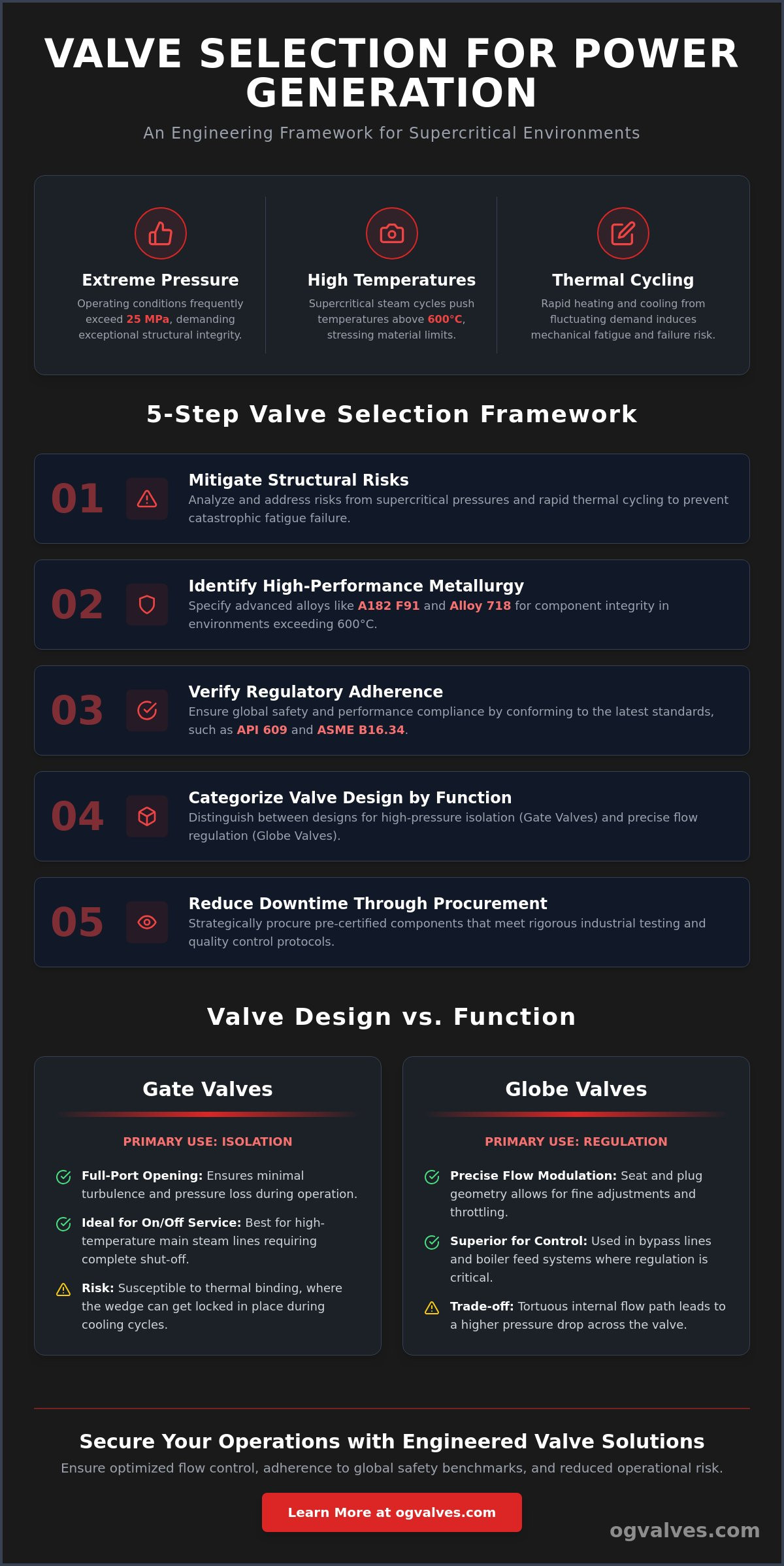
Prioritizing simple pressure ratings over metallurgical stability under extreme thermal cycling is a direct path to catastrophic fatigue failure in modern utility environments. The technical complexity of valve selection for power generation demands a rigorous adherence to the latest engineering benchmarks, including the tenth edition of API Std 609 and the revised MSS SP-78-2026. You recognize that operating at temperatures above 600°C places unprecedented stress on critical components like gate, globe, and check valves, where even minor material deviations lead to non-compliance or extended plant downtime.
This technical guide provides an engineering-led framework for selecting industrial valves capable of withstanding the supercritical pressures of current infrastructure. We’ll analyze the structural performance of advanced alloys like A182 F91 and Alloy 718, evaluate the necessity of API 624 for fugitive emissions control, and define the specification requirements for maintaining long-term seat integrity. By aligning your procurement with these clinical standards, you ensure optimized flow control efficiency and adherence to global safety benchmarks. This methodical approach targets the reduction of operational risks through precise material classification and regulatory alignment.
- Implement a 5-step engineering framework for valve selection for power generation to mitigate the structural risks associated with supercritical pressures and rapid thermal cycling.
- Identify high-performance metallurgical classifications, including A182 F91 and Alloy 718, necessary for maintaining component integrity in ultra-supercritical environments exceeding 600°C.
- Verify adherence to the latest 2025 and 2026 regulatory updates, such as API Std 609 and ASME B16.34, to ensure global safety and performance compliance.
- Categorize valve designs, specifically gate and globe variants, by their functional capacity for either high-pressure isolation or precise flow regulation within power plant subsystems.
- Reduce operational downtime through strategic procurement of pre-certified components that meet rigorous industrial testing and quality control protocols.
The transition from base-load operation to frequent cycling in response to intermittent renewable energy sources has fundamentally altered the operational requirements for power plant infrastructure. Thermal cycling involves the rapid heating and cooling of pressure-retaining components as plants ramp up or down to meet fluctuating grid demand. This process induces significant mechanical stress. In the context of valve selection for power generation, the primary challenge lies in managing the expansion and contraction of heavy-walled valve bodies without compromising the integrity of internal seals or metallurgical stability.
Supercritical and ultra-supercritical steam cycles, often exceeding temperatures of 600°C and pressures of 25 MPa, push traditional material boundaries to their limits. Under these conditions, steam behaves as a dense fluid with exceptionally high kinetic energy. High-velocity steam flow through partially open valves often leads to wire-drawing, a form of localized erosion that creates deep grooves in the seating surface. This degradation isn’t merely a maintenance concern; it represents a high-stakes risk of catastrophic fatigue failure. While high-specification metallurgy increases initial component investment, the cost is marginal compared to the financial impact of unplanned plant downtime caused by seat leakage or pressure boundary rupture.
Mechanical Fatigue and Thermal Stress
Rapid temperature fluctuations cause differential expansion between the valve body, stem, and internal trim. In traditional gate valves, this often results in thermal binding. As the valve cools, the body contracts more rapidly than the wedge, locking the valve in a closed position and preventing critical operation. Engineering solutions must prioritize advanced body-to-bonnet joint designs, such as pressure-seal bonnets, which utilize system pressure to maintain seal integrity during thermal transients. Selecting materials with matched coefficients of thermal expansion is critical to preventing fatigue-induced cracking at high-stress junctions.
Erosion and Cavitation in High-Pressure Steam
Erosion remains a primary cause of isolation valve failure in high-pressure drop applications. High-velocity steam physically abrades the trim, leading to rapid seat degradation. This is particularly prevalent in control valve designs where throttling is required for process regulation. To counteract this, hardened seating materials like Stellite are mandatory for steam service to provide the necessary hardness at elevated temperatures. In liquid-phase subsystems, such as boiler feed water, the risk shifts to cavitation. When local pressure drops below the vapor pressure, bubbles form and collapse violently against the valve walls. Effective valve selection for power generation requires multi-stage trim designs to dissipate energy gradually and prevent these destructive vapor phase transitions.
Effective valve selection for power generation hinges on the precise mapping of mechanical designs to specific subsystem requirements. Isolation and regulation represent two distinct functional categories that can’t be treated interchangeably. Selecting a valve designed for isolation to perform throttling duties results in rapid seat erosion. This degradation eventually leads to the failure of the pressure boundary and costly unplanned outages. Precision in this phase involves evaluating how a seating mechanism responds to both high differential pressures and the thermal transients discussed in previous sections.
In main steam lines, gate valves are the preferred choice for high-temperature isolation. The wedge gate design allows for a full-port opening, which ensures minimal turbulence and pressure loss during normal operation. For applications requiring precise flow modulation, such as bypass lines or boiler feed control, globe valves provide superior performance. Their seat and plug geometry allows for fine adjustments to the flow coefficient. However, the tortuous internal flow path increases the pressure drop across the component. Adhering to power plant control valve guidelines is essential when specifying these units to avoid the economic penalties of incorrect trim selection.
Isolation Valves: Gate and Globe Designs
Wedge gate valves offer a robust mechanical seal for high-temperature isolation, but they’re prone to thermal binding during rapid cool-down phases. Engineers must specify flexible wedge designs to accommodate the slight contraction of the valve body without locking the wedge in place. For throttling service, globe valve seat designs must be carefully selected to match the process fluid’s velocity. For detailed design parameters, engineers should consult A Technical Guide to Industrial Gate Valves to understand how different wedge configurations respond to extreme thermal expansion.
Non-Return and Flow Control: Check and Butterfly Valves
Non-return and low-pressure auxiliary lines require specialized flow control designs to maintain system stability. Triple offset butterfly valves are often utilized in cooling water circuits and large-diameter low-pressure lines. The triple-offset geometry eliminates seat friction during operation, providing zero-leakage isolation that traditional concentric designs can’t achieve. In high-pressure pump discharge lines, high-performance check valves are critical for preventing backflow. They protect upstream equipment from water hammer and reverse flow damage. Additionally, needle valves remain the standard for precision instrumentation and pressure sensing lines where minimal flow rates and extreme pressure sensitivity are mandatory. Reviewing the technical specifications of API-certified inventory helps ensure that every component matches the unique stressors of your power facility.

Adherence to global regulatory benchmarks is the primary mechanism for ensuring the structural integrity of a power facility. In the process of valve selection for power generation, ASME B16.34 serves as the foundational standard for determining pressure-temperature ratings. This standard defines the maximum allowable working pressure across various material groups, ensuring that the valve body can withstand the supercritical steam pressures typical of modern utility boilers. For heavy-duty isolation, API 600 provides the specific manufacturing requirements for bolted bonnet steel gate valves, prioritizing wall thickness and stem diameter to prevent mechanical failure under high-torque conditions.
The transition from standard carbon steel to high-performance Chrome-Molybdenum alloys is a technical necessity for high-temperature steam service. While carbon steel is suitable for auxiliary lines, main steam and reheat systems require grades like F11, F22, and F91. These alloys offer superior oxidation resistance and mechanical strength at elevated temperatures. Specifically, F91 has become the industry standard for ultra-supercritical plants due to its enhanced creep-rupture strength. In cooling tower subsystems, where exposure to brackish water or seawater is common, the focus shifts to corrosion resistance. Stainless steel and duplex alloys are utilized here to prevent pitting and stress corrosion cracking that would otherwise compromise the cooling circuit’s efficiency.
Material Selection for High-Temperature Integrity
Evaluating creep resistance is critical when specifying alloys for service lives exceeding 100,000 hours. F91 and F92 grade steels are engineered with precise vanadium and nitrogen additions to maintain metallurgical stability under constant stress at 600°C. For aggressive seawater cooling applications, Super Duplex alloys provide the necessary resistance to chloride-induced corrosion. Given the high stakes of material failure, Positive Material Identification (PMI) is a non-negotiable procurement protocol. This on-site verification ensures that the delivered valve’s chemical composition aligns exactly with the mill test reports, eliminating the risk of installing incorrect alloys in critical high-pressure lines.
Sealing Technology and Fugitive Emissions
Sealing systems must maintain integrity despite the thermal transients discussed in previous sections. Graphite-based packing is the preferred material for high-temperature steam, offering thermal stability and low friction coefficients. Adherence to ISO 15848-1 standards is mandatory for controlling fugitive emissions, particularly as environmental regulations become more stringent. In valve selection for power generation, metal-to-metal seating is almost exclusively favored over soft-seated designs for high-pressure applications. This choice prevents seat degradation from high-velocity steam and ensures long-term component durability in the most demanding operational environments.
Integrating mechanical design with metallurgical requirements requires a systematic approach to procurement. This 5-step framework streamlines valve selection for power generation by prioritizing functional reality over generic specifications. Engineers must move beyond simple pipe size matching to ensure every component survives the operational stressors of modern utility boilers. The process begins with rigorous data collection and concludes with the verification of automation protocols.
- Step 1: Define process parameters. Record the fluid state (saturated vs. superheated steam), maximum operating pressure, peak temperature, and required flow rates.
- Step 2: Determine valve function. Distinguish between isolation (Gate), throttling (Globe), and non-return (Check) requirements to ensure the seating mechanism matches the duty cycle.
- Step 3: Calculate required Flow Coefficient (Cv). Verify the bore size to maintain optimal velocity and prevent the mechanical instability associated with oversized trim.
- Step 4: Select metallurgy. Match the material classification to the corrosion and thermal stress profiles, utilizing the high-performance alloys discussed in previous sections.
- Step 5: Define actuation requirements. Specify the necessary torque and fail-safe positions for emergency shutdown (ESD) or automated process control.
Calculating Flow and Sizing
Precision in sizing is a prerequisite for long-term component durability. Oversized valves in throttling service are a common cause of “hunting,” where the actuator constantly adjusts, leading to accelerated seat wear and packing failure. Using precise Cv values allows engineers to optimize system efficiency and minimize the pressure drop across the valve body. For a deeper analysis of sizing calculations and industry benchmarks, technical specialists should refer to Industrial Valves: The Engineer’s Comprehensive Guide. Correct sizing ensures the valve operates within its intended control range without inducing vibration or noise.
Actuation and Control Integration
The final stage involves selecting actuators capable of meeting the plant’s safety and response requirements. In high-vibration power plant environments, pneumatic actuators are frequently specified for their reliability and rapid stroke times, which are critical for steam bypass systems. Electric actuation provides superior precision for fine-tuning flow rates in boiler feed lines but requires robust housing to withstand thermal radiation. Every fail-safe operation must be rigorously tested to guarantee performance during a total power loss. To ensure your facility meets these stringent safety standards, request a technical consultation for your specific actuation and control requirements.
The transition from engineering specification to procurement execution is where operational risk is often highest. A rigorous valve selection for power generation framework is only effective when supported by a supply chain capable of delivering high-specification components without compromise. OG VALVES LTD. functions as a technical partner for critical infrastructure, maintaining an extensive inventory of API and ASME compliant valves ready for immediate dispatch. Our stock includes gate, globe, ball, check, butterfly, plug, and needle valves engineered for the extreme pressures and temperatures characteristic of modern power cycles.
Reliability in heavy industry isn’t just about the physical product; it’s about the documentation and testing that validate its performance. Every component in our inventory undergoes rigorous quality control protocols. We provide comprehensive Mill Test Reports (MTRs) and conduct on-site Positive Material Identification (PMI) testing to ensure metallurgical compliance. This clinical focus on data eliminates the risk of material substitution, ensuring that the F91 or Super Duplex alloys specified for your steam lines meet every regulatory benchmark for creep resistance and structural integrity. These measures are essential for maintaining the safety margins required by global regulatory bodies.
Fast-Track Delivery for Critical Outages
Plant downtime is a significant financial liability. Whether you’re managing a planned maintenance cycle or responding to an emergency shutdown, rapid component availability is essential. Our logistical framework utilizes a global supply chain to ensure that high-specification valves reach international project sites with minimal lead times. We understand the cost of failure. Our team provides technical support from the initial procurement phase through to operational integration, ensuring that every valve matches the specific mechanical stressors of your facility’s on-demand energy production. This comprehensive project management serves as a signature of our capability to handle large-scale industrial demands.
Request a Technical Specification Review
Precision in valve selection for power generation requires collaboration between procurement specialists and technical experts. Our engineers are available to verify valve suitability for your specific steam cycle, ensuring that the selected designs can withstand the thermal cycling and supercritical pressures discussed throughout this guide. You can access our full inventory of high-performance isolation and regulation valves to find the exact match for your subsystem requirements. We prioritize functional reality and long-term durability in every consultation. Our technical team consistently anchors its claims in rigorous testing, positioning OG VALVES LTD. as a benchmark for industrial safety.
Contact OG VALVES LTD. for a technical quote on power generation valves to secure the components necessary for your facility’s operational excellence.
Technical precision in valve selection for power generation remains the primary defense against the mechanical fatigue induced by modern utility steam cycles. You’ve analyzed the necessity of matching high-performance alloys like F91 to supercritical pressures and the importance of a structured 5-step selection methodology. Adhering to these rigorous engineering protocols ensures that every isolation and regulation component maintains its pressure boundary integrity under extreme thermal stress. This methodical approach minimizes the risk of seat degradation and unplanned plant downtime.
OG VALVES LTD. provides the technical foundation required for these high-stakes industrial applications. Our inventory maintains strict API 600 and ASME B16.34 compliance, supported by comprehensive PMI and technical testing to eliminate material ambiguity before installation. Through global fast-track logistics, we ensure that your facility receives certified components within the narrow windows of planned maintenance or emergency shutdowns. Precision is the benchmark of our service.
Request a Technical Specification Quote from OG VALVES LTD. today to align your procurement with global safety benchmarks. We look forward to supporting your next infrastructure project with clinical accuracy and engineering excellence.
What is the best valve type for high-pressure steam isolation?
Gate valves with pressure seal bonnets are the primary choice for high-pressure steam isolation. This design utilizes internal system pressure to compress the gasket, ensuring a leak-proof seal that exceeds the capabilities of traditional bolted bonnet designs. It’s particularly effective in managing the supercritical pressures typical of modern utility boilers where shell integrity is paramount.
Why is thermal cycling a major concern for power plant valves?
Thermal cycling causes mechanical fatigue by inducing differential expansion between the valve body and internal trim. In plants responding to intermittent grid demand, these rapid temperature shifts lead to material stress that compromises seal integrity. If valve selection for power generation isn’t optimized for these cycles, the resulting fatigue often leads to unplanned plant downtime and accelerated component degradation.
Which standards govern valve selection for the power generation industry?
Selection is governed by ASME B16.34 for pressure-temperature ratings and API 600 for heavy-duty steel gate valves. These standards ensure that the mechanical boundaries of the valve can withstand operational stressors. Additionally, API 598 defines the specific testing protocols required to verify shell and seat integrity before the component is commissioned for high-pressure service.
When should I use a triple offset butterfly valve in a power plant?
Triple offset butterfly valves are ideal for large-diameter lines where zero-leakage isolation is required within a compact footprint. The offset geometry eliminates friction during the stroke, protecting the seat from wear in cooling water circuits. They provide a high-performance alternative to gate valves in low-pressure steam or auxiliary subsystems where installation space is restricted.
What materials are recommended for valves operating above 500°C?
For service temperatures exceeding 500°C, Chrome-Molybdenum alloys like A182 F91 or F92 are mandatory. These materials provide the necessary creep-rupture strength to prevent long-term structural deformation under constant load. Utilizing these high-performance alloys is critical for maintaining metallurgical stability in ultra-supercritical plants operating at temperatures reaching or exceeding 600°C.
How do I prevent thermal binding in my gate valves?
Preventing thermal binding requires the use of flexible wedge designs or parallel slide gate valves. These configurations accommodate the contraction of the valve body during cool-down phases without locking the seating mechanism. This flexibility is essential for ensuring the valve remains operable after high-temperature transients, preventing mechanical failure during critical restart sequences.
What is the role of Stellite in power generation valve trim?
Stellite serves as a hard-facing overlay that protects seating surfaces from high-velocity steam erosion. In utility environments, untreated metal seats are susceptible to wire-drawing, which creates localized leak paths across the seat face. Stellite maintains its hardness at elevated temperatures, ensuring the valve’s seat integrity remains intact even under severe throttling or high-pressure drop conditions.
How does OG VALVES LTD. ensure material traceability for power sector clients?
OG VALVES LTD. ensures material traceability through comprehensive Mill Test Reports (MTRs) and on-site Positive Material Identification (PMI) testing. This verification process confirms that the chemical composition of each component aligns with the specified metallurgy. Such rigorous documentation is vital for technical experts who require absolute certainty regarding the material classifications used in critical valve selection for power generation.
 Responsive Menu