An ATEX label on a valve assembly is not a mere administrative formality. It is a critical engineering verification of mechanical ignition prevention in environments where the cost of failure is measured in lives and total asset loss. Professionals in heavy industry understand that the margin for error in hazardous zones is zero. You likely face significant pressure to reconcile the regulatory ambiguity between electrical and mechanical requirements while managing the risk of catastrophic failure and extended procurement lead times.
This technical guide provides a rigorous framework for selecting, specifying, and procuring ATEX certified valves for explosive atmospheres to ensure unwavering compliance with Directive 2014/34/EU. We’ll analyze the implications of the January 2026 ATEX guidelines and the transition to standard EN 13852-1:2025. By the end of this article, you’ll have a clinical understanding of how to define product capabilities against global benchmarks. We’ll move methodically from identifying specific technical needs to established quality assurance protocols for gate, ball, and butterfly valves in volatile environments.
- Identify the core regulatory shifts under Directive 2014/34/EU and the specific technical implications of the January 2026 guideline updates.
- Map Equipment Categories 1, 2, and 3 to their respective operational Zones to ensure mechanical compliance across diverse hazardous environments.
- Evaluate the critical design features of ATEX certified valves for explosive atmospheres, focusing on the elimination of mechanical ignition sources like friction and static discharge.
- Execute a technical procurement framework that prioritizes the correct determination of gas groups and maximum allowable surface temperatures.
- Streamline global procurement by leveraging expert technical knowledge and inventory management for rapid deployment to international industrial facilities.
ATEX is an acronym derived from the French “Appareils destinés à être utilisés en ATmosphères EXplosibles”. It represents the primary regulatory framework for equipment intended for use in potentially explosive environments. The transition from the original Directive 94/9/EC to the current 2014/34/EU framework, which became mandatory on April 20, 2016, established more rigorous conformity assessment procedures. This directive ensures that equipment, including complex mechanical assemblies, doesn’t introduce ignition risks into volatile industrial sectors.
High-pressure systems rely on ATEX certified valves for explosive atmospheres to maintain plant integrity and personnel safety. A common misconception is that manual valves don’t require certification because they lack electrical components. This is technically incorrect. Mechanical actions such as the friction between a stem and its packing, or the high-velocity impact of a disc against a seat, can generate sufficient thermal energy to ignite ambient gases. Static electricity buildup on non-conductive surfaces poses an additional hazard. The procurement of ATEX certified valves for explosive atmospheres requires a precise understanding of these mechanical risks.
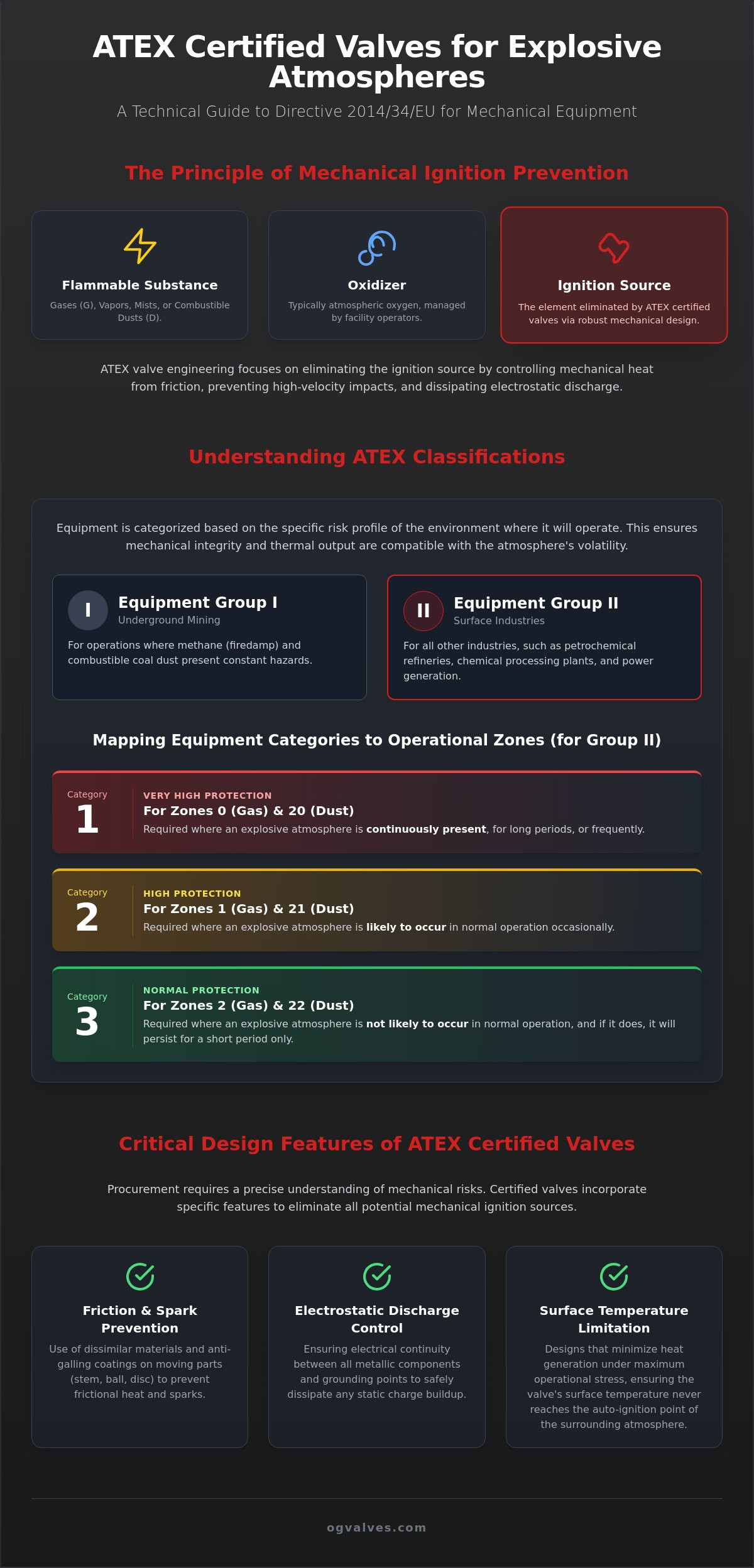
Engineering for safety focuses on the “explosion triangle”. For a catastrophic event to occur, three pillars must coexist: a flammable substance, an oxidizer (typically atmospheric oxygen), and an ignition source. While facility operators manage the first two pillars, valve engineering focuses on the absolute elimination of the ignition source. By controlling mechanical heat and preventing electrostatic discharge, the valve assembly remains inert even if a leak occurs.
Defining Potentially Explosive Atmospheres
Industrial hazards are categorized into two primary groups. Group G covers flammable gases, vapors, and mists, while Group D addresses combustible dusts. In petrochemical processing, even a minor release of volatile organic compounds (VOCs) creates a localized explosive atmosphere. A single spark initiates a rapid exothermic chain reaction. Power generation sectors face similar risks, particularly in hydrogen cooling systems or during the transport of pulverized coal. Operational conditions, such as high ambient temperatures or restricted ventilation, further elevate these risks.
Legal Compliance and Manufacturer Responsibility
Adherence to the ATEX Directive is a legal prerequisite for any industrial equipment placed on the EU or UK markets. This framework, detailed in this ATEX Directives Overview, places the burden of technical conformity squarely on the manufacturer. We must ensure that every gate, ball, or check valve meets specific design standards before the ‘Ex’ mark is applied. It’s vital to differentiate between manufacturer obligations and employer duties. While the manufacturer certifies the equipment, the employer is responsible for “zoning” the workplace under Directive 1999/92/EC. Safety audits rely on the ‘Ex’ marking to confirm that the equipment’s protective level is appropriate for the designated zone.
Precision in classification is the cornerstone of industrial safety. ATEX certified valves for explosive atmospheres are categorized based on the specific risk profile of the environment they’ll inhabit. This systematic approach ensures that the mechanical integrity and thermal output of the valve assembly are compatible with the surrounding atmosphere’s volatility. Failure to align equipment specifications with site-specific classifications invalidates safety protocols and risks catastrophic ignition.
The directive bifurcates equipment into two primary groups. Equipment Group I is reserved for underground mining operations where methane (firedamp) and combustible coal dust present constant hazards. Equipment Group II covers all other surface industries, such as petrochemical refineries, chemical processing plants, and grain silos. Within Group II, equipment is further delineated by Categories (1, 2, or 3), which define the level of protection provided. These categories are non-negotiable benchmarks for procurement specialists.
Valve tagging also includes ‘G’ for gas, vapor, and mist environments, or ‘D’ for combustible dust. These designations are critical. A valve certified for gas (G) may not possess the ingress protection required for a dust (D) environment. Furthermore, temperature classes (T1 to T6) dictate the maximum surface temperature the valve can reach during operation. A T6 rating ensures the surface won’t exceed 85°C, whereas a T1 rating allows for temperatures up to 450°C. Selecting a T-class that exceeds the ignition temperature of the ambient substances is a fundamental engineering error.
Equipment Groups and Risk Levels
Group I equipment must maintain safety despite the abrasive and harsh conditions found in mining. In contrast, Group II surface applications require a nuanced approach to material selection. Category 1 equipment provides a very high level of protection, remaining safe even in the event of rare equipment malfunctions. Category 3 provides standard protection, suitable for areas where explosive atmospheres occur only occasionally. If you’re currently specifying hardware for a high-stakes project, you can consult our technical engineering team to ensure your selections meet these rigorous group requirements.
Zone Mapping for Procurement Specialists
The alignment between equipment categories and operational zones is the most critical step in the procurement process. Zones 0 (gas) and 20 (dust) represent areas where explosive risks are present constantly or for long periods. These environments require Category 1 valves. Zones 1 and 21 indicate that an explosive risk is likely to occur during normal operation, necessitating Category 2 equipment. Zones 2 and 22 are areas where an explosive atmosphere is unlikely to occur, and if it does, it’ll persist for a short period only. Category 3 valves are sufficient for these lower-risk areas. Mapping these requirements accurately prevents over-specification costs while maintaining absolute safety.

Mechanical safety in hazardous environments requires the rigorous elimination of non-electrical ignition sources. While electrical systems are often the focus of safety audits, mechanical assemblies present significant risks through friction, impact, and electrostatic discharge. ATEX certified valves for explosive atmospheres are engineered to mitigate these risks through specific material selections and design configurations. One critical design consideration is the prevention of thermite reactions. This is achieved by strictly limiting the aluminum, magnesium, and titanium content in external components to prevent sparking upon high-velocity impact with ferrous materials. Precision engineering ensures that these valves don’t become the catalyst for an industrial incident.
Sealing integrity is the final defense against the formation of an explosive atmosphere. Fugitive emission control through high-integrity packing systems prevents the release of flammable media into the surrounding environment. By maintaining a gas-tight seal, the valve assembly minimizes the likelihood of reaching the lower explosive limit (LEL) of the process medium. This holistic approach to engineering ensures that ATEX certified valves for explosive atmospheres provide reliable performance throughout their operational lifecycle, even under extreme pressure differentials.
Anti-Static Devices in Valve Design
High-performance ball valves used in volatile service must incorporate dedicated anti-static devices. These components ensure continuous electrical continuity between the ball, the stem, and the valve body. Without this path to ground, the friction generated by the flow of non-conductive media can cause a significant build-up of static electricity. Design standards typically employ spring-loaded plungers or conductive inserts to maintain contact during operation. Testing protocols for these valves require measured electrical resistance to remain below established thresholds, usually 10 ohms, to guarantee the safe discharge of accumulated energy.
Friction and Heat Management
Friction is a primary source of thermal energy in rotating or sliding mechanical components. When specifying butterfly valves for hazardous areas, engineers must prioritize low-friction bearings and specialized seat materials. High-cycle automation poses a specific risk as rapid, repeated movement can cause surface temperatures to exceed the designated T-class rating. The use of high-grade lubricants and specific material hardness combinations reduces the potential for localized hot spots. These design choices ensure the valve operates within its thermal limits even under demanding process conditions. It’s a clinical approach to preventing heat-induced ignition in the most sensitive industrial zones.
Procuring hardware for high-risk zones requires a methodical framework to ensure every component adheres to Directive 2014/34/EU. The process isn’t merely about checking a box; it’s about verifying that ATEX certified valves for explosive atmospheres are fit for the exact chemical and thermal conditions of your facility. A failure in the specification phase can lead to costly procurement delays or, worse, a catastrophic safety breach during operation. Every technical detail must be documented and verified against the site’s hazardous area classification.
Step 1 requires defining the specific gas or dust group. Gas groups range from IIA (Propane) to the highly volatile IIC (Hydrogen and Acetylene). Selecting a valve rated only for IIB doesn’t provide the necessary protection in a IIC environment. Step 2 involves determining the T-Class. You must ensure the valve’s maximum surface temperature remains below the ignition point of the ambient substances, accounting for both process and ambient heat.
Step 3 focuses on the mechanical function required for the application. High-pressure isolation typically requires heavy-duty gate valves, while backflow prevention necessitates the use of check valves. Finally, Step 4 involves verifying that any attached actuator maintains an ATEX rating that matches or exceeds the valve body. A mismatch here creates a weak link that compromises the entire assembly’s safety integrity.
Material and Standard Alignment
Engineers must cross-reference ATEX requirements with established manufacturing standards like API 600 for heavy-wall gate valves. Fugitive emission compliance under ISO 15848-1 is equally vital to prevent the leakage that creates explosive atmospheres in the first place. Material selection plays a dual role in safety and durability. In corrosive offshore environments, Super Duplex alloys provide the necessary structural soundness that standard Stainless Steel might lack over time. For non-slam check valves, mechanical dampening must be achieved without introducing friction-based heat sources that violate the T-class rating.
Documentation and Certification Packages
A clinical review of the documentation package is the final step in quality assurance. Every shipment must include an EU Declaration of Conformity (DoC) that explicitly references the applicable standards and categories. For Category 2 non-electrical equipment, manufacturers must complete a Technical File Lodgement with a Notified Body. Traceability is non-negotiable. Ensure that all pressure-containing parts are backed by EN 10204 3.1 or 3.2 material certificates to verify chemical composition and mechanical properties. If you’re managing a large-scale project, contact our engineering team to align your procurement specifications with current global safety benchmarks.
Navigating the global market for ATEX certified valves for explosive atmospheres requires a partner capable of executing complex technical specifications under strict timelines. In critical infrastructure projects, the procurement phase is often the most vulnerable to regulatory oversight and logistical delays. Technical expertise in hazardous area approvals is mandatory to ensure that every component, from the primary valve body to the smallest limit switch, adheres to the specified safety protocols. A clinical focus on durability and regulatory adherence prevents the high-stakes risks associated with component failure in volatile environments.
Technical Specification Support
Successful project execution depends on the precise verification of ATEX codes against project data sheets. Our engineering team collaborates with procurement specialists to manage complex assemblies that include valves, actuators, and control accessories. Every component in a fast-track order must maintain its certification integrity throughout the assembly process. We provide rigorous technical support to ensure that the final equipment package meets the exact environmental and operational requirements defined in the initial engineering phase. This methodical approach eliminates the ambiguity often found in multi-component procurement.
Global Logistics and Reliability
Minimizing downtime in international industrial facilities requires a robust and responsive global supply chain. We maintain strategic stock holding of various industrial valves to facilitate immediate dispatch to critical projects. Our quality assurance protocols include rigorous testing and verification of all traceable material certificates before any equipment leaves our facility. This commitment to functional reality ensures that your project remains on schedule without compromising on safety or engineering standards. For detailed project assistance, Contact OG Valves for ATEX-certified solutions and request a technical consultation with our engineering experts.
The engineering of ATEX certified valves for explosive atmospheres requires a clinical focus on the elimination of mechanical ignition sources and strict adherence to material traceability. By aligning equipment categories with site-specific zones and verifying T-class ratings against process media, you ensure the long-term safety of critical industrial infrastructure. Maintaining a comprehensive project documentation package, including EU Declarations of Conformity and EN 10204 3.1/3.2 certificates, remains the benchmark for regulatory compliance. It’s a process that allows for zero ambiguity in execution.
Our organization provides the specialist technical expertise required to navigate these complex heavy industry requirements. We maintain a comprehensive inventory of API and ISO compliant valves ready for global fast-track delivery to minimize operational downtime. This ensures your facility remains compliant without sacrificing project timelines. For precision-engineered hardware that meets the highest safety benchmarks, Request a Technical Quote for ATEX Certified Valves. We’re prepared to assist with your most demanding technical specifications to ensure operational excellence and safety.
Is ATEX certification required for manual valves?
Manual valves require certification if they’re used in a potentially explosive atmosphere and present a mechanical ignition risk. While they lack electrical components, friction between the stem and packing or the build-up of static electricity on the valve body can trigger an explosion. Directive 2014/34/EU covers non-electrical equipment to ensure that mechanical actions don’t reach the ignition temperature of the surrounding environment.
What is the difference between ATEX and IECEx for industrial valves?
ATEX is a mandatory legal framework for equipment used within the European Union, while IECEx is an international certification scheme recognized in over 30 countries. ATEX focuses on compliance with EU directives, whereas IECEx provides a standardized approach to testing and assessment for global markets. Many engineers specify both certifications to ensure the equipment meets the most rigorous safety benchmarks regardless of the facility’s location.
Can I use a non-ATEX valve with an ATEX-certified actuator?
You cannot use a non-certified valve body with an ATEX-certified actuator in a hazardous zone. The entire assembly must be evaluated as a single mechanical unit to ensure the valve body doesn’t introduce ignition sources through friction or material composition. Using non-certified components in a hazardous area assembly invalidates the safety integrity of the system and creates a significant risk of catastrophic failure.
How do I identify an ATEX-certified valve in the field?
Certified valves are identified by a permanent nameplate featuring the “Ex” hexagon symbol. This plate provides critical technical data including the equipment group, category, and the specific gas or dust designation. It also lists the temperature class and the serial number for traceability. If this plate is missing or illegible, the valve’s certification cannot be verified during a safety audit.
What are the temperature classes (T1-T6) in ATEX valve specifications?
Temperature classes define the maximum surface temperature the valve can reach during operation under fault conditions. T1 allows for a maximum temperature of 450°C, while T6 is the most restrictive at 85°C. Engineers must ensure the selected T-class is lower than the auto-ignition temperature of any flammable substances present in the operational zone to prevent thermal ignition.
Do ATEX valves require special maintenance or lubrication?
Maintenance for ATEX certified valves for explosive atmospheres must focus on preserving the integrity of anti-static devices and grounding paths. Only manufacturer-approved lubricants should be used, as incorrect greases can increase friction or degrade seals, leading to fugitive emissions. Any maintenance activity must be documented to ensure the valve continues to operate within the parameters defined in its technical file.
What happens if a valve is installed in the wrong ATEX zone?
Installing a valve in a zone for which it isn’t rated creates an immediate safety breach and a violation of industrial regulations. Equipment rated for Zone 2 (Category 3) doesn’t have the protective features required for Zone 1 (Category 2) or Zone 0 (Category 1). This mismatch increases the likelihood of an ignition event and can result in the immediate shutdown of the facility during a regulatory inspection.
How does anti-static design work in a ball valve assembly?
Anti-static design in ATEX certified valves for explosive atmospheres utilizes spring-loaded plungers to maintain constant electrical continuity between the ball, stem, and valve body. This conductive path prevents the accumulation of static electricity caused by the high-velocity flow of non-conductive media. By safely discharging energy to the ground, the design eliminates the risk of a spark occurring within the valve assembly.
 Responsive Menu