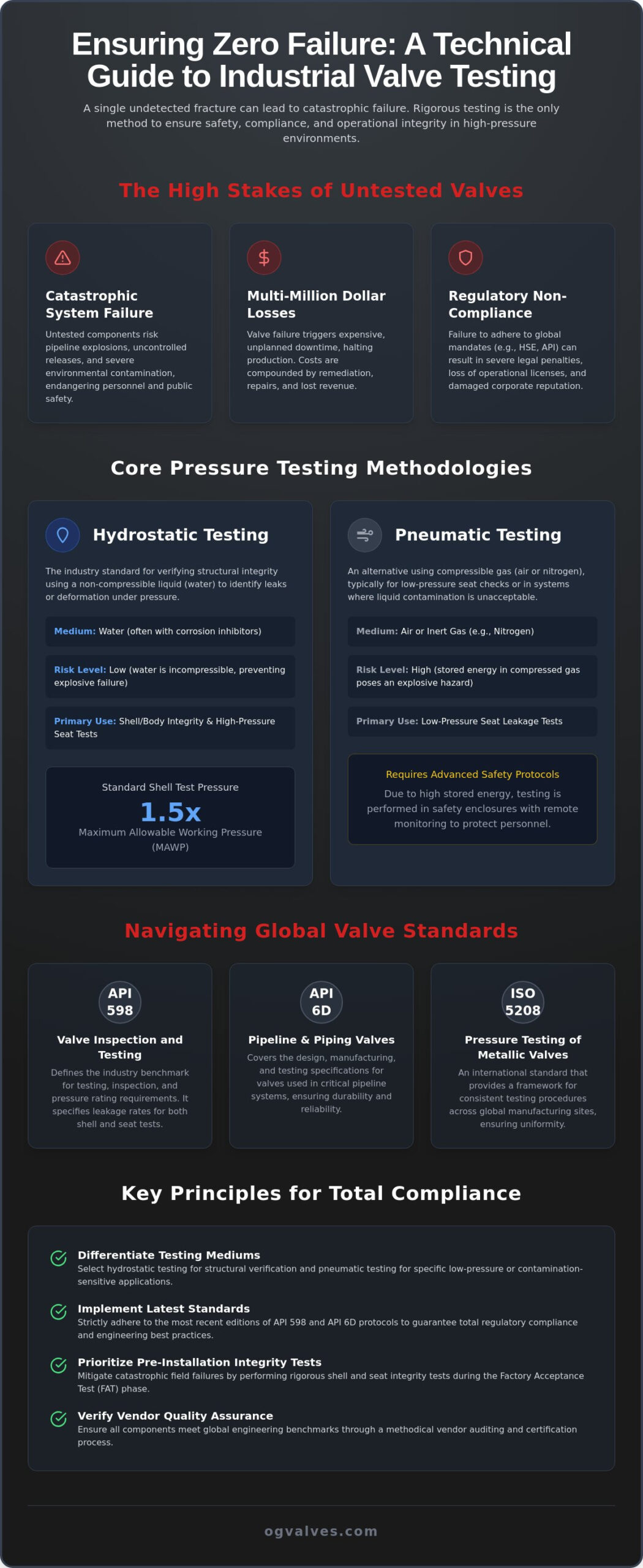
A single undetected hairline fracture in a high-pressure gate valve is not a minor maintenance oversight; it is a multi-million dollar liability waiting to trigger a catastrophic system failure. Technical experts in the oil, gas, and petrochemical sectors recognize that the margin for engineering error in high-stakes environments has effectively reached zero. You already know that relying on inferior components leads to non-compliance with global safety mandates and expensive, unplanned downtime that erodes project profitability. Adhering to rigorous hydrostatic valve testing standards is the only clinical method to ensure operational output remains uninterrupted.
This technical analysis provides a comprehensive breakdown of industrial protocols, ensuring your procurement and engineering teams maintain absolute regulatory adherence. We’ll examine the critical 2026 updates to the API 6D 25th Edition and the API 598 11th Edition, focusing on the precise verification of material integrity and leak-tight performance. This guide delivers a methodical overview of the testing lifecycle, from initial pressure containment checks to final quality assurance. You’ll gain the technical clarity needed to validate valve durability and confirm that every component meets the strict pressure requirements of modern industrial infrastructure before it reaches the field.
Key Takeaways
- Differentiate between hydrostatic and pneumatic testing mediums to select the appropriate verification method for specific operational pressures.
- Implement the latest hydrostatic valve testing standards, including updated API 598 and API 6D protocols, to guarantee total regulatory compliance.
- Evaluate the necessity of specialized fire-safe and fugitive emissions testing to maintain safety in high-temperature and environmentally sensitive applications.
- Mitigate the threat of catastrophic system failure by prioritizing rigorous shell and seat integrity tests during the pre-installation phase.
- Verify that all components meet global engineering benchmarks through a methodical vendor auditing and certification process.
The Critical Necessity of Valve Testing in High-Pressure Systems
Valve testing functions as a clinical simulation of operational stresses executed within controlled, repeatable environments. It isn’t a mere formality. It is a rigorous engineering requirement. These procedures validate that a valve can withstand the mechanical and thermal loads inherent to high-pressure systems. By adhering to established hydrostatic valve testing standards, manufacturers and engineers prevent catastrophic leakages, pipeline explosions, and severe environmental contamination. Factory Acceptance Testing (FAT) serves as a non-negotiable gatekeeper for critical infrastructure. It ensures every component, from the shell to the internal seat, possesses the material integrity required for long-term operational durability. A hydrostatic test is the primary mechanism used to verify that the structural soundness of the valve body is sufficient to contain the specified design pressure without permanent deformation or leakage.
FAT protocols involve a series of pressure, leakage, and functional tests performed at the manufacturer’s facility before shipment. This process identifies manufacturing defects or material impurities that could lead to stress corrosion cracking or premature fatigue. By catching these issues early, engineers maintain the reliability of the global supply chain and ensure that the equipment performs exactly as specified in the technical data sheet. This verification of material integrity is the foundation of industrial safety.
The Economic Impact of Valve Failure
Unplanned downtime in petrochemical or power generation facilities results in immediate and compounding financial losses. When a critical valve fails, the entire production chain often halts. This leads to lost revenue that accumulates by the minute. Beyond lost production, the cost of environmental remediation after a failure can be astronomical; it often dwarfs the initial procurement price of the component. Rigorous testing protocols mitigate these risks by identifying potential failure points before installation. Establishing a clear link between high-specification industrial valves and operational ROI is essential for procurement specialists who value long-term stability over short-term savings.
Regulatory Compliance and Personnel Safety
Core Pressure Testing Methodologies: Hydrostatic vs. Pneumatic
Hydrostatic testing remains the primary methodology for industrial valve validation. It uses water, often supplemented with corrosion inhibitors, as the test medium. Water’s incompressibility provides a clinical environment for measuring structural limits without the explosive risk associated with compressed gas. Adhering to the ISO 5208 international standard ensures that these procedures remain consistent across global manufacturing sites. Most hydrostatic valve testing standards require a shell test pressure of 1.5 times the maximum allowable working pressure (MAWP). This rigorous ratio establishes a safety buffer against operational surges and material fatigue that could otherwise lead to structural failure.
Pneumatic testing is an alternative utilized for low-pressure seat leakage checks or systems where water is a contaminant. It uses air or inert gases like nitrogen. Because gas is highly compressible, it stores significant potential energy. This necessitates advanced safety enclosures and remote monitoring to protect personnel from high-velocity projectiles in the event of a rupture. While hydrostatic valve testing standards are the default for structural verification, pneumatic methods are specialized for gas-service valves where moisture must be excluded from the internal cavity to prevent downstream process contamination or icing.
Shell Testing: Verifying Structural Soundness
This procedure targets the valve body, bonnet, and all pressure-containing joints to ensure there’s no external leakage. Technicians apply the test pressure while the valve is in a partially open position. They observe for visible leaks or permanent deformation over a set duration defined by the valve size and pressure class. For high-pressure gate valves, the observation period is critical to ensure that the casting and bolted connections remain stable under peak load. Any drop in pressure or visible weeping indicates a failure in structural integrity that requires immediate rejection.
Seat Testing: Ensuring Tight Shut-Off
Seat testing evaluates the internal closure mechanism to determine if the ball, wedge, or disc can effectively isolate the flow. Standards define acceptable leakage rates, ranging from “Zero Leakage” (Class A) to specific allowable volumes for metal-seated components. Seat testing for industrial ball valves typically requires a high-pressure closure test to verify the integrity of the soft or metal seats under operational load, whereas metal-seated globe valves may allow for minimal volumetric leakage according to their design class. This distinction ensures the valve’s sealing capability matches its intended application.
Selecting the correct methodology is a technical decision that impacts both safety and project costs. Technical experts at OG VALVES LTD. can assist in defining the optimal testing parameters for your specific project requirements.
Standard hydrostatic valve testing standards provide a baseline for pressure containment, yet they are insufficient for applications involving volatile chemicals or extreme thermal gradients. High-performance industrial systems require validation that accounts for material behavior under duress. Fire-safe testing, cryogenic evaluation, and fugitive emissions monitoring ensure that the valve maintains its pressure boundary and sealing capabilities when standard operating conditions are exceeded. These tests are essential for subsea installations and high-pressure gas pipelines where the cost of intervention is prohibitive. Engineers must verify that materials won’t fail when subjected to conditions that deviate from ambient temperature and pressure.
Fire-Safe Validation for Oil and Gas
Fire-safe certification under API 607 or API 6FA is a critical requirement for any valve handling flammable media. During a fire event, primary soft seals, such as PTFE or elastomers, typically disintegrate due to intense heat. The engineering solution involves a secondary metal-to-metal seating mechanism that engages once the soft seal fails, preventing a massive release of fuel. This capability is verified by subjecting the valve to temperatures between 750°C and 1000°C for a 30 minute duration. Successfully passing these protocols is a prerequisite for passing safety audits and securing industrial insurance for refineries. For instance, high-specification butterfly valves in flammable service must demonstrate that they won’t contribute to fire escalation through external or through-seat leakage during thermal exposure.
Mitigating Fugitive Emissions
Environmental regulations, such as ISO 15848-1, have tightened the requirements for sealing volatile organic compounds (VOCs). The primary technical challenge lies in the valve stem and packing area, which is the most common site for microscopic leaks. Fugitive emissions testing classifies valves into Class A, B, or C based on their leakage rates. Class A represents the most stringent requirement, often necessitating the use of bellows seals or specialized packing sets. Helium leak detection is the preferred method for these tests because helium’s small molecular size allows it to identify escape paths that standard air or water tests would miss.
Cryogenic testing ensures functionality at temperatures as low as -196°C. This is vital for Liquefied Natural Gas (LNG) applications. At these temperatures, materials can become brittle, and seals may lose their elasticity. Testing involves immersing the valve in liquid nitrogen and cycling it to verify that the torque requirements remain within design limits and that the seat remains tight. High-pressure gas testing for subsea applications uses nitrogen or helium to simulate the high-penetration characteristics of gas under extreme external pressure, ensuring the valve remains a dependable barrier in deep-water environments.
Navigating Global Valve Standards: API 598, API 6D, and ISO 5208
Global engineering frameworks ensure that hydrostatic valve testing standards remain uniform across international borders, providing a clinical basis for safety verification. API 598, currently in its 11th Edition as of February 2023, serves as the primary inspection and testing standard for the majority of industrial valve types. It defines the required test durations and acceptable leakage rates for both shell and seat integrity. ISO 5208:2015 remains the international benchmark for pressure testing metallic valves; it provides a structured methodology for verifying structural soundness. ASME B16.34 complements these protocols by defining the pressure-temperature ratings and minimum wall thicknesses required to maintain safety under specific operational loads.
API 598 vs. API 6D: Key Differences
API 598 applies to a wide range of standard components, including check valves and general isolation valves. API 6D, which reached its 25th Edition in November 2022, focuses exclusively on pipeline valves for the petroleum and natural gas industries. API 6D is more stringent for pipeline applications because it mandates longer test durations and specific functional requirements to ensure long-distance transport safety. While API 598 allows for specific volumetric leakage in certain metal-seated classes, API 6D often requires tighter shut-off performance for pipeline isolation to prevent downstream contamination or pressure loss.
Understanding Certification and Documentation
Procurement specialists must prioritize documentation to ensure absolute material traceability and regulatory compliance. EN 10204 3.1 certification is the standard requirement; it involves a declaration of compliance validated by the manufacturer’s authorized representative independent of the manufacturing department. For high-risk projects, EN 10204 3.2 is necessary as it requires additional verification by an independent third-party inspector. Mill Test Reports (MTRs) are indispensable for tracing the heat number and chemical composition of the valve body casting or forging. Positive Material Identification (PMI) further verifies that the alloy composition matches the technical specification before the unit enters the global supply chain.
Adhering to these rigorous standards is the only way to mitigate the risk of catastrophic failure in high-pressure systems. You can consult with our engineering team to verify the specific certification requirements for your next procurement cycle to ensure total project alignment.
Quality Assurance in Valve Procurement: The OG VALVES LTD. Protocol
OG VALVES LTD. maintains a clinical focus on structural soundness and regulatory adherence. We act as a dependable partner in critical infrastructure rather than a mere vendor. Every component in our inventory undergoes verification to ensure it meets the hydrostatic valve testing standards defined by API and ISO. Our commitment to industrial safety is anchored in a rigorous vendor auditing process. This protocol involves the systematic evaluation of global manufacturing partners to confirm their facilities align with ASME benchmarks. The auditing process extends beyond paper certifications; it involves on-site inspections of manufacturing processes and witness testing of critical batches. By maintaining this oversight, we eliminate the risk of introducing inferior material into high-stakes industrial environments.
Expert Technical Consultation
Interpreting the complexities of fire-safe validation or cryogenic testing requirements demands deep engineering expertise. Our technical team bridges the gap between theoretical engineering requirements and the practicalities of procurement logistics. We assist technical experts in interpreting complex testing specifications for high-specification projects in power generation and petrochemical sectors. This ensures that the selected testing regime matches the operational output and safety integrity levels required for the specific application. We provide the technical clarity needed to ensure that every Gate, Ball, and Globe valve performs exactly as specified under peak load.
Global Supply Chain Reliability
Maintaining a comprehensive documentation trail is a core component of our quality assurance packet. We manage the flow of data from the initial forge to the final facility, ensuring that every Mill Test Report (MTR) and EN 10204 3.1 or 3.2 certificate is accounted for. The primary advantage for our clients is our centralized inventory of pre-tested industrial valves. Our logistics network is optimized for the urgent demands of heavy industry. We recognize that every hour of downtime represents a quantifiable loss in operational output. By holding a significant volume of pre-tested inventory, we bypass the lead times typically associated with factory-level testing cycles.
This logistical efficiency directly minimizes site downtime during critical maintenance windows or emergency repairs. By providing hardware that is already verified against global engineering benchmarks, we accelerate the project timeline without compromising on durability or performance. This methodical approach to supply chain management ensures that your facility remains compliant and operational.
Request a technical specification or quote for your valve requirements from OG VALVES LTD.
Securing Operational Integrity through Rigorous Validation
Adherence to the latest hydrostatic valve testing standards remains the primary safeguard against the catastrophic failure of high-pressure infrastructure. Technical precision in selecting between API 598 and API 6D protocols ensures that every component is fit for its specific operational environment. Beyond physical testing, the verification of material traceability through EN 10204 3.1 certification provides the empirical data required for high-stakes safety audits. These systematic validation processes are essential for maintaining the structural soundness of critical systems across the global supply chain.
OG VALVES LTD. maintains a comprehensive inventory of API and ASME compliant valves, specializing in the high-specification requirements of the oil, gas, and power generation sectors. Our global delivery capabilities ensure that pre-tested components reach your facility without the delays typically associated with factory acceptance testing. By prioritizing engineering excellence and rigorous quality control, you secure long-term durability and operational uptime. Consult with our technical experts on your industrial valve testing requirements to ensure your next project aligns with global engineering benchmarks. Maintaining these rigorous protocols ensures a reliable and safe industrial future.
Frequently Asked Questions
What is the difference between a shell test and a seat test?
A shell test validates the structural integrity of the valve body, bonnet, and joints by applying pressure at 1.5 times the maximum allowable working pressure. In contrast, a seat test evaluates the internal closure mechanism to ensure effective flow isolation at 1.1 times the rated pressure. Both procedures are fundamental components of hydrostatic valve testing standards to prevent external rupture and internal bypass during high-pressure operations.
How long does a standard valve pressure test last according to API 598?
Test durations under API 598 11th Edition are determined by the nominal valve size and the specific pressure test being performed. For valves sized NPS 2 and smaller, a shell test requires a 15 second minimum duration. Larger valves, such as those NPS 14 and above, require a 300 second observation period. These precise intervals ensure any material defects or assembly errors are identified before the unit enters the global supply chain.
What is “Zero Leakage” in valve testing, and is it always required?
Zero leakage, often referred to as Class A integrity, signifies that no visible leakage was detected during the specified test duration. This standard is mandatory for soft-seated ball and butterfly valves where absolute shut-off is critical for safety and process isolation. Metal-seated valves follow different classifications that allow for a calculated volumetric leakage rate based on the nominal pipe size and the specific application’s tolerance.
When is pneumatic testing preferred over hydrostatic testing?
Pneumatic testing is utilized when the presence of moisture would compromise the downstream process or when performing low-pressure seat leakage checks. It is the preferred method for instrument air systems or cryogenic valves where water freezing could damage internal components. Because gas is compressible, these tests require specialized safety barriers and remote monitoring to manage the stored potential energy in the event of a structural failure.
What documentation should I receive to verify a valve has been tested?
Verification of testing requires a comprehensive documentation packet including the Pressure Test Certificate and a Mill Test Report (MTR). Procurement specialists should also demand EN 10204 3.1 or 3.2 certification to ensure material traceability and compliance with international benchmarks. These documents provide the empirical proof of structural soundness and chemical composition required for safety audits and regulatory adherence in heavy industrial sectors.
Does a fire-safe certification mean the valve is fireproof?
Fire-safe certification does not imply that a valve is fireproof; rather, it confirms the valve can maintain its pressure boundary and provide minimal leakage during and after intense thermal exposure. Standards like API 607 verify that a secondary metal-to-metal seat will engage if the primary soft seals are destroyed by heat. This capability is critical for preventing fuel escalation and protecting personnel in refinery and petrochemical environments.
What are fugitive emissions, and how are they tested in valves?
Fugitive emissions are microscopic leaks of volatile organic compounds (VOCs) that escape through the valve stem and packing area. Testing involves the use of helium or methane gas under pressure, with specialized sensors detecting leakage rates according to ISO 15848-1 classifications. Managing these emissions is a strict regulatory requirement for environmental compliance, often necessitating the use of advanced bellows seals or high-performance packing sets.
How often should valves be re-tested after installation?
Re-testing frequency is dictated by the criticality of the service and established maintenance standards such as API 570. While factory testing is a non-negotiable requirement before installation, in-service valves are typically inspected every three to five years during scheduled plant shutdowns. These intervals ensure that corrosion or mechanical wear hasn’t compromised the initial hydrostatic valve testing standards. Specific intervals should always align with your facility’s Risk-Based Inspection program.
 Responsive Menu