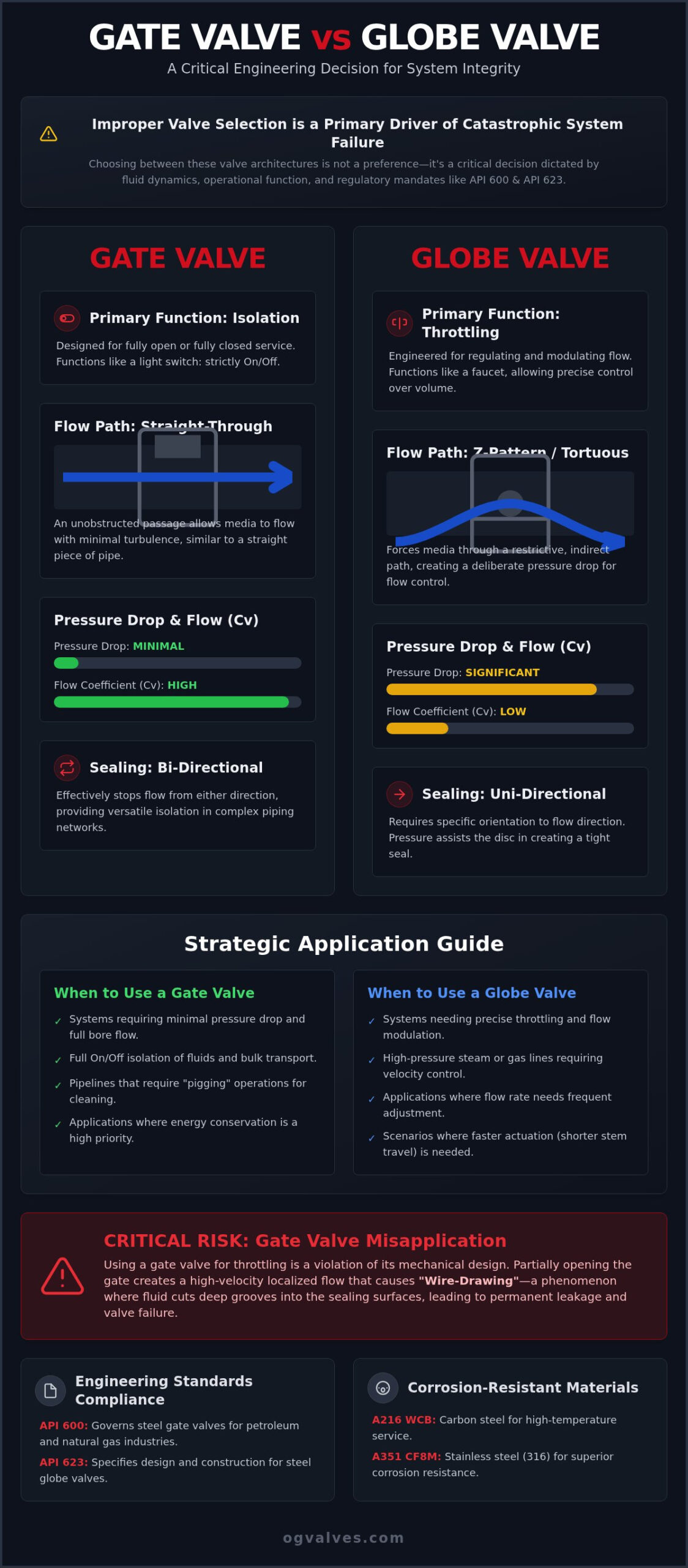
The assumption that any linear-motion valve can handle isolation and throttling interchangeably is a primary driver of catastrophic system failure in high-pressure environments. Selecting between a gate valve vs globe valve is not a matter of preference. It’s a critical engineering decision dictated by fluid dynamics and strict regulatory mandates. Operational data indicates that improper valve selection accounts for a significant percentage of unplanned downtime and premature seat erosion in heavy industrial sectors.
Technical experts understand that the cost of failure in critical infrastructure is unacceptable. This article provides a rigorous engineering analysis of the mechanical and operational differences between these architectures. It ensures your selection aligns with API 600 and API 623 standards to maintain system integrity. We examine flow coefficient (Cv) requirements, structural soundness under high-pressure differentials, and the specific material classifications necessary for long-term reliability in specialized environmental applications. By the end of this technical review, you’ll have the data required to optimize maintenance frequency and ensure compliance with international safety benchmarks.
Key Takeaways
- Differentiate between straight-through and Z-pattern flow paths to mitigate turbulence and mechanical vibration in heavy-duty piping systems.
- Implement rigorous selection criteria based on the API 600 Fourteenth Edition and API 623 Second Edition to ensure regulatory adherence and structural integrity.
- Compare the mechanical trade-offs of a gate valve vs globe valve to determine which architecture provides the necessary balance between absolute isolation and precise throttling.
- Identify specific material classifications like A216 WCB and A351 CF8M to extend component lifespan in corrosive petrochemical or steam environments.
- Analyze total lifecycle costs by weighing initial capital expenditure against the operational benefits of in-line seat repairability and reduced maintenance frequency.
Mechanical Architecture and Flow Path Analysis
Linear motion stems actuate the closure members in both designs, yet the resulting fluid dynamic profiles are irreconcilable. The fundamental technical distinction in the gate valve vs globe valve debate resides in the internal flow path. A Gate valve facilitates an unobstructed, straight-through passage. A globe valve forces media through a restrictive Z-pattern. This architectural divergence dictates the flow coefficient (Cv) and the magnitude of the pressure drop across the valve body. In high-velocity systems, these geometric differences determine the risk of cavitation and mechanical vibration.
Internal geometry governs system efficiency and pressure management. Gate valves provide a high Cv because the wedge retracts completely into the bonnet, removing all physical barriers from the flow stream. The globe valve’s internal baffle and seat arrangement remain permanent fixtures within the flow path. This configuration causes significant head loss, an inherent design requirement for precise flow modulation. Sealing orientation also differs. Gate valves offer bi-directional sealing for versatile isolation in complex piping networks. Globe valves are typically uni-directional, necessitating strict adherence to flow direction markers to ensure pressure assists the closure mechanism correctly. It’s critical to evaluate these factors:
- Flow Coefficient (Cv): Gate valves offer maximum flow capacity with minimal resistance.
- Pressure Differential: Globe valves create a deliberate pressure drop to facilitate control.
- Sealing Directionality: Gate valves manage flow from either direction, while globe valves require specific orientation.
Gate Valve: Minimal Resistance and Full-Bore Flow
The wedge-to-seat interface ensures hermetic isolation through mechanical interference or pressure-assisted sealing. Full-bore designs align the valve’s internal diameter with the pipeline, eliminating obstructions. This architectural choice is mandatory for pigging operations and systems requiring minimal turbulence. The absence of internal geometry changes prevents sediment buildup and maintains laminar flow characteristics during full-open operation. It’s the preferred solution for bulk transport where energy conservation is a priority.
Globe Valve: The Tortuous Path for Controlled Flow
The Z-pattern baffle arrangement is the core of the globe valve’s regulatory capability. By forcing the media through a restricted aperture, the valve achieves stable throttling and precise gas modulation. High-pressure steam applications rely on this tortuous path to dissipate energy and control flow velocity. While the pressure drop is substantial, the control accuracy provided by the disc-to-seat proximity remains superior to any isolation-focused valve architecture. It’s the industry standard for systems requiring frequent adjustment and modulation.
Operational Functionality: Isolation vs. Throttling
The operational utility of a gate valve vs globe valve is defined by the necessity of flow control versus total isolation. Gate valves function as binary components. They’re either fully open to minimize pressure drop or fully closed to provide hermetic sealing. Using a gate valve for throttling is a violation of its mechanical design and leads to rapid component degradation. Conversely, globe valves are engineered for continuous regulation. Their internal architecture allows for incremental adjustments to flow volume without compromising the structural integrity of the sealing surfaces.
Actuation speed also separates these designs. Gate valves require multiple turns of the handwheel or long actuator strokes. The wedge must travel the full diameter of the bore to clear the flow path. Globe valves feature a significantly shorter stem travel. This allows for faster response times in critical modulation scenarios. However, closing a globe valve against high pressure requires higher torque. The disc must overcome the direct force of the media acting upon its surface area. This mechanical resistance is absent in gate valves since the wedge moves perpendicular to the flow stream. Engineers must consider these torque requirements when sizing pneumatic or electric actuators.
Erosion and Cavitation Risks in Gate Valves
Partial opening of a gate valve creates a high-velocity localized flow between the wedge and the seat. This phenomenon, known as “wire-drawing,” results in the fluid cutting deep grooves into the sealing surfaces. Once this erosion occurs, the valve can no longer achieve a bubble-tight shutoff. This failure is irreversible without significant machining or component replacement. Cavitation also poses a severe risk in liquid service. Low-pressure zones created by the restricted path cause vapor bubbles to collapse violently against the internal body. For a deeper analysis of these failure modes, refer to A Technical Guide to Industrial Gate Valves. Mechanical vibration during throttling can further damage wedge guides and stem connections, leading to eventual stem seizure.
Precision Control in Globe Valve Disc Designs
Globe valves utilize specific disc geometries to achieve varying degrees of regulation. Plug-type discs provide a wide seating surface and are the most resilient against erosion during heavy throttling. Needle-type discs allow for micro-adjustments in low-flow applications. Composition discs utilize non-metallic inserts for improved sealing in gas service. These designs make globe valves the industry standard for frequent cycling and automated control loops. Engineers must account for high torque requirements in large-diameter assemblies, especially when operating against high differential pressures. Pressure-balanced trim is often required to ensure operational safety and reduce actuator size. Procurement specialists should consult with a specialised global supplier to verify disc configurations for high-frequency cycling and extreme temperature service.
Engineering Standards: API 600 vs. API 623 Compliance
Regulatory adherence serves as the primary benchmark for industrial safety and operational output. API 600 (Fourteenth Edition, May 2021) defines the design, construction, and wall thickness requirements for bolted-bonnet steel gate valves. It’s the definitive standard for heavy-duty refinery service where structural soundness is non-negotiable. For corrosion-resistant applications, API 603 provides the technical specifications for stainless steel and high-alloy variants. In contrast, API 623 (Second Edition, January 2021) is the modern governing standard for steel globe valves. It specifically addresses historical failure modes in globe valves, such as stem-to-disc connection fatigue and seat durability during high-cycle throttling operations.
Both valve architectures must adhere to ASME B16.34. This standard establishes the pressure-temperature ratings and minimum wall thickness requirements across all material groups. It’s the foundation for ensuring that a gate valve vs globe valve can withstand the design pressure of a specific piping class. Environmental compliance has also become a critical procurement factor. Fugitive emission certifications, specifically API 624 for rising-stem valves, are now mandatory for many petrochemical projects. These standards ensure that packing systems maintain integrity and prevent the release of hazardous volatile organic compounds (VOCs).
Regulatory Divergence in Valve Trim
API trim charts provide a structured framework for selecting compatible material combinations for stems, seats, and wedges. Choosing the correct trim is a vital step in the gate valve vs globe valve procurement process. High-temperature globe valves often utilize Trim 5 or Trim 8, which specify Stellite hard-facing on the seating surfaces. This cobalt-chromium-tungsten alloy offers exceptional resistance to thermal shock and mechanical galling. For a detailed analysis of material suitability, see Industrial Valves: The Engineer’s Comprehensive Guide. Proper trim selection prevents premature seat erosion and extends the operational life of the component.
Pressure Testing and Quality Assurance
Verification of manufacturing quality is achieved through API 598. This standard mandates rigorous hydrostatic and pneumatic testing protocols. It defines the specific duration and pressure levels required for shell and seat integrity tests. For valves intended for sour service, compliance with NACE MR0175/ISO 15156 is essential to prevent stress corrosion cracking. Positive Material Identification (PMI) is utilized during the inspection phase to verify the chemical composition of high-alloy castings. Ensuring full traceability via Mill Test Reports (MTRs) is a standard protocol for critical infrastructure. This clinical focus on documentation ensures that every component meets the engineering excellence required for high-pressure industrial applications.
Material Specification and Environmental Suitability
Engineering excellence in valve selection requires a clinical alignment between material metallurgy and the operational environment. Carbon steel, specifically ASTM A216 WCB, serves as the industrial baseline for standard refinery and high-pressure steam service. However, as media toxicity or corrosivity increases, procurement specialists must transition to specialized alloys. ASTM A351 CF8M stainless steel and Duplex alloys provide the necessary resistance to pitting and stress corrosion cracking in aggressive petrochemical environments. For upstream operations involving H2S, strict adherence to NACE MR0175/ISO 15156 is mandatory to prevent hydrogen-induced cracking in sour gas service.
Temperature fluctuations dictate the choice of casting and forging grades. Arctic and cryogenic applications necessitate ASTM A352 LCC or LC1 materials, which maintain structural toughness at sub-zero temperatures. Failure to specify the correct material grade for the intended thermal range can lead to brittle fracture and catastrophic pressure boundary failure. When evaluating a gate valve vs globe valve for high-temperature service, engineers must also account for the coefficient of thermal expansion of the internal trim components to ensure consistent sealing performance.
Managing Thermal Binding and Pressure Locking
Gate valves are uniquely susceptible to thermal binding in high-temperature service. When a valve is closed while hot and subsequently cools, the body contracts more rapidly than the wedge, pinning the closure member between the seats. This risk is minimized in globe valve architecture because the disc moves vertically against the seat rather than being wedged between two parallel or tapered surfaces. Pressure locking in the bonnet cavity of a gate valve is another critical safety concern that requires specialized venting. Understanding these mechanical risks is as vital as Understanding Industrial Check Valves to ensure comprehensive system safety.
Packing and Sealing for Fugitive Emission Control
Modern environmental regulations, such as API 624, demand rigorous fugitive emission control. Graphite packing is the standard for high-temperature steam, while PTFE is utilized for its superior chemical resistance in lower-temperature hazardous service. Both gate and globe valves incorporate a back-seat design. This feature allows the stem packing to be isolated from line pressure when the valve is fully open, providing an additional layer of operational safety. For lethal or ultra-pure chemical service, bellows-sealed valves offer a hermetic barrier that eliminates the leak path entirely. To secure high-specification components for critical infrastructure, specialists should source API-compliant valves from established global suppliers who provide full material traceability.
Strategic Procurement: Lifecycle and Maintenance
Strategic procurement of high-specification components requires a clinical evaluation of the total cost of ownership. While the initial capital expenditure (CAPEX) for a gate valve is typically lower than a globe valve of equivalent pressure class and bore size, the operational expenditure (OPEX) often tells a different story. Selecting a gate valve vs globe valve involves more than matching a specification sheet to a price point; it requires an analysis of maintenance accessibility and system downtime. Globe valves feature superior maintenance accessibility because their design often allows for in-line seat repair or replacement. Gate valves usually require complete removal from the piping for seat resurfacing or wedge replacement, which significantly increases labor costs and extends scheduled outages.
Structural considerations also influence the procurement process. Globe valves are inherently heavier and possess larger face-to-face dimensions compared to gate valves. This increased mass necessitates more robust piping supports and can complicate installation in space-constrained offshore or refinery modules. Engineers must account for these physical variables during the FEED (Front-End Engineering Design) phase to prevent unforeseen structural modifications. OG VALVES LTD. serves as a technical authority in this space, providing the precise dimensional data and material certifications required to integrate these components into complex global supply chains.
Maintenance Protocols for Critical Isolation
Proactive maintenance is the primary defense against unplanned downtime. Routine lubrication of rising stems and gear operators ensures smooth actuation and prevents stem seizure in high-temperature service. Technicians must monitor for early signs of seat leakage or stem packing failure, as these issues often signal the need for incremental adjustments or seal replacement. Sourcing specialized technical support during the selection phase helps ensure that the valve trim and packing materials are optimized for the specific media and cycle frequency. This clinical focus on maintenance prevents the “wire-drawing” and erosion failures discussed in previous sections.
Global Supply Chain and Lead Time Management
Mitigating project delays is a critical priority for procurement specialists. OG VALVES LTD. maintains an extensive physical inventory of API-compliant components to support fast-track delivery for critical infrastructure projects. Sourcing from a supplier with documented adherence to API 600 and API 623 ensures that every component meets the highest benchmarks for industrial safety and engineering excellence. Reliable global logistics and comprehensive project management are essential signatures of a dependable partner. To ensure your facility remains compliant with the latest international standards, you can request a technical quote for industrial gate and globe valves directly from our engineering team.
Optimizing Industrial Infrastructure Through Engineering Precision
The technical selection between a gate valve vs globe valve remains a primary factor in the durability and safety of high-pressure piping systems. As analyzed in this comparison, isolation efficiency and throttling precision are distinct mechanical objectives that shouldn’t be compromised. Successful implementation requires a clinical focus on API 600 and API 623 standards, alongside rigorous material verification for corrosive or high-temperature service. Proper selection ensures long-term operational output and reduces the risk of unplanned facility downtime.
OG VALVES LTD. provides an extensive inventory of API 600, 603, and 623 compliant components to meet the demands of critical infrastructure. Our team offers specialized technical support for heavy industrial procurement, backed by global logistics capabilities for fast-track delivery. We ensure that every component meets the highest benchmarks for quality assurance and material traceability. Contact OG VALVES LTD. for Technical Specifications and Industrial Valve Quotes to secure reliable components for your next project. We’re prepared to act as your dependable partner in achieving engineering excellence.
Frequently Asked Questions
What is the primary difference between a gate valve and a globe valve?
The primary difference lies in the internal flow path and the intended functional objective. Gate valves utilize a straight-through passage designed for absolute isolation with minimal pressure loss. Globe valves employ a restrictive Z-pattern baffle to facilitate precise flow regulation and throttling. This architectural divergence means gate valves function as binary components, while globe valves are engineered for continuous modulation and energy dissipation.
Can a gate valve be used for throttling if only done occasionally?
No, a gate valve shouldn’t be used for throttling, regardless of the frequency. Partial opening creates high-velocity localized flow that causes “wire-drawing” and permanent erosion of the sealing surfaces. This mechanical violation leads to irreversible seat damage and prevents the valve from achieving a bubble-tight shutoff. Vibration during occasional throttling can also fatigue the wedge guides and stem connections, leading to eventual component failure.
Why do globe valves have a higher pressure drop than gate valves?
Globe valves exhibit a higher pressure drop because of their tortuous internal geometry. The media must change direction multiple times as it passes through the Z-pattern baffle and over the seat. This creates significant turbulence and resistance, which is an inherent design trade-off for achieving precise flow control. In contrast, gate valves provide a full-bore, unobstructed path that maintains laminar flow and minimizes head loss across the valve body.
Which valve type is better for high-pressure steam applications?
Globe valves are the superior choice for high-pressure steam applications requiring modulation or frequent adjustment. Their design is specifically engineered to withstand the erosive forces of high-velocity steam during throttling. For main steam line isolation where minimal pressure drop is required, gate valves are preferred. Selecting the correct gate valve vs globe valve depends entirely on whether the system requires absolute shut-off or energy dissipation for control.
What is API 623 and how does it relate to globe valves?
API 623 is the current governing standard for bolted-bonnet steel globe valves, with the Second Edition published in January 2021. It addresses historical design weaknesses by mandating improved stem-to-disc connections and seat durability. This standard ensures that globe valves can survive high-cycle throttling and extreme pressure differentials in heavy industrial service. Compliance with API 623 is a critical benchmark for ensuring the structural integrity and safety of the component.
Are gate valves bi-directional or uni-directional?
Gate valves are inherently bi-directional, meaning they can manage fluid flow and provide hermetic sealing from either side of the wedge. This makes them versatile for complex piping networks where flow direction might change during different operational phases. Globe valves are typically uni-directional and feature a flow direction arrow on the body. Installing a globe valve in the incorrect orientation can lead to operational failure or an inability to close against line pressure.
How does the cost of a globe valve compare to a gate valve of the same size?
Globe valves typically command a higher initial capital expenditure than gate valves of an equivalent size and pressure class. This cost difference results from the increased material mass and the complex internal casting required for the Z-pattern flow path. While more expensive upfront, the globe valve’s ability to facilitate in-line seat repairs can lead to lower long-term operational costs in systems requiring frequent maintenance or regulation.
What is thermal binding in gate valves and how can it be prevented?
Thermal binding occurs when a gate valve is closed at high temperatures and the body subsequently contracts more rapidly than the wedge during cooling. This pins the wedge between the seats, making it difficult or impossible to actuate the valve. Engineers prevent this by specifying flexible wedges or split-wedge designs that accommodate thermal expansion. Utilizing globe valves for high-temperature fluctuating service is another strategy since their architecture inherently avoids this specific failure mode.
 Responsive Menu