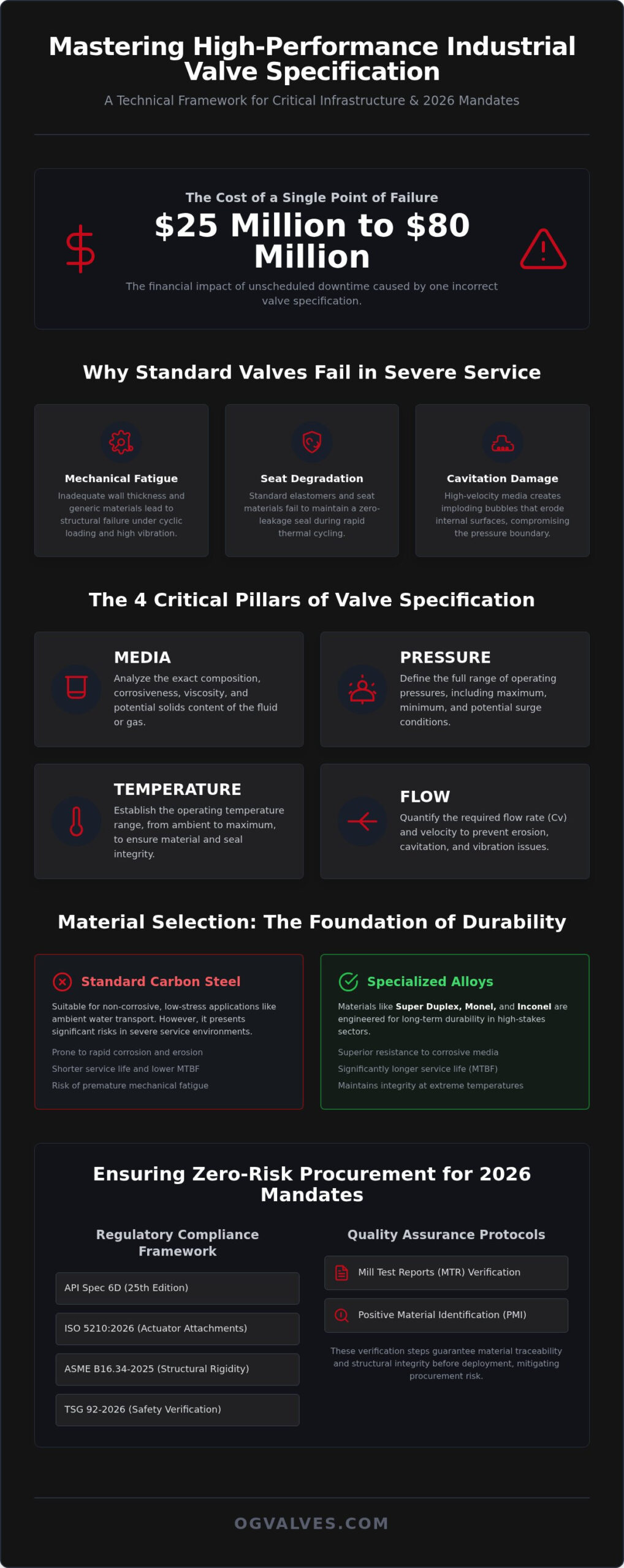
In high-stakes industrial infrastructure, a valve is never just a commodity; it’s a single point of failure that can cost a facility between $25 million and $80 million in unscheduled downtime. Technical procurement specialists recognize that sourcing valves for specific applications requires more than basic dimensional matching. It demands a rigorous alignment with 2026 safety mandates, including the TSG 92-2026 regulation and the 25th edition of API Spec 6D. Failure to account for these shifting benchmarks results in costly retrofits and compromised safety audits.
You likely face the persistent friction of navigating conflicting international standards while managing the extended lead times associated with specialized alloys like Super Duplex. This guide provides the technical framework to master the parameters required to specify high-performance valves for your most critical assets. We will examine the updated ISO 5210:2026 requirements for actuator attachments and the latest ASME B16.34-2025 rules for structural rigidity. This methodical approach ensures zero-leakage performance in corrosive media and an extended equipment lifecycle through precise material matching and verified quality assurance protocols.
Key Takeaways
- Identify the four critical technical pillars-Media, Pressure, Temperature, and Flow-to establish a baseline for high-performance valve selection.
- Master the process of sourcing valves for specific applications by translating complex operational requirements into precise Technical Valve Data Sheets.
- Ensure full regulatory compliance for 2026 by adhering to the latest API 6D 25th Edition and ISO 5210/5211 standards for actuator attachments.
- Reduce long-term operational costs by matching specialized alloys like Super Duplex and Monel to specific corrosive environments and high-pressure conditions.
- Mitigate procurement risk through the verification of Mill Test Reports and Positive Material Identification (PMI) to guarantee structural integrity before deployment.
Beyond the Standard: The Engineering Necessity of Custom Industrial Valve Specifications
Custom industrial valve specifications represent bespoke engineering solutions designed to maintain structural integrity under non-standard operating conditions. For technical procurement specialists, sourcing valves for specific applications involves a shift from commodity acquisition to risk-managed engineering. While a standard industrial valve may suffice for ambient water transport, critical infrastructure in oil, gas, and power generation requires components capable of withstanding extreme pressure differentials and corrosive media. Relying on generic specifications often leads to premature mechanical fatigue and catastrophic containment loss.
The economic reality of valve selection is defined by the cost of failure. In large-scale power generation facilities, the total investment in valves ranges from $25 million to $80 million. However, the financial impact of a single unscheduled shutdown caused by component failure far outweighs the initial procurement premium of a specialized unit. Engineering custom specifications ensures that every component, from the stem packing to the seat material, is verified for the exact chemical and physical stressors of the facility. This precision is essential for meeting 2026 ESG mandates and safety regulations, such as the revised TSG 92-2026, which requires full traceability and safety verification for hydrogen energy and emergency shut-off systems.
The Limitations of Commodity Valve Solutions
Generic gate and ball valves frequently fail in severe service environments characterized by high vibration, extreme thermal cycling, or high fluid velocity. Off-the-shelf designs lack the reinforced housing and specialized trim required to resist cavitation and erosion. Common failure points in commodity solutions include:
- Mechanical Fatigue: Inadequate wall thickness leads to structural failure under cyclic loading.
- Seat Degradation: Standard elastomers fail to maintain a zero-leakage seal during rapid temperature fluctuations.
- Cavitation Damage: High-velocity media causes imploding bubbles that erode internal surfaces and compromise the pressure boundary.
Precise engineering identifies these stressors during the design phase. This allows for the integration of hardened face materials and robust body architectures that commodity products cannot provide.
Risk Mitigation and the Total Cost of Ownership (TCO)
A Total Cost of Ownership (TCO) model demonstrates that specialized procurement is a financial necessity. High-performance gate valves and check valves manufactured from specialized alloys like Super Duplex or Inconel offer significantly longer service lives in corrosive environments compared to carbon steel alternatives. This longevity directly supports plant uptime and quarterly profitability by extending the mean time between failures (MTBF). When sourcing valves for specific applications, technical teams must account for the high costs of environmental discharge. Precise specification protects the organization from the severe regulatory fines associated with safety audit failures and ensures compliance with evolving international standards.
Precision in sourcing valves for specific applications rests on the clinical analysis of four technical pillars: media composition, operating pressure, temperature range, and flow velocity. These variables define the boundary conditions for mechanical design. A failure to quantify these parameters results in improper sizing, which manifests as cavitation, vibration, or premature seal failure. Technical procurement specialists must move beyond generic catalog numbers and define the exact physical and chemical stressors the component will face.
Material selection must move beyond the limitations of standard carbon steel. In high-stakes sectors like offshore oil or chemical processing, specifying advanced alloys like Super Duplex, Inconel, or Monel is a prerequisite for long-term durability. These materials provide the necessary resistance to pitting and galvanic corrosion in saline or acidic environments. Adherence to API standards ensures these material choices are validated against proven industry benchmarks for safety and performance.
Sealing technology selection is equally critical to operational output. Soft-seated designs provide bubble-tight shut-off for clean gas services where zero-leakage is mandatory. Conversely, metal-to-metal seats are essential for abrasive media or high-frequency cycling where elastomer degradation is inevitable. For control and throttling, the Flow Coefficient (Cv) must be precisely calculated. An incorrect Cv leads to system instability and potential component damage due to choked flow conditions, as the valve may operate too close to its seat, causing high-velocity erosion.
Material Science: Sourcing for Corrosive and Sour Gas Service
Sour gas service demands strict adherence to NACE MR0175/ISO 15156 to mitigate the risk of sulphide stress cracking. Sourcing for these environments requires rigorous Positive Material Identification (PMI) testing. This process verifies that the chemical composition of the alloy matches the technical specifications and mill test reports exactly. For cryogenic service, materials must maintain impact strength at sub-zero temperatures, often requiring specialized austenitic stainless steels to prevent brittle fracture.
Thermal Dynamics and Pressure-Temperature De-rating
Thermal dynamics dictate the pressure-temperature de-rating of the valve body. According to ASME B16.34, the maximum allowable working pressure decreases as the operating temperature rises. This relationship is vital in supercritical power generation where transient thermal shocks can cause body distortion or stem binding. Engineers must select material groups that provide a sufficient safety margin for the highest anticipated temperature peaks. Partnering with a specialist who maintains a global inventory of specialized components is the most effective way to ensure that material selection aligns with these rigorous thermal requirements.
Navigating Global Standards: API, ASME, and ISO Frameworks
The regulatory framework governing industrial valve manufacturing is a structured hierarchy consisting of codes, standards, and specifications. While codes provide the legal mandates for safety and structural integrity, American Petroleum Institute (API) standards establish the technical benchmarks for design and performance. When sourcing valves for specific applications, procurement specialists must distinguish these from project-specific specifications. These bespoke documents provide the granular requirements for custom engineering that often exceed general industry guidelines to meet unique operational stressors.
API 6D, specifically the 25th edition effective as of January 1, 2026, serves as the primary benchmark for pipeline valves. It ensures reliability in long-distance transport infrastructure and is now a critical referenced standard in PHMSA regulations. For heavy-duty refinery service, API 600 defines the wall thickness and stem diameter requirements for steel gate valves to ensure extended service life under cyclic loading. Global interoperability is maintained through ASME B16.10 for face-to-face dimensions and the ASME B16.34-2025 edition, which governs pressure-temperature ratings and includes updated rules for stiffness and rigidity as of June 2026.
Regulatory Compliance and Fire Safety Standards
Fire safety is a non-negotiable requirement for valves handling flammable media. Compliance with API 607 or API 6FA protocols ensures that a valve maintains sealing integrity during and after a thermal event. Environmental mandates have also prioritized fugitive emission control. Standards like ISO 15848-1 and API 622 provide the testing frameworks to quantify stem seal leakage. This ensures full compliance with global ESG safety audits and addresses emerging legal requirements, such as the mandatory PFAS reporting laws effective July 1, 2026.
Quality Control and Non-Destructive Testing (NDT)
Quality assurance for custom-engineered valves relies on rigorous Non-Destructive Testing (NDT). Radiographic Testing (RT) and Magnetic Particle Inspection (MT) are utilized to detect internal casting defects or surface cracks that could compromise the pressure boundary. Every custom build must undergo hydrostatic and pneumatic pressure testing to verify seat tightness and shell integrity. Documentation is equally critical; ensuring compliance with EN 10204 3.1 or 3.2 certification provides the necessary traceability for material chemistry and mechanical properties. This level of technical oversight is essential when sourcing valves for specific applications where the cost of failure is prohibitive.
Engineering the Valve Data Sheet: A Strategic Procurement Framework
The technical Valve Data Sheet serves as the definitive engineering record for any procurement project. It translates the theoretical parameters discussed in previous sections into actionable manufacturing instructions. When sourcing valves for specific applications, an incomplete data sheet is the primary driver of technical queries and production delays. Precision in defining end connections, such as Raised Face (RF) or Ring Type Joint (RTJ) flanges, is mandatory for ensuring a leak-proof seal under high-pressure conditions. Alternatively, butt-weld (BW) or socket-weld (SW) configurations are specified where permanent, high-integrity joints are required to eliminate potential flange leak paths. These choices aren’t merely aesthetic; they dictate the maintenance philosophy and safety profile of the entire piping system.
Procurement strategies must also account for ‘Variable Clauses’. These are specific requirements, such as NACE MR0103 compliance, Positive Material Identification (PMI), or extended cryogenic testing, that significantly impact lead times and total project costs. In the context of 2026 supply chain volatility and new tariffs on industrial components, identifying these requirements early prevents the logistical friction often associated with specialized alloy procurement. A strategic data sheet anticipates these hurdles by locking in technical requirements before the manufacturing phase begins. This proactive approach is essential for maintaining project timelines in high-stakes infrastructure environments.
Defining Operational Parameters for Actuation
Automation requires a detailed analysis of torque requirements, particularly in high-differential pressure scenarios where the break-away torque can exceed standard operating limits. Specifying the correct valve actuators involves defining the fail-safe position-Fail-Open, Fail-Closed, or Fail-Last-based on the safety integrity level (SIL) of the process loop. These units must be fully compatible with centralized plant control systems. This requires precise definition of signaling protocols and power supply specifications to avoid integration failures during commissioning. Compliance with the February 2026 updates to ISO 5210 and ISO 5211 for actuator attachments is now a mandatory requirement for new installations.
Critical Dimensions and Face-to-Face Standards
Maintaining dimensional adherence is critical for brownfield piping modifications where space is limited. Technical teams must verify face-to-face lengths against ASME B16.10 to ensure seamless integration without requiring extensive pipework reconfiguration. Stem extensions must be specified for insulated lines or where clearance is required for maintenance access in congested plant areas. This level of detail is vital when sourcing valves for specific applications to prevent interference with surrounding infrastructure. Standardizing industrial valves across global facilities reduces the complexity of spare parts inventory and streamlines maintenance protocols.
For technical assistance in developing high-precision specifications, you can consult with our engineering team to ensure full compliance with your facility’s operational demands.
Specialist Procurement: Mitigating Risk in Global Valve Supply
Specialist procurement represents the final, critical phase in the technical procurement cycle, ensuring that engineering data translates into operational reality without compromise. When sourcing valves for specific applications, the role of the technical partner shifts toward the clinical verification of manufacturing outputs against project-specific mill test reports. This oversight is vital for high-stakes environments where the deployment of heavy-duty gate valves or high-pressure components requires absolute structural certainty. A specialized supplier doesn’t merely fulfill an order; they manage the technical risk associated with material integrity and logistical friction.
Managing global logistics in the 2026 landscape requires navigating new trade complexities, including the 50% tariffs on industrial components from Canada effective August 19, 2026. These geopolitical factors, combined with the stringent traceability requirements of the TSG 92-2026 regulation, demand a procurement strategy that prioritizes speed and regulatory transparency. By leveraging fast-track sourcing and localized testing protocols, a specialist entity ensures that critical components are dispatched with full documentation, preventing the costly facility shutdowns that can occur when documentation fails a safety audit.
Global Sourcing and Material Traceability
Achieving total material traceability is a non-negotiable requirement for critical infrastructure. Technical suppliers must verify Mill Test Reports (MTRs) for specialized alloys like Super Duplex to ensure the chemical composition aligns with the initial engineering specification. Maintaining a strategic global inventory of high-specification butterfly valves allows for immediate dispatch to international facilities. Verified industry data indicates that utilizing such a strategic inventory can reduce project lead times by up to 40% when compared to standard manufacture-to-order cycles. This efficiency is a primary driver for maintaining plant uptime during emergency repairs.
Technical Partnership vs. Commodity Sourcing
The distinction between a technical partner and a commodity vendor is most evident during the procurement of check valves for critical backflow prevention. A technical partner understands the fluid dynamics and pressure transients that dictate component failure, providing an additional layer of engineering oversight. Utilizing a single-source partner for complex industrial projects ensures that all components meet a unified quality benchmark, simplifying the safety audit process. This centralized approach guarantees that all documentation, including EN 10204 3.1 and 3.2 certifications, is consistent and ready for immediate regulatory review.
Consult with OG VALVES LTD. for your specialised specification needs to ensure your procurement strategy is backed by technical precision and global logistical expertise.
Strategic Alignment for Critical Infrastructure Integrity
Valve specification is a clinical risk mitigation strategy for high-stakes industrial assets rather than a simple procurement exercise. Navigating the 2026 regulatory landscape, including the 25th edition of API Spec 6D and updated ISO actuator standards, ensures that every component maintains structural integrity under extreme stressors. By adhering to the methodical frameworks for material selection and data sheet engineering discussed in this guide, technical teams can prevent the catastrophic financial and environmental consequences of component failure.
The process of sourcing valves for specific applications demands a partner that understands the cost of downtime and the necessity of precision. OG VALVES LTD. acts as a dependable partner in critical infrastructure, offering a global inventory of specialized components and fast-track delivery to international facilities. Our technical expertise in material testing and PMI provides the quality assurance required for safety audits and long-term operational output.
Request a Technical Quote for Custom Industrial Valves to align your next project with the highest engineering benchmarks. We look forward to providing the technical oversight your facility requires.
Frequently Asked Questions
What is the difference between a valve standard and a valve specification?
A valve standard, such as API 6D or ASME B16.34, provides the universal benchmark for design, manufacturing, and testing. A valve specification is a bespoke engineering document that defines the unique operational requirements of a specific project or facility. While standards ensure global interoperability, specifications address the granular stressors of the process media and site-specific environmental conditions.
How does NACE MR0175 affect the material specification of ball valves?
NACE MR0175 mandates specific material hardness limits and chemical compositions to prevent sulphide stress cracking in sour gas environments. For ball valves, this often requires the use of specialized alloys and controlled heat treatment processes to ensure structural integrity. Adhering to these requirements is vital when sourcing valves for specific applications involving high concentrations of hydrogen sulphide.
What technical parameters are required for a comprehensive valve data sheet?
A comprehensive data sheet must include media composition, maximum operating pressure, temperature range, and the required Flow Coefficient (Cv) for throttling. Additionally, it must define end connection types, such as RTJ flanges or butt-weld ends, and actuation requirements. These parameters allow manufacturers to verify the structural suitability of the valve for the intended service and prevent premature mechanical fatigue.
What are the most common standards for industrial gate valves in the oil and gas sector?
The primary standards for gate valves in the oil and gas sector are API 600 for heavy-duty refinery service and API 6D for pipeline applications. ASME B16.34 is also essential for defining pressure-temperature ratings and wall thickness requirements. These standards ensure the component can withstand the high-stakes stressors of critical energy infrastructure and maintain containment under cyclic loading.
How is the pressure-temperature rating of a valve determined using ASME B16.34?
Pressure-temperature ratings are determined by cross-referencing the material group with the operating temperature in ASME B16.34 lookup tables. As temperature increases, the maximum allowable working pressure of the valve body decreases. This de-rating process is critical for maintaining the safety factor of the pressure boundary during thermal transients in power generation or refinery applications.
Why is PMI testing critical for custom industrial valves in corrosive environments?
Positive Material Identification (PMI) testing is a non-destructive method used to verify that the chemical composition of an alloy matches the Mill Test Report. This is critical in corrosive environments where using the wrong grade of stainless steel or Super Duplex can lead to rapid pitting. It ensures that sourcing valves for specific applications meets the specified corrosion resistance benchmarks before deployment.
What does ‘fire-safe’ certification actually mean for industrial valves under API 607?
Fire-safe certification under API 607 signifies that a valve can maintain internal and external sealing integrity during and after a thermal event. This typically involves a secondary metal-to-metal seal that activates when the primary soft seat is consumed by heat. It’s a mandatory requirement for valves handling flammable hydrocarbons to prevent catastrophic environmental discharge during a plant fire.
How can I reduce the lead time for custom-specified valves for critical repairs?
Reducing lead times for custom valves requires partnering with a specialist supplier that maintains a global inventory of high-spec components like Super Duplex or Inconel. Utilizing fast-track sourcing and in-house material testing protocols can bypass standard manufacturing cycles. Access to technical expertise in material specification further accelerates the dispatch of critical components for urgent facility repairs.
 Responsive Menu