A single material specification error in a high-pressure manifold doesn’t just cause a leak; it compromises an entire facility’s operational integrity and safety profile. Precision in flow regulation is a fundamental safety mandate rather than a secondary design consideration. This industrial needle valve guide provides the rigorous technical framework required to align metallurgy, pressure ratings, and flow coefficients with international safety standards. You’ve likely experienced how inaccurate flow control leads to system instability and costly downtime, especially in corrosive environments where material failure remains a constant risk.
This article delivers a comprehensive engineering analysis to ensure your components meet strict ASME and ISO material standards. We’ll examine critical design parameters, specific material classifications for high-temperature applications, and procurement strategies designed to mitigate supply chain delays. By following this technical guide, you can identify the precise needle valve configuration for your specific flow rates while securing a reliable supply chain for global project sites. We’ve structured this data to support technical experts and procurement specialists. These professionals require clinical accuracy and long-term performance in critical infrastructure.
Key Takeaways
- Analyze the mechanical interaction between tapered plungers and valve seats to achieve high-precision flow regulation in critical environments.
- Utilize this industrial needle valve guide to specify advanced metallurgy that prevents galvanic corrosion and material failure in severe service applications.
- Evaluate the performance limitations of ball and globe valves to understand why needle valves are the engineering standard for accurate throttling.
- Implement a rigorous five-step selection framework to ensure all components adhere to ASME B16.34 pressure and temperature benchmarks.
- Optimize global project timelines by leveraging fast-track procurement strategies and clinical material testing protocols to ensure regulatory compliance.
Understanding the Industrial Needle Valve: Mechanism and Engineering Purpose
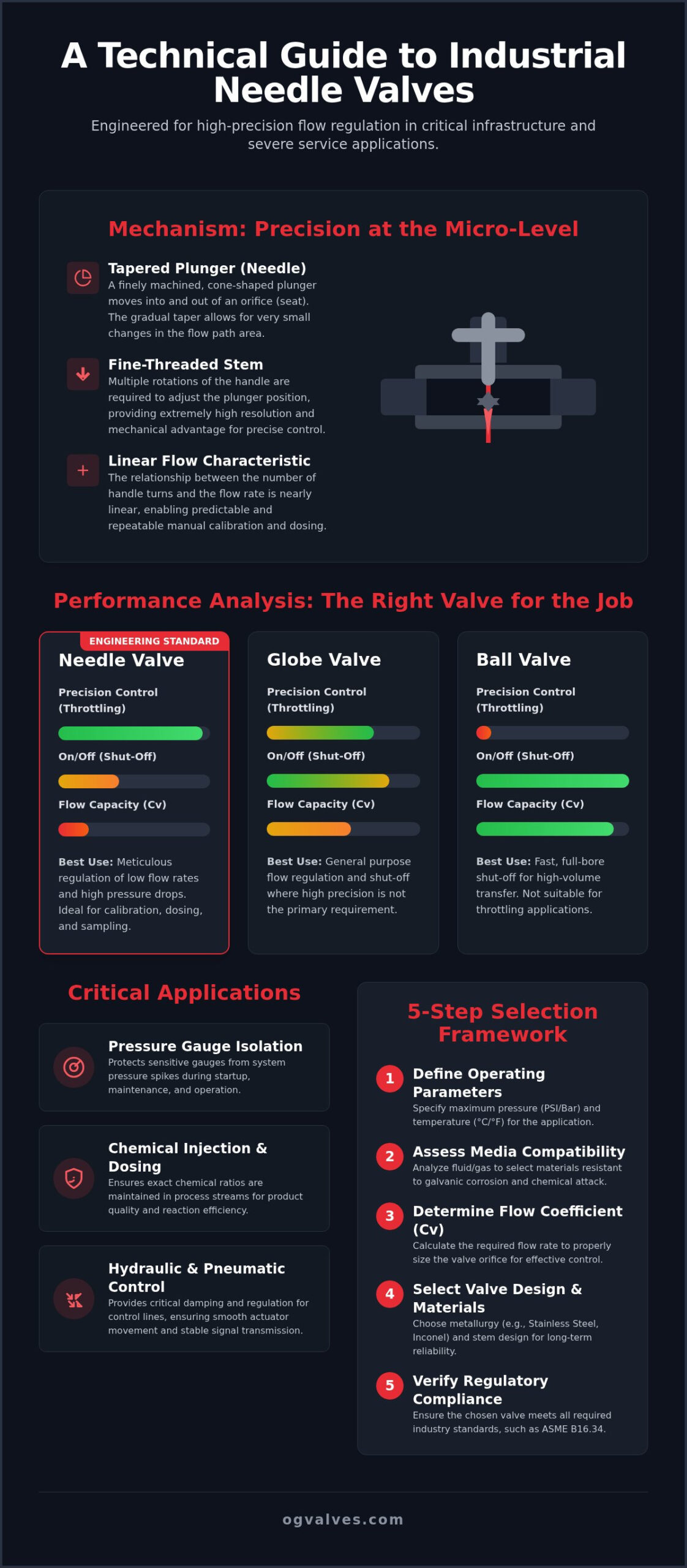
An industrial needle valve is a precision-engineered instrument designed for the exact regulation of fluid or gas flow. Unlike generic shut-off valves, its architecture facilitates incremental adjustments that are required for stable process control. The primary mechanism involves a tapered, needle-like plunger that fits precisely into a matching valve seat. As the stem rotates, the plunger moves linearly, varying the cross-sectional area of the orifice. This design remains critical for maintaining system stability in high-pressure environments where sudden shifts in volume could result in mechanical failure.
Linear flow control serves as the technical foundation for calibration and dosing systems. In these environments, minor fluctuations in flow can compromise chemical reactions or sensor accuracy. While a standard globe valve utilizes a similar internal flow path, the needle valve’s significantly smaller orifice and elongated seat interface distinguish it. This industrial needle valve guide emphasizes that these valves aren’t intended for high-volume transfer. Instead, they’re designed for the meticulous management of low flow rates and high pressure drops. The distinction is primarily one of scale and intent; the needle valve’s orifice is intentionally restricted to provide superior throttling capability.
The Tapered Stem Design: Precision at the Micro-Level
The fine-threaded stem is the core of the needle valve’s mechanical advantage. These threads allow for micro-level positioning of the plunger, ensuring that each rotation of the handle translates into a minute change in the flow coefficient (Cv). This gradual opening sequence is vital for preventing sudden surges in fluid pressure. Such surges can damage downstream instrumentation or cause system-wide instability. The relationship between the turns-of-the-handle and the resulting flow is often nearly linear in high-quality designs. This predictability allows engineers to calculate flow rates based on stem position, a requirement for manual calibration procedures in this industrial needle valve guide context. High-specification designs often feature a non-rotating stem to reduce friction and eliminate seat galling, which ensures long-term repeatability in critical flow paths.
Typical Applications in Critical Infrastructure
Needle valves are ubiquitous in heavy industrial sectors where precision is a safety requirement. Their role in critical infrastructure is defined by their ability to provide reliable isolation and regulation under extreme conditions. Common applications include:
- Pressure Gauge Isolation: They allow for the controlled isolation of gauges, protecting sensitive equipment from pressure spikes during system startup or maintenance.
- Chemical Injection: Dosing skids in petrochemical plants rely on needle valves to maintain exact chemical ratios within process streams to ensure product quality.
- Hydraulic Control Systems: They provide the necessary damping for hydraulic control lines, preventing erratic actuator movement and ensuring smooth operation of heavy machinery.
- Pneumatic Instrumentation: These valves regulate air supply to sensitive pneumatic controllers, ensuring stable signal transmission across the facility.
By integrating these valves into complex manifolds, engineers can achieve a level of control that larger valves cannot match. This makes them indispensable for laboratory environments and industrial process sampling where accuracy is the primary performance metric.
Material Specifications and Design Variations for Severe Service
Selection for severe service requires a transition from standard instrumentation to heavy-duty process specifications. This industrial needle valve guide identifies the critical distinction between basic flow control and the rigorous requirements of high-pressure, high-temperature (HPHT) environments. Material compatibility is the primary defense against galvanic corrosion and stress corrosion cracking. When specifying valves for critical infrastructure, engineers must evaluate the electrochemical potential between the valve body, stem, and process media to prevent premature component failure.
Configuration choice impacts both flow efficiency and installation footprint. Straight-way needle valves are the industry standard for inline applications, yet angle configurations offer a distinct advantage by reducing pressure drop and simplifying piping layouts in high-velocity systems. Bonnet design remains a significant safety variable. While integral bonnets are sufficient for low-pressure applications, union bonnets provide a higher factor of safety in high-pressure service. The union nut secures the bonnet to the body, preventing accidental loosening under vibration and providing a robust seal that resists internal pressure blowouts.
Advanced Metallurgy: Beyond Standard Stainless Steel
Heavy industrial applications often exceed the performance limits of standard 316 stainless steel. Super Duplex alloys are mandatory for seawater and high-chloride environments due to their superior pitting resistance. Monel is the engineering preference for hydrofluoric acid service, while carbon steel remains the standard for high-temperature steam applications where corrosion is not the primary threat. Verification is non-negotiable; Positive Material Identification (PMI) testing ensures that the delivered alloy matches the project’s metallurgical specification exactly. Technical teams can verify material availability through the needle valve inventory at OG Valves to ensure compliance with global project standards.
Sealing and Packing: Ensuring Zero-Leakage Performance
The integrity of the stem seal determines the valve’s reliability in fugitive emission control. PTFE packing is the default for temperatures below 232 degrees Celsius, offering excellent chemical resistance and low friction. For high-temperature service exceeding this threshold, graphite packing is required to maintain a seal under thermal cycling. Metal-to-metal seating is the benchmark for bubble-tight shut-off in gas applications, as it resists the erosive effects of high-velocity particulates. A non-rotating stem design is a critical feature for severe service. By ensuring the stem moves linearly without rotation at the seat interface, the design eliminates galling and extends the operational life of both the plunger and the seat.

Selecting the correct valve for a high-pressure system requires a clinical understanding of flow dynamics and mechanical limitations. While ball valves are the industry standard for high-volume isolation, they’re fundamentally unsuitable for throttling. The quarter-turn operation lacks the mechanical resolution required for precise flow adjustment. When a ball valve is partially open, the resulting high-velocity fluid creates turbulent flow patterns that lead to rapid seat erosion and cavitation. This industrial needle valve guide emphasizes that precision regulation is only achievable through the multi-turn, fine-threaded stem found in needle designs.
The distinction between needle and globe valves centers on the scale of the orifice and the intended flow capacity. Globe valves are engineered for larger-scale throttling where higher flow rates are necessary. However, needle valves provide superior stability in low-flow, high-differential pressure scenarios where a globe valve’s larger orifice would be too sensitive for micro-adjustments. A common engineering error is utilizing a needle valve for primary isolation. While they can achieve shut-off, their primary purpose is regulation. Over-tightening a needle valve to ensure isolation in high-pressure lines can deform the tapered plunger, compromising its future calibration accuracy.
Throttling Capabilities and Flow Stability
Flow stability depends on the valve’s ability to manage pressure drops without inducing cavitation. Cavitation-induced pitting can destroy a valve seat in weeks if the fluid velocity exceeds metallurgical limits. Needle valves excel here by providing a long, restrictive flow path that gradually dissipates energy. For a broader analysis of how these mechanisms fit into larger systems, consult our Industrial Valves: The Engineer’s Comprehensive Guide. In low-flow systems, the needle valve’s geometry ensures that the flow coefficient (Cv) remains predictable across the entire range of the stem’s travel, preventing the erratic “hunting” common in oversized control valves.
Pressure Drop Considerations and System Impact
High-resistance flow paths are inherent to needle valve design. This resistance creates a significant pressure drop that engineers must account for when calculating pump energy requirements. If the pressure drop across a needle valve exceeds system design limits, it’s often necessary to transition to a larger globe valve to maintain operational efficiency. Correct sizing isn’t just about flow volume; it’s about mitigating erosion. Operating a needle valve at less than 10% of its rated capacity can lead to “wire drawing,” where high-velocity fluid cuts grooves into the seat. Aligning the valve’s orifice size with the actual operational flow rate is a fundamental requirement for long-term component integrity.
Selection Framework: Sizing, Pressure Ratings, and Regulatory Standards
Specifying a needle valve for critical service requires a clinical adherence to engineering protocols. This industrial needle valve guide utilizes a five-step framework to ensure system safety and operational longevity. First, engineers must define the process media, including chemical concentration and phase. Second, pressure and temperature limits must align with ASME B16.34 benchmarks. Third, the flow coefficient (Cv) is calculated to prevent control instability. Fourth, metallurgy and sealing materials are selected based on the corrosive profile of the environment. Finally, procurement must confirm compliance with international testing protocols. This structured approach eliminates the risk of component failure in high-stakes infrastructure.
Adherence to ASME B16.34 is the primary requirement for establishing pressure-temperature ratings. This standard defines the maximum allowable working pressure for various material groups across a range of operational temperatures. Beyond body ratings, testing protocols such as API 598 dictate the requirements for shell and seat leakage tests. These standards ensure the valve maintains its integrity under extreme stress. For high-pressure gaseous oxygen or hydrogen service, a heightened safety factor is mandatory. These applications require specialized cleaning and material verification to prevent spontaneous ignition or hydrogen embrittlement. You can view our needle valve technical specifications to verify compliance with these global regulatory mandates.
Sizing for Precision: The Flow Coefficient (Cv) Method
The Cv method is the engineering standard for preventing valve hunting, a condition where an oversized valve causes erratic flow oscillations. Selecting a valve with an appropriate Cv ensures that the stem operates within its optimal throttling range. While needle valves manage precise regulation, other system components like those discussed in our guide to Understanding Industrial Check Valves manage directional integrity. The orifice diameter directly determines the maximum achievable flow rate at a specific differential pressure. Engineers must calculate this value based on the fluid’s specific gravity and the required volume to ensure the valve isn’t operating too close to its seat, which prevents wire-drawing and premature erosion.
Connection Types and Installation Standards
Connection integrity is a prerequisite for zero-leakage performance in high-pressure systems. Threaded connections, including NPT and BSPP, are common for instrumentation, though they require careful sealant application to prevent galling. Compression fittings offer a reliable alternative for tubing systems, providing a mechanical seal that resists vibration. For permanent installations in hazardous environments, socket weld connections provide the highest level of structural soundness. Standardizing these connections across global industrial projects simplifies maintenance and ensures compatibility with existing instrumentation tubing. Procurement teams should prioritize vendors who adhere to these rigid dimensional standards to ensure seamless integration into complex manifolds.
Procurement Excellence: Ensuring Material Integrity and Global Reliability
Procurement in heavy industry is governed by the necessity for clinical precision and the mitigation of lead-time risks. A single delayed component in a chemical injection skid or pressure manifold can result in significant operational losses. This industrial needle valve guide emphasizes that securing a reliable supply chain is as critical as the initial engineering specification. OG VALVES LTD. operates as a dependable partner in critical infrastructure, maintaining an extensive inventory of high-specification needle valves to ensure project continuity. By integrating these precision instruments into broader valve packages, procurement specialists can streamline logistics and ensure consistent material standards across the entire fluid control system. The integration of needle valves into comprehensive project management strategies allows for the synchronization of material testing and documentation across all valve types, ensuring that it’s easier to verify compliance at every project stage.
Quality Assurance and Material Traceability
Material traceability is a fundamental safety mandate in environments characterized by high pressure and corrosive media. In heavy industrial sectors, EN 10204 3.1 or 3.2 certification is required to verify that the chemical and mechanical properties of the valve body align with project specifications. Positive Material Identification (PMI) testing serves as a secondary validation layer, preventing the installation of counterfeit or substandard alloys that could lead to catastrophic failure in high-stress environments. Similar rigorous standards apply across our full product range, as detailed in our A Technical Guide to Industrial Gate Valves. This unwavering commitment to metallurgical integrity ensures that every component withstands the operational stresses of petrochemical and power generation facilities without compromising safety.
Global Supply Chain and Fast-Track Delivery
Minimizing downtime requires a logistics framework capable of rapid procurement and global distribution. OG VALVES LTD. leverages its global logistics capability to offer fast-track delivery options for specialized high-spec valves, addressing the common industry pain point of long lead times for critical infrastructure. Our technical expertise in specification compliance ensures that international project sites receive components that meet local regulatory requirements and international safety standards without delay. It’s this capability that transforms the vendor-client relationship into a strategic partnership, rooted in the understanding that quality and speed are inseparable in heavy industry. Our team provides technical support to ensure minimal downtime through rapid supply and rigorous quality control. Contact OG VALVES LTD. for technical specifications and quotes on industrial needle valves.
Advancing Flow Precision in Critical Infrastructure
Achieving reliable flow regulation in high-pressure environments depends on the clinical alignment of mechanical design and metallurgical standards. This industrial needle valve guide has detailed the technical requirements for specifying components that withstand severe service while maintaining calibration accuracy. Successful implementation requires a rigorous selection framework that prioritizes ASME B16.34 compliance and precise flow coefficient calculations. By focusing on non-rotating stem designs and advanced alloy verification, engineers can mitigate the risks of cavitation and material failure in critical process streams. It’s essential to treat these valves as precision instruments rather than simple fittings.
Operational efficiency is further secured through strategic procurement that emphasizes material traceability and global logistics. OG Valves maintains an extensive inventory of API and ASME compliant valves to support the immediate needs of heavy industrial sectors. Our global fast-track delivery capability and specialist technical support ensure that your facility maintains maximum uptime without compromising on safety or regulatory adherence. We invite you to Request a Technical Quote for Industrial Needle Valves to secure the precision your infrastructure demands. We look forward to supporting your next global project with engineering excellence and unwavering reliability.
Frequently Asked Questions
What is the primary difference between a needle valve and a globe valve?
The primary difference is the scale of flow control and orifice geometry. While a globe valve manages high-volume throttling, a needle valve utilizes a tapered plunger for micro-adjustments in low-flow systems. This industrial needle valve guide highlights that needle valves offer higher mechanical resolution due to fine stem threads. They’re designed for precision rather than high capacity. Globe valves feature larger orifices that make them less effective for the minute regulation required in instrumentation.
Can a needle valve be used for high-pressure steam applications?
Needle valves are suitable for high-pressure steam if specified with appropriate metallurgy and packing. Carbon steel or 316 stainless steel bodies are standard, but graphite packing is mandatory for temperatures exceeding 232 degrees Celsius. PTFE seals will fail under thermal stress in steam service. You must ensure the valve’s pressure-temperature rating complies with ASME B16.34 material groups to maintain structural integrity during thermal cycling and prevent steam-induced erosion and component failure.
How do I calculate the correct size for a needle valve?
Correct sizing requires calculating the required flow coefficient (Cv) based on the fluid’s specific gravity, inlet pressure, and desired pressure drop. You shouldn’t select a valve based solely on pipe size. An oversized valve leads to “hunting” where the plunger operates too close to the seat, causing rapid wear. Engineers use the standard Cv formula for liquids to ensure the valve operates in the middle 50% of its stroke, which provides optimal control stability.
Why is material traceability (PMI) important for needle valves?
Positive Material Identification (PMI) is critical for verifying that the valve alloy matches the required specification for corrosive or high-pressure environments. In petrochemical facilities, installing a standard stainless steel valve where Super Duplex is required can lead to rapid pitting or stress corrosion cracking. PMI testing provides a non-destructive method to confirm the elemental composition of the body and stem. This verification process is a primary safety mandate for preventing catastrophic containment loss in infrastructure.
What are the common failure modes of industrial needle valves?
Common failure modes include seat galling, wire drawing, and packing degradation. Seat galling occurs when the plunger and seat materials fuse under high pressure, often due to over-tightening. Wire drawing is a form of erosion where high-velocity fluid cuts grooves into the seat during low-flow operation. Additionally, stem packing can leak if it’s not adjusted to account for thermal expansion. Utilizing a non-rotating stem design significantly reduces the risk of mechanical wear at the seat interface.
Are needle valves suitable for slurry or dirty fluid service?
Needle valves aren’t suitable for slurry or dirty fluid service because the restricted orifice and narrow flow path are prone to clogging. Particulates in the media will also cause rapid erosion of the tapered plunger and valve seat, compromising the valve’s ability to achieve a bubble-tight shut-off. For media containing solids, a ball valve or plug valve is a more durable choice. These applications require valves with a clear flow path that doesn’t trap debris within the mechanism.
What industry standards govern the design of needle valves?
Several international standards govern the design and testing of these precision instruments. ASME B16.34 defines the pressure-temperature ratings for the valve body, while API 598 provides the protocols for shell and seat leakage testing. MSS SP-99 is a specific standard for instrument valves that covers design, testing, and pressure ratings. Compliance with these benchmarks ensures that the valve meets the rigorous safety requirements of heavy industrial sectors like power generation and petrochemical processing.
 Responsive Menu