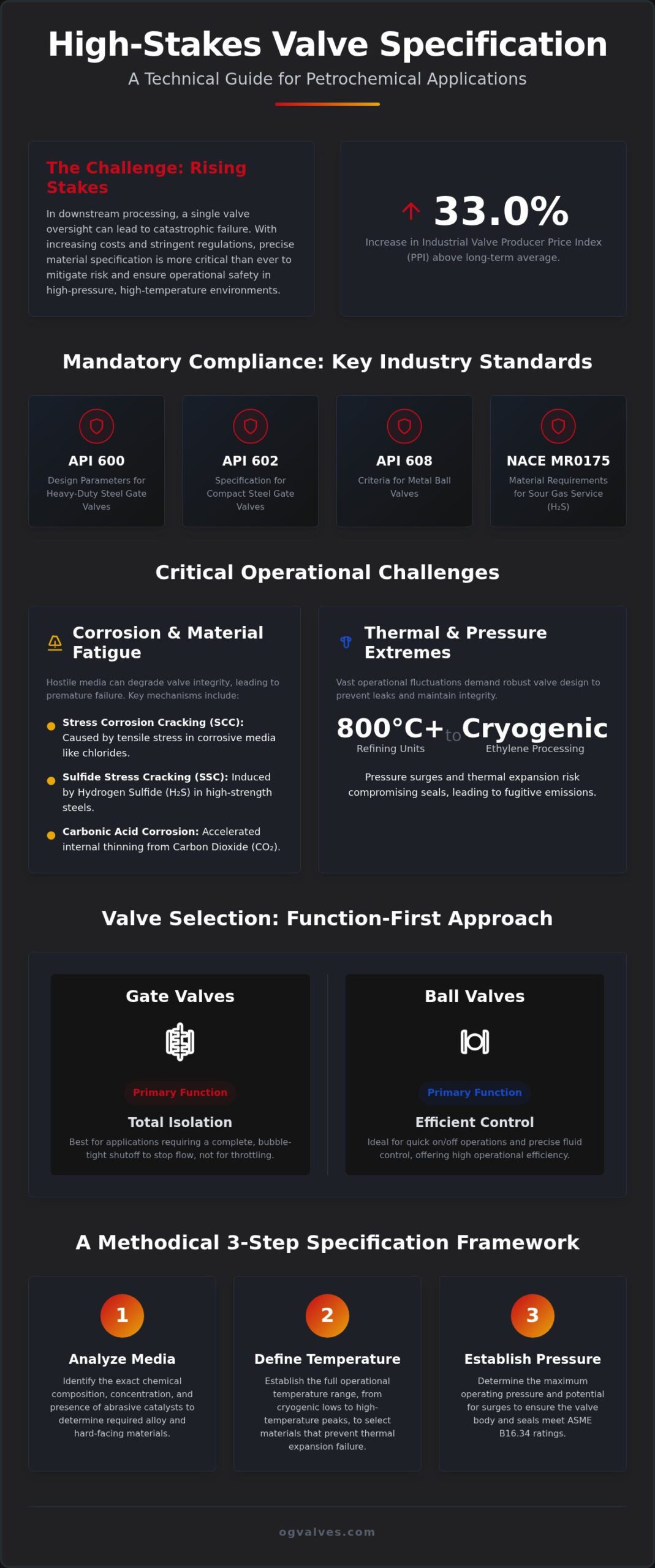
In the high-pressure environment of downstream processing, a single metallurgical oversight in your valve specification can result in catastrophic system failure and millions in liquidated damages. With the Producer Price Index for industrial valve manufacturing sitting 33.0% above its long-term average as of June 2026, the financial stakes of procurement errors have never been higher. You’re likely managing the tension between increasing operational output and the absolute necessity of adhering to stringent API and NACE standards. Selecting valves for petrochemical industry applications is no longer just a routine mechanical choice; it’s a high-stakes exercise in risk mitigation and regulatory adherence.
This technical guide provides a clinical analysis of material integrity, structural soundness, and the engineering criteria required to maintain safety in corrosive environments. We’ll examine the specific performance benchmarks for gate, ball, and globe valves while addressing the 2026 regulatory landscape, including new PFAS reporting mandates and OGI monitoring deadlines. By the end of this analysis, you’ll have the technical data needed to identify the correct valve types for specific downstream processes and secure a reliable global supply partner capable of delivering high-specification alloys under tight project timelines.
Key Takeaways
- Assess the impact of high-pressure, high-temperature (HPHT) media on component performance to mitigate the risk of catastrophic failure in petrochemical systems.
- Ensure rigorous adherence to API 600, 602, and 608 benchmarks and NACE MR0175 standards for valves for petrochemical industry in sour gas service.
- Distinguish between the isolation capabilities of gate valves and the operational efficiency of ball valves to ensure you’re optimizing fluid control precision.
- Apply a methodical specification framework that prioritizes media concentration, temperature, and pressure to define exact hardware requirements.
- Implement strategic procurement protocols that leverage global logistics to secure high-specification components and minimize operational downtime.
Operational Challenges in Petrochemical Fluid Control
Petrochemical facilities operate under high-pressure, high-temperature (HPHT) conditions that push mechanical components to their absolute physical limits. Within these systems, valves serve as the primary containment barriers. Their performance is the difference between controlled flow and catastrophic failure. Key operational stressors include the thermal expansion of heavy-wall piping, the presence of abrasive catalysts in fluid catalytic cracking (FCC) units, and the stringent containment of volatile organic compounds (VOCs). Petrochemical valves are specialized flow control devices designed for high-cycle reliability in hazardous environments.
Reliability in these settings requires an understanding of how media interacts with hardware. For instance, abrasive catalysts can erode valve internals in hours if the wrong hard-facing materials are used. Additionally, meeting the January 2026 South Coast AQMD emissions limits requires hardware that can pass rigorous Optical Gas Imaging (OGI) inspections. Choosing high-performance valves for petrochemical industry use ensures that these variables don’t lead to unscheduled downtime or environmental non-compliance.
Corrosion Mechanisms and Material Fatigue
Stress Corrosion Cracking (SCC) remains a primary cause of premature hardware failure in petrochemical pipelines. This degradation occurs when tensile stress and a corrosive medium, such as chlorides or caustic solutions, act upon a susceptible alloy. The presence of hydrogen sulphide (H2S) further complicates material selection, as it induces sulfide stress cracking (SSC) in high-strength steels. Carbon dioxide (CO2) also accelerates internal thinning through carbonic acid corrosion. Maintaining long-term operational safety necessitates the use of high-grade metallurgy. Materials must adhere to NACE MR0175 standards to ensure they possess the fracture toughness required to resist hydrogen-induced cracking in sour gas service.
Thermal Extremes and Pressure Fluctuations
Operational temperatures in a single facility can fluctuate from cryogenic levels in ethylene processing to over 800°C in refining units. These extremes cause significant volumetric changes in both the media and the valve body itself. Pressure surges can compromise stem seals, leading to fugitive emissions that violate environmental protocols. Integrating a pressure relief valve (PRV) is a standard safety measure to mitigate these overpressure events. However, selecting the correct valves for petrochemical industry service requires focusing on seat design to provide a bubble-tight shutoff. In high-cycle applications, metal-to-metal seating with Tungsten Carbide or Stellite overlays is often required to maintain seal integrity under fluctuating thermal and pressure loads.
Key Standards and Material Integrity for Petrochemical Valves
The structural integrity of valves for petrochemical industry applications is governed by a rigorous hierarchy of international engineering standards. Adherence to American Petroleum Institute (API) benchmarks isn’t optional; it’s a foundational requirement for industrial safety. API 600 and 602 define the design parameters for heavy-duty and compact gate valves, while API 608 establishes the criteria for metal ball valves. These standards work in conjunction with ASME B16.34, which provides the mandatory pressure-temperature ratings that dictate the permissible operating limits of the valve body. Every specification must align with these benchmarks to ensure system compatibility and long-term reliability.
In environments containing hydrogen sulfide, compliance with NACE MR0175/ISO 15156 is critical to prevent sulfide stress cracking. To ensure these standards are met, Positive Material Identification (PMI) is utilized during the manufacturing process. PMI provides a non-destructive verification of the alloy composition. This step confirms that the hardware matches the specified mill test reports (MTRs) and eliminates the risk of material substitution in critical lines.
Advanced Metallurgy: From Stainless Steel to Exotic Alloys
Material selection is dictated by the chemical composition of the process media. ASTM A351 CF8M is the standard specification for general corrosive service, offering reliable performance for most stainless steel requirements. However, high-chloride environments, such as those found in coastal refineries, necessitate the use of Duplex or Super Duplex stainless steels. These materials provide superior pitting and crevice corrosion resistance. For specialized chemical resistance against sulfuric or hydrofluoric acids, engineers specify Alloy 20 or Monel. You can find detailed material classifications for high-cycle isolation in our industrial ball valves engineering guide.
Regulatory Compliance and Testing Protocols
Modern petrochemical operations face increasing environmental scrutiny. Fugitive emission testing under API 622 for packing and API 624 for rising stem valves is mandatory to meet 2026 monitoring deadlines, such as the South Coast AQMD Optical Gas Imaging (OGI) requirements. Additionally, new mandates like the Minnesota PFAS reporting deadline on July 1, 2026, require manufacturers to disclose any intentionally added per- and polyfluoroalkyl substances in valve components. Fire-safe testing according to API 607 is equally vital. It verifies that the valve can maintain a seal during and after a fire event. Every unit must also undergo hydrostatic and pneumatic shell testing to confirm structural soundness before field deployment.
Comparative Analysis of Primary Valve Types in Petrochemical Applications
Petrochemical fluid control requires a categorical distinction between isolation and throttling functions. Selecting the wrong architecture compromises safety and process efficiency. For process isolation, engineers must choose between the rapid response of ball valves and the low-pressure-drop characteristics of gate valves. Refinery systems also rely on check valves to prevent backflow and protect upstream equipment from pressure reversals. In high-flow, low-pressure applications, integrating butterfly valves provides a compact, lightweight solution for large-diameter piping. It’s vital to match the valve’s mechanical motion to the specific operational frequency of the line.
Isolation Efficiency: Ball vs. Gate Valves
Quarter-turn industrial ball valves are the preferred choice for rapid shutoff and high-cycle reliability. They’re designed with either floating or trunnion-mounted architectures. Floating balls rely on upstream pressure to push the ball against the downstream seat. This is effective for smaller bore sizes and lower pressures. Trunnion-mounted designs use fixed stems and spring-loaded seats. This ensures consistent sealing at both high and low pressures while reducing operating torque. Conversely, multi-turn gate valves offer a straight-through flow path that minimizes pressure drop. Their slow-acting operation prevents water hammer in large-diameter pipelines. They aren’t suited for frequent cycling, but they’re excellent for main isolation lines that remain open for long durations.
Throttling and Control: Globe and Needle Valves
Throttling requires a valve geometry that can withstand the erosive forces of high-velocity flow. Globe valves feature a plug-and-seat design that allows for precise flow regulation. It’s the industry standard for maintaining specific process parameters, even though it creates a significant pressure drop across the valve. For instrumentation and sampling systems where fine control is paramount, needle valves provide the necessary resolution. Material selection for trim components is critical in these applications. Hardened stainless steel or Stellite overlays resist the wire-drawing effects common in high-pressure-drop throttling service. Specifying the correct valves for petrochemical industry regulation ensures that control loops remain stable. It prevents the premature degradation of internal components under high-stress flow conditions.
A Technical Framework for Petrochemical Valve Specification
Successful procurement of valves for petrochemical industry service requires a methodical engineering workflow. It’s not enough to simply replace a legacy component; engineers must validate the specification against current process conditions and 2026 regulatory benchmarks. This framework ensures that every mechanical selection addresses the specific risks of high-stress industrial environments. A clinical approach to specification reduces the likelihood of premature fatigue and ensures adherence to global safety benchmarks.
- Step 1: Define Media Characteristics. Document the chemical concentration, minimum and maximum temperature, and operating pressure. This data dictates the required corrosion allowance and seal material compatibility.
- Step 2: Determine Valve Function. Establish whether the application requires absolute isolation, precise regulation, or backflow prevention. As analyzed in previous sections, the mechanical motion of the valve must match its process intent.
- Step 3: Select Material Grades. Align metallurgy with NACE MR0175 for sour gas service or API 600 for heavy-wall gate valves to ensure structural soundness under tensile stress.
- Step 4: Identify Certifications. Specify API 607 fire-safe or API 624 low-emission certifications to meet current environmental mandates and safety protocols.
- Step 5: Evaluate Actuation. Determine if the valve requires manual operation or integration into an automated control loop for remote monitoring.
Sizing and Pressure Class Determination
Correct sizing is critical to prevent cavitation and excessive pressure drops. Engineers must calculate the Flow Coefficient (Cv) based on the required volumetric flow and specific gravity of the media. If a valve’s oversized, it leads to poor control resolution. Undersized valves cause high-velocity erosion. Matching ANSI/ASME pressure classes to existing piping specifications is mandatory. In high-pressure zones, transitioning from Class 150 to Class 2500 requires a clinical assessment of the flange ratings and wall thicknesses defined in ASME B16.34. This precision prevents mechanical failure at the connection points.
Automation and Actuation Needs
Modern plants prioritize remote operation to enhance personnel safety. Integrating valve actuators allows for precise control from a centralized station. Selection depends on the available power source and the required fail-safe position. Pneumatic actuators are common for rapid response; electric versions offer high positioning accuracy. For critical safety loops, components must meet Safety Instrumented Systems (SIS) requirements and carry appropriate SIL ratings. This ensures the valve performs its safety function during an emergency shutdown (ESD) without hesitation.
To secure components that meet these rigorous technical benchmarks, you need a dependable partner in critical infrastructure. Consult with OG VALVES LTD. for high-specification hardware and technical compliance support across your global project sites.
Global Supply Logistics and Technical Compliance in Valve Procurement
Procuring valves for petrochemical industry applications requires a clinical focus on supply chain logistics to prevent the high cost of facility downtime. Engineering excellence is negated if the hardware isn’t on-site when required. Refineries and chemical plants operate on razor-thin margins where unscheduled outages can result in significant financial losses. Strategic inventory management allows for the immediate deployment of high-specification components, including Super Duplex ball valves and high-pressure gate valves. OG VALVES LTD. operates as a reliability partner, leveraging global logistics capabilities to ensure that critical infrastructure remains operational despite the volatility of the 2026 valve market.
Technical compliance extends beyond the physical product to include a comprehensive documentation package. Every valve must be accompanied by Mill Test Reports (MTRs), pressure test reports, and certificates of conformity. These documents provide the necessary verification that the metallurgy and pressure ratings meet the project’s specific engineering standards. Without this data, components cannot be cleared for installation in high-stakes environments where the cost of failure is absolute. Maintaining a transparent and traceable supply chain is the only way to ensure long-term operational output and safety.
Fast-Track Delivery for Critical Infrastructure
Managing complex logistics for international petrochemical sites involves navigating diverse regulatory frameworks and transport requirements. Fast-track delivery is essential for minimizing the impact of equipment failure. Technical expertise in the procurement process ensures that the logistics team understands the urgency of high-cycle applications. By utilizing established global networks, OG VALVES LTD. reduces supply chain risk and provides predictable lead times for exotic material grades. This capability allows procurement specialists to secure complex components, such as Alloy 20 or Monel valves, without the delays typical of standard industrial vendors. We prioritize functional reality, ensuring that every shipment meets the exact logistical demands of heavy industry.
Technical Support and Specification Verification
Engineering teams must collaborate closely with suppliers to verify material suitability before procurement is finalized. This verification process involves a detailed review of the process media, pressure fluctuations, and thermal extremes. Ensuring adherence to industrial valve standards is a shared responsibility between the engineer and the supplier. Quality control protocols, such as third-party inspections and witness testing, provide an additional layer of assurance for high-stakes industrial applications. This methodical approach to specification verification eliminates ambiguity and confirms that the selected hardware is capable of performing under the specific environmental stressors of the facility. It’s a voice of experience that understands that in heavy industry, quality isn’t an option; it’s a necessity for survival.
Optimizing Operational Reliability in Petrochemical Infrastructure
Securing long-term performance in high-stress environments requires a precise intersection of metallurgy, regulatory adherence, and logistical coordination. This guide has detailed the necessity of aligning component selection with API and NACE standards while addressing the evolving 2026 environmental mandates. You now have the technical framework to distinguish between isolation and throttling requirements and to implement a rigorous specification workflow. Every mechanical choice must be anchored in quantifiable data and verified certifications.
Selecting the correct valves for petrochemical industry applications is a critical risk-management decision. It’s essential to partner with an organization that understands the cost of failure. As a global reliability partner, OG VALVES LTD. provides the technical expertise and fast-track delivery needed to maintain system integrity across international facilities. Our global supply chain expertise and comprehensive API and NACE compliance ensure your infrastructure operates without interruption. We’re ready to support your most demanding engineering requirements.
Request a Technical Quote for Petrochemical Valves to secure high-specification hardware for your next project.
Frequently Asked Questions
What are the most common valve materials used in the petrochemical industry?
ASTM A216 WCB carbon steel and ASTM A351 CF8M stainless steel serve as the primary materials for most refinery applications. High-chloride or high-temperature zones necessitate more robust metallurgy, such as Duplex, Super Duplex, or Nickel alloys like Monel and Inconel. Material selection depends on media concentration and pressure-temperature ratings defined in ASME B16.34. Choosing the correct valves for petrochemical industry service requires matching these alloys to the specific corrosion profile of the process stream.
Why is API 600 considered the gold standard for petrochemical gate valves?
API 600 specifies the heavy-duty design requirements for bolted bonnet steel gate valves. It mandates thicker wall sections and specific stem diameters that exceed standard industrial benchmarks. This ensures structural integrity under the high-cycle, high-stress conditions found in refinery mainlines. Compliance with this standard provides a quantifiable baseline for durability and safety in critical isolation applications where mechanical failure isn’t an option for facility operators.
How do fugitive emission standards impact valve selection in 2026?
Regulatory mandates like the January 2026 South Coast AQMD deadline require valves to meet stringent low-leakage criteria. Engineers must specify hardware certified to API 622 for packing and API 624 for rising stem valves. These standards ensure that fugitive emissions are minimized during high-cycle operation. This shift necessitates the use of advanced bellows seals or engineered packing sets to comply with OGI monitoring protocols and current environmental laws.
What is the difference between a ball valve and a plug valve for chemical service?
Ball valves utilize a spherical disk for quarter-turn isolation, offering high-cycle reliability and lower operating torque in most process lines. Plug valves use a tapered or cylindrical plug that provides a larger seating area, which is advantageous for abrasive slurries or high-viscosity chemicals. While ball valves are more common for general service, plug valves offer superior performance in applications where solids might accumulate in the valve cavity and obstruct flow.
Can OG VALVES provide material test reports (MTRs) for all petrochemical components?
Yes, OG VALVES LTD. provides full traceability for all high-specification industrial components. Every valve is accompanied by an MTR that verifies the chemical composition and mechanical properties of the specific heat lot. This documentation is essential for technical compliance and quality assurance in heavy industrial sectors. We ensure that all test reports and certificates of conformity align with the project’s specific engineering standards and global safety protocols.
What are the requirements for a valve to be certified as “Fire-Safe”?
A fire-safe certification, typically governed by API 607 or API 6FA, requires the valve to maintain a seal during and after exposure to high-temperature flames. The design must incorporate secondary metal-to-metal seating to prevent leakage if the primary soft seals are destroyed by heat. Testing protocols involve rigorous shell and seat leakage measurements under extreme thermal stress. This ensures the valve remains a reliable containment barrier during an emergency fire event.
How does NACE MR0175 affect material choices in sour gas applications?
NACE MR0175/ISO 15156 dictates the metallurgical requirements for materials exposed to H2S-containing environments. It limits the hardness of carbon and low-alloy steels to prevent sulfide stress cracking (SSC). For stainless steels and nickel alloys, it specifies environmental limits based on temperature and chloride concentration. Adherence to these standards is mandatory for valves for petrochemical industry use in sour service to avoid brittle fracture and catastrophic system failure.
What are the advantages of using Super Duplex valves in petrochemical processing?
Super Duplex alloys, such as ASTM A890 Grade 5A, offer exceptional resistance to pitting and crevice corrosion in high-chloride media. They provide nearly double the mechanical strength of standard austenitic stainless steels, allowing for reduced wall thicknesses and lower overall component weight. These valves are ideal for offshore platforms and coastal refineries where seawater or aggressive chemical catalysts would cause premature failure in conventional 316 stainless steel hardware.
 Responsive Menu