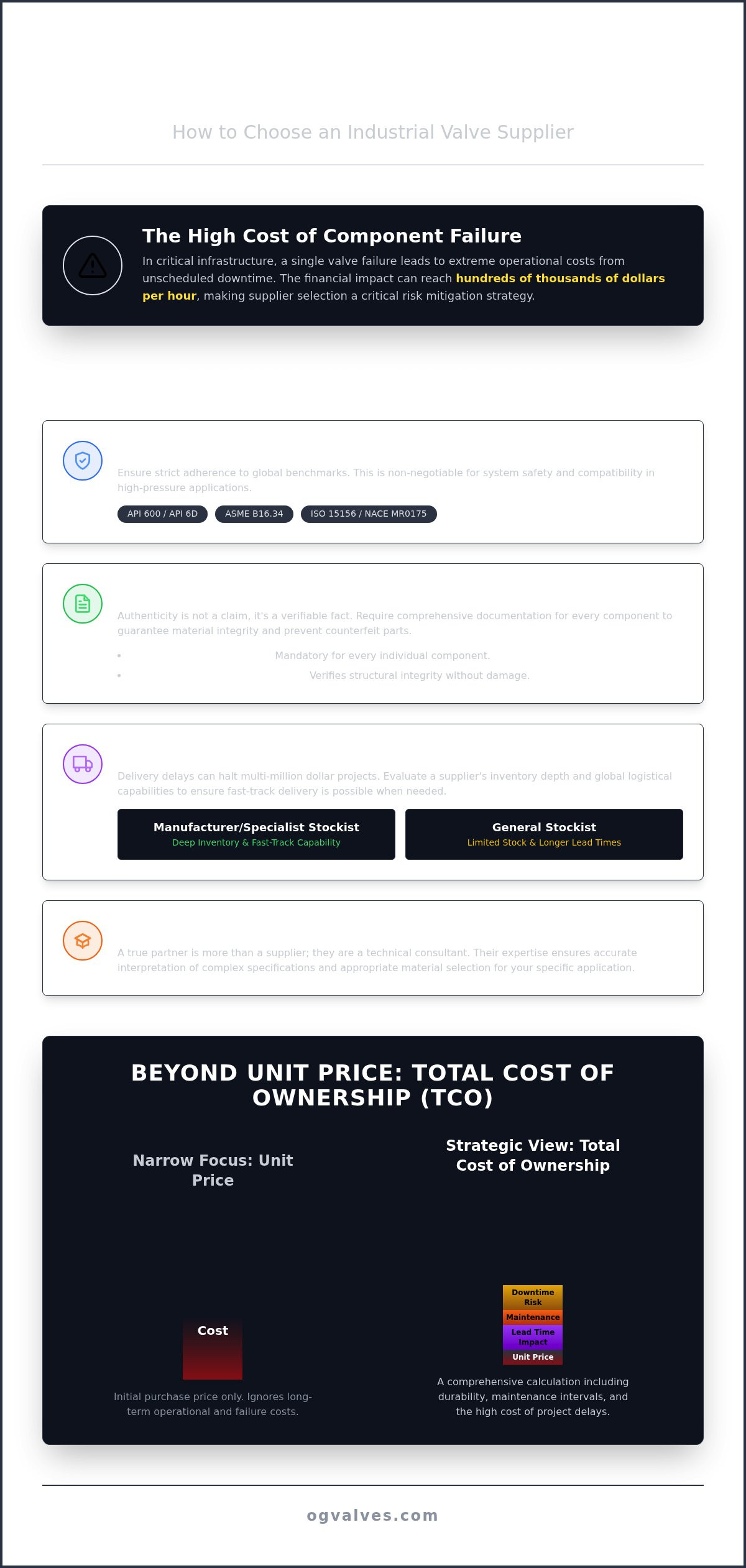
In critical infrastructure, a single valve failure is not merely a maintenance issue; it is a significant operational liability that results in extreme costs due to unscheduled downtime. Technical experts recognize that the structural integrity of a high-pressure system depends entirely on the verifiable quality of its components. However, the difficulty of verifying material authenticity and ensuring 100% compliance with international safety standards often complicates procurement cycles.
This guide establishes a technical selection framework for how to choose an industrial valve supplier that prioritizes engineering excellence and regulatory adherence. You’ll gain a clinical understanding of how to vet partners based on material traceability, adherence to API and ASME benchmarks, and global logistical reliability. We will analyze the essential criteria for securing high-specification gate, ball, and globe valves, moving from initial technical verification through to final quality assurance protocols and the logistical agility required for fast-track delivery in 2026.
Key Takeaways
- Establish a rigorous vetting process focused on minimizing the high operational costs associated with unscheduled downtime in critical infrastructure.
- Verify supplier adherence to global benchmarks such as API, ASME, and ISO through the mandatory provision of Mill Test Reports for every individual component.
- Distinguish between stockists and manufacturers to evaluate inventory depth and ensure the capability for fast-track delivery of high-specification valves.
- Assess a partner’s engineering support capabilities to ensure the accurate interpretation of complex technical specifications and specific material classifications.
- Master the technical selection framework for how to choose an industrial valve supplier that prioritizes material integrity and 100% compliance with international safety standards.
The Strategic Impact of Industrial Valve Supplier Selection
High-stakes industrial environments, such as oil and gas or power generation, leave zero margin for component failure. Choosing a supplier is a critical decision that dictates the long-term safety and efficiency of the entire infrastructure. When determining how to choose an industrial valve supplier, engineers must prioritize technical verification over initial savings. A technical partner doesn’t just deliver hardware; they act as a consultant to ensure every specification meets rigorous API or ASME standards.
Mitigating Operational Risk and System Failure
Material failure in corrosive or high-pressure environments results in catastrophic consequences, including environmental hazards and significant personnel risk. An industrial valve must maintain structural integrity under extreme thermal and mechanical stress. Specialist suppliers identify potential failure modes during the early procurement phase, ensuring that the selected metallurgy and sealing designs are appropriate for the specific medium. This clinical focus on application-specific selection prevents the premature degradation of critical components. It’s a standard requirement for maintaining 100% compliance with international safety protocols.
Beyond the Unit Cost: Analyzing Total Cost of Ownership
Procurement specialists often focus on unit price, yet this is a secondary metric compared to the Total Cost of Ownership (TCO). High-quality industrial valves reduce long-term operational expenditure (OPEX) by extending maintenance intervals and increasing durability. In heavy industry, the operational cost of unscheduled downtime can reach hundreds of thousands of dollars per hour. A supplier that provides fast-track delivery and deep technical support minimizes these risks. This makes the vetting process a fundamental component of project management. Consider these factors when evaluating TCO:
- Lead Time Impact: Quantifiable effect of delivery delays on project capital expenditure (CAPEX).
- Maintenance Intervals: The frequency of required servicing based on material grade and manufacturing precision.
- Component Durability: The projected lifespan of the valve in aggressive chemical or high-cycle applications.
- System Compatibility: The role of the supplier in ensuring seamless integration with existing piping and control systems.
Understanding how to choose an industrial valve supplier involves evaluating how their logistical reliability influences your bottom line. Unreliable lead times for critical components can stall multi-million dollar projects. A partner with a deep inventory and global logistical reach ensures that the cost of waiting doesn’t exceed the value of the equipment itself. Every procurement decision should reflect the necessity of quality and the heavy cost of potential failure.
Evaluating Technical Compliance and Regulatory Standards
Technical compliance represents the fundamental baseline for industrial safety. In high-pressure applications, quality is a quantifiable metric defined by international regulatory bodies rather than a marketing claim. Understanding how to choose an industrial valve supplier requires a clinical assessment of their ability to provide verifiable documentation for every component. This process begins with a review of the supplier’s adherence to global benchmarks and their internal quality control protocols.
Adherence to API, ASME, and ISO Benchmarks
Suppliers must demonstrate strict adherence to industry-standard design codes to ensure system compatibility and safety. For instance, high-specification gate valves must comply with API 600 requirements regarding wall thickness and stem diameter. Similarly, ball valves in pipeline service are governed by API 6D specifications. All pressure-containing components must align with ASME B16.34 pressure-temperature ratings to ensure structural stability under operational loads. In environments containing hydrogen sulfide, compliance with NACE MR0175/ISO 15156 is mandatory to prevent sulfide stress cracking.
Material Verification and Non-Destructive Testing (NDT)
Authenticity is verified through comprehensive Mill Test Reports (MTRs) that track the chemical composition and mechanical properties of the heat lot. These reports aren’t optional; they’re the primary instrument of material traceability. Positive Material Identification (PMI) testing serves as a final safeguard against material grade substitution in high-alloy or duplex steel applications. Structural integrity is further validated through specific Non-Destructive Testing (NDT) protocols:
- Dye Penetrant Inspection (DPI): Identifies surface-breaking defects in non-porous materials through capillary action.
- Magnetic Particle Inspection (MPI): Detects surface and near-surface discontinuities in ferromagnetic components.
- Radiographic and Ultrasonic Testing: Essential for identifying internal volumetric flaws in high-pressure castings or critical welds.
A supplier’s internal quality management system, typically certified to ISO 9001:2015, ensures consistent procedural adherence throughout the procurement cycle. This framework guarantees that every valve undergoes rigorous pressure testing according to API 598 before shipment. For projects requiring uncompromising technical verification, reviewing a supplier’s certification portfolio is a necessary step in the vetting process. Without this data, the risk of installing a sub-standard component in a high-pressure line is unacceptably high.
Assessing Supply Chain Reliability and Inventory Management
Supply chain reliability is the pivot point between project success and costly delays. When determining how to choose an industrial valve supplier, procurement specialists must distinguish between stockists, distributors, and manufacturers. While manufacturers offer customization, stockists provide the immediate availability required to mitigate the high cost of unscheduled downtime. A partner with a clinical focus on inventory depth ensures that critical components are available for rapid dispatch. This logistical agility is a prerequisite for maintaining operational output in heavy industrial sectors.
Stock Availability vs. Fast-Track Procurement
Inventory depth for high-specification components, such as butterfly valves, is a primary indicator of a supplier’s capability. During emergency shutdowns or scheduled turnarounds, standard manufacturing lead times are often unacceptable. Fast-track procurement involves the rapid sourcing of non-standard material specifications through established global networks. Reliable suppliers define clear Service Level Agreements (SLAs) that quantify delivery timelines. This transparency allows engineers to plan maintenance windows with precision, reducing the risk of project creep. It ensures that the procurement process remains aligned with the technical demands of the facility.
Global Logistics and Critical Lead Time Management
Managing the logistics of heavy industrial components requires expertise in international freight and complex customs documentation. A seasoned supplier acts as a logistical partner, providing real-time tracking for every shipment across global borders. This oversight is particularly vital for automated valve assemblies that include actuators and control instrumentation. These multi-component systems require synchronized delivery to avoid assembly delays at the project site. Failure to manage these logistical variables results in increased capital expenditure and extended system outages.
Transparency in lead time reporting is essential for effective supply chain risk management. In 2026, global supply chains remain sensitive to geopolitical and logistical shifts. A technically proficient supplier provides accurate data on standard lead times for specialized materials, such as super duplex alloys, rather than offering unrealistic estimates. This honesty is a signature of a dependable partner in critical infrastructure. It ensures that the selection process is grounded in functional reality rather than marketing hyperbole. By identifying potential supply chain bottlenecks before they impact the critical path, a partner facilitates a more resilient procurement strategy. This proactive approach to risk management separates a mere vendor from an established global entity.
Technical Expertise and Engineering Support Capabilities
Technical proficiency distinguishes a strategic partner from a mere hardware vendor. When evaluating how to choose an industrial valve supplier, look for an organization capable of interpreting complex technical data sheets and P&IDs without ambiguity. Engineering support is vital for selecting specific components like check valves, where precise cracking pressures and closure speeds are necessary to prevent water hammer. This phenomenon causes catastrophic surge pressures that compromise piping integrity. A supplier’s ability to perform dynamic flow calculations ensures the selected valve matches the operational reality of the system, preventing costly repairs and hazardous leaks.
A technical supplier provides essential value-added services such as valve automation, precision modification, and supplementary pressure testing. Every component should undergo rigorous verification, including API 598 hydrostatic and pneumatic tests, before arriving at the project site. These services consolidate the supply chain and ensure that automated assemblies, including actuators and positioners, are fully calibrated and ready for immediate integration. This reduces the burden on site engineers and minimizes the risk of installation errors. It also ensures that all modifications, such as stem extensions for insulated lines, meet the original design standards.
Specialized Application Knowledge for Heavy Industry
High-stakes sectors like petrochemicals and power generation require specialized application knowledge. Suppliers must understand the metallurgical requirements for cryogenic services or high-temperature steam applications where thermal expansion is a factor. Providing technical consultation on material selection for abrasive or multi-phase media prevents premature erosive wear. This expertise is a fundamental requirement for maintaining long-term system reliability in aggressive environments. It involves a deep understanding of how specialized alloys like super duplex or Inconel perform under specific chemical concentrations.
Documentation and Full Traceability Requirements
Safety audits and project handovers require structured documentation packages that leave no room for error. Every component must have a digital record-keeping trail that includes Mill Test Reports, certificates of conformity, and NDT results. This full traceability ensures that maintenance teams can verify material specifications decades after the initial installation. It’s a critical component of liability management and operational safety. A supplier’s digital certification retrieval system must be robust enough to support immediate data access during urgent inspections or emergency maintenance planning.
For organizations requiring this level of technical precision, consulting with a technical valve specialist ensures that every specification is met with engineering accuracy and full regulatory compliance.
OG Valves: Technical Procurement for Heavy Industry
OG VALVES LTD. operates as a specialized technical partner for procurement specialists evaluating how to choose an industrial valve supplier. We address the clinical requirements of heavy industry, focusing on structural soundness and operational output. Our organization acts as a dependable partner in critical infrastructure projects where the cost of failure is absolute. By maintaining an unwavering focus on engineering excellence, we ensure that every component delivered meets the exact technical specifications required for high-pressure and corrosive environments. This commitment to precision eliminates the ambiguity often found in generalist supply chains.
Global Reach with Technical Precision
Our logistical framework is designed to handle large-scale industrial demands across the globe. We provide fast-track delivery solutions that are essential for minimizing facility downtime during emergency maintenance or scheduled turnarounds. This capability is anchored in a deep understanding of global supply chains and the necessity of precise customs documentation. OG VALVES LTD. doesn’t just supply parts; we manage the logistical risk associated with critical infrastructure components. Our technical support teams focus specifically on the oil, gas, and power generation sectors, providing the specialized knowledge required to interpret complex project demands.
Comprehensive Inventory of High-Specification Components
OG VALVES LTD. maintains an extensive inventory of high-specification gate, ball, and globe valves ready for immediate dispatch. Our stock also includes check, butterfly, plug, and needle valves, ensuring a comprehensive solution for diverse piping requirements. When determining how to choose an industrial valve supplier for high-pressure systems, inventory depth is a decisive factor. Every individual component we supply is backed by rigorous testing and full documentation, including Mill Test Reports and certificates of compliance with international standards like API and ASME. This commitment to transparency ensures 100% material traceability for every order.
Reliability in 2026 depends on a supplier’s ability to manage fluctuating lead times for specialized materials. OG VALVES LTD. monitors standard lead times for super duplex components to provide our partners with accurate data for project planning. This no-nonsense approach to procurement builds high-stakes trust with technical experts. Our focus remains on the functional reality of long-term performance, ensuring that your facility operates within the highest safety benchmarks. To secure a technical partner capable of meeting these rigorous engineering standards, contact our team for an industrial valve quote today. We provide the technical verification and logistical agility necessary to support your most demanding industrial applications.
Securing Operational Integrity Through Technical Selection
The framework for how to choose an industrial valve supplier in 2026 prioritizes verifiable engineering data over initial procurement savings. Reliable system performance requires strict adherence to international benchmarks like API and ASME, supported by comprehensive Mill Test Reports and Positive Material Identification. These protocols ensure that material integrity remains consistent with the high-stakes demands of heavy industry. Establishing a rigorous vetting process isn’t just a procurement task; it’s a critical risk-mitigation strategy for your facility.
Beyond compliance, logistical agility acts as a critical safeguard against the extreme costs of unscheduled downtime. A partner with an extensive inventory of API-certified valves and a proven record in fast-track global delivery provides the necessary stability for critical infrastructure projects. We anchor our technical support in the specific requirements of the oil, gas, and power generation sectors, ensuring that every specification is met with clinical precision. Don’t leave your infrastructure to chance. Request a Technical Quote for Industrial Valves to ensure your operations maintain 100% compliance and engineering excellence.
Frequently Asked Questions
What are the most critical certifications to look for in an industrial valve supplier?
API 6D for pipeline ball valves, API 600 for gate valves, and ASME B16.34 for pressure-temperature ratings are the primary benchmarks. Suppliers must also maintain ISO 9001:2015 for quality management. These certifications provide verifiable evidence of structural soundness and adherence to global safety protocols. When evaluating how to choose an industrial valve supplier, reviewing their certification portfolio is the first step in technical verification.
How can I verify the material integrity of valves from a new supplier?
Material integrity is verified through the provision of Mill Test Reports (MTRs) for every heat lot. These document chemical composition and mechanical properties. Verification also requires:
- Positive Material Identification (PMI) for alloy verification.
- Dye Penetrant or Magnetic Particle Inspection for surface defects.
- Radiographic or Ultrasonic testing for internal volumetric flaws.
These clinical data points confirm the component meets the specific material classification required for high-stakes industrial applications.
What is the difference between a valve stockist and a manufacturer?
A manufacturer designs and builds valves, often resulting in long lead times for non-standard specifications. A stockist maintains an extensive inventory of finished products ready for immediate dispatch. For critical infrastructure projects, a stockist with deep technical expertise provides the agility required to minimize unscheduled downtime. They act as a logistical partner, sourcing components from multiple manufacturers to meet complex project demands without the delay of a full production cycle.
Why is PMI testing essential for industrial valve procurement?
Positive Material Identification (PMI) is essential because it prevents the catastrophic failure caused by material grade substitution. In high-pressure or corrosive environments, installing a lower-grade alloy can lead to rapid degradation or rupture. PMI testing uses X-ray fluorescence to verify the elemental composition of the metal before it enters the field. This process ensures that every component is 100% compliant with the metallurgical requirements defined in the engineering specification.
How do I evaluate a supplier’s fast-track delivery capabilities?
Evaluating fast-track capabilities requires a review of the supplier’s on-shelf inventory and their global logistical reach. Ask for specific data on standard lead times for super duplex or other specialized materials. A dependable partner provides transparent Service Level Agreements (SLAs) and has experience managing complex customs documentation for international freight. This logistical agility is a signature of a supplier capable of supporting emergency facility turnarounds and minimizing operational output loss.
What documentation should accompany an industrial valve order?
Every order must be accompanied by a structured documentation package to ensure full traceability. This typically includes:
- Mill Test Reports (MTRs) documenting chemical and mechanical properties.
- Certificates of Conformity (CoC) and API 598 pressure test results.
- Supplementary NDT reports and PMI verification data.
This information is necessary for project handovers and future safety audits, allowing maintenance teams to verify component specifications throughout the asset’s lifecycle.
Can a supplier help with valve actuator sizing and selection?
Technical specialists provide engineering support for actuator sizing based on specific torque requirements and operational conditions. This involves calculating the breakaway torque and ensuring the actuator matches the valve stem dimensions and pressure ratings. Proper selection prevents mechanical failure and ensures precise control in automated systems. When determining how to choose an industrial valve supplier, prioritize those who offer these value-added services as part of their comprehensive technical procurement framework.
What are the risks of choosing a supplier based solely on price?
Choosing a supplier based solely on unit price ignores the Total Cost of Ownership and increases the risk of system failure. Sub-standard components often lack verifiable material traceability, leading to premature wear and expensive unscheduled downtime. The operational cost of a single valve failure in heavy industry far exceeds the initial savings of a low-cost vendor. Prioritize technical compliance and durability to secure long-term safety and reduce long-term operational expenditure (OPEX).
 Responsive Menu