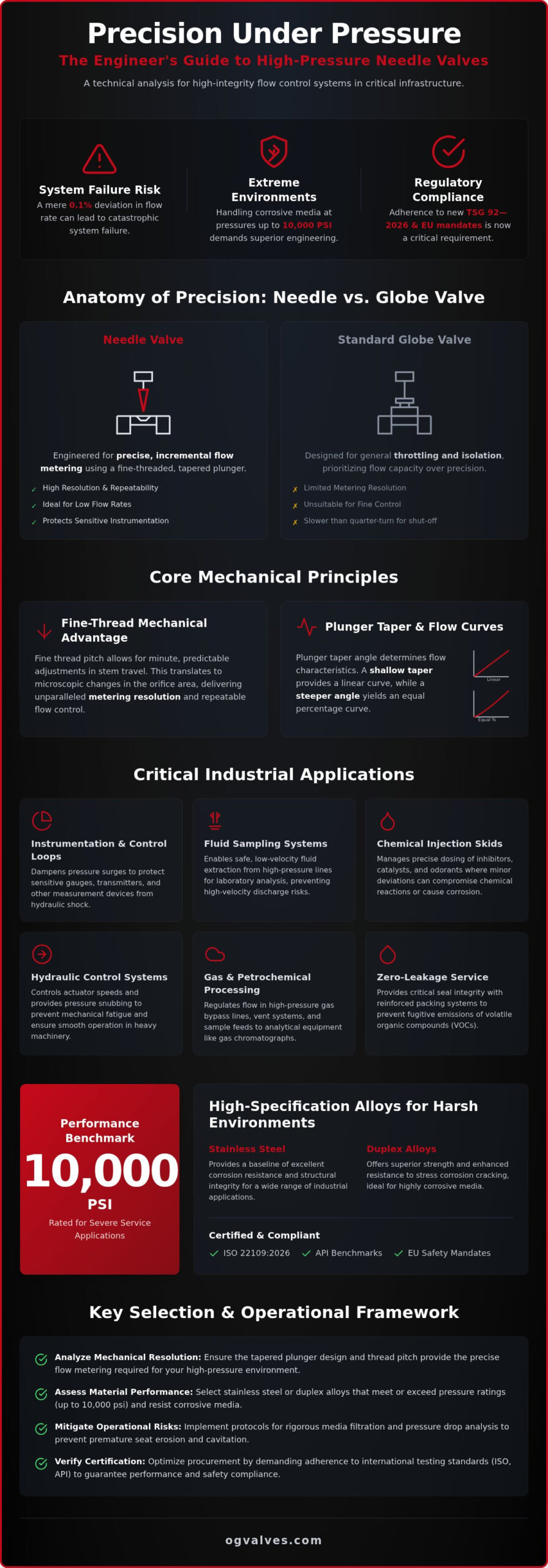
In critical infrastructure, a deviation of 0.1% in flow rate isn’t just an inefficiency; it’s a potential system failure. While standard globe or ball valves provide isolation, they lack the mechanical resolution required for the most demanding industrial needle valve applications. Engineering teams frequently encounter flow instability at low rates or premature seat degradation when handling corrosive media at 10,000 psi. These technical hurdles demand a clinical approach to valve selection that prioritizes structural soundness and precision over generic procurement strategies.
Managing precise control is increasingly complex as global regulations, such as the TSG 92—2026 standards and updated EU safety mandates, tighten requirements for pressure equipment. This guide provides a comprehensive technical analysis of needle valve engineering, focusing on material classifications and adherence to ISO 22109:2026 and API benchmarks. You’ll gain a framework for selecting high-spec alloys that resist wear in harsh environments. We also examine how to navigate the 2026 regulatory landscape to ensure your flow control systems meet the latest international safety and performance certifications.
Key Takeaways
- Analyze the mechanical resolution of tapered plunger designs to ensure precise flow metering in high-pressure environments.
- Identify the most effective industrial needle valve applications across instrumentation control loops and specialized fluid sampling systems.
- Assess material performance benchmarks for stainless steel and duplex alloys to meet pressure ratings up to 10,000 psi.
- Establish operational protocols to mitigate seat erosion and cavitation risks through rigorous media filtration and pressure drop analysis.
- Optimize procurement by verifying adherence to international testing standards and leveraging strategic inventory for fast-track project delivery.
Defining the Needle Valve as a Precision Metering Instrument
A needle valve is a multi-turn, fine-thread metering device engineered for the incremental regulation of fluid flow. Its primary function isn’t bulk isolation but the precise adjustment of flow rates in high-pressure systems. Unlike standard isolation valves, the needle valve utilizes a long, tapered plunger that fits into a precisely matched seat. This design creates a variable orifice that changes size gradually as the stem is rotated. In many industrial needle valve applications, this level of control is necessary to protect sensitive instrumentation or to maintain specific chemical concentrations in a process stream.
Distinguishing these instruments from globe valves is essential for system integrity. While globe valves are used for throttling, they prioritize flow capacity over precision. Needle valves offer superior resolution but limited flow volume. Consequently, they’re unsuitable for quick-acting isolation. The fine threads require multiple turns to fully open or close, which is too slow for emergency shut-off scenarios. Using a needle valve for frequent on/off service can also cause premature seat wear; this compromises the metal-to-metal seal required for precision metering.
The Mechanical Advantage of Fine-Thread Stems
The precision of a needle valve depends on its thread pitch. Fine threads allow for minute adjustments in stem travel, which translates to microscopic changes in the orifice opening area. This mechanical advantage ensures that even small rotations of the handle result in predictable, repeatable flow changes. Metering resolution is defined as the specific degree of incremental change in the orifice opening area achieved per unit of rotational stem travel. This resolution allows operators to calibrate flow with a high degree of accuracy. It’s a technical requirement in industrial needle valve applications involving high-pressure gasses or volatile chemicals.
Linear vs. Equal Percentage Flow Characteristics
The flow coefficient (Cv) in these valves is inherently low, often measured in fractions of a unit. Plunger taper angles directly influence the flow curve’s shape. A shallow taper angle provides a linear flow characteristic, where the flow rate increases at a constant rate relative to stem position. Conversely, steeper angles may result in equal percentage characteristics, where each turn of the stem changes the flow by a consistent percentage of the previous rate. Selecting the correct needle profile is a technical necessity. It ensures the valve matches the specific requirements of the control loop, whether the priority is constant sensitivity or rapid adjustment at higher flow rates.
Critical Applications Across Heavy Industrial Sectors
Precision in fluid dynamics is a prerequisite for safety in high-pressure environments. The primary industrial needle valve applications involve scenarios where flow velocity must be strictly governed to maintain system stability. In instrumentation and control loops, these valves serve as a critical defense for sensitive pressure gauges and transmitters. By dampening pressure surges, they prevent hydraulic shock from deforming sensing elements. Sampling systems also rely on this mechanical resolution; they facilitate safe, low-velocity fluid extraction for laboratory analysis from high-pressure process lines. This ensures that technicians can collect samples without the risks associated with high-velocity discharge.
Chemical injection skids utilize needle valves to manage the precise dosing of inhibitors, catalysts, and odorants. Even minor deviations in these flow rates can compromise chemical reactions or lead to equipment corrosion. Similarly, hydraulic control systems employ these instruments for managing actuator speeds and pressure snubbing. This controlled movement prevents mechanical fatigue in heavy machinery. For engineering teams overseeing these complex fluid systems, sourcing high-specification needle valves is essential for maintaining operational uptime and structural integrity.
Oil, Gas, and Petrochemical Processing
Petrochemical facilities integrate needle valves into high-pressure gas bypass lines and vent systems to manage differential pressures during startup sequences. These valves are standard in analytical instrumentation sheds, where they regulate the flow of process samples to gas chromatographs. With the 2026 enforcement of stricter VOC regulations, zero-leakage performance is no longer optional. Needle valves with reinforced packing systems provide the necessary seal integrity for volatile organic compound service. This prevents fugitive emissions and ensures that facilities remain compliant with updated international environmental standards.
Power Generation and Steam Systems
In power generation, needle valves are utilized in steam trap bypass and boiler feed-water sampling lines. These environments demand material classifications capable of withstanding extreme thermal cycling and high-temperature steam. Turbine control fluid systems also require the high-resolution metering provided by fine-thread stems to ensure precise mechanical response. For large-scale infrastructure, engineers often integrate these components with industrial valve actuators for remote precision control. This automation enables real-time flow adjustments from a centralized control room, which is a necessity for modern grid stability and safety protocols.

Engineering for severe service requires a rigorous evaluation of metallurgical properties and pressure-temperature ratings. In many industrial needle valve applications, standard materials fail when subjected to the 6000 or 10,000 psi demands of offshore or petrochemical systems. ASME B16.34 provides the essential regulatory framework for these pressure-temperature ratings, while API 6D considerations ensure that valves maintain structural integrity under high-load conditions. Procurement teams must prioritize forged bodies over cast alternatives to minimize porosity and ensure long-term reliability in high-cycle environments.
Pressure ratings are categorized by service severity. 3000 psi service is sufficient for general process control, but 6000 and 10,000 psi ratings are mandatory for hydraulic power units and high-pressure gas injection. Temperature performance depends largely on the selection of packing material. PTFE is the standard for chemical compatibility and low-friction operation up to 232°C; however, graphite packing is a technical necessity for steam or high-heat service to prevent thermal degradation and subsequent stem leakage.
Corrosion Resistance and NACE Compliance
Sour gas (H2S) environments demand strict adherence to NACE MR0175/ISO 15156 to prevent sulfide stress cracking and hydrogen embrittlement. In these scenarios, duplex or super duplex alloys provide the necessary yield strength and localized corrosion resistance. Positive Material Identification (PMI) is a non-negotiable step in high-stakes procurement. It verifies that the delivered chemical composition matches the mill test report. 316 stainless steel serves as the industry benchmark for corrosive needle valve applications because its molybdenum content provides essential resistance to pitting and crevice corrosion in chloride-rich environments.
Sealing Technology and Fugitive Emissions
Stem seal design is the primary factor in preventing fugitive emissions and maintaining environmental compliance. Chevron-style PTFE packing provides a self-energizing seal under pressure, while specialized O-rings offer a reliable solution for lower-temperature gas service. For high-temperature reliability, metal-to-metal seating ensures a bubble-tight shut-off by utilizing the mechanical force of the tapered plunger against the seat. Rigorous testing protocols, including hydrostatic and pneumatic seat leak tests, verify that each valve meets the zero-leakage requirements of modern safety standards. These processes ensure that the valve maintains its seal even under fluctuating thermal and pressure loads.
Strategic Integration and Operational Constraints in Fluid Systems
Successful deployment in industrial needle valve applications depends on strict adherence to media purity standards. These valves are precision-engineered instruments; even microscopic particulates can cause catastrophic seat erosion. When abrasive solids are carried through the narrow orifice at high velocities, they induce a phenomenon known as wire-drawing. This creates permanent leak paths across the metal-to-metal seal. Upstream filtration is a non-negotiable technical requirement to ensure the longevity of the matched plunger and seat assembly. Without clean media, the resolution of the valve’s metering capability degrades rapidly.
In liquid service, engineers must account for cavitation risks during high-pressure drop scenarios. If the local pressure within the valve body falls below the fluid’s vapor pressure, vapor bubbles form and subsequently collapse. This results in localized shockwaves that pit the internal components and compromise structural integrity. Maintenance protocols should prioritize regular inspections for stem galling and seat deformation, especially in high-cycle systems. For facilities requiring immediate replacements or upgrades, you can request a technical quote for high-spec needle valves to ensure system-wide reliability.
Managing Pressure Drops and Flow Velocity
Calculating the pressure drop across the needle valve orifice is essential for determining the flow coefficient (Cv) requirements. High-velocity flow doesn’t just increase erosion; it can also induce vibration that leads to fatigue in small-bore tubing. Proper installation requires adequate support and orientation according to the manufacturer’s flow direction markers. To protect metering lines from reverse flow during system surges, it’s common practice to link needle valves with industrial check valves. This integration maintains the integrity of the control loop and prevents the back-pressure damage of sensitive instrumentation.
Preventing Failure through Proper Sizing
A frequent error in fluid system design is over-sizing needle valves for small-bore applications. While a larger valve might seem robust, it significantly reduces control sensitivity. If a valve is too large for the required flow, the plunger operates too close to the seat, increasing the risk of erosion and making fine adjustments nearly impossible. Engineers should consult the comprehensive guide to industrial valves to align valve sizing with specific process parameters. Correct sizing ensures the stem remains in the optimal throttling range, preserving the mechanical resolution of the fine-thread stem.
Optimising Procurement for High-Specification Needle Valves
Strategic procurement for industrial needle valve applications requires a partner capable of mitigating supply chain volatility through robust inventory management. In 2026, global industrial markets face significant cost pressures; for instance, stainless steel prices in the USA reached approximately USD 2,365.86/MT as of June. Minimizing facility downtime during unplanned maintenance or large-scale turnarounds depends on the immediate availability of high-pressure components that meet exact engineering specifications. Relying on standard lead times for custom-engineered valves often results in unacceptable delays for critical infrastructure projects.
OG Valves operates as a technical partner by maintaining an extensive inventory of needle valves in various high-spec alloys, ensuring fast-track global delivery. This logistics capability is essential for heavy industry sectors like oil, gas, and power generation, where operational output is directly linked to the reliability of the supply chain. By positioning stock strategically, the organization supports the urgent requirements of global projects, providing a clinical focus on durability and regulatory adherence that procurement specialists require for high-stakes environments.
Quality Assurance and Certification Documentation
Technical experts require comprehensive documentation to verify that components meet international engineering benchmarks. Every high-specification valve must be accompanied by 3.1 Material Certificates and detailed pressure test reports. This ensures full traceability and validates that the metallurgical properties match the requirements of the specified service environment. Standardization of these components across global projects simplifies maintenance protocols and reduces the volume of spare parts required on-site. OG Valves anchors its supply process in rigorous testing and quality control, providing the necessary validation for safety-critical industrial environments.
Technical Support for Procurement Specialists
Navigating complex RFQs for multi-valve industrial projects requires a deep understanding of fluid dynamics and material compatibility. Procurement specialists often face the challenge of verifying that selected valves meet specific high-pressure certifications, such as 10,000 psi ratings or NACE compliance for sour gas service. Leveraging expert technical support helps avoid costly material and specification mismatches that lead to premature equipment failure. Streamlining the supply chain for urgent MRO requirements is a core capability; it ensures that technical experts receive the precise data points needed for project approval without the use of unnecessary filler or transitions.
Advancing Flow Precision in Critical Infrastructure
Achieving long-term operational output in high-pressure environments requires a clinical focus on material compatibility and mechanical resolution. Industrial needle valve applications in the oil, gas, and power sectors demand adherence to rigorous standards like ISO 9001 and API 6D to prevent system failure. By prioritizing forged body designs and matched plunger-seat assemblies, engineers can mitigate risks associated with cavitation and particulate erosion. These technical considerations are essential for maintaining the structural soundness of sensitive instrumentation loops.
Managing procurement for critical infrastructure shouldn’t be a bottleneck for project timelines. OG Valves facilitates these engineering requirements through an extensive inventory and fast-track global delivery. Our expert technical support ensures that every component aligns with your project’s specific high-specification demands and regulatory benchmarks. To secure reliable components for your next facility maintenance or turnaround, Request a Technical Quote for Industrial Needle Valves today. We look forward to supporting your high-precision flow control objectives.
Frequently Asked Questions
What is the primary function of a needle valve in an industrial fluid system?
The primary function of a needle valve is the precise regulation and metering of fluid flow in low-flow rate scenarios. Unlike standard valves that prioritize bulk volume, the needle valve utilizes a tapered plunger to achieve incremental mechanical adjustments. This high-resolution control is vital in industrial needle valve applications where protecting sensitive pressure gauges or maintaining specific chemical dosing rates is a technical requirement for overall system stability.
Can needle valves be used as primary isolation or shut-off valves?
Needle valves aren’t recommended for primary isolation or emergency shut-off service. Their fine-thread stems require multiple rotations to achieve a full seal; this is too slow for critical safety isolations. Additionally, frequent on/off cycling can cause premature deformation of the metal-to-metal seat. For bulk isolation, ball or gate valves are superior. Needle valves should be reserved for throttling and high-resolution flow control within a process loop.
Why is clean media essential for the operation of needle valves?
Clean media is essential because the narrow orifice and matched seat are highly susceptible to erosion from particulates. Solid contaminants traveling at high velocities induce wire-drawing; this creates permanent leak paths across the sealing surfaces. In various industrial needle valve applications, upstream filtration must be implemented to prevent this degradation. Maintaining fluid purity ensures the long-term integrity of the tapered plunger and the accuracy of the metering resolution.
What are the typical pressure ratings for industrial needle valves?
Typical pressure ratings for high-specification industrial needle valves include 3,000, 6,000, and 10,000 psi classes. Selection depends on the specific operational demands of the system, such as offshore hydraulic units or high-pressure gas injection lines. These ratings must align with ASME B16.34 standards to ensure structural soundness. Forged body constructions are typically utilized for the 10,000 psi class to provide the necessary safety margins in severe service environments.
How do needle valves differ from globe valves in throttling applications?
Needle valves differ from globe valves primarily in their degree of metering resolution and flow capacity. While both are used for throttling, globe valves are designed for higher flow volumes with less precision. Needle valves utilize a much finer thread pitch and a more gradual plunger taper, allowing for microscopic adjustments. This makes them the preferred instrument for low-flow control loops where a globe valve’s adjustment increments would be too coarse.
What materials are best suited for needle valves in corrosive petrochemical environments?
316 stainless steel is the industry benchmark for corrosive petrochemical service due to its molybdenum content. However, for sour gas environments containing H2S, duplex or super duplex alloys are required to meet NACE MR0175/ISO 15156 standards. These materials provide the necessary resistance to sulfide stress cracking and pitting. Selecting high-spec alloys ensures that the valve body and internal components maintain their structural integrity against aggressive chemical media.
Are needle valves compatible with automated actuators for remote control?
Needle valves are compatible with automated actuators for remote precision control in modernized industrial facilities. Multi-turn electric or pneumatic actuators are integrated with the valve stem to facilitate real-time adjustments from a centralized control room. This setup is common in large-scale power generation and chemical processing plants. It allows for high-resolution flow management without manual intervention, which is necessary for maintaining grid stability or complex reaction parameters.
What industry standards govern the design and testing of needle valves?
The design and testing of needle valves are governed by international benchmarks including ASME B16.34 for pressure-temperature ratings and API 6D for pipeline service. For corrosive environments, NACE MR0175/ISO 15156 defines material requirements for sour service. Additionally, ISO 9001 certified quality management systems ensure that manufacturing processes remain consistent. Adhering to these standards is a non-negotiable requirement for verifying the safety and reliability of components in heavy industrial infrastructure.
 Responsive Menu