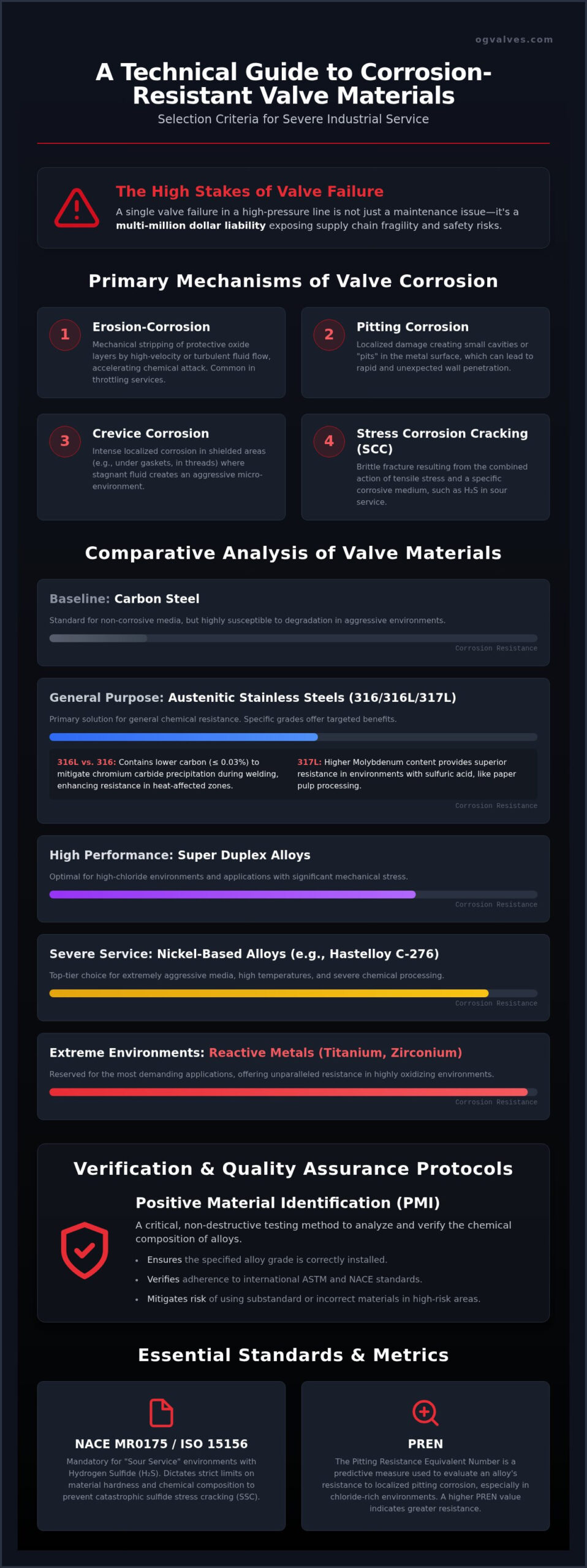
A single valve failure in a high-pressure chemical line is not just a maintenance ticket; it’s a multi-million dollar liability that exposes the fragility of an unverified supply chain. Selecting the correct corrosion resistant valve materials requires more than a cursory review of chemical compatibility charts. You know that the margin for error is non-existent when dealing with aggressive media and stringent regulatory environments. The complexity of adhering to NACE MR0175/ISO 15156 while managing the risk of receiving sub-standard alloys can overwhelm even the most experienced procurement teams.
This guide provides a clinical, technical breakdown of high-performance alloys and the rigorous selection criteria necessary for severe industrial service. We’ll examine the structural soundness of specific grades, such as Hastelloy C-276 and high-spec stainless steels, within the context of the latest 2026 engineering standards. You’ll gain a clear understanding of the mandatory verification protocols, including Positive Material Identification (PMI) testing, required to ensure operational output and safety. This analysis moves from identifying specific chemical needs to establishing the quality control benchmarks that define a reliable global supply partner.
Key Takeaways
- Identify the specific electrochemical degradation and erosion-corrosion mechanisms that compromise the structural integrity of metallic valve components in high-velocity industrial flows.
- Compare high-performance corrosion resistant valve materials, including austenitic and Super Duplex alloys, to determine the optimal grade for specific chloride and pH environments.
- Evaluate how thermal expansion and media composition influence the selection of valve trim and body materials for high-pressure, severe-service applications.
- Implement rigorous quality assurance protocols, such as Positive Material Identification (PMI), to verify adherence to international ASTM and NACE material standards.
- Mitigate the risk of operational downtime by leveraging specialist global supply chains for high-specification industrial valves and fast-track delivery requirements.
Mechanisms of Valve Corrosion in Industrial Environments
Industrial valve corrosion is the electrochemical degradation of metallic components resulting from their interaction with the surrounding environment. This process fundamentally alters the material properties, leading to loss of structural integrity and eventual component failure. Understanding the Mechanisms of Valve Corrosion is critical for engineers tasked with infrastructure longevity. In high-velocity flow applications, such as those involving globe valves or butterfly valves, the mechanical action of the fluid often strips away protective oxide layers. This phenomenon, known as erosion-corrosion, accelerates the underlying chemical attack. This is particularly prevalent in throttling services where turbulence is localized at the valve trim.
Operating temperature and chemical concentration serve as primary catalysts for material degradation. As temperature increases, the rate of chemical reactions typically doubles for every 10-degree Celsius rise, intensifying the demand for high-performance corrosion resistant valve materials. Higher concentrations of acids or alkalis similarly decrease the incubation period for localized attacks. Pitting corrosion is localized damage that results in the formation of small cavities, which can lead to rapid wall penetration.
Pitting and Crevice Corrosion
Stagnant fluids trapped in valve seats, gaskets, or threaded joints often trigger localized crevice corrosion. These shielded areas facilitate the accumulation of corrosive species, creating an aggressive micro-environment that differs from the bulk fluid composition. Engineers rely on the Pitting Resistance Equivalent Number (PREN) to evaluate the suitability of an alloy for these conditions. Austenitic stainless steels, such as Grade 316, face significant risks in chloride-rich environments where the PREN value may be insufficient to prevent localized breakdown of the passive film. Higher alloyed materials are required to maintain surface passivity in these zones.
Stress Corrosion Cracking (SCC) and Sour Service
Stress Corrosion Cracking (SCC) represents a complex failure mode where the synergy between tensile stress and a specific corrosive medium leads to brittle fracture. In oil and gas applications, the presence of Hydrogen Sulfide (H2S) defines sour service conditions, necessitating adherence to NACE MR0175/ISO 15156. This standard dictates strict limits on material hardness and chemical composition to prevent sulfide stress cracking. Selecting corrosion resistant valve materials for these environments requires verified compliance with these international benchmarks to ensure the safety of critical infrastructure. Material verification through PMI testing is essential to confirm that the specified alloy grade is correctly installed in these high-risk areas.
Metallic selection for industrial service follows a rigorous hierarchy defined by chemical compatibility and mechanical endurance. While carbon steel remains the baseline for non-corrosive media, the transition to corrosion resistant valve materials becomes mandatory when process fluids introduce oxidation or chloride-induced stress. Technical experts often consult The A to Z of Valve Materials to navigate the vast spectrum of metallurgical options available for critical infrastructure. Austenitic stainless steels, specifically Grades 304, 316, and 317, serve as the primary solution for general chemical resistance. However, as fluid aggressiveness increases, engineers must escalate to nickel-based alloys or reactive metals like Titanium and Zirconium to prevent catastrophic wall thinning in highly oxidizing environments.
Stainless Steel Grades in Valve Manufacturing
The distinction between Grade 316 and 316L is a critical specification point for procurement specialists. Grade 316L contains a lower carbon content, typically capped at 0.03%, which mitigates the risk of chromium carbide precipitation during welding. This enhances intergranular corrosion resistance in heat-affected zones. Grade 317L, characterized by its higher molybdenum content, provides superior performance in flue gas desulfurization and paper pulp processing where sulfuric acid concentrations are elevated. Standard austenitic grades exhibit significant limitations in high-chloride seawater applications. In these environments, pitting and crevice corrosion occur rapidly, necessitating a shift toward alloys with a higher Pitting Resistance Equivalent Number (PREN).
Exotic Alloys and Super Duplex Specifications
Super Duplex alloys, such as ASTM A890, have emerged as the benchmark for high-strength, chloride-resistant service. These materials are frequently specified for offshore ball valves due to their exceptional yield strength and resistance to stress corrosion cracking. For extreme acid service, nickel-based alloys offer unparalleled durability. Hastelloy C276 maintains structural integrity in both oxidizing and reducing environments, including sulfuric and phosphoric acid processes. Monel 400 remains the industry standard for hydrofluoric acid handling and marine engineering. As of August 2026, finished product prices for Hastelloy C-276 range from $35 to $85 per kg, reflecting its status as a high-value asset for severe service. Procuring these corrosion resistant valve materials from a verified partner like OG Valves ensures that material certifications align with project-specific regulatory benchmarks and safety protocols.
Strategic Material Selection for Severe Service Applications
Engineering selection of corrosion resistant valve materials requires a clinical evaluation of the process media’s chemical and thermal profile. Media composition, specifically pH levels and chloride concentration, dictates the baseline metallurgical requirements. In sour service environments, adherence to NACE MR0175/ISO 15156 is mandatory to prevent sulfide stress cracking, a failure mode that often remains undetected until catastrophic rupture. Beyond chemistry, temperature-pressure ratings determine the mechanical suitability of the valve. Thermal expansion coefficients must be aligned between the body and trim to prevent binding or seat leakage at elevated temperatures. While high-performance alloys increase initial procurement costs, they significantly reduce the Total Cost of Ownership (TCO) by extending service intervals from 12 months to 36 months in many aggressive applications.
Material Selection for Gate and Globe Valves
The design of gate valves necessitates high-hardness trim materials to resist galling and mechanical wear during operation. Stellite overlays are frequently specified for seating surfaces to maintain a bubble-tight seal under high-differential pressures. In contrast, globe valves utilized for throttling service face intense erosion-corrosion due to localized turbulence. Hardened alloys or ceramic inserts are required to withstand the high-velocity fluid impingement that occurs near the seat. Engineers must also verify body-to-trim compatibility to prevent galvanic corrosion, which occurs when dissimilar metals are coupled in a conductive electrolyte.
Check Valve and Butterfly Valve Considerations
Reliable operation of check valves depends on the integrity of the disc and seat interface. In severe service, even minor pitting can lead to backflow failure and downstream equipment damage. Aluminum Bronze is the preferred selection for seawater check valves due to its inherent resistance to biofouling and cavitation. High-performance butterfly valves often utilize non-metallic liners or elastomers for sealing. Selection must account for chemical swelling and thermal degradation. For aggressive media, PTFE or reinforced graphite seals provide the necessary chemical inertness. Integrating these corrosion resistant valve materials into critical infrastructure ensures long-term operational output and adherence to global safety benchmarks.
Verification and Quality Assurance Protocols for Corrosion Resistance
Material selection is only as reliable as the verification protocols used to validate the alloy. In high-stakes industrial environments, the risk of receiving sub-standard corrosion resistant valve materials poses a direct threat to infrastructure safety and operational output. Adherence to API 600 and API 6D standards ensures that valves meet the required wall thickness and structural integrity benchmarks for heavy industrial service. These standards dictate the baseline for non-destructive testing (NDT), including dye penetrant inspection for identifying surface defects and radiographic inspection for verifying internal casting volumetric integrity. Without these clinical verification steps, the theoretical performance of an alloy cannot be guaranteed in the field.
The Process of Positive Material Identification (PMI)
Positive Material Identification (PMI) serves as the primary technical safeguard against alloy mix-ups in the global supply chain. Handheld X-ray Fluorescence (XRF) analyzers allow for the verification of elemental composition in seconds without compromising the component’s structural integrity. This process is mandatory for valves intended for high-pressure petrochemical service, where even a minor deviation in chromium or molybdenum content leads to premature failure. A comprehensive PMI protocol must verify the chemistry of the valve body, bonnet, and stem independently to ensure the entire assembly meets the engineering specification. This methodical approach eliminates the risk of installing a valve with a non-compliant trim that could fail under aggressive chemical attack.
Corrosion Testing Standards (ASTM G48 and others)
Laboratory testing provides the empirical data needed to validate the long-term performance of high-performance alloys. ASTM G48 testing remains the industry standard for evaluating the pitting and crevice corrosion resistance of duplex and super duplex alloys in chloride-rich environments. For austenitic stainless steel grades, intergranular corrosion testing under ASTM A262 is utilized to detect susceptibility to sensitization in heat-affected zones. These tests are often supplemented by ASTM G31-21(2025) protocols to determine general corrosion rates in specific media. Material Test Reports (MTRs) must be verified against physical PMI results to ensure total traceability. Procurement specialists should prioritize suppliers who anchor their quality control in these rigorous testing regimes. OG Valves LTD. provides technical expertise in PMI testing and maintains a specialist inventory of high-specification valves to ensure your project meets the highest safety and engineering benchmarks.
Procuring High-Specification Valves for Critical Infrastructure
Selecting the correct metallurgy is only half the engineering challenge. The procurement phase represents the most significant risk to project timelines and operational safety. Working with specialist industrial valve suppliers ensures that the technical specifications established during the design phase are translated accurately into physical assets. In a global industrial valves market valued at $84.1 billion in 2026, the complexity of international supply chains requires a partner who understands the clinical necessity of material verification. OG VALVES LTD. maintains an unwavering focus on technical precision and rigorous quality control to mitigate the risks associated with severe service environments. This commitment ensures that every component, from high-performance gate valves to specialized needle valves, meets the exact requirements for corrosion resistant valve materials.
Managing Lead Times for Exotic Materials
Procuring exotic alloys like Hastelloy C-276 or Super Duplex often involves manufacturing lead times that can exceed 30 weeks if sourced directly from mills. Leveraging a specialist inventory allows operators to bypass these bottlenecks. Global logistics capabilities are essential for supporting international industrial facilities where a single day of unplanned downtime results in multi-million dollar losses. Fast-track delivery protocols ensure that critical infrastructure projects remain on schedule despite the volatility of raw material prices, such as the $3.06/kg rate for stainless steel in North America recorded in August 2026. Streamlined procurement processes are the only way to maintain operational output in high-stakes sectors. By maintaining a deep stock of high-specification gate, ball, and globe valves, a supplier can provide the immediate response required for emergency shutdowns or urgent project expansions.
Partnering for Technical Excellence
Technical expertise is as vital as the physical component in the oil, gas, and power sectors. Regulatory adherence to NACE and ASTM standards is a fundamental safety requirement rather than an optional benchmark. OG VALVES LTD. acts as a dependable partner by providing comprehensive project management and custom technical support for complex material specifications. This partnership approach ensures that material grades are correctly matched to specific chemical media, preventing the localized pitting or stress corrosion cracking failures discussed in previous sections. Verification through PMI testing is integrated into the supply chain to provide absolute traceability and peace of mind for procurement specialists. Contact OG Valves for a technical consultation or quote on high-spec valves.
Securing Operational Output Through Material Excellence
Engineering durability in severe service environments requires a clinical approach to metallurgical selection. We’ve analyzed the mechanisms of electrochemical degradation and the specific performance profiles of high-performance alloys. Adhering to the latest 2026 standards, such as NACE MR0175 and ASTM G31-21(2025), is the only verified method to ensure long-term structural integrity. Integrating corrosion resistant valve materials like Super Duplex or nickel-based alloys into your infrastructure provides the necessary resistance to pitting and stress corrosion cracking that defines severe service applications.
OG VALVES LTD. acts as a dependable partner by providing comprehensive PMI testing for all high-alloy components. Our specialist inventory of gate, globe, and ball valves in exotic grades is available for global fast-track delivery to ensure minimal industrial downtime. It’s a strategic necessity to partner with a technical expert who understands the clinical cost of failure and the importance of rigorous regulatory adherence. Secure your next critical infrastructure project with precision-engineered solutions that meet the highest global benchmarks.
Request a Technical Quote for High-Specification Industrial Valves
Frequently Asked Questions
What is the most corrosion-resistant material for industrial valves?
Tantalum and Zirconium offer the highest resistance in specific oxidizing environments, though nickel-based alloys like Hastelloy C-276 are the industrial standard for broad-spectrum chemical service. These alloys maintain structural integrity where standard stainless steels fail. Selecting the correct corrosion resistant valve materials involves matching the specific redox potential of the process media to the alloy’s passivity range. Titanium remains a critical choice for high-strength, low-weight applications in oxidizing chloride solutions.
How does NACE MR0175 compliance affect valve material selection?
NACE MR0175/ISO 15156 establishes strict metallurgical requirements for valves used in sour service environments containing Hydrogen Sulfide (H2S). Compliance requires specific limits on material hardness and chemical composition to mitigate the risk of Sulfide Stress Cracking (SSC). Engineers must verify that every component, including the body and trim, meets these international benchmarks. This often necessitates specialized heat treatment processes to ensure the material remains within the mandated hardness ranges for safe operation.
What is the difference between 316 and 316L stainless steel for valves?
The primary technical distinction lies in the carbon concentration. Grade 316L contains a maximum of 0.03% carbon, whereas standard 316 allows up to 0.08%. This lower carbon content prevents chromium carbide precipitation at grain boundaries during welding processes. By maintaining chromium levels throughout the matrix, 316L provides superior resistance to intergranular corrosion in heat-affected zones. This makes it the preferred specification for welded valve assemblies in aggressive chemical service.
Why is PMI testing necessary for corrosion-resistant valves?
Positive Material Identification (PMI) is a clinical safeguard against alloy mix-ups within the global procurement chain. It provides empirical verification of elemental composition using handheld XRF analyzers. This testing ensures that the delivered valve matches the engineering specification and the provided Material Test Report (MTR). For high-pressure petrochemical service, PMI is mandatory to prevent the installation of non-compliant corrosion resistant valve materials that could lead to catastrophic failure.
Can I use standard stainless steel valves in seawater applications?
Standard austenitic stainless steels like 304 and 316 are generally unsuitable for long-term seawater immersion. These grades frequently suffer from localized pitting and crevice corrosion due to the high chloride concentration. For reliable offshore or marine service, engineers specify Super Duplex alloys or Aluminum Bronze. These materials offer the high Pitting Resistance Equivalent Number (PREN) required to maintain a stable passive film in saline environments, significantly extending the valve’s operational lifecycle.
What is PREN and how is it calculated for valve alloys?
The Pitting Resistance Equivalent Number (PREN) is a quantifiable index used to rank alloys by their resistance to localized pitting. The standard formula is PREN = %Cr + 3.3(%Mo + 0.5%W) + 16(%N). Higher values indicate a more robust passive layer. For example, Super Duplex alloys typically feature a PREN greater than 40, making them suitable for severe chloride service. This calculation serves as a primary screening tool during the initial material selection phase.
How do temperature fluctuations affect the corrosion resistance of alloys?
Temperature increases typically accelerate the rate of electrochemical degradation. For every 10-degree Celsius rise, the chemical reaction rate often doubles, placing higher demands on the alloy’s passivity. Thermal fluctuations also induce mechanical stress through differential expansion between the valve body and trim. This cycling can lead to the breakdown of protective oxide scales or trigger Stress Corrosion Cracking (SCC) in susceptible materials. Selection must account for the maximum operating temperature of the process.
Which valve type is best for highly corrosive chemical throttling?
Globe valves are the technically superior choice for throttling service due to their precise flow control and pressure-drop capabilities. In highly corrosive environments, these valves require hardened trim materials, such as Stellite or ceramic inserts, to resist erosion-corrosion. The high-velocity fluid impingement at the seat can rapidly strip away passive films on standard alloys. Proper selection ensures that both the body and the internal components can withstand the mechanical and chemical stresses of throttling.
 Responsive Menu