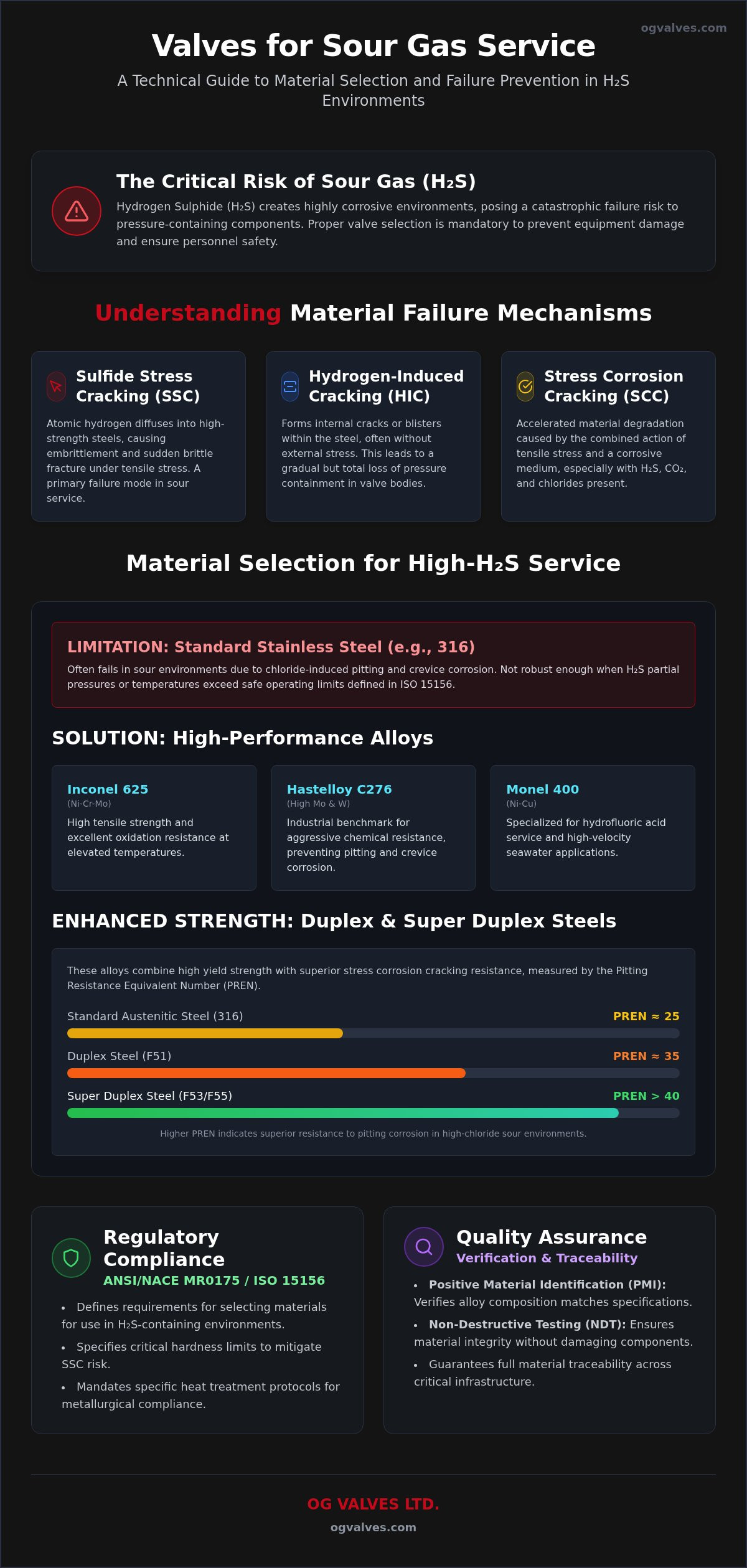
The failure of a single pressure-containing component in H2S-saturated environments represents a catastrophic risk to personnel and infrastructure, yet the global oil and gas valve market is expanding toward a 16.27 billion dollar valuation by 2030. Engineers and procurement specialists recognize that the selection of valves for sour gas applications requires absolute adherence to metallurgical constraints to prevent sulfide stress cracking and hydrogen-induced damage. This technical discipline is mandatory for maintaining the structural integrity of critical infrastructure under extreme pressure.
This article delivers a clinical analysis of exotic alloy performance, current ANSI/NACE MR0175-2021/ISO 15156:2020 regulatory standards, and procurement strategies for high-pressure service. It examines the technical specifications of nickel-based alloys, the role of Positive Material Identification in ensuring full material traceability, and methodologies for securing fast-track delivery of high-specification gate, ball, and check valves.
By prioritizing engineering excellence and rigorous testing protocols, operators can mitigate the risks of regulatory non-compliance and costly project delays. The following sections detail the engineering benchmarks and material classifications required to maintain operational output in the most demanding sour service environments.
Key Takeaways
- Identify the electrochemical mechanisms of Sulfide Stress Cracking (SSC) to effectively specify valves for sour gas applications in high-pressure environments.
- Evaluate the performance characteristics of nickel-based alloys and super duplex steels to ensure chemical inertness against Hydrogen Sulphide and chloride-induced corrosion.
- Implement the requirements of ANSI/NACE MR0175/ISO 15156, including critical hardness limits and heat treatment protocols for metallurgical compliance.
- Utilize a data-driven engineering framework to match valve metallurgy with specific H2S partial pressures and chloride concentrations.
- Verify material integrity through rigorous Positive Material Identification (PMI) and Non-Destructive Testing (NDT) to ensure full traceability across critical infrastructure.
Understanding Sour Gas Environments and Material Failure Mechanisms
Sour gas is characterized by significant concentrations of Hydrogen Sulphide (H2S), a highly toxic and corrosive compound. In upstream and midstream operations, the presence of H2S initiates complex electrochemical reactions that compromise the structural integrity of metallic components. When selecting valves for sour gas applications, engineers must account for the partial pressure of H2S. This value determines the severity of the corrosive environment and dictates the required metallurgy to ensure safe containment.
Sulphide Stress Cracking (SSC) occurs when atomic hydrogen, produced by the corrosion reaction, diffuses into the metal lattice. In high-strength steels, this leads to embrittlement and sudden, brittle fracture under tensile stress. Hydrogen-Induced Cracking (HIC) differs by forming internal cracks or blisters along the rolling direction of the steel, often without external stress. Both mechanisms can lead to a total loss of pressure containment in valve bodies and internals. It’s often the case that standard carbon steels and low-alloy steels are particularly vulnerable without specific heat treatments and hardness controls.
The Limitations of Standard Stainless Steel in Sour Service
Standard austenitic grades like 316 stainless steel often fail in sour environments due to chloride-induced pitting and crevice corrosion. Offshore environments exacerbate this through high salinity and humidity. Stress Corrosion Cracking (SCC) pathways develop when tensile stress meets a corrosive medium. The synergy between H2S, CO2, and chlorides accelerates material degradation. It’s simply not robust enough when H2S partial pressures or temperatures exceed the safe operating limits defined in ISO 15156, necessitating a shift to higher-specification alloys.
Economic Risks of Material Failure
Material failure in critical infrastructure results in substantial financial losses. Unplanned shutdowns in midstream facilities can cost hundreds of thousands of dollars per day in lost throughput and emergency repair labor. Beyond the financial impact, valve seal failures present severe environmental and safety risks that damage corporate reputation. While standard industrial valves are cost-effective for benign service, the technical justification for exotic alloys lies in their ability to prevent catastrophic failure. Specifying high-performance valves for sour gas applications ensures long-term operational reliability and adherence to global safety benchmarks.
Material Specifications: Exotic Alloys for High-H2S Service
Nickel-based alloys represent the primary metallurgical defense against the electrochemical degradation mechanisms inherent in H2S-rich environments. Inconel 625 utilizes a nickel-chromium-molybdenum matrix to deliver high tensile strength and oxidation resistance at elevated temperatures. Hastelloy C276 remains the industrial benchmark for aggressive chemical resistance. Its high molybdenum and tungsten content prevents localized pitting and crevice corrosion in stagnant media. Monel 400, a nickel-copper alloy, is reserved for specialized hydrofluoric acid service and high-velocity seawater applications where austenitic grades fail. Failure to select appropriate metallurgy in H2S service poses significant health and safety hazards to facility personnel and the environment.
Duplex and Super Duplex (F51, F53, F55)
Duplex stainless steels utilize a balanced ferritic-austenitic microstructure to combine high yield strength with superior stress corrosion cracking resistance. The Pitting Resistance Equivalent Number (PREN) serves as the critical metric for material selection. Super Duplex grades like F55 typically maintain a PREN above 40, ensuring stability in high-chloride sour environments. The mechanical strength advantages of these alloys are particularly critical for the structural integrity of high-pressure industrial ball valves. Engineers must strictly observe temperature limits, as duplex steels are susceptible to phase transformation and 475°C embrittlement when operated outside the -50°C to 280°C range.
Specialist Metallurgy for Oxidative and Acidic Media
Titanium and Zirconium are specified for highly oxidative or acidic sour media where conventional alloys demonstrate insufficient passivity. Alloy 20 and 904L provide targeted resistance in environments containing high concentrations of sulphuric or phosphoric acids alongside H2S. These materials are often required for valves for sour gas applications involving complex, multi-component chemical compositions. As of August 2026, raw material costs for Inconel alloys range from $46 to $58 per kilogram, while Hastelloy C276 can reach $85 per kilogram for finished components. These costs reflect the technical complexity and performance reliability of high-specification metallurgy.
For precise metallurgical selection and fast-track procurement of NACE-compliant components, the technical specialists at OG VALVES provide comprehensive material verification and engineering support.
Regulatory Standards and Compliance: NACE MR0175 and ISO 15156
The technical foundation for selecting materials in H2S-containing environments is established by NACE MR0175 and ISO 15156. This unified international standard defines the specific environmental limits, including H2S partial pressure, temperature, and pH levels, where various alloys remain resistant to sulfide stress cracking (SSC) and stress corrosion cracking (SCC). For engineers specifying valves for sour gas applications, absolute adherence to these limits is a prerequisite for operational safety. The current active version, ANSI/NACE MR0175-2021/ISO 15156:2020, provides the clinical data required to match metallurgy with the severity of the sour service. As of 2026, a major restructuring of this standard is in progress to further refine material processing and verification requirements for increasingly harsh downhole environments.
Manufacturing standards like API 6D for pipeline service and API 600 for heavy-duty gate valves provide the structural engineering framework, but the metallurgy must also align with ASTM and ASME specifications for exotic castings and forgings. These benchmarks ensure that the valve body, bonnet, and trim components possess the necessary mechanical properties to withstand high-pressure differentials while maintaining chemical passivity. Rigorous adherence to these global standards eliminates the ambiguity often found in generic material specifications.
Understanding Hardness and Heat Treatment Requirements
The 22 HRC (Rockwell C) hardness limit is the engineering cornerstone for carbon and low-alloy steels in sour service. Exceeding this threshold increases the risk of hydrogen-induced embrittlement. Achieving compliance requires precise heat treatment protocols, such as solution annealing followed by rapid quenching for nickel alloys. Documentation is mandatory. Every component must be supported by Material Test Reports (MTR) that verify chemical composition and hardness values. Without full material traceability and certified hardness data, a valve cannot be validated for NACE-compliant service.
Dual-Use Regulations and Export Controls
Procuring high-specification valves for sour gas applications often involves navigating complex dual-use regulations. High-nickel alloys like Inconel 625 and Hastelloy C276 are frequently subject to export controls, such as EC 428/2009, due to their performance in sensitive industrial sectors. Procurement specialists must often provide End-User Statements (EUS) to facilitate the international transit of these components. Global supply chain volatility, influenced by nickel prices which stood at approximately $16,857.95 per ton in August 2026, further emphasizes the need for strategic planning in critical infrastructure projects. Managing these regulatory and economic variables is essential for preventing project delays in high-stakes industrial environments.
The precise selection of valves for sour gas applications depends on a clinical analysis of the process media composition. Engineers must differentiate between Sweet Service, characterized by CO2 presence, and Sour Service, defined by H2S concentrations. CO2 induces sweet corrosion, a weight-loss mechanism where carbonic acid causes uniform metal thinning. Sour service introduces the risk of localized, brittle cracking that can occur without visible material loss. It’s the electrochemical reality of the wellbore that dictates whether a standard alloy or an exotic specification is required for safe containment.
Offshore environments introduce high chloride concentrations that significantly impact the longevity of check valves. Chloride-induced pitting is a primary concern for internal sealing faces, where even minor localized corrosion can lead to backflow and system failure. In these high-salinity environments, materials with a Pitting Resistance Equivalent Number (PREN) exceeding 40, such as Super Duplex F55, are often the minimum engineering requirement to maintain passivity.
Deepwater wells often operate under High-Pressure High-Temperature (HPHT) conditions, creating a synergistic effect that accelerates corrosion. High-velocity gas flows containing sand or particulates introduce erosion-corrosion risks. This mechanical wear strips the protective oxide layer from the valve internals, exposing fresh metal to the H2S-rich environment and rapidly accelerating the rate of hydrogen diffusion into the substrate.
Alloy Selection for Sour Gas (H2S)
Mapping H2S partial pressure against pH levels is the standard methodology for determining material suitability under ISO 15156. Standard Duplex (F51) often reaches its performance limit when pH levels drop or H2S partial pressure exceeds 0.05 psi. Super Duplex grades provide a necessary buffer in moderately sour environments. For high-concentration H2S service, nickel-based alloys like Hastelloy C276 are the only viable solution to prevent sulfide stress cracking and ensure long-term structural integrity.
Sealing Material Compatibility in Sour Service
Soft sealing components must demonstrate chemical and mechanical stability in H2S-rich media. While PTFE and PEEK are standard, they must be specified with Explosive Decompression (ED) resistance for high-pressure service. Rapid system depressurization can cause absorbed gas to expand violently within the seal structure, leading to internal ruptures. Metal-to-metal sealing remains the superior engineering choice for high-temperature sour service, providing a robust, wear-resistant barrier that soft seals cannot match in extreme conditions.
To secure high-performance components that meet these rigorous engineering benchmarks, consult with the technical team at OG VALVES for specialized material specifications and fast-track procurement.
Quality Assurance and Global Procurement for Critical Infrastructure
The final stage of commissioning critical infrastructure requires absolute validation of metallurgical integrity. In high-pressure sour service, quality assurance is the only safeguard against the catastrophic failure mechanisms discussed in previous sections. Non-Destructive Testing (NDT) protocols provide a clinical assessment of component soundness without compromising the material. Dye Penetrant inspection is utilized to identify surface-level discontinuities, while Ultrasonic and Radiographic testing detect subsurface volumetric flaws in thick-walled valve bodies. These rigorous examinations ensure that valves for sour gas applications are free from manufacturing defects that could serve as initiation points for sulfide stress cracking.
Material traceability is maintained through adherence to EN 10204 certification standards. Type 3.1 certification provides manufacturer-verified traceability, confirming that the chemical and mechanical properties align with the purchase specification. For high-risk sour gas environments, Type 3.2 certification is often mandatory. This requires an independent third-party authority to witness testing and verify the material paper trail. This dual-verification process eliminates the risk of non-compliant metallurgy entering the supply chain, protecting the long-term operational output of the facility.
Positive Material Identification (PMI) Protocols
PMI serves as the primary technical gate to prevent alloy mix-ups during the procurement and assembly phases. X-Ray Fluorescence (XRF) technology allows for rapid, non-destructive elemental analysis in the field. When precise carbon or light element detection is required, Optical Emission Spectroscopy (OES) provides a more comprehensive chemical breakdown. Every PMI result must be verified against the original Mill Test Reports (MTR) to ensure the physical component matches its digital twin. Positive Material Identification (PMI) serves as the final technical gate for ensuring alloy integrity in sour service.
Fast-Track Procurement and Global Logistics
The procurement of exotic alloys often involves significant lead times that can jeopardize project schedules. Strategic inventory management and centralized logistics hubs allow for the rapid deployment of high-specification components when maintenance windows are narrow. Technical expertise during the specification phase is critical. By identifying the exact metallurgical requirements early, engineers avoid the delays associated with technical rework or material rejection. Leveraging a global supply chain ensures that even hard-to-find alloys like Hastelloy C276 or Inconel 625 are accessible for critical maintenance.
As a specialist technical partner, OG VALVES maintains an extensive inventory of high-specification components to support global industrial facilities. Our expertise in NACE MR0175 compliance and rigorous PMI protocols ensures that your valves for sour gas applications meet the highest standards of industrial safety and engineering excellence.
Securing Operational Integrity in Sour Gas Infrastructure
Maintaining safety and performance in H2S-saturated environments requires a clinical approach to material science and regulatory adherence. As analyzed, the selection of valves for sour gas applications isn’t merely a procurement task; it’s a critical engineering decision that mitigates the risk of catastrophic sulfide stress cracking. Operators must balance chemical inertness with mechanical hardness limits while ensuring full material traceability through standards like EN 10204 3.2. Verification protocols, specifically Positive Material Identification (PMI) and Non-Destructive Testing (NDT), serve as the final technical gates before installation.
OG VALVES provides the technical expertise in NACE and API compliance necessary to navigate these complex specifications. With global fast-track delivery capabilities and comprehensive testing on all exotic alloy components, we act as a dependable partner for critical infrastructure projects. We invite you to Request a Technical Quote for Exotic Alloy Valves to ensure your facility meets the highest benchmarks for industrial safety and durability. Your project’s long-term reliability depends on the precision of today’s metallurgical choices.
Frequently Asked Questions
What is the primary difference between Duplex and Super Duplex valves for sour service?
The primary difference lies in the Pitting Resistance Equivalent Number (PREN). Super Duplex alloys like F53 and F55 maintain a PREN above 40 due to elevated chromium and molybdenum content. Standard Duplex (F51) typically falls between 30 and 35. This makes Super Duplex mandatory for valves for sour gas applications where chloride concentrations and H2S partial pressures exceed the performance limits of standard ferritic-austenitic grades.
Why is NACE MR0175 compliance critical for exotic alloy valves in oil and gas?
NACE MR0175/ISO 15156 is critical because it establishes the metallurgical boundaries for preventing sulfide stress cracking (SSC). It dictates mandatory hardness limits, typically 22 HRC for carbon steels, and specifies heat treatment protocols like solution annealing. Non-compliance results in brittle fracture and catastrophic pressure containment failure. This standard provides the clinical framework necessary for ensuring industrial safety and structural integrity in H2S-containing environments.
Can exotic alloy valves be used for cryogenic applications in LNG?
Specific exotic alloys are suitable for both sour service and cryogenic LNG applications. Austenitic stainless steels and high-nickel alloys like Inconel 625 maintain high impact strength and ductility at temperatures as low as -196°C. While many sour-service materials are selected for corrosion resistance, cryogenic service requires materials that don’t undergo a ductile-to-brittle transition. Nickel-based alloys provide the necessary structural integrity for these dual-hazard industrial environments.
How does PMI testing ensure the quality of nickel alloy valves?
Positive Material Identification (PMI) utilizes X-Ray Fluorescence (XRF) or Optical Emission Spectroscopy (OES) to verify the elemental composition of an alloy. This process ensures that the physical component matches the Mill Test Report (MTR) specifications. It’s the final technical gate to prevent alloy mix-ups during manufacturing. For nickel alloy valves, PMI confirms that critical elements like molybdenum and chromium are present in the exact concentrations required for NACE compliance.
What are dual-use alloy regulations and how do they affect valve procurement?
Dual-use regulations, such as EC 428/2009, govern materials that have both industrial and military applications. High-nickel alloys are often restricted because of their performance in sensitive sectors. Procurement requires End-User Statements (EUS) to verify the final application and destination. These controls affect supply chain lead times and require detailed documentation to facilitate international transit. Strategic planning is essential to manage these regulatory hurdles without delaying critical infrastructure projects.
When should I specify Hastelloy C276 over 316L stainless steel?
Hastelloy C276 should be specified when 316L stainless steel cannot maintain passivity due to high H2S partial pressure, low pH, or extreme chloride levels. 316L is susceptible to pitting and stress corrosion cracking in aggressive sour media. Hastelloy C276 contains approximately 16% molybdenum and 4% tungsten, providing a universal resistance to localized corrosion. It’s the standard engineering choice for valves for sour gas applications involving severe chemical concentrations.
Are exotic alloy valves available for fast-track global delivery?
OG VALVES LTD. maintains an extensive inventory of high-specification components to support fast-track global delivery. Our centralized logistics hub facilitates rapid deployment to international industrial facilities. This capability minimizes operational downtime during critical maintenance or unplanned shutdowns. We provide technical expertise in material testing and PMI to ensure that even fast-tracked exotic alloy valves meet all NACE and API compliance requirements for heavy industrial service and safety.
What is the PREN value and how is it calculated for corrosion resistance?
The Pitting Resistance Equivalent Number (PREN) is a theoretical calculation used to rank the localized corrosion resistance of stainless steels. The standard formula is PREN = %Cr + 3.3(%Mo + 0.5%W) + 16(%N). A higher value indicates superior resistance to pitting in chloride-rich environments. Engineers use this metric to select metallurgy for offshore sour service, where a PREN of 40 or higher is typically required for Super Duplex components.
 Responsive Menu