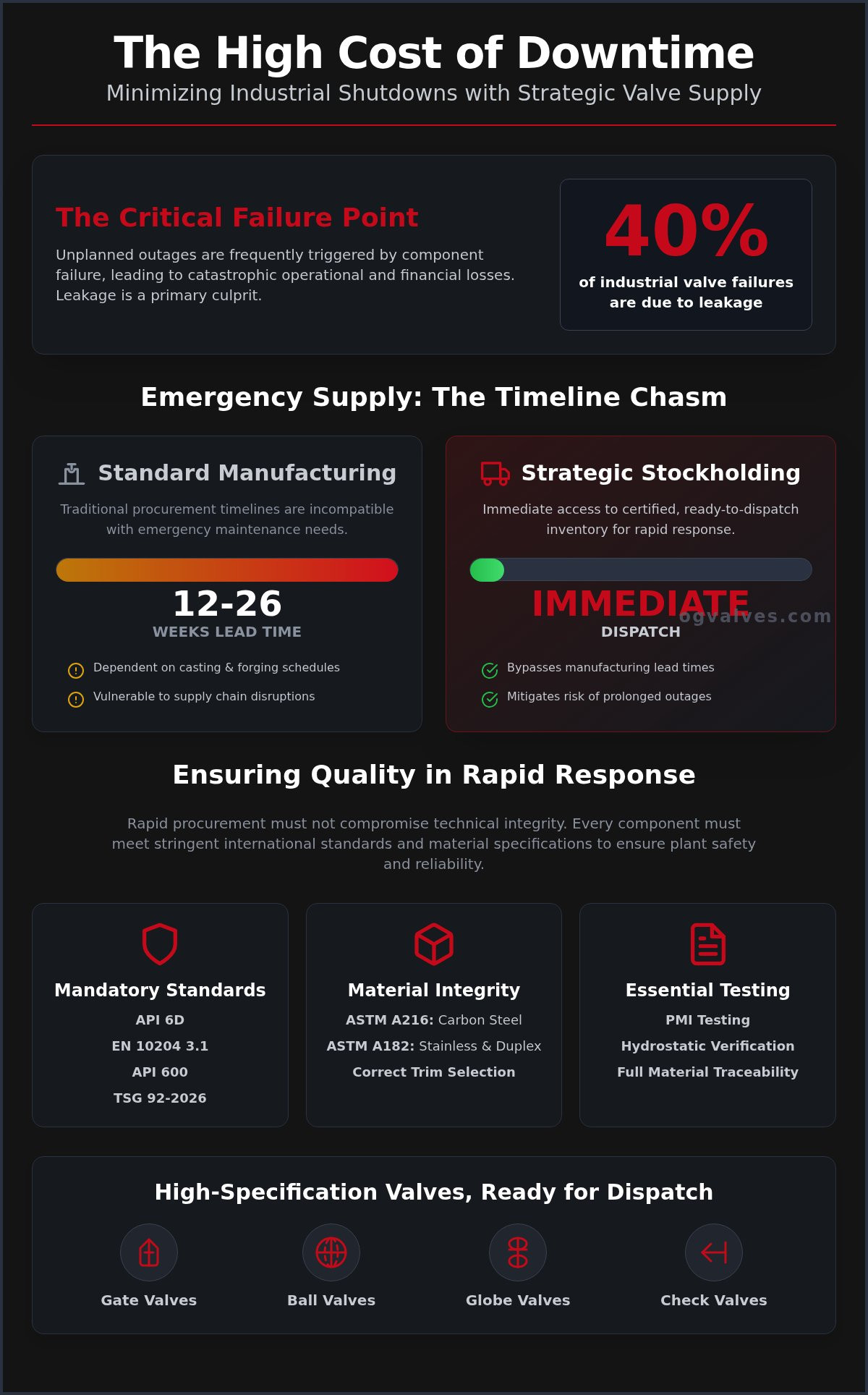
Leakage accounts for up to 40% of industrial valve failures, a statistic that translates into catastrophic operational losses when a facility is forced into an unplanned outage. For procurement specialists in the oil, gas, and petrochemical sectors, the primary challenge isn’t just finding a replacement; it’s securing an urgent valve supply for plant shutdowns that adheres to rigorous API 6D and EN 10204 3.1 standards. The risk of integrating non-compliant or counterfeit materials during a crisis can lead to secondary failures that far outweigh the initial delay.
You recognize that the true cost of downtime isn’t measured in the price of a component but in the hourly erosion of operational output. This article details how strategic stockholding of gate, ball, and globe valves, combined with rapid-response logistics, minimizes these critical windows of inactivity. We’ll explore the necessity of full material traceability and PMI testing in the current regulatory environment, specifically regarding the TSG 92-2026 enforcement. By leveraging a strategic logistics hub, operators can secure verified, high-specification components that meet stringent international leakage norms and ensure a safe, compliant return to service.
Key Takeaways
- Understand how strategic inventory management bypasses standard manufacturing lead times to mitigate the significant economic impact of unplanned downtime.
- Identify the critical protocols for securing an urgent valve supply for plant shutdowns, ensuring that rapid procurement does not compromise technical specifications or material integrity.
- Learn the necessity of mandatory testing protocols, including PMI and hydrostatic verification, to maintain regulatory compliance during emergency replacement scenarios.
- Evaluate the logistical advantages of sourcing from a strategic Northern Ireland hub to facilitate accelerated global delivery of API-standard components.
- Explore the technical engineering benefits of ready-to-dispatch stock, including high-specification ball, gate, and globe valves designed for severe service environments.
The Impact of Valve Lead Times on Industrial Downtime
Fast-track valve supply isn’t a mere logistics service; it’s a strategic procurement framework designed for immediate deployment within critical infrastructure. In high-output sectors such as oil, gas, and power generation, the failure of a single component can halt entire production lines. While a standard industrial valve overview confirms the mechanical necessity of these components, their procurement complexity is significant. Standard manufacturing lead times often range from 12 to 26 weeks due to casting and forging schedules. These timelines are incompatible with emergency maintenance requirements. An urgent valve supply for plant shutdowns bridges the gap between a catastrophic component failure and a successful plant restart by providing immediate access to verified inventory.
Quantifying the Cost of Operational Delays
The economic impact of an unplanned shutdown is measured by the hour. For power generation and petrochemical facilities, daily revenue loss can be substantial, depending on the specific output volume and market fluctuations. Beyond immediate fiscal deficits, secondary costs include labour standby fees, contractual penalties for missed delivery targets, and severe downstream supply chain disruptions. Procurement officers must define downtime cost as the primary metric for urgency, as the premium for expedited delivery is negligible compared to the expense of a prolonged outage. Every hour a plant remains offline represents a direct erosion of the organization’s bottom line and structural reliability.
Strategic Inventory as a Risk Mitigation Tool
Maintaining a diverse stock of industrial valves serves as a vital risk mitigation strategy. There’s a clear industry shift from just-in-time to just-in-case procurement for critical infrastructure. This approach ensures that gate, ball, and globe valves are available for immediate dispatch from a strategic logistics hub. Evaluating supplier reliability requires real-time inventory visibility and technical verification. For an urgent valve supply for plant shutdowns, the supplier acts as a technical partner, ensuring that every component meets API standards and includes full material traceability before it leaves the facility. This clinical focus on stock readiness eliminates the 26-week manufacturing wait, allowing for a methodical and safe restoration of operations. Reliable procurement during these periods depends on the supplier’s ability to provide high-specification components, such as API 600 gate valves, without the delays associated with traditional production cycles.
Technical Specifications for Urgent Valve Procurement
Precision in specification is the baseline for any effective urgent valve supply for plant shutdowns. Replacing a failed unit during a turnaround requires an exact match of material, pressure class, and design standards to maintain system integrity. Mismatched specifications lead to accelerated wear, leakage, or catastrophic rupture under high-pressure conditions. Sourcing must focus on high-demand components like Gate, Ball, Globe, and Check valves that adhere to verified engineering benchmarks. Procurement officers must navigate pressure classes ranging from Class 150 to Class 2500, ensuring that every replacement component aligns with the original piping design and process requirements.
Material Integrity and Environmental Suitability
Material selection is a critical determinant of valve longevity in corrosive or high-temperature environments. Standard procurement during emergencies typically involves choosing between ASTM A216 (WCB/WCC) for cast carbon steel applications and ASTM A182 (F316/F316L or F51) for forged stainless and duplex alloys. Durability is defined by these standards, ensuring the valve body can withstand the specific chemical and thermal stresses of the media. Trim materials, including the stem, seat, and disc, must be meticulously matched to the process fluid. Whether the application involves aggressive hydrocarbons, high-pressure steam, or volatile chemicals, the trim must provide a bubble-tight seal and resist erosion. Ensuring these materials are available from stock allows for immediate dispatch without the compromise of utilizing “near-fit” alternatives that could jeopardize plant safety.
Standards and Certification Compliance
Adherence to global standards ensures that replacement valves function reliably within the existing infrastructure. API 600 remains the definitive benchmark for industrial gate valves used in heavy refining and power applications. Compliance with ASME B16.34 is essential for determining pressure-temperature ratings across the full spectrum of pressure classes. For fire-hazardous zones, API 607 fire-safe certification is a non-negotiable requirement. While some procurement teams focus heavily on control valve standards for automated loops, the standards for isolation and check valves are equally vital for process safety. Professionals requiring immediate technical data can review our technical specifications for API-standard valves to ensure exact compatibility with their existing systems. Every component sourced during an urgent valve supply for plant shutdowns must be accompanied by EN 10204 3.1 certification to verify its manufacturing pedigree and material properties.

Emergency Valve Supply: Standard Lead Times vs. Strategic Stockholding
Standard manufacturing schedules are dictated by foundry capacity and metallurgical processing times; a factory order for a high-specification valve typically involves a 12 to 26-week cycle. This duration encompasses pattern creation, casting, machining, and assembly. Such timelines are fundamentally incompatible with an urgent valve supply for plant shutdowns, where every hour of inactivity results in measurable revenue erosion. Strategic stockholding eliminates these production phases by maintaining a comprehensive inventory of API-standard components ready for immediate dispatch. By bypassing the foundry queue, procurement specialists reduce lead times from several months to a 24 to 72-hour window. This shift from production-dependent sourcing to inventory-based deployment is the only viable method for mitigating the costs of an extended outage.
The Logistics Advantage of a UK-Based Technical Hub
Northern Ireland serves as a strategic logistics hub, providing a technical base for national and international distribution. The region’s robust air and sea freight infrastructure facilitates rapid transit to heavy industrial sites globally. UK-based export protocols for high-specification components are streamlined, ensuring that technical documentation and material certifications move as fast as the physical assets. By utilizing established global trade routes, suppliers minimize customs friction and administrative delays that often plague international emergency orders. Managing the “last mile” requires a clinical focus on transit security and documentation accuracy. This ensures the valve arrives at the facility ready for immediate integration, supported by all necessary regulatory clearances and technical data sheets.
Comparing Procurement Timelines
Analyzing procurement timelines reveals the stark contrast between traditional and fast-track models. A standard factory order remains bound to a 12-26 week manufacturing cycle, contingent on material availability and foundry scheduling. Even “fast-track” custom builds, which prioritize specific orders through the production line, generally require a 4-8 week window. For critical infrastructure, these “express” models are often insufficient to prevent significant downstream disruptions. Strategic stock dispatch remains the industry standard for emergency scenarios, offering a 24-72 hour delivery timeframe. This model relies on a significant capital investment in diverse material classifications and pressure ratings. It ensures that the necessary component is already on the shelf when the failure occurs, providing a reliable urgent valve supply for plant shutdowns without the uncertainty of manufacturing delays.
Ensuring Compliance and Quality in Rapid-Response Scenarios
Rapid procurement often increases the risk of receiving non-compliant or counterfeit components from the secondary market. In high-stakes industrial environments, the pressure to restart operations must never override the necessity for rigorous technical verification. An urgent valve supply for plant shutdowns must include a comprehensive quality assurance framework that mirrors the standards of a primary manufacturing cycle. This includes mandatory testing protocols such as hydrostatic and pneumatic pressure tests to verify shell and seat integrity. Fugitive emission testing, referencing ISO 15848 international norms, is also critical for environmental compliance and methane abatement. These protocols ensure that every component, whether it’s a gate or ball valve, performs to its design specifications under actual operating conditions.
The Necessity of Positive Material Identification (PMI)
Positive Material Identification (PMI) serves as the primary safeguard against material mix-ups during accelerated dispatch. In facilities handling corrosive media or extreme temperatures, the distinction between standard stainless steel and high-nickel alloys is vital for structural soundness. PMI is non-negotiable for valves in corrosive service. Using X-ray fluorescence (XRF) or optical emission spectroscopy (OES), technicians verify the exact chemical composition of the valve body and trim before the item leaves the logistics hub. This testing is integrated into the fast-track workflow, providing clinical certainty without extending the 24 to 72-hour delivery window. It eliminates the risk of metallurgical failure that can occur when incorrect material classifications are introduced into a process stream.
Certification and Traceability Requirements
Full material traceability is maintained through the validation of Mill Test Reports (MTRs) and EN 10204 3.1 certification. This document serves as the minimum standard for heavy industrial check valves and isolation units. It confirms that the component’s chemical and mechanical properties comply with the specified order and relevant ASTM standards. During plant shutdowns, maintaining a digital trail of these certificates is essential for technical audits and safety inspections. It ensures that every valve can be traced back to its original heat number and manufacturing batch. For projects requiring the highest level of validation, third-party verification can be coordinated to achieve EN 10204 3.2 status. To ensure your procurement meets these rigorous benchmarks, you can request technical certification for your valve requirements from our technical team. This methodical approach to quality control guarantees that urgent valve supply for plant shutdowns enhances operational safety rather than introducing new risks.
OG VALVES LTD.: Rapid-Response Supply for Heavy Industry
OG VALVES LTD. operates as a specialist partner for critical infrastructure, maintaining a vast inventory of API-standard components designed for immediate deployment. Our Northern Ireland facility serves as a strategic logistics hub, facilitating an urgent valve supply for plant shutdowns across the globe. We prioritize engineering precision over marketing hyperbole, focusing on the structural soundness and regulatory adherence of every component. With a proven track record in the oil, gas, petrochemical, and power generation sectors, we understand the functional reality of high-stakes environments. Our technical experts provide the necessary oversight to ensure that rapid procurement never compromises operational safety or material integrity. This seasoned approach ensures that every valve meets the specific durability requirements of the manufacturing sector.
Comprehensive Inventory of API-Standard Components
We maintain a ready-to-ship inventory of gate, globe, check, and industrial ball valves. This stock includes a diverse range of butterfly valves and needle valves, specifically selected for high-pressure and high-temperature applications. Every component adheres to global benchmarks, including API 600 and ASME B16.34. Our specialization extends to corrosive service environments, where material classifications such as ASTM A182 and ASTM A216 are essential. Technical support is provided for every order, ensuring precise specification matching for urgent replacement scenarios. This clinical focus on inventory diversity allows us to bridge the gap between component failure and system restart without the 26-week manufacturing delay. We eliminate the ambiguity often found in generalist supply chains by providing quantifiable data for every asset.
Partnering for Operational Reliability
Operational reliability is anchored in rigorous quality control and technical verification. Our commitment to international standards is demonstrated through in-house testing protocols, including hydrostatic and pneumatic verification. Every urgent valve supply for plant shutdowns is accompanied by Positive Material Identification (PMI) and EN 10204 3.1 certification. This methodical approach ensures full material traceability and adherence to safety technical regulations like TSG 92-2026. Our global logistics network leverages Northern Ireland’s infrastructure to reach remote industrial sites with clinical efficiency. We act as a dependable entity in critical infrastructure, providing the quantifiable data and engineering excellence required for long-term performance. You can contact our engineering team to request a technical consultation for your specific fast-track procurement requirements, ensuring your facility returns to service with verified, high-specification components.
Optimising Operational Continuity through Strategic Procurement
Efficiency in heavy industry is dictated by the speed of critical component replacement. We’ve established that bypassing standard 26-week manufacturing cycles through strategic stockholding is the only viable method to mitigate exorbitant downtime costs. Maintaining a clinical focus on material integrity and regulatory adherence ensures that rapid procurement doesn’t introduce systemic risks during high-stakes turnarounds. Securing an urgent valve supply for plant shutdowns requires a partner who understands the necessity of technical precision and global logistical reach.
Our extensive inventory of API-standard Gate, Ball, and Globe valves is supported by a strategic Northern Ireland logistics hub. We provide full EN 10204 3.1 certification and PMI testing to guarantee every asset meets your facility’s exact durability benchmarks. This methodical approach ensures that your infrastructure returns to service with verified, high-specification components that comply with international leakage standards. Reliability isn’t just about speed; it’s about engineering certainty in every dispatch.
Request a Technical Quote for Fast-Track Valve Supply and ensure your next maintenance window remains on schedule.
Frequently Asked Questions
What defines a “fast-track” valve supply service?
Fast-track supply is characterized by the immediate allocation of existing inventory to bypass traditional casting and forging schedules. It eliminates the standard 12 to 26-week manufacturing cycle through strategic stockholding of API-standard components. This model is essential for securing an urgent valve supply for plant shutdowns, where the cost of operational delays necessitates a transition from production-dependent sourcing to immediate asset deployment and technical verification.
How quickly can OG VALVES LTD. deliver to international sites?
Standard delivery to international industrial facilities typically occurs within a 24 to 72-hour window. By leveraging our location as a strategic logistics hub, we utilize prioritized air and sea freight channels to minimize transit duration. This timeframe includes the necessary technical verification and documentation processing required for high-stakes environments. Our logistics framework is optimized to prevent the extended downtime often associated with standard international procurement routes.
Do you provide material certification for urgent orders?
Every dispatch is accompanied by comprehensive material traceability, including EN 10204 3.1 certification as a minimum standard. We ensure that Mill Test Reports (MTRs) are validated against the physical assets before they leave our facility. This documentation confirms the chemical and mechanical properties of the valve body and trim. For projects requiring enhanced validation, we can coordinate third-party inspections to provide EN 10204 3.2 certification without compromising delivery speed.
What types of industrial valves do you keep in stock for shutdowns?
We maintain a diverse inventory of isolation and non-return valves, including Gate, Ball, Globe, and Check types. Our stockholding also extends to Butterfly, Plug, and Needle valves suitable for various process conditions. These components are available in multiple pressure classes and material grades to ensure compatibility with existing piping specifications. This breadth of inventory allows procurement specialists to consolidate their urgent valve supply for plant shutdowns through a single technical partner.
Can you supply valves for high-pressure oil and gas applications?
Our inventory is specifically tailored for severe service, including high-pressure applications ranging from Class 150 to Class 2500. We stock valves that adhere to ASME B16.34 pressure-temperature ratings and API 6D pipeline standards. These components are engineered for the thermal and mechanical stresses found in refining and power generation. Every high-pressure unit undergoes rigorous technical review to ensure it meets the structural soundness required for volatile process media.
Is PMI testing included in the rapid-response dispatch process?
Positive Material Identification (PMI) is a standard component of our quality assurance protocol for all urgent dispatches. We utilize X-ray fluorescence (XRF) technology to verify the metallurgical composition of the valve body, stem, and seating materials. This non-destructive testing ensures that the material matches the specified ASTM grade, preventing the installation of incorrect alloys in corrosive environments. PMI testing is performed in-house to maintain our clinical focus on precision and safety.
How do you ensure compliance with API 600 standards?
Compliance is maintained by sourcing exclusively from manufacturers who hold current API 600 and API 6D certifications. Our technical team performs a methodical review of all manufacturing data and physical dimensions to ensure adherence to these global benchmarks. We anchor our quality control in a predictable cadence of testing and documentation. This ensures that every valve, particularly those used in critical isolation service, meets the rigorous safety and performance criteria of the industry.
What logistics routes are used for Northern Ireland-based supply?
We utilize a multi-modal logistics network that leverages Northern Ireland’s strategic air and sea freight infrastructure. This includes direct access to international cargo hubs, facilitating rapid transit to heavy industrial sites across the UK, Europe, and globally. By managing export protocols and customs documentation in-house, we eliminate the administrative friction that often delays emergency shipments. This methodical logistics approach ensures a steady and information-dense flow from our facility to the plant site.
 Responsive Menu