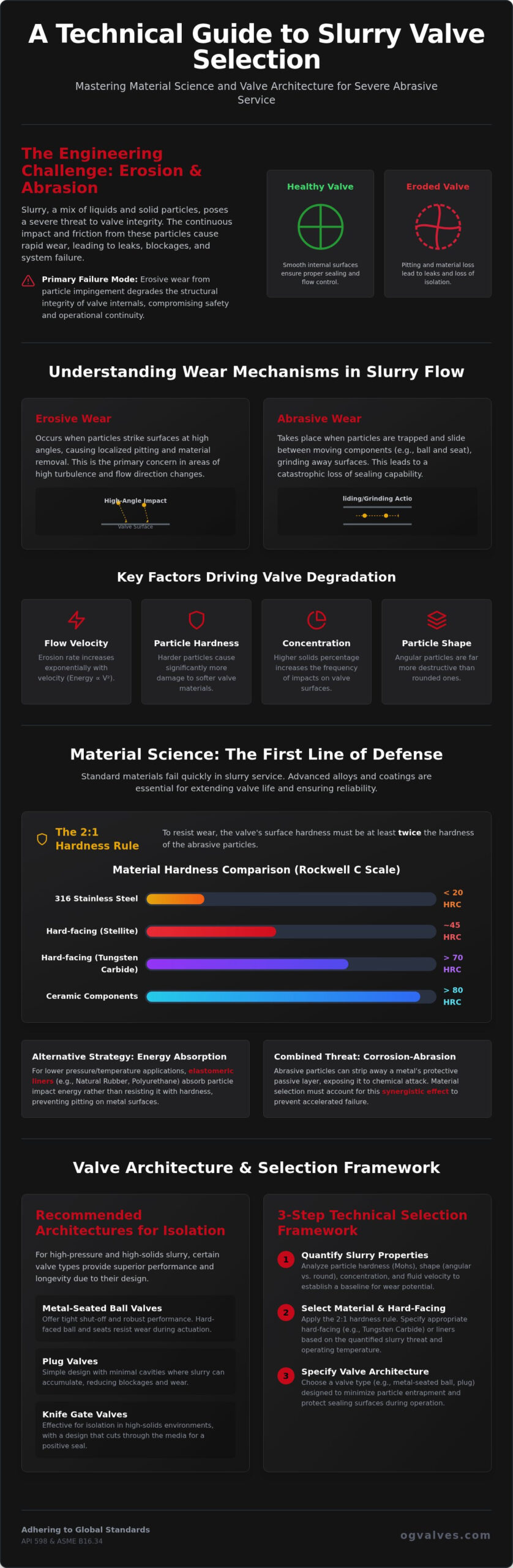
In heavy industrial processing, the difference between operational continuity and a catastrophic system failure often rests on a single material specification within a valve assembly. You’re likely already aware that the aggressive nature of abrasive media makes valve erosion an inevitability rather than a mere possibility. Frequent leaks and unplanned downtime due to blockages represent a constant drain on maintenance budgets and overall plant efficiency. This technical guide provides the rigorous framework required for selecting a valve for slurry applications that balances metallurgical durability with procurement velocity.
By mastering the material science behind slurry resistance, engineers can move beyond reactive maintenance toward a strategy of industrial precision. We’ll examine the performance of gate, ball, and plug valves in severe service environments while adhering to the 11th edition of API 598 and the 2025 updates to ASME B16.34. This analysis covers the critical selection criteria for high-spec components, including hard-facing requirements and port geometry, to ensure your procurement decisions are backed by quantifiable engineering data and global safety standards.
Key Takeaways
- Identify primary failure modes in multi-phase fluids, focusing on erosive wear caused by particle impingement on valve internals.
- Evaluate advanced metallurgical solutions, including Stellite and Tungsten Carbide hard-facing, to supersede standard 316 stainless steel in severe service.
- Analyze the performance of metal-seated ball valves and plug valves for isolation in high-pressure and high-solids content environments.
- Implement a rigorous technical framework for selecting a valve for slurry applications by quantifying particle hardness and required flow characteristics.
- Address procurement challenges by leveraging fast-track delivery protocols for high-specification components in critical industrial sectors.
The Engineering Challenges of Slurry Service: Erosion and Abrasion
Slurry is defined as a multi-phase fluid containing suspended solid particles within a liquid carrier. In heavy industrial environments, selecting a valve for slurry applications requires a deep understanding of fluid dynamics and material degradation. The primary failure mode in these systems is erosive wear. This occurs when particle impingement degrades the structural integrity of valve internals through continuous mechanical impact. Selecting a valve for slurry applications necessitates a quantifiable assessment of the fluid’s abrasive potential to prevent premature component failure.
Secondary failure modes involve abrasive wear within sealing zones, often resulting in a complete loss of isolation. Flow velocity is a critical variable. Kinetic energy is proportional to the square of the velocity; consequently, even minor increases in flow rate result in an exponential surge in the rate of material loss. Engineering teams must calculate these fluid speeds during the design phase to ensure the selected valve architecture can withstand the projected operational lifespan.
Understanding Erosive vs. Abrasive Wear
Impingement erosion occurs when particles strike internal surfaces at high angles, causing localized pitting and material removal. Conversely, sliding abrasion takes place when particles become trapped between moving components, such as seats and balls, during actuation. Under the framework of ASME B16.34, erosive wear is classified as the mechanical degradation of pressure-containing boundaries caused by the kinetic energy of entrained solids within the process stream. This distinction is vital when specifying a knife gate valve for isolation in high-solids environments where traditional designs might fail.
The Impact of Particle Concentration and Morphology
Particle characteristics dictate the metallurgical requirements of the valve body and trim. The hardness of the solids, measured on the Mohs scale, must be lower than the hardness of the valve’s contact surfaces to prevent rapid failure. Angular particles exert higher stress on surfaces compared to rounded grains, significantly reducing valve longevity. Concentration levels also play a role; higher percentages of solids increase the frequency of particle-to-wall collisions.
The chemical corrosiveness of the carrier fluid often acts synergistically with physical abrasion. When corrosive elements are present, the mechanical action of the slurry removes the passivated layer of the metal, exposing fresh surface area to chemical attack. This electrochemical reaction accelerates material loss by stripping away protective oxide layers, leaving the base metal vulnerable to continuous mechanical impingement. Engineering specifications must account for this combined effect to ensure long-term reliability in critical infrastructure.
Material Science in Slurry Valve Selection
Standard austenitic steels like 316 stainless steel lack the surface hardness required for prolonged exposure to abrasive solids. When selecting a valve for slurry applications, material selection must prioritize surface integrity and structural support. Hard-facing techniques involve applying specialized alloys to the base metal to create a sacrificial or ultra-hard barrier. Stellite is frequently employed for its high-temperature hardness and galling resistance. For higher abrasion levels, Tungsten Carbide or Chrome Carbide coatings provide a dense, wear-resistant layer that significantly extends the service life of high-pressure slurry pipeline valves.
Elastomeric liners, such as natural rubber or polyurethane, offer an alternative strategy by absorbing particle impact energy. These materials are effective in low-temperature, high-impingement applications where metal surfaces would otherwise pit. For extreme high-velocity abrasive flow control, ceramic inserts represent the ultimate solution. Ceramics maintain their hardness at elevated temperatures and resist almost all forms of particle-induced erosion.
Hardness Scales and Material Performance
Engineers must evaluate material performance using standardized hardness scales, specifically Rockwell C (HRC) and Vickers (HV). A fundamental engineering principle in slurry service is that the material hardness must exceed the particle hardness by a factor of at least 2:1. This ratio ensures the valve trim resists penetration by entrained solids. The substrate material plays a critical role; it must provide sufficient mechanical strength to support brittle hard-coatings under high-pressure cycles. Without a rigid substrate, even the hardest coating will succumb to subsurface deformation and subsequent delamination.
Corrosion-Resistant Alloys (CRA) in Slurry Applications
In environments where chemical attack accompanies physical wear, Corrosion-Resistant Alloys (CRA) like Super Duplex or Inconel are mandatory. These alloys provide the necessary pitting resistance in corrosive mining or chemical process slurries. To ensure adherence to technical specifications, Positive Material Identification (PMI) testing is a standard quality assurance protocol. This process verifies the elemental composition of the valve components before deployment into critical infrastructure. For a deeper technical analysis of these benchmarks, refer to The Engineer’s Comprehensive Guide to Selection and Standards (2026).
Ensuring your system utilizes the correct metallurgy is the only way to avoid catastrophic failure. If you require technical assistance with material verification, OG Valves provides specialized expertise in specifying ball valves and gate valves for severe service.
Evaluating Valve Architectures for Slurry Service
Selecting a valve for slurry applications requires a strategic alignment between the valve’s internal geometry and the physical characteristics of the process media. While material science provides the surface resistance, the architecture dictates how the fluid moves through the assembly. Metal-seated ball valves have become the benchmark for high-pressure slurry isolation. These designs utilize precision-ground metal seats and balls, often treated with the hard-coatings mentioned in previous sections, to maintain a bubble-tight seal despite the presence of entrained solids.
For operations involving heavy slurries with exceptionally high solids content, plug valves provide a robust alternative. Their design features a large seating area that distributes abrasive forces across a wider surface, effectively reducing localized wear. In contrast, knife-gate valves are the preferred architecture for thick sludges or tailings. The sharp, tapered edge of the gate is engineered to cut through settled solids, ensuring a complete closure in media that would typically obstruct a standard gate or globe valve. Butterfly valves are generally reserved for low-pressure, high-volume lines where weight and installation footprint are the primary technical constraints.
Metal-Seated Ball Valves vs. Plug Valves
Full-port ball valves are essential in slurry service because they provide an unobstructed flow path. This configuration minimizes turbulence and eliminates the impingement points that drive erosion. High-specification ball valves often incorporate scraper-seat designs. These components mechanically clear particles from the ball surface during every actuation, preventing solids from becoming trapped between the sealing surfaces and causing sliding abrasion. Plug valves offer superior durability in static conditions due to their massive metal-to-metal contact zones, which resist deformation under the weight of settling particles better than the narrower seating bands found in some ball designs.
Check Valves in Slurry Lines
Non-return valves in slurry service face significant risks from solids settling. If the flow velocity falls below the critical settling speed, particles accumulate within the valve body, leading to clogging or a failure to reseat. When selecting a valve for slurry applications in a non-return capacity, engineers must choose between swing check and ball check architectures. Ball checks are frequently superior in vertical installations because the ball’s random rotation during flow creates a self-cleaning effect on the seat. For a comprehensive breakdown of these mechanisms, consult Understanding Industrial Check Valves: Design, Function, and Critical Selection (2026).
Technical Framework for Selecting Slurry Valves
Establishing a rigorous technical framework is essential for mitigating the operational risks associated with abrasive media. Selecting a valve for slurry applications requires a multi-stage evaluation process that prioritizes quantifiable data over qualitative estimates. This methodical approach ensures that the specified component maintains structural integrity under the severe service conditions typical of mining, power generation, and chemical processing.
- Step 1: Quantify the Abrasive Nature. Engineers must determine particle size distribution, solids concentration by weight, and particle hardness using the Mohs scale. These variables dictate the required HRC ratings for the valve trim.
- Step 2: Determine Flow Characteristics. Define whether the application requires absolute isolation or precise throttling. Throttling slurry is inherently more destructive due to the concentrated flow path.
- Step 3: Calculate Fluid Velocity. Material erosion rates are sensitive to velocity changes. Maintaining flow below critical impingement thresholds is necessary to prevent rapid wall thinning.
- Step 4: Align with International Standards. Specifications must adhere to the latest regulatory benchmarks. This includes the 11th Edition of API 598 (2023) for leakage testing and the 2025 updates to ASME B16.34 for pressure-temperature ratings.
- Step 5: Evaluate Total Cost of Ownership (TCO). Compare the initial procurement cost against the projected maintenance interval. High-spec valves often reduce the frequency of unplanned downtime, justifying the capital expenditure.
Sizing and Flow Control Considerations
The Flow Coefficient (Cv) of a valve is not a static value in slurry service. As particle impingement erodes internal surfaces, the Cv will drift, potentially compromising system control. Cavitation poses an additional risk; the collapse of vapor bubbles in a slurry stream accelerates mechanical erosion, leading to catastrophic failure of the valve body. Selecting the correct automation package is equally critical. High-torque slurry valves require robust actuation to overcome the friction of settled solids. For detailed specifications on drive systems, refer to our guide on Industrial Valve Actuators: A Technical Guide to Automation and Control.
Operational Reliability and Safety Standards
Achieving a Class VI tight shut-off is difficult in abrasive environments where particles can lodge in the sealing zone. Metal-to-metal seating must be precision-lapped to maintain isolation. In petrochemical applications, valves must also meet fire-safe testing standards to ensure containment during thermal events. Valve orientation is a final, often overlooked, technical detail. Horizontal installations in low-velocity lines risk particle settling within the valve cavity, which can lead to blockages or prevent full gate travel. To ensure your project meets these rigorous benchmarks, consult with the technical specialists at OG Valves for precise component specification.
Procuring High-Spec Valves for Critical Slurry Infrastructure
Procurement of severe-service valves often presents a significant bottleneck in industrial project management. Selecting a valve for slurry applications involves navigating a landscape where specialty components, such as those with ceramic inserts or tungsten carbide hard-facing, typically involve lead times ranging from 12 to 26 weeks. During periods of high industrial demand, these timelines can expand, leaving critical infrastructure vulnerable to prolonged outages. OG Valves addresses this challenge by maintaining an extensive inventory of high-specification gate, ball, and plug valves, enabling fast-track delivery to global industrial sites. This capability is vital in a market projected to reach a value of approximately USD 185 million by the end of 2026.
Fast-Track Delivery and Global Logistics
Reducing downtime requires more than just local stock; it necessitates strategic inventory management of components that meet global regulatory benchmarks. Supplying remote mining operations, which account for roughly 38% of global slurry valve demand, requires a logistics framework designed for heavy industry. These sites often face harsh environmental conditions where the cost of failure is exceptionally high. Reliable supply chains ensure that critical replacements are available within weeks, even for specialized metallurgy like Super Duplex or Inconel. By managing the entire project lifecycle, from specification to final delivery, OG Valves ensures that procurement specialists receive the hardware necessary to maintain operational continuity without the delays typical of custom manufacturing.
Technical Partnership and Specification Support
Selecting a valve for slurry applications isn’t a mere transactional process; it’s an engineering collaboration. Matching a valve to a specific slurry requires a clinical focus on the fluid’s unique characteristics, including particle concentration and corrosive potential. Our engineering support teams assist in refining these specifications, ensuring that the selected metallurgy and architecture align with the 2025 updates to ASME B16.34 and the 11th Edition of API 598. This technical justification for high-spec valve procurement balances the immediate need for procurement speed with the long-term requirement for durability.
Rigorous testing and quality assurance protocols are standard procedures to prevent premature failure in the field. Every component undergoes Positive Material Identification (PMI) and pressure testing to verify structural soundness before deployment. This seasoned, no-nonsense approach to quality control ensures that each valve acts as a dependable partner in critical infrastructure. If your project demands industrial precision and unwavering reliability, Contact OG VALVES LTD. for a technical consultation on your slurry valve requirements.
The global slurry valve market is forecasted to grow at a compound annual growth rate of approximately 5.1% through 2036. As industries like wastewater treatment and mining expand, the necessity for high-performance valves that adhere to international certifications becomes even more pronounced. Partnering with an established global entity that understands the practicalities of heavy industry is the most effective way to secure your infrastructure against the costs of unplanned downtime and abrasive wear.
Optimizing Operational Integrity in Severe Service Environments
Effective slurry management requires more than standard hardware; it demands a technical synergy between advanced metallurgy and optimized internal geometry. Successful implementation hinges on maintaining a 2:1 hardness ratio between valve trim and entrained solids while adhering to the 2025 updates of ASME B16.34. These specifications aren’t merely suggestions; they’re the benchmarks for industrial safety and structural soundness in abrasive media. Selecting a valve for slurry applications remains a high-stakes engineering decision where the cost of failure far outweighs the initial procurement investment.
OG Valves acts as a dependable partner for technical experts and procurement specialists facing these challenges. We provide technical expertise in severe service and ensure full API and ASME compliance across our high-spec inventory. Our global fast-track delivery capability minimizes operational disruptions by providing critical components precisely when they’re needed. To secure your infrastructure with engineering excellence, Request a Technical Quote for Slurry-Grade Industrial Valves. You can rely on our clinical focus on durability to maintain your plant’s operational output and safety standards.
Frequently Asked Questions
What is the best valve material for highly abrasive slurry?
Hardened alloys such as Tungsten Carbide or Chrome Carbide are superior for high-abrasion service. These materials provide a sacrificial barrier that maintains structural integrity under constant particle impingement. Ceramic inserts are the ultimate choice for high-velocity flows where metal surfaces would fail rapidly. Selecting a valve for slurry applications requires ensuring the trim hardness exceeds the particle hardness by a factor of 2:1 to prevent penetration of the base metal substrate.
How does fluid velocity affect the lifespan of a slurry valve?
Fluid velocity has an exponential impact on the rate of material erosion within a valve assembly. Because kinetic energy is proportional to the square of the velocity, even a minor increase in flow rate significantly accelerates wall thinning. High velocities drive particles into internal surfaces at greater force, causing severe impingement erosion. Engineers must calculate critical settling speeds to maintain flow while keeping velocities low enough to prevent premature mechanical failure of the pressure boundary.
Can standard butterfly valves be used in slurry applications?
Standard butterfly valves are typically unsuitable for abrasive slurry service due to the vulnerability of the disc and seat. Entrained solids cause rapid erosion of the disc edge, leading to a loss of sealing capability and potential leakage. While specialized lined butterfly valves exist for low-pressure wastewater, they don’t provide the durability required for mining or petrochemical tailings. For these severe service environments, full-port ball valves or knife gate designs are technically superior choices.
What is the difference between a knife gate valve and a standard gate valve for slurry?
Knife gate valves feature a sharpened, tapered gate specifically engineered to cut through thick sludges and settled solids. This ensures a bubble-tight seal in media that would obstruct a standard gate valve. Standard gate valves often have internal cavities where solids accumulate, preventing the gate from fully seating and causing blockages. For heavy industrial slurries, the knife gate architecture is mandatory to maintain operational reliability and prevent unplanned maintenance during isolation cycles.
Why do metal-seated ball valves often fail in slurry service?
Failure in metal-seated ball valves often results from particle entrapment between the ball and the seat during actuation. This causes sliding abrasion that scores the precision-ground surfaces, leading to seat leakage. To mitigate this risk, high-specification ball valves utilize scraper-seat designs to mechanically clear particles. Selecting a valve for slurry applications requires verifying that the seat-to-ball interface is protected by hard-coatings that can withstand the mechanical stress of trapped solids without delaminating.
How often should slurry valves be inspected for erosive wear?
Inspection intervals are dictated by the abrasiveness and concentration of the slurry media. Initial inspections should occur every three to six months to establish a baseline for material loss. Engineers utilize non-destructive testing, such as ultrasonic thickness gauging, to monitor wall thinning on the valve body and internals. If the measured erosion rate is low, intervals can be extended; however, high-velocity systems or those with angular particles require continuous monitoring to prevent catastrophic pressure boundary failure.
What are the benefits of using tungsten carbide coatings on valve trims?
Tungsten carbide coatings provide exceptional surface hardness, often exceeding 70 HRC, which is essential for resisting sliding abrasion. These coatings are applied to the valve trim to create a dense, wear-resistant layer that protects the underlying substrate. This metallurgical solution is particularly effective in high-pressure slurry pipelines where standard stainless steel would erode within weeks. The use of such advanced coatings significantly extends the mean time between failures, reducing the total cost of ownership for critical infrastructure.
Is a plug valve better than a ball valve for high-solids content slurry?
Plug valves are often superior for high-solids slurries because their large seating areas distribute abrasive forces more effectively than the narrower contact bands of ball valves. This design is robust against solids that settle when the valve is in the closed position. However, full-port ball valves provide a more streamlined flow path, which reduces turbulence during operation. The choice depends on whether the valve remains static for long periods or requires frequent actuation in a high-velocity stream.
 Responsive Menu