Bulk Industrial Valve Procurement Process: A Technical Engineering Guide (2026)
May 06, 2026
Home+Bulk Industrial Valve Procurement Process: A Technical Engineering Guide (2026)
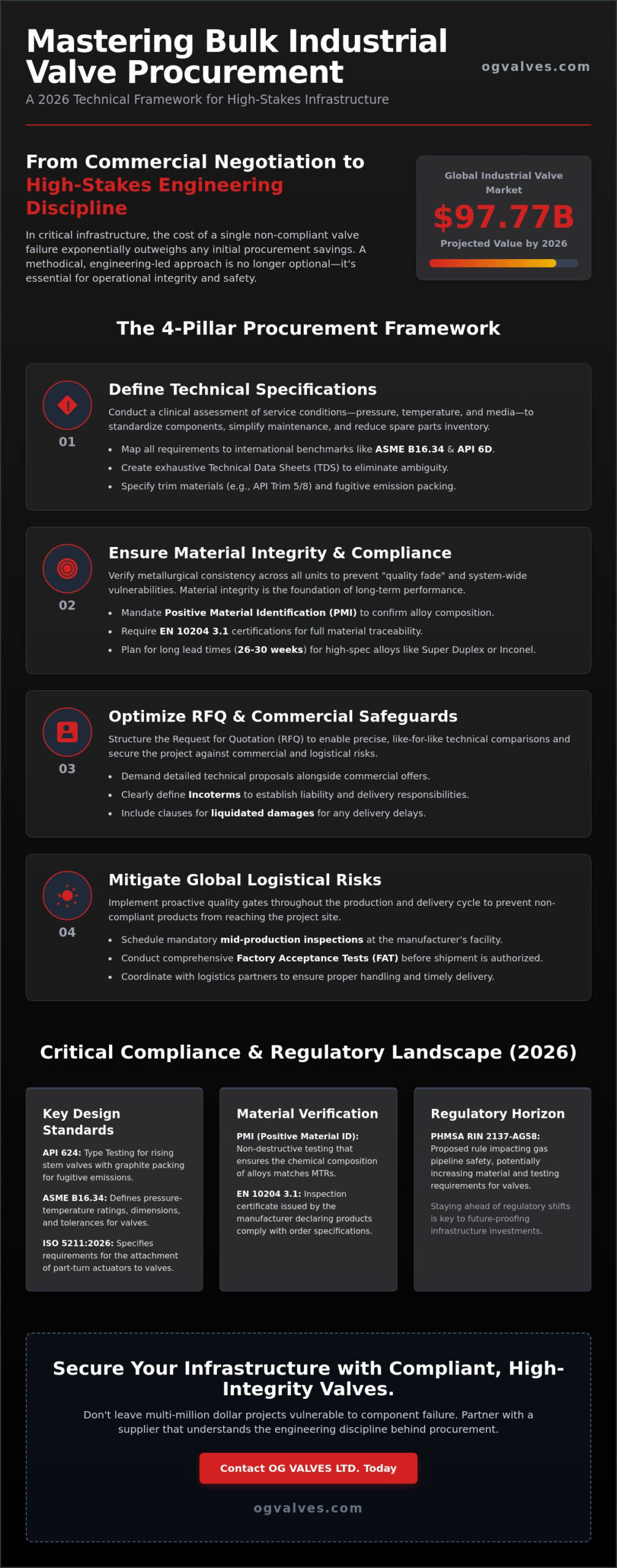
What if the 50% Section 232 tariff on steel imports is the least of your project’s risks compared to a single non-compliant forged steel gate valve in a critical high-pressure line? In a global market projected to reach $97.77 billion by the end of 2026, the bulk industrial valve procurement process has shifted from a commercial negotiation to a high-stakes engineering discipline. You’re likely aware that the cost of catastrophic failure in oil, gas, or water treatment infrastructure far outweighs any initial savings from a low-cost vendor.
This guide provides the technical framework necessary to master large-scale sourcing, ensuring every component meets rigorous standards like API 624 and the updated ISO 5211:2026. You’ll gain a repeatable system for verifying material integrity through Positive Material Identification (PMI) and EN 10204 3.1 certification. We’ll also examine the 2026 regulatory landscape, including PHMSA proposed rule RIN 2137-AG58, and provide strategies to optimize global logistics while mitigating the risks of quality fade in international supply chains. This methodical approach ensures your procurement strategy aligns with the precision of your engineering specifications.
Key Takeaways
Conduct a clinical assessment of service conditions to standardize technical specifications and reduce long-term maintenance complexity across large-scale projects.
Execute a rigorous bulk industrial valve procurement process that prioritizes metallurgical integrity and strict adherence to international compliance standards like EN 10204 3.1.
Optimize RFQ structures to enable precise technical comparisons while securing commercial safeguards such as defined Incoterms and liquidated damages for delivery delays.
Mitigate global logistical risks through proactive quality gates, including mandatory mid-production inspections and comprehensive Factory Acceptance Tests (FAT).
Defining Technical Specifications for Large-Scale Valve Procurement
The bulk industrial valve procurement process initiates with a clinical assessment of the specific service conditions encountered within the industrial system. This phase demands an exhaustive review of operational variables: fluid velocity, maximum operating pressure, temperature fluctuations, and the corrosive nature of the media. Establishing these parameters early prevents the acquisition of components that fail prematurely under stress. Standardization across a bulk order is a strategic necessity. It reduces the diversity of the spare parts inventory and simplifies the training requirements for maintenance personnel. Mapping every requirement to international benchmarks like ASME, API, and ISO remains a non-negotiable requirement for industrial integrity. The technical scope serves as the absolute foundation for multi-million dollar infrastructure integrity.
Mapping Standards: ASME B16.34 and API 6D
Technical precision in large-scale sourcing depends on the accurate application of international design standards. Engineers must identify pressure-temperature ratings according to ASME B16.34 for various material groups to ensure the valve body and bonnet can withstand the intended stresses. For example, a Class 600 valve manufactured from forged steel A105 has different performance limits than one cast from A216 WCB. Specifying API 6D requirements for pipeline valves is equally critical for operational safety in the oil and gas sector, particularly for features like double block and bleed (DBB) capabilities. Ensuring all components in a bulk order meet the same rigorous certification threshold prevents the creation of system weak points that could lead to catastrophic failure.
The Role of Technical Data Sheets (TDS)
Creating exhaustive Technical Data Sheets (TDS) for every component, including gate valve and check valves, provides a clinical roadmap for the manufacturer. These documents eliminate technical ambiguity by defining industrial valve specifications such as the specific trim material (e.g., API Trim 5 or 8), packing types for fugitive emission control, and precise end connection dimensions. It’s essential that these sheets align with the overarching piping specification of the facility to ensure seamless installation. A mismatch here results in costly project delays or on-site modifications that compromise the original engineering design. Verifying compliance at the TDS level is the first practical gate in the quality assurance process.
Material Integrity and Compliance in Bulk Sourcing
Material selection serves as the primary driver of both capital expenditure and long-term performance in aggressive service environments. Within the technical framework of a bulk industrial valve procurement process, ensuring metallurgical consistency across hundreds of units is a significant engineering challenge. Sub-standard alloys or “quality fade” during production cycles can introduce system-wide vulnerabilities that lead to premature failure. Verification of material origins remains a critical barrier against counterfeit components entering the supply chain. For high-specification alloys such as Super Duplex or Inconel, procurement specialists must account for extended lead times, which often exceed 26 to 30 weeks in the 2026 market due to limited raw material availability and complex forging requirements.
Positive Material Identification (PMI) Protocols
Integrating Positive Material Identification (PMI) as a mandatory contractual requirement is essential for high-integrity projects. This non-destructive testing ensures that the chemical composition of the valve body and trim matches the submitted Mill Test Report (MTR) for every production batch. It’s particularly vital for cryogenic service or high-pressure steam applications where even a minor deviation in nickel or chromium content compromises mechanical safety. For projects requiring absolute certainty, reviewing a manufacturer’s material testing capabilities ensures that the delivered components meet the precise metallurgical grade specified in the original engineering design.
EN 10204 3.1 and 3.2 Certification
Rigorous traceability is maintained through international certification standards that define the level of inspection and validation. An EN 10204 3.1 certificate is the baseline requirement for any bulk industrial valve procurement process, providing a statement of compliance validated by the manufacturer’s authorized inspection representative. For critical infrastructure or high-risk offshore environments, specifying EN 10204 3.2 certification is necessary. This involves an independent third-party inspection agency (TPIA) witnessing the tests and verifying the results. While 3.2 certification increases documentation packages and vendor lead times by approximately 15%, it provides the highest level of assurance regarding material integrity and compliance with international safety protocols. This clinical focus on documentation prevents the introduction of weak points in high-pressure piping systems.
Optimizing the Request for Quotation (RFQ) for Industrial Scale
A structured RFQ functions as a technical filter, allowing for a direct comparison between competing industrial suppliers based on objective engineering data. Within a rigorous bulk industrial valve procurement process, the document must explicitly define commercial expectations, including Incoterms 2020, payment milestones linked to production gates, and liquidated damages for project delays. Large-scale sourcing also provides a unique opportunity for strategic hedging against the volatility of raw material costs. By locking in volume commitments early, procurement teams can mitigate the impact of the 50% Section 232 steel tariffs currently affecting the 2026 global market. Evaluation of these bids requires a clinical framework that prioritizes technical merit over initial cost.
To ensure system integrity, use this 5-step RFQ evaluation framework:
Technical Compliance Verification: Cross-reference every bid against the original ASME and API specifications.
Production Capacity Audit: Confirm the manufacturer’s ability to meet volume requirements within the project timeline.
Quality Management Review: Validate ISO 9001:2015 certifications and previous audit results.
Commercial Risk Assessment: Evaluate the impact of proposed Incoterms and payment structures on project cash flow.
Total Cost Analysis: Calculate the long-term financial impact of maintenance cycles and spare parts availability.
Evaluating Vendor Technical Capability
Engineers must rigorously assess the manufacturer’s production capacity for specialized ball valve or butterfly valve units. This review includes a deep dive into historical performance data and current Quality Management System (QMS) certifications to ensure consistency across hundreds of units. It’s also vital to verify the vendor’s ability to provide technical support and comprehensive documentation packages post-sale. A vendor’s inability to produce accurate CAD drawings or material traceability records during the bidding phase is a primary indicator of future project delays.
Commercial Strategy and Volume Discounts
Leveraging economies of scale allows procurement specialists to secure competitive pricing without compromising on technical specifications. For multi-year infrastructure projects, structuring framework agreements is a standard practice to ensure price stability in a volatile market. This strategy balances initial capital expenditure (CAPEX) against the total cost of ownership (TCO). While a lower bid may seem attractive, it often hides the costs of frequent maintenance or premature failure. In the bulk industrial valve procurement process, the clinical focus remains on the durability and performance of the component over its entire service life.
Rigorous Quality Assurance and Global Logistics Coordination
A clinical approach to quality assurance ensures that the technical specifications established during the design phase are realized in the physical product. In a bulk industrial valve procurement process, relying on retrospective inspections is insufficient. Proactive oversight requires mid-production audits and final witness testing to verify adherence to project-specific tolerances. The Factory Acceptance Test (FAT) serves as the definitive technical gate. No unit should be released for shipment until its performance is validated against the operational parameters of the facility. Meticulous logistics planning is equally critical to prevent port delays and minimize site downtime during the 2026 global trade environment. Fast-track delivery protocols act as a necessary safeguard for maintaining the project schedule when unexpected site conditions require immediate component deployment.
Pressure Testing and Leakage Standards
Adherence to API 598 or ISO 5208 is the standard for verifying zero-leakage performance across large-scale orders. These protocols involve rigorous shell and seat tests to confirm the mechanical integrity of industrial valves under high-pressure conditions. Depending on the service media, specialized tests such as high-pressure gas testing or cryogenic seat leakage verification may be required. Results must be compiled into a structured Quality Data Book (QDB), providing a permanent record of compliance for future safety audits. Securing this documentation during the manufacturing phase prevents regulatory bottlenecks during the final commissioning of the infrastructure.
Managing Global Supply Chain Logistics
Shipping bulk orders to international industrial sites requires sophisticated multi-modal transport coordination. Technical oversight is necessary to manage customs clearance efficiently, utilizing accurate HTS coding to navigate the complex tariff structures of 2026. Strategic logistics planning reduces the risk of demurrage and ensures that specialized components arrive in the correct sequence for installation. Implementing “fast-track” procurement strategies allows for the rapid transition of critical items from the factory floor to the project site, effectively neutralizing the impact of long-lead production cycles. For projects requiring unwavering reliability and technical precision, partner with OG VALVES LTD. to secure your industrial supply chain.
Strategic Partnering for High-Stakes Industrial Infrastructure
Successful execution of a bulk industrial valve procurement process depends on a partnership that acknowledges the severe financial and environmental costs of failure in heavy industry. Engineering specialists in the petrochemical and power sectors don’t just require a vendor; they require a technical ally capable of navigating the complexities of multi-million dollar infrastructure projects. OG VALVES LTD. acts as this critical bridge, aligning rigorous engineering specifications with a reliable global supply chain. This partnership ensures that every gate, globe, and check valve delivered meets the clinical standards of durability and compliance required for high-pressure service. By prioritizing industrial precision over marketing hyperbole, we provide the technical assurance necessary for large-scale industrial scale-up in a market projected to reach $97.77 billion by the end of 2026.
The Value of Technical Inventory Management
Technical inventory management is a significant advantage for projects facing compressed timelines. Access to an extensive, pre-verified stock of gate, globe, and check valves allows for a substantial reduction in lead times compared to direct-to-mill orders. While mills are often constrained by rigid production cycles and raw material volatility, technical distributors provide an immediate layer of QA/QC that ensures every unit is ready for deployment. This model allows for the rapid customization of valve packages to meet specific project requirements, including the integration of a specialized actuator for automated flow control. This agility is essential for maintaining project momentum when technical specifications evolve during the construction phase.
Ensuring Minimal Downtime for Global Facilities
Our commitment to fast-track delivery and continuous technical support is tailored for the operational realities of international petrochemical and power plants. In an era where the 2026 global supply chain faces regionalization and trade volatility, having a partner that prioritizes industrial safety and precision is a non-negotiable requirement. We understand that a single non-compliant component can halt a facility’s commissioning. Therefore, our focus remains on providing a repeatable framework for technical evaluation and material integrity. This methodical approach minimizes the risk of receiving counterfeit components and ensures that global facilities operate at peak efficiency. Contact our technical team today for a comprehensive procurement consultation to secure the integrity of your next industrial project.
Engineering Resilience into Your 2026 Supply Chain
Mastering the bulk industrial valve procurement process requires a transition from transactional purchasing to rigorous technical risk management. You’ve established that long-term infrastructure integrity depends on precise specification mapping to ASME B16.34 and API 6D standards. Uncompromising material verification via PMI and EN 10204 3.1 certification is the only defense against sub-standard alloys entering the system. Integrating these protocols with a proactive Factory Acceptance Test (FAT) ensures that every component performs as specified before it reaches the field. This methodical approach eliminates the miscommunications that frequently lead to project delays and ensures that your facility meets the latest 2026 safety regulations.
Secure your project’s timeline and safety by partnering with an entity that understands the high cost of mechanical failure. OG VALVES LTD. maintains strict adherence to ISO standards and provides comprehensive pressure testing and proven global logistics for heavy industry sectors. Request a technical consultation for your bulk valve procurement requirements with OG VALVES LTD. and take the first step toward a compliant, high-performance industrial supply chain. We look forward to supporting your next major infrastructure project with the precision it demands.
Frequently Asked Questions
What are the most critical factors in a bulk valve procurement strategy?
Technical compliance to ASME and API standards, production capacity audits, and supply chain resilience are the primary factors. In the 2026 industrial landscape, procurement must also account for the 50% Section 232 steel tariffs and regionalized sourcing trends. A successful strategy balances initial capital expenditure against the total cost of ownership while ensuring every unit meets the clinical threshold for high-pressure service.
How can I ensure material compliance in large-scale valve orders?
Compliance is ensured through rigorous verification of Mill Test Reports (MTR) and material origins. For a bulk industrial valve procurement process, implementing mandatory Positive Material Identification (PMI) on a 100% sampling basis for high-specification alloys prevents the introduction of sub-standard metals. This clinical focus on metallurgical integrity is essential for preventing system failures in aggressive or corrosive environments.
What is the difference between EN 10204 3.1 and 3.2 certification in procurement?
EN 10204 3.1 is a compliance statement validated by the manufacturer’s authorized inspector, whereas 3.2 requires an independent third-party inspection agency (TPIA). While 3.1 is the baseline for traceability, 3.2 provides the highest level of assurance for critical infrastructure. Specifying 3.2 typically increases documentation packages and extends vendor lead times by approximately 15% due to the coordination of external witnesses.
How does PMI testing mitigate risk in bulk industrial valve sourcing?
PMI testing provides non-destructive verification that the chemical composition of the valve body and trim matches the specified metallurgical grade. It’s a vital barrier against “quality fade” in international supply chains. By confirming nickel, chromium, and molybdenum levels, engineers prevent mechanical failure in cryogenic or high-temperature applications where material integrity remains the primary safety factor.
What standards govern the testing of bulk industrial valves?
Industrial valve testing is primarily governed by API 598 and ISO 5208. These standards specify the duration and pressure requirements for shell and seat leakage tests. For fugitive emissions compliance, valves must also meet standards such as API 624, which necessitates specialized packing and seal designs to ensure zero-leakage performance under the operational stresses found in heavy industry.
How can fast-track delivery be managed for long-lead industrial components?
Fast-track delivery is managed by leveraging technical inventory from established distributors who maintain stock of gate, globe, and check valves. This approach bypasses the 26 to 30-week lead times common for direct-to-mill orders of high-specification alloys. Strategic logistics coordination and accurate HTS coding are also required to prevent delays during customs clearance for specialized industrial components.
What information must be included in an industrial valve RFQ?
An industrial valve RFQ must include comprehensive Technical Data Sheets (TDS), specific trim material requirements, packing types, and end connection dimensions. It should also define commercial terms like Incoterms 2020, payment milestones, and liquidated damages for project delays. Providing this level of detail allows for an objective technical comparison between vendors during the bulk industrial valve procurement process.
Why is standardization important in bulk valve procurement?
Standardization reduces maintenance complexity and minimizes the diversity of the spare parts inventory across a facility. It’s particularly important for actuator interfaces, where the updated ISO 5210:2026 and ISO 5211:2026 standards ensure mechanical compatibility between actuators and valves. Uniformity across a bulk order simplifies technician training and improves the overall reliability of multi-million dollar infrastructure.
 Responsive Menu