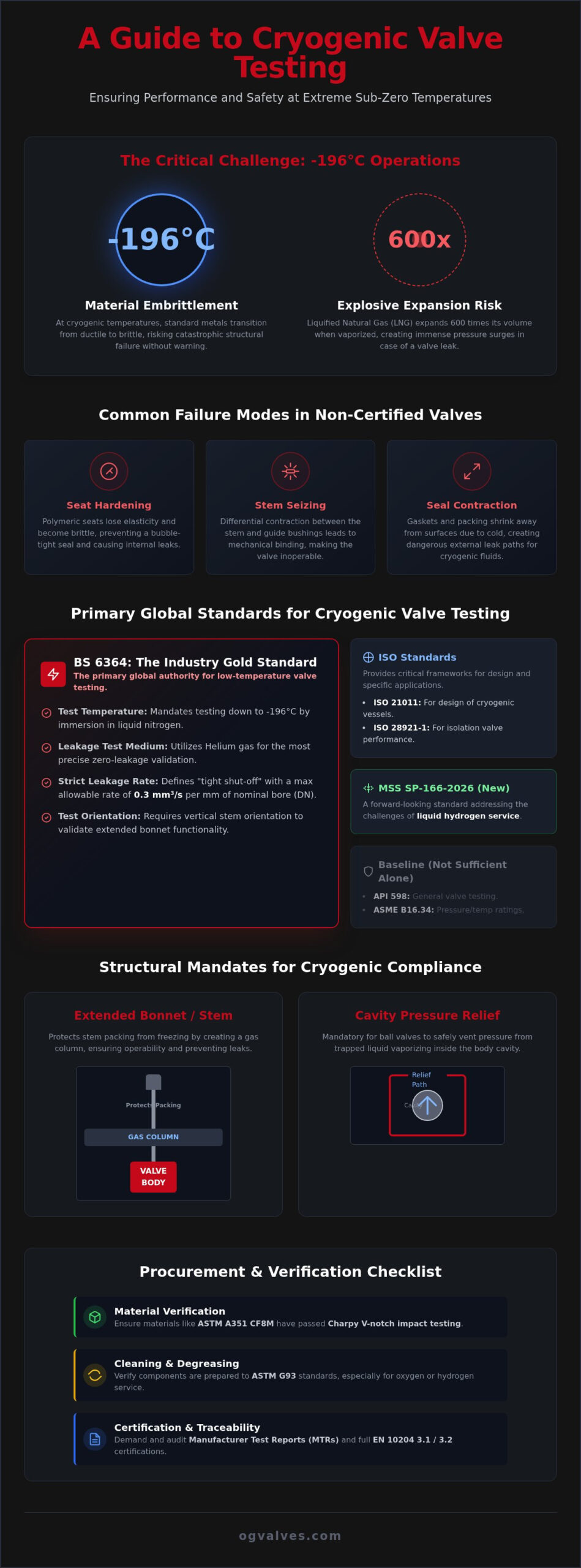
At temperatures reaching -196°C, the transition from ductile to brittle behavior in metallic alloys isn’t just a technical concern; it’s a precursor to catastrophic structural failure. Maintaining operational safety in these sub-zero environments depends entirely on the rigorous application of cryogenic valve testing standards. These protocols ensure that every component, from ball valves to check valves, retains its mechanical properties and sealing capabilities when exposed to the intense thermal shock of liquified gases.
You recognize that ambient temperature verification cannot simulate the extreme shrinkage and material stresses found in LNG or liquid hydrogen applications. This guide provides a clinical analysis of the global regulatory landscape to simplify your procurement and compliance processes. We’ll examine the specific requirements of BS 6364 and ISO 21011, alongside the newly released MSS SP-166-2026 for hydrogen service. This technical breakdown provides a definitive checklist for verifying valve certifications and securing pre-tested components that meet the most stringent industrial benchmarks for zero-leakage performance.
Key Takeaways
- Understand the fundamental physics of sub-zero operation, specifically how material embrittlement and coefficient of thermal expansion (CTE) dictate valve material selection.
- Identify the critical differences between primary cryogenic valve testing standards such as BS 6364, ISO 21011, and the 2026 updates for hydrogen service.
- Learn to verify essential structural mandates, including extended bonnet gas column lengths and mandatory cavity relief mechanisms for ball valves.
- Master technical verification methodologies, including ASTM G93 degreasing protocols and the use of helium as a test medium for zero-leakage validation.
- Streamline procurement cycles by establishing a checklist for auditing Manufacturer Test Reports (MTRs) and EN 10204 3.1/3.2 certifications.
The Critical Role of Cryogenic Testing in Industrial Safety
Cryogenic service is technically defined by operations at temperatures below -40°C, extending down toward absolute zero. At these levels, the fundamental science of cryogenics dictates that standard industrial materials undergo radical physical changes. Engineering valves for these environments requires strict adherence to cryogenic valve testing standards to mitigate the risks of material embrittlement and coefficient of thermal expansion (CTE) mismatches.
Standard valve components often fail in sub-zero service because they aren’t designed for the volumetric changes associated with deep cooling. The stakes of such failures are exceptionally high due to the explosive expansion of liquefied gases. For instance, LNG expands approximately 600 times its liquid volume when vaporized, creating massive pressure surges if contained within a failing valve body. Common failure modes in non-certified hardware include:
- Seat Hardening: Polymeric materials lose elasticity, preventing a bubble-tight seal.
- Stem Seizing: Differential contraction between the stem and guide bushings leads to mechanical binding.
- Seal Contraction: Gaskets and packing shrink away from mating surfaces, creating external leak paths.
Thermal Contraction and Material Stability
Disparate materials contract at significantly different rates. While a stainless steel body might contract marginally, a PTFE seal will shrink at a much higher rate, potentially compromising the zero-leakage requirement. To prevent structural failure, engineers must specify materials like austenitic stainless steels, such as ASTM A351 CF8M. These alloys require Charpy V-notch impact testing to ensure they maintain toughness at service temperatures. The ductile-to-brittle transition is a critical material property where carbon steels lose their fracture toughness and become susceptible to sudden, catastrophic failure when exposed to temperatures below their transition point.
Regulatory Framework Overview
Ensuring compliance requires a synthesis of general valve standards and cryogenic-specific protocols. While ASME B16.34 defines the pressure-temperature ratings and wall thicknesses for flanged and welding end valves, it must be supplemented by cryogenic valve testing standards from the American Petroleum Institute (API) and the International Organization for Standardization (ISO). These frameworks address unique operational realities, including Cold Box applications. Cold box applications utilize an insulated, often vacuum-sealed enclosure to house multiple cryogenic components, requiring valves with extended stems that penetrate the insulation barrier for external operation. This setup ensures that critical hardware remains accessible while maintaining the thermal integrity of the system.
Primary Global Standards for Cryogenic Valve Testing
Compliance with cryogenic valve testing standards requires a precise understanding of how different regulatory bodies define performance benchmarks. While general pressure-testing protocols like API 598 provide a baseline, they don’t account for the unique thermal stresses of sub-zero service. Engineers must look to specialized frameworks to ensure that components such as ball valves and globe valves operate without mechanical failure or fugitive emissions at extreme temperatures.
The regulatory landscape is dominated by a few critical documents. BS 6364 remains the most widely referenced benchmark globally, while ISO 21011 provides essential requirements for the design and manufacture of cryogenic vessels. Additionally, ISO 28921-1 focuses specifically on isolation valves for low-temperature applications, ensuring that isolation performance isn’t compromised by seal contraction.
BS 6364: The Industry Gold Standard
Published by the British Standards Institution, BS 6364 is the primary authority for testing valves intended for temperatures as low as -196°C. The standard mandates that valves are immersed in liquid nitrogen to reach thermal equilibrium before testing begins. It defines “tight shut-off” with high precision; for example, the maximum allowable seat leakage rate is often capped at 0.3 mm³/s per mm of nominal bore (DN) when using helium gas.
Testing orientation is a critical factor under this standard. Valves must typically be tested with the stem in a vertical position to ensure the “cold box” or extended bonnet functions correctly. This orientation allows a gas column to form, protecting the gland packing from freezing. If your project requires non-vertical installation, the testing protocol must be adjusted to verify performance at the specific angle of operation.
MSS SP-134 and ASME B16.34 Integration
While BS 6364 focuses on the testing process, MSS SP-134 provides the design mandates for valves with gas column extensions. This standard dictates the minimum length of the extended bonnet based on the service temperature and the thickness of the insulation. It’s designed to ensure that the packing gland remains at a temperature high enough to maintain seal integrity, usually above 0°C, even when the valve body is at -196°C.
These requirements must be integrated with ASME B16.34, which defines the pressure-temperature ratings for cryogenic alloys like CF8 and CF8M. When selecting industrial valves for cryogenic service, it’s vital to confirm that the material’s pressure rating hasn’t been de-rated by the extreme cold. For technical guidance on matching these standards to your specific project requirements, consulting with a specialist supplier like OG VALVES LTD. can help prevent costly specification errors.
Technical Methodologies: How Standards Are Verified
Verification of compliance with cryogenic valve testing standards begins long before the first thermal cycle. For components intended for oxygen or high-purity gas service, pre-test preparation requires rigorous degreasing and cleaning per ASTM G93. Any hydrocarbon residue remaining on the internal surfaces can lead to spontaneous ignition when exposed to liquid oxygen. This methodology ensures the pressure-retaining integrity defined in ASME B16.34 remains intact while eliminating contamination risks during the testing phase.
During the actual test, the extended bonnet’s gas column plays a vital role. By positioning the valve with the stem vertical, a pocket of vaporized gas forms in the extension. This column acts as a thermal insulator, preventing the packing gland from reaching the cryogenic temperatures of the test medium. If the gland freezes, the resulting seal failure is a result of improper testing setup rather than a design flaw, making precise orientation a non-negotiable requirement for valid data collection.
The Cryogenic Testing Sequence
The verification process follows a logical, multi-stage progression to isolate performance variables at different thermal states. It starts with an ambient temperature high-pressure shell and seat test to establish a baseline. Following this, the valve is submerged in liquid nitrogen (LN2) at -196°C. It’s critical that the valve remains submerged until thermal stabilization is achieved, which is confirmed when the boil-off rate of the LN2 becomes constant. Once stabilized, technicians perform low-pressure and high-pressure seat leakage tests. The sequence concludes with a controlled warm-up to ambient temperature, followed by a final functional verification to ensure no permanent mechanical deformation occurred during the deep freeze.
Helium Mass Spectrometry for Leak Detection
High-purity Helium is the required medium for cryogenic leakage verification because of its unique physical properties. Helium has a molecular diameter of approximately 0.26 nanometers, allowing it to penetrate microscopic leak paths that open as metallic and polymeric materials contract at -196°C. While bubble counting provides a visual confirmation for gross leaks, mass spectrometry offers the precision required for high-specification industrial projects. Leakage rates are quantified in standard cubic centimeters per second (sccs), providing a granular view of seal performance. This data allows engineers to differentiate between shell leakage, which indicates a failure in the body or bonnet casting, and seat leakage, which points to issues with the internal sealing geometry or material selection.
Structural Mandates: Design Requirements for Compliance
Design compliance isn’t achieved through testing alone; it must be engineered into the valve’s physical architecture. Cryogenic valve testing standards mandate structural features that address the volumetric expansion and material fragility inherent to sub-zero service. Material selection is the first line of defense. Austenitic stainless steels like 316SS and high-strength alloys like Super Duplex are standard for check valves because they maintain high impact toughness at -196°C. Standard elastomers are replaced with Lip Seals or Kel-F (PCTFE) inserts to ensure the seal remains pliable enough to maintain a bubble-tight shut-off under extreme thermal contraction.
These mandates extend to the external assembly, where the valve must interface with control systems without compromising thermal integrity. Every component, from the stem to the body bolting, must be specified to handle the mechanical stresses of rapid thermal cycling. Failure to incorporate these design elements renders a valve incapable of passing the rigorous validation protocols required for hazardous fluid service.
The Gas Column Principle
The extended bonnet, or gas column, is the most visible requirement of these standards. This extension is designed to maintain the packing gland and stem seal at a temperature near ambient, typically above 0°C. The minimum length of this extension is calculated based on the thermal conductivity of the alloy and the specific insulation thickness of the system. A properly sized vapor space prevents the formation of ice on the stem, which would otherwise damage seals or lead to the mechanical failure of valve actuators. This design ensures that the soft components of the gland remain within their operational temperature range while the valve body is submerged in cryogenic fluid.
Internal Design Adjustments
Internal pressure management is equally critical, particularly for ball valves. When liquid becomes trapped in the valve cavity, even a slight increase in temperature causes rapid vaporization. Without a relief mechanism, this internal pressure can exceed the material’s yield strength, leading to explosive body rupture. Compliance is achieved through self-relieving seats or vented balls that allow excess pressure to bleed back into the upstream line. These design choices determine whether a valve is classified for unidirectional or bidirectional service. Engineers must specify the relief method during the design phase to ensure the valve meets the safety benchmarks of the project.
For procurement teams, verifying these structural features is as important as reviewing the test certificates. You can secure fully compliant hardware by exploring our inventory of pre-tested industrial valves designed for the most demanding cryogenic environments.
Procuring Certified Cryogenic Valves for Global Projects
Procurement for cryogenic systems requires a shift from price-centric selection to verification-centric auditing. Since sub-zero applications involve hazardous fluids like LNG or liquid hydrogen, the risk of material failure is absolute. Cryogenic valve testing standards serve as the regulatory baseline, but the actual procurement process hinges on the validity of documentation. A specialist supplier provides the technical oversight needed to ensure that every component, from ball valves to high-pressure gate valves, arrives with verifiable data that matches your project’s specific safety requirements.
This oversight acts as a safeguard against the material embrittlement risks discussed in previous sections. Procurement teams must move beyond surface-level quotes and demand a detailed breakdown of the testing protocols used by the manufacturer. Relying on a generalist vendor often leads to specification gaps, where a valve may meet general pressure requirements but lacks the specific structural mandates for -196°C service.
Documentation and Quality Assurance
A standard Cryogenic Test Report must include specific data points: stabilization time, test medium purity, and exact leakage rates in sccs. Verification of Manufacturer Test Reports (MTRs) ensures that the chemical composition and mechanical properties of the casting align with ASTM requirements for low-temperature service. EN 10204 3.1 or 3.2 certification is mandatory for high-stakes infrastructure. While a 3.1 certificate is issued by the manufacturer’s authorized inspector, a 3.2 certificate requires an independent third-party inspection (TPI) to witness the testing process. This level of traceability ensures that the material hasn’t been compromised between the foundry and the final assembly, providing a clinical record of structural soundness.
Global Logistics for Critical Valves
Managing lead times is a primary challenge for procurement specialists in heavy industry. Custom cryogenic testing can add several weeks to a standard production cycle, which is unacceptable during emergency maintenance or critical infrastructure repairs. OG VALVES LTD. addresses this through an extensive inventory of high-specification components and established fast-track delivery capabilities. By maintaining a global supply chain, we minimize downtime and ensure that pre-tested valves meeting BS 6364 or ISO 28921-1 are available for immediate dispatch.
Our technical support team assists in project specification and standard alignment, ensuring that your procurement strategy accounts for the most recent 2026 updates in cryogenic valve testing standards. This methodical approach to global logistics ensures that safety-critical hardware is delivered without the delays typically associated with specialized industrial components. By positioning as a technical partner rather than a mere vendor, OG VALVES LTD. provides the engineering excellence required for high-risk industrial environments.
Securing Infrastructure Integrity Through Technical Compliance
The operational success of high-stakes industrial projects depends on the clinical application of cryogenic valve testing standards. You’ve seen how material selection, extended bonnet geometry, and Helium mass spectrometry work in unison to prevent catastrophic structural failure. These protocols aren’t optional; they’re the technical foundation for safety in liquified gas environments. Maintaining zero-leakage performance requires a partner who understands the cost of failure and the necessity of engineering excellence.
OG VALVES LTD. acts as your technical authority, providing an extensive inventory of high-specification components that meet the rigorous benchmarks of API, ISO, and BS. Our global logistics capabilities ensure fast-track delivery for critical infrastructure repairs, minimizing downtime without compromising on regulatory adherence. Every valve is backed by comprehensive project management and rigorous quality control. It’s time to secure your facility with hardware that’s been verified for the most demanding sub-zero applications. Request a Technical Quote for Certified Cryogenic Valves and ensure your project meets the highest benchmarks of industrial safety.
Frequently Asked Questions
What is the primary difference between BS 6364 and MSS SP-134?
BS 6364 is primarily a testing protocol that defines immersion procedures, thermal stabilization requirements, and allowable leakage limits for cryogenic service. In contrast, MSS SP-134 is a design standard focusing on the physical dimensions and structural requirements of valves with gas column extensions. While BS 6364 verifies performance, MSS SP-134 ensures the valve architecture supports that performance by specifying extension lengths based on service temperature and insulation thickness.
Can a standard industrial valve be retrofitted for cryogenic service?
Standard industrial valves cannot be reliably retrofitted for cryogenic service due to material and design constraints. Cryogenic applications require specific material grades like ASTM A351 CF8M to prevent brittle fracture, which standard carbon steel valves lack. Additionally, the integrated extended bonnet and cavity relief mechanisms required by cryogenic valve testing standards must be cast or forged into the original design. Attempting to modify standard hardware introduces unacceptable risks of catastrophic structural failure.
Why is helium used instead of nitrogen or air for cryogenic leakage testing?
Helium is used because it remains in a gaseous state at -196°C and possesses a smaller molecular diameter than nitrogen or air. At these extreme temperatures, nitrogen can liquefy, making it unsuitable as a pressure testing medium. Helium’s ability to penetrate microscopic leak paths that open during thermal contraction ensures the most rigorous verification of seal integrity. This precision is required for achieving the zero-leakage benchmarks mandated by global industrial standards.
What is an extended bonnet, and why is it mandatory for cryogenic valves?
An extended bonnet is a mandatory vertical column that creates a vapor space between the cryogenic fluid and the valve’s stem packing. This gas column acts as a thermal insulator, keeping the packing gland at or near ambient temperatures to prevent freezing. If the packing reaches cryogenic levels, the seals shrink and harden, leading to fugitive emissions. Proper extension length is determined by the thermal conductivity of the valve material and the system’s insulation.
How does material embrittlement affect valve selection at -196°C?
Material embrittlement at -196°C causes standard carbon steels to lose their fracture toughness, leading to sudden, brittle failure under stress. Valve selection must prioritize austenitic stainless steels or high-nickel alloys that retain ductility at absolute zero. Impact testing, such as the Charpy V-notch test, is required to verify that the selected alloy can withstand thermal shock and mechanical loads without undergoing a ductile-to-brittle transition during operation.
What are the allowable leakage rates for a BS 6364 compliant valve?
Allowable leakage rates for a BS 6364 compliant valve are strictly defined based on the nominal bore of the component. For most cryogenic applications using helium, the maximum seat leakage is capped at 0.3 mm³/s per mm of the nominal diameter (DN). This quantifiable metric ensures “tight shut-off” performance. Technicians measure these rates using mass spectrometry to ensure the valve meets the stringent safety requirements for handling hazardous liquified gases.
Does OG VALVES provide technical support for cryogenic valve specification?
OG VALVES provides comprehensive technical support for the specification and alignment of cryogenic valve testing standards. Our engineering team assists procurement specialists in navigating complex international certifications, ensuring that selected hardware meets the precise demands of global infrastructure projects. We act as a technical authority, helping you verify that every gate, ball, or check valve in your system is fully compliant with API and ISO protocols.
What certifications should I look for in a cryogenic valve test report?
A cryogenic valve test report should include EN 10204 3.1 or 3.2 certification to ensure material traceability and testing oversight. You must also verify the Manufacturer Test Reports (MTRs) for chemical composition and mechanical properties. Essential data points in the report include the stabilization duration, the purity of the helium test medium, and the specific leakage rates recorded at both ambient and cryogenic temperatures to confirm structural soundness.
 Responsive Menu