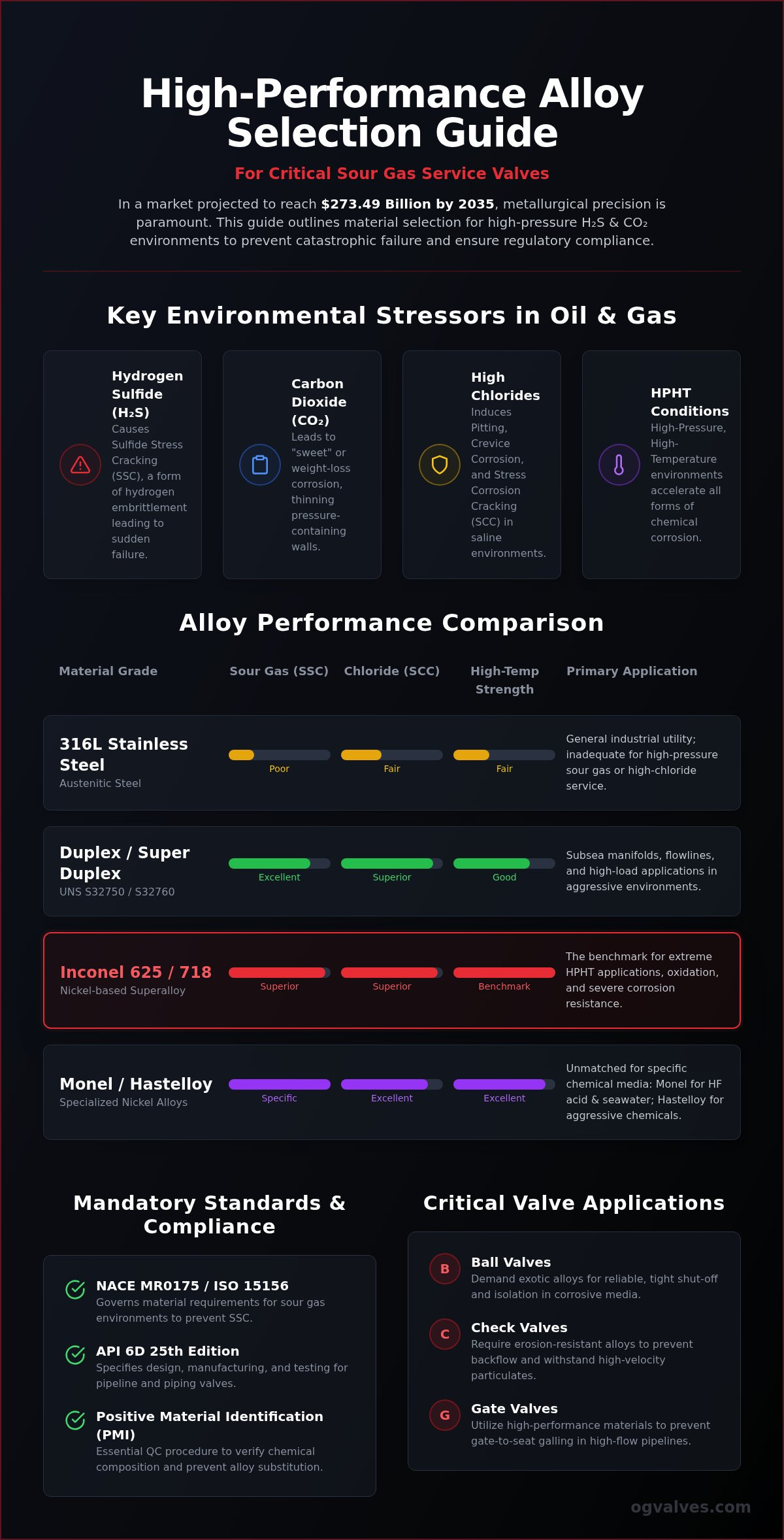
With the global industrial valves market projected to reach USD 273.49 billion by 2035, the margin for metallurgical error in high-pressure environments has effectively vanished. Engineering teams recognize that specifying valves for sour gas service is no longer a matter of simple corrosion resistance; it requires a precise metallurgical synergy to withstand the specific stressors of H2S and CO2. Failure to account for these variables leads to catastrophic sulfide stress cracking and the extreme cost of operational downtime.
This guide provides a definitive technical framework for selecting and sourcing high-performance exotic alloy components. It ensures your infrastructure maintains structural integrity while adhering to the mandatory API 6D 25th Edition standards and the latest 2026 NACE MR0175/ISO 15156 requirements. We will analyze critical material classifications, examine the impact of the April 9, 2026 EPA technical amendments on fugitive emissions, and detail procurement strategies to mitigate the ongoing volatility in global nickel and Inconel supply chains. You’ll gain the technical insight necessary to identify reliable global suppliers capable of fast-track delivery for gate, ball, and check valves in critical oil and gas infrastructure.
Key Takeaways
- Define the mechanical limitations of standard 316L stainless steel and identify optimal applications for Duplex and Inconel alloys in high-pressure systems.
- Establish precise engineering specifications for valves for sour gas service to mitigate the risk of sulfide stress cracking and ensure regulatory adherence.
- Execute comprehensive quality control procedures, including Positive Material Identification (PMI), to verify chemical composition and prevent alloy substitution errors.
- Optimize industrial procurement by leveraging global logistics networks for the fast-track delivery of high-specification gate, ball, and check valves.
The Role of Exotic Alloy Valves in Critical Oil and Gas Infrastructure
Standard austenitic stainless steels, specifically 316 and 316L, provide sufficient corrosion resistance for general industrial utility. They’re often inadequate for high-pressure upstream oil and gas environments where chemical complexity is high. The presence of Hydrogen Sulfide (H2S), Carbon Dioxide (CO2), and high chloride concentrations creates a volatile environment that demands superior metallurgical properties. Selecting the correct valves for sour gas service is a critical engineering decision that directly impacts the safety and structural integrity of the entire asset. Procurement specialists must prioritize material compliance to avoid the risk of sudden mechanical failure.
Environmental stressors in these sectors are rarely isolated. Sour gas environments facilitate Sulfide Stress Cracking (SSC), a form of hydrogen embrittlement that causes sudden, catastrophic failure in susceptible materials. When combined with CO2, “sweet” corrosion or weight-loss corrosion occurs, thinning the pressure-containing walls of industrial valves. Material failure represents a significant financial liability. In subsea operations, the logistical complexity of intervention combined with lost production revenue often results in costs that dwarf the initial procurement value of the equipment. Investing in exotic alloys is a strategic move to ensure long-term infrastructure longevity and regulatory adherence.
Understanding Corrosive Environments in Upstream and Downstream
Upstream reservoirs often present high-pressure, high-temperature (HPHT) conditions that accelerate chemical reactions. Pitting and crevice corrosion are frequent in offshore saline environments. Chloride ions penetrate the protective oxide layer of lower-grade steels, leading to localized metal loss. Stress Corrosion Cracking (SCC) becomes a primary failure mode when temperatures exceed 60°C in the presence of chlorides and tensile stress. These factors necessitate materials with a high Pitting Resistance Equivalent Number (PREN) to maintain operational safety and prevent leakage.
Industrial Valve Categories Requiring Exotic Materials
The mechanical design of a valve must complement its material composition. High-performance industrial ball valves are essential for reliable isolation in sour environments where tight shut-off is non-negotiable. For backflow prevention, critical check valves must be manufactured from erosion-resistant alloys to withstand high-velocity particulates. The heavy-duty nature of gate valves in high-flow pipelines requires exotic materials to prevent gate-to-seat galling. Utilizing specialized valves for sour gas service ensures compliance with NACE MR0175 and prevents the degradation of critical infrastructure components.
The selection of high-performance alloys is a precise engineering exercise. For infrastructure requiring valves for sour gas service, the material must meet the rigorous criteria of NACE MR0175/ISO 15156 to ensure long-term integrity. Duplex and Super Duplex alloys, such as UNS S32750 and S32760, provide a dual-phase microstructure consisting of austenite and ferrite. This specific structure offers superior yield strength and resistance to chloride-induced stress corrosion cracking. These alloys are frequently specified for subsea manifolds and flowlines where mechanical loads are high and environmental conditions are aggressive.
Inconel 625 and 718 represent the benchmark for extreme temperature and oxidation resistance. These nickel-based superalloys maintain high mechanical strength at elevated temperatures, making them indispensable for high-pressure, high-temperature (HPHT) applications. For specific chemical stressors, Monel 400 remains the preferred choice for hydrofluoric acid service and marine exposure due to its exceptional resistance to flowing seawater. Hastelloy C276 provides unmatched protection against aggressive chemical media and high-concentration sour gas, often utilized in the most severe processing environments where other alloys fail. Engineers often consult a specialized alloy inventory to verify availability before finalizing these high-stakes specifications.
Pitting Resistance Equivalent Number (PREN) Explained
Pitting Resistance Equivalent Number (PREN) is the primary metric for evaluating the pitting resistance of stainless steels and nickel alloys in chloride-bearing environments. The calculation follows a standardized formula: PREN = %Cr + 3.3(%Mo + 0.5%W) + 16%N. Materials with a PREN value exceeding 40 are generally considered resistant to seawater corrosion. This numerical value allows procurement specialists to objectively compare the durability of different alloys during the selection process for valves for sour gas service.
Mechanical Properties vs. Chemical Resistance
Material selection involves a trade-off between chemical inertness and mechanical performance. Super Duplex alloys exhibit yield strengths significantly higher than standard 316L or carbon steel, allowing for thinner wall sections in high-pressure valve designs. Engineers must also account for thermal expansion coefficients when designing components for cryogenic or high-heat service to prevent binding or leakage. Subsea valve bodies require high impact toughness at low temperatures to mitigate the risk of brittle fracture under operational loads. Every specification must be balanced against the physical demands of the installation site to ensure structural soundness.
Material Selection Criteria for Corrosive and High-Pressure Environments
Effective material selection for valves for sour gas service depends on the precise chemical composition of the process fluid. Sweet gas applications typically permit the use of standard carbon or stainless steels, but sour environments contain H2S concentrations that trigger aggressive failure mechanisms. Engineers must evaluate the partial pressure of H2S alongside chloride levels and pH values to determine the appropriate metallurgical grade. This evaluation ensures that the selected alloy provides sufficient resistance to environmental cracking while maintaining the necessary mechanical strength for high-pressure containment.
Flow dynamics introduce additional stressors that go beyond static chemical resistance. In butterfly valves, high flow velocities increase the risk of erosion-corrosion, particularly when abrasive particulates or droplets are present in the stream. While ASME B16.34 provides a baseline for pressure-temperature ratings, critical infrastructure often requires more stringent specifications. These custom ratings account for cyclic loading, thermal shocks, and the long-term degradation of material properties in harsh service. Reliability in these systems is non-negotiable, necessitating a selection process that prioritizes metallurgical stability over initial procurement costs.
Sour Service and NACE Compliance
Sulfide Stress Cracking (SSC) is the primary threat in sour service, occurring when atomic hydrogen enters the metal lattice and causes embrittlement under tensile stress. To mitigate this risk, NACE MR0175/ISO 15156 material compliance mandates strict hardness limits, often capping carbon steel components at 22 HRC. Heat treatment processes, such as solution annealing or double tempering, are essential to achieve the required microstructure. Internal trim materials must also be selected with compatible electrochemical potentials to prevent galvanic corrosion between the valve body and its moving parts, ensuring consistent operational performance.
Alloy Selection for Specific O&G Sub-Sectors
Upstream assets, including subsea manifolds and Christmas trees, demand high-nickel alloys like Inconel to handle unprocessed wellbore fluids and extreme hydrostatic pressures. Midstream operations focused on pipeline isolation and compressor station blowdown require materials that withstand rapid pressure differentials and potential hydrate formation. Downstream refining involves aggressive media such as sulfuric or hydrochloric acids. These environments necessitate the use of Hastelloy or Monel for critical process control to prevent localized pitting and ensure the safety of the refining facility. Every sub-sector requires a tailored approach to ensure that valves for sour gas service perform reliably throughout their design life.
Quality Assurance and Regulatory Compliance in Exotic Alloy Procurement
Ensuring the structural soundness of valves for sour gas service requires a rigorous quality assurance framework. Compliance with API 6D, API 600, and ASME B16.34 isn’t just a regulatory hurdle; it’s the baseline for industrial safety. Non-Destructive Testing (NDT) protocols identify internal and surface defects without compromising the component’s integrity. Radiography (RT) provides a definitive view of internal casting or welding soundness. Dye penetrant (PT) and magnetic particle inspection (MPI) detect surface-cracks that could lead to stress corrosion cracking in high-pressure environments. Every component must be accompanied by a Mill Test Report (MTR) to provide full chemical and physical traceability back to the original heat number.
Verifying these reports ensures the material meets the exact mechanical properties required for the project. For assets requiring absolute material certainty, engineers should utilize comprehensive material testing services to validate alloy integrity before final installation. This level of oversight is essential when managing the high-stakes risks associated with sour gas infrastructure.
The Importance of PMI Testing
X-ray Fluorescence (XRF) and Optical Emission Spectroscopy (OES) technologies allow for on-site verification of elemental composition. PMI testing ensures valve materials match procurement specifications by providing a definitive chemical analysis of the alloy before it enters service. High-risk industrial applications often require 100% PMI verification for all pressure-containing parts and internal trim to eliminate the risk of accidental alloy substitution during the manufacturing process.
Third-Party Inspections and Factory Acceptance Tests (FAT)
Hydrostatic and pneumatic pressure testing procedures are conducted to validate shell and seat integrity. Hydrostatic tests typically involve pressures at 1.5 times the rated capacity to ensure the valve body can withstand extreme operational surges. Fugitive emission testing, adhering to API 622 or 624, ensures environmental compliance and minimizes product loss. Independent third-party inspectors play a critical role in global supply chains by providing unbiased oversight during these tests. This ensures that valves for sour gas service meet all international standards for safety and operational output.
Strategic Sourcing and Global Logistics for Specialist Industrial Valves
Strategic procurement in the current industrial climate requires more than simple vendor selection. The volatility in the global supply chain for rare and exotic alloys, characterized by the pricing fluctuations recorded in Q1 2026 for nickel-based superalloys, necessitates a shift toward a “just-in-case” inventory strategy. For technical experts specifying valves for sour gas service, the ability to bypass the extended lead times of custom-engineered components is a significant operational advantage. A specialized supplier doesn’t just provide a product; they manage the technical complexity of material verification and global distribution to ensure critical infrastructure remains functional. This approach minimizes the high cost of operational downtime due to component failure or delayed delivery.
Procurement optimization involves balancing immediate inventory availability with deep technical consultation. Specialized global suppliers provide the necessary expertise to navigate fluctuating material constraints and logistical challenges. By anchoring sourcing decisions in rigorous testing and quality control, organizations ensure that every component meets the high-stakes requirements of heavy industrial sectors. This level of oversight is essential for maintaining the long-term structural integrity of assets in corrosive environments.
Minimising Lead Times for Exotic Materials
Maintaining a strategic inventory of industrial valves reduces the risk of prolonged facility shutdowns. While custom-engineered solutions are necessary for unique project requirements, stocking programs for standard pressure classes and alloy grades provide a buffer against supply chain disruptions. Global logistics capabilities are essential for rapid deployment to remote upstream sites or offshore platforms. Efficient distribution networks ensure that high-specification components reach their destination without the delays common in non-specialized shipping, providing a dependable solution for fast-track project demands.
Partnering with a Specialist Valve Supplier
A single-source provider offers technical expertise across a broad range of product categories, including gate, ball, globe, and needle valves. This consolidation simplifies project management and ensures that all components meet the same rigorous engineering standards and material certifications. Technical consultation during the procurement phase helps identify the most cost-effective alloy that meets the required safety benchmarks for valves for sour gas service. Reliability is the ultimate metric in critical infrastructure. Contact OG VALVES LTD. for a technical consultation or project quote to secure high-performance components for your next international project.
Securing Long-Term Integrity in Critical Oil and Gas Infrastructure
Ensuring the structural soundness of heavy industrial assets requires a precise alignment between metallurgical specifications and environmental stressors. The transition from standard stainless steels to high-performance alloys like Super Duplex and Inconel is no longer optional for high-pressure reservoirs. By prioritizing valves for sour gas service that adhere to the latest NACE MR0175 and API 6D standards, engineering teams mitigate the risk of catastrophic sulfide stress cracking and unplanned operational downtime. Rigorous quality assurance, specifically Positive Material Identification (PMI), remains the definitive benchmark for verifying chemical composition and ensuring regulatory compliance.
Reliable procurement is the final pillar of infrastructure safety. Partnering with a specialist global supplier ensures that technical data translates into functional reality through comprehensive project management and stringent testing protocols. OG VALVES LTD. maintains an extensive inventory of high-specification gate, ball, globe, and check valves, offering fast-track delivery options to minimize industrial downtime. Accurate material selection today prevents the extreme costs of failure tomorrow. Request a Technical Specification Quote from OG VALVES LTD. to secure the specialized components required for your next global project.
Frequently Asked Questions
What are exotic alloy valves and why are they used in oil and gas?
Exotic alloy valves are flow control components manufactured from specialized nickel, chromium, and molybdenum-based materials such as Inconel, Hastelloy, and Monel. They’re utilized in the oil and gas sector because standard carbon or stainless steels lack the metallurgical properties to withstand aggressive media. In environments containing high concentrations of H2S and CO2, these alloys prevent catastrophic failures like sulfide stress cracking and localized pitting, ensuring the structural soundness of critical infrastructure.
How does Super Duplex compare to standard stainless steel for offshore valves?
Super Duplex alloys, specifically UNS S32750 and S32760, offer significantly higher yield strength and corrosion resistance compared to standard 316L stainless steel. With a Pitting Resistance Equivalent Number (PREN) exceeding 40, Super Duplex provides superior protection against chloride-induced stress corrosion cracking in saline offshore environments. This allows engineers to specify thinner wall sections while maintaining high-pressure ratings, effectively optimizing both weight and durability in subsea manifolds and flowlines.
What is NACE MR0175 and why is it critical for valve material selection?
NACE MR0175/ISO 15156 is the international standard defining material requirements for equipment used in H2S-containing environments. It’s critical for valves for sour gas service because it establishes strict hardness limits and heat treatment protocols to prevent hydrogen-induced cracking. Adherence to this standard is a mandatory safety requirement for upstream production and processing facilities to mitigate the risk of sudden mechanical failure in the presence of sour process fluids.
Can OG VALVES LTD. provide PMI testing for exotic alloy orders?
Yes, OG VALVES LTD. performs comprehensive Positive Material Identification (PMI) testing on all exotic alloy orders to ensure metallurgical accuracy. Using XRF and OES technologies, technical experts verify the elemental composition of every pressure-containing part and internal trim component. This process ensures that the delivered hardware matches the exact specifications required by the project, eliminating the risk of material substitution or alloy mix-ups in high-stakes industrial applications.
What are the most common exotic alloys used for high-pressure ball valves?
High-pressure ball valves often utilize Inconel 625, Inconel 718, or Hastelloy C276 for their internal trim and body components. These alloys are selected for their high yield strength and excellence in extreme temperature and oxidation resistance. In subsea isolation applications, Super Duplex is frequently specified due to its mechanical toughness and resistance to the abrasive effects of high-velocity particulates in unprocessed wellbore fluids, ensuring long-term operational reliability.
How do exotic alloys impact the total cost of ownership (TCO) for a pipeline?
While the initial procurement cost of exotic alloys is higher than carbon steel, they significantly reduce the Total Cost of Ownership (TCO) by extending the service life of the asset. By preventing corrosion-related failures, these materials minimize the extreme costs associated with emergency repairs, environmental remediation, and lost production revenue. For critical pipelines, the investment in high-performance alloys ensures consistent operational output and reduces the frequency of expensive component replacements over the asset life.
What international standards govern the manufacturing of exotic alloy gate valves?
The manufacturing of exotic alloy gate valves is governed by API 600 for bolted bonnet designs and API 6D for pipeline service. These standards, alongside ASME B16.34, define the pressure-temperature ratings, wall thicknesses, and testing protocols required for industrial safety. Compliance with these benchmarks ensures that valves for sour gas service maintain structural integrity under extreme mechanical loads and adhere to the rigorous regulatory requirements of global energy infrastructure.
Does OG VALVES LTD. offer fast-track delivery for international industrial sites?
OG VALVES LTD. specializes in the fast-track delivery of high-specification valves to international industrial sites to minimize project delays. By maintaining an extensive inventory of gate, ball, globe, and check valves in specialized alloys, the organization bypasses standard manufacturing lead times. This capability is essential for minimizing industrial downtime during emergency shutdowns or when critical infrastructure projects require the rapid deployment of certified components to remote global locations.
 Responsive Menu