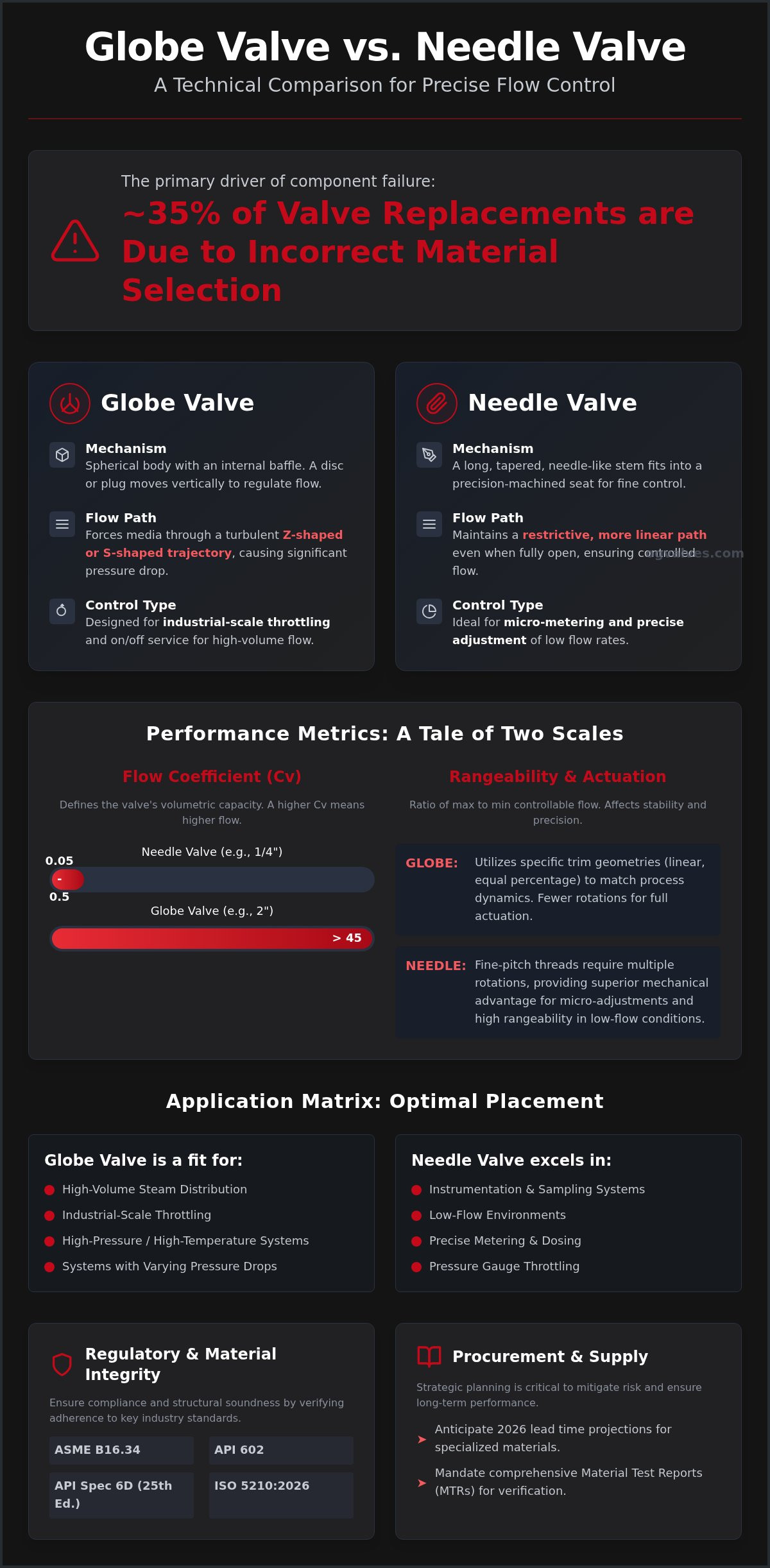
Incorrect material selection is the primary driver of component failure, accounting for approximately 35% of all industrial valve replacements. For engineers overseeing high-pressure environments, the technical distinction between a globe valve vs needle valve for precise control is a critical factor in maintaining system efficiency and ensuring adherence to ASME B16.34 standards. You recognize that inaccurate flow metering directly compromises operational safety and regulatory compliance, particularly as API Spec 6D 25th edition requirements become effective in 2026.
This article provides a rigorous comparison of these components to establish definitive selection criteria for industrial control loops. We deliver the technical data required to determine the exact flow thresholds where needle valves outperform globe valves in micro-metering applications. The following analysis details maintenance protocols under ISO 5210:2026 and verifies material classifications for corrosive media to ensure your infrastructure remains structurally sound. By evaluating these specifications, procurement specialists can mitigate the risk of premature material failure and optimize long-term performance.
Key Takeaways
- Analyze the mechanical distinctions between the globe valve’s internal baffle design and the needle valve’s tapered stem to identify the correct throttling mechanism for your system.
- Establish definitive selection criteria for a globe valve vs needle valve for precise control by comparing Flow Coefficient (Cv) data and rangeability ratios.
- Determine the optimal placement for each valve type within industrial environments, from instrumentation sampling systems to high-volume steam distribution lines.
- Verify adherence to ASME B16.34 and API 602 standards to ensure material integrity and regulatory compliance in high-pressure process loops.
- Streamline procurement processes by understanding 2026 lead time projections for specialized materials and the necessity of comprehensive Material Test Reports (MTRs).
Technical Fundamentals of Throttling: Globe vs. Needle Mechanisms
Industrial flow regulation relies on specific internal geometries to manage kinetic energy and volumetric throughput. The primary distinction between a globe valve vs needle valve for precise control lies in the relationship between the closure member and the seat orifice. While both are linear motion valves designed for throttling, their mechanical configurations serve different scales of industrial demand.
The globe valve features a spherical body housing an internal baffle, where a plug or disk moves vertically to obstruct the flow. In contrast, needle valves utilize a long, tapered, needle-like stem that fits into a precision-machined seat. Sensitivity is a function of stem travel. Needle valves employ fine-pitch threads, requiring more rotations for full actuation. This mechanical advantage allows for micro-adjustments that are impossible with the broader plug of a standard globe valve. Sealing efficiency also varies by design. Metal-to-metal seats are standard for high-temperature steam, while soft-seated options are utilized in gas applications requiring bubble-tight shutoff.
Flow Path Geometry and Pressure Drop
The globe valve’s internal baffle forces the media through a Z-shaped trajectory. This configuration induces significant head loss and turbulence, which is a deliberate trade-off for the ability to regulate high-velocity flows without immediate seat erosion. When evaluating a globe valve vs needle valve for precise control, engineers must account for the resistance coefficient (K). Needle valves maintain a restrictive orifice even at 100% lift, creating a high K-factor. This results in substantial pressure drops, particularly in high-velocity systems where calculating energy loss across the seat is vital for pump sizing and system efficiency.
Sealing Mechanisms: Plug vs. Tapered Stem
Standard globe valve plug designs include contoured, v-port, and needle-plug variations to achieve specific flow characteristics, such as linear or equal percentage. Precision-machined needle stems provide even finer increments of regulation. Industrial specifications often reference Needle Valve Fundamentals when documenting instrumentation requirements for high-pressure sampling systems. These tapered stems allow for a gradual increase in the flow area, ensuring stability in low-flow environments where larger valves would hunt or vibrate.
A forced-sealed valve utilizes mechanical stem torque to drive the closure element into the seat, ensuring a reliable seal that does not depend on the differential pressure of the process fluid.
Quantifying valve performance requires a rigorous analysis of the Flow Coefficient (Cv), which defines the volumetric capacity of a component at a specific pressure differential. When evaluating a globe valve vs needle valve for precise control, the scale of Cv values dictates the application’s suitability. A standard 1/4-inch needle valve often features a Cv between 0.05 and 0.5, providing the resolution needed for micro-metering. Conversely, a 2-inch globe valve may possess a Cv exceeding 45, making it the preferred choice for industrial-scale throttling where higher throughput is mandatory.
Rangeability serves as another critical metric, representing the ratio between the maximum and minimum controllable flow rates. In complex petrochemical control loops, high rangeability prevents “hunting” and ensures stability across varying load conditions. Globe valves utilize specific trim geometries, such as linear or equal percentage, to match the process dynamics. Linear trim provides a flow rate directly proportional to the stem position, while equal percentage trim is essential for systems where pressure drops across the valve vary significantly with flow. Technical experts often consult the Control Valve Handbook to calculate these dynamics accurately.
Mechanical performance is further influenced by hysteresis and dead-band. Hysteresis occurs when the valve position differs depending on whether the stem is opening or closing, often due to packing friction or linkage play. In automated systems, this is minimized through high-torque actuators and digital positioners, whereas manual needle valves rely on fine-thread precision to maintain set-point accuracy.
Flow Coefficient (Cv) and Rangeability
The precision of a control loop is only as reliable as the valve’s ability to maintain a steady state. While needle valves excel at low Cv applications, their rangeability is often limited compared to high-performance globe valves. In many critical infrastructure projects, industrial check valves are integrated upstream of globe valves to prevent backflow and protect the sensitive throttling trim from hydraulic shock. For procurement specialists, selecting the correct Cv ensures that the valve operates within its optimal 20% to 80% opening range. If you require technical assistance with sizing, our team provides high-specification globe valves tailored for rigorous industrial environments.
Cavitation and Flashing Considerations
Throttling high-pressure liquids introduces the risk of cavitation, where the static pressure drops below the fluid’s vapor pressure threshold. The resulting bubble collapse can cause severe mechanical damage to globe valve plugs and seats. Needle valves mitigate this risk in sampling lines by providing a highly restrictive path that dissipates energy through friction rather than sudden expansion. To prevent flashing, where the pressure remains below vapor pressure at the outlet, engineers must specify hardened trim materials or multi-stage pressure reduction designs. Implementing these technical mitigation strategies reduces noise and vibration, extending the component’s operational lifespan.
Application Matrix: Selection Based on Industrial Environment
Industrial valve selection is a function of the operational environment and the specific volumetric demands of the process loop. The decision to implement a globe valve vs needle valve for precise control is often dictated by the scale of the fluid dynamics involved. While needle valves are typically relegated to micro-metering and instrumentation, globe valves govern the primary process lines of heavy industrial facilities where higher flow rates are standard.
High-Pressure Instrumentation and Sampling
Needle valves serve as the definitive standard for high-pressure instrumentation and sampling systems. Their primary role in pressure gauge isolation allows for controlled venting and calibration without disrupting the main process flow. In laboratory settings and pilot plants, managing micro-flow rates requires the mechanical advantage of fine-pitch threads and tapered stems. These components are essential for gas chromatography sampling lines, where zero-leakage performance is mandatory to maintain the integrity of analytical data. The ability to achieve minute adjustments ensures that sensitive instruments aren’t overwhelmed by sudden pressure surges.
Main Process Throttling and Steam Systems
Within main process throttling and steam distribution networks, globe valves provide the robust construction necessary for high-volume regulation. They are the preferred choice for boiler feed water systems and high-temperature steam lines in power generation plants. The DOE Valve Handbook details how the globe valve’s internal baffle design manages the kinetic energy of high-velocity fluids. While engineers may consider butterfly valves for large-diameter flow control, globe valves remain superior for applications requiring high-differential pressure throttling and precise set-point maintenance.
Chemical injection skids also rely on this application matrix to ensure the precise dosing of inhibitors and catalysts. Small-bore needle valves are ideal for high-pressure, low-volume injection, whereas globe valves manage the bulk flow in larger distribution headers. In hydraulic systems, needle valves provide essential damping for gauges and transmitters to prevent needle flutter. It’s critical to remember that throttling valves aren’t intended for primary isolation. For full-stop shutoff, industrial ball valves should be utilized to ensure a bubble-tight seal and prevent the seat erosion frequently associated with using partially open throttling components for isolation purposes.
When evaluating a globe valve vs needle valve for precise control in corrosive environments, material compatibility must align with the media’s chemical properties. Stainless steel 316 or super duplex alloys are often required to prevent pitting and stress corrosion cracking in offshore applications. Selecting the correct valve type based on these environmental factors ensures long-term reliability and reduces the frequency of unscheduled maintenance intervals.
Material Integrity and Regulatory Compliance Standards
Regulatory adherence is the baseline for industrial safety in high-pressure environments. ASME B16.34 defines the pressure-temperature ratings that govern the operational limits of both globe and needle valves. When evaluating a globe valve vs needle valve for precise control, engineers must verify that the selected component meets the specific stress requirements of the process environment. API 602 provides the necessary framework for compact carbon steel globe valves, ensuring they withstand the high-velocity throttling common in refinery service. These standards ensure that every component integrated into a critical loop possesses the structural soundness required for long-term performance.
API and ASME Standards for Control Valves
Distinguishing between API 600 and API 603 is essential for specialized procurement. API 600 covers heavy-duty bolted bonnet steel globe valves, while API 603 addresses corrosion-resistant, flange-end valves used in chemical processing. All components must undergo standardized testing protocols for seat leakage as defined by API 598. While industrial gate valves are governed by similar pressure ratings, their compliance requirements focus on isolation rather than the sustained throttling performance expected from globe and needle valves. API 602 also specifies design requirements for small-bore valves, typically 4 inches and smaller, which are critical for high-pressure throttling in refinery piping systems.
Material Selection for Corrosive Media
In sour gas environments, compliance with NACE MR0175/ISO 15156 is non-negotiable to prevent sulfide stress cracking. For offshore applications, needle valves often utilize Super Duplex or Inconel alloys to resist chloride-induced pitting. High-velocity globe valve service requires erosion-resistant trim materials to maintain flow coefficient integrity over time. Stellite facing is applied to valve seats to provide a hard, wear-resistant surface that significantly extends the component’s operational life. These material choices are a primary factor in the total lifecycle cost of a valve and must be verified during the procurement phase.
Positive Material Identification (PMI) serves as a final verification step in critical supply chains. It employs X-ray fluorescence (XRF) to confirm that the chemical composition of the valve body matches the Material Test Reports (MTRs). This verification is essential when procurement involves super duplex materials where 2026 lead times influence project scheduling. This clinical focus on material integrity minimizes the risk of catastrophic failure in high-pressure loops. To ensure your facility meets these rigorous benchmarks, explore our inventory of API-compliant globe valves designed for critical infrastructure.
Procurement and Strategic Supply for Critical Infrastructure
Strategic procurement is as essential to system integrity as the technical selection of a globe valve vs needle valve for precise control. In 2026, the industrial landscape faces specific challenges regarding the availability of high-specification alloys and adherence to updated global standards. Procurement specialists must look beyond initial unit costs to evaluate the total cost of ownership, including lead times, documentation accuracy, and the reliability of the global supply chain. Minimizing facility downtime requires a partner capable of navigating these logistical complexities while maintaining clinical focus on engineering excellence.
Evaluating Lead Times and Fast-Track Delivery
Current 2026 lead times for specialized materials, such as super duplex and Inconel, remain a significant variable in project scheduling. Managing supply chain disruptions for these alloys necessitates a proactive procurement strategy that prioritizes vendors with extensive existing inventories. OG VALVES LTD. addresses this requirement through a global fast-track delivery model, ensuring that critical components reach the project site before downtime escalates. For automated systems, integrating valve supply with industrial valve actuators is vital. Adherence to ISO 5210:2026 ensures that multi-turn actuator attachments for globe and needle valves meet standardized interface requirements, facilitating seamless site integration and reducing commissioning delays.
Technical Documentation and Quality Assurance
Material traceability is the backbone of industrial safety and regulatory compliance. Every component must be accompanied by comprehensive Material Test Reports (MTRs) that verify chemical composition and mechanical properties. In the oil and gas sector, certifications such as API 6D and EN 10204 3.1 or 3.2 are mandatory to confirm that the valve body and trim meet the rigorous demands of high-pressure service. Ensuring this level of traceability from the foundry to the final installation site eliminates the risk of integrating non-compliant materials into a critical loop.
Selecting the optimal component from a wide range of industrial valves requires deep technical expertise. When determining the appropriate choice between a globe valve vs needle valve for precise control, engineers should request technical support for sizing and Cv calculation. OG VALVES LTD. acts as a technical partner rather than a mere vendor, providing the data points necessary to verify material suitability for corrosive media and high-velocity throttling. This authoritative approach to supply ensures that critical infrastructure projects remain on schedule and operate within the safety parameters defined by global regulatory bodies.
Optimizing Industrial Control Loops for 2026 and Beyond
Engineering excellence in flow regulation depends on aligning component geometry with process scale. The mechanical distinctions between a globe valve vs needle valve for precise control dictate their application in either main process throttling or instrumentation micro-metering. Adherence to ASME B16.34 and API 602 standards provides the necessary benchmark for safety and performance in high-pressure environments. Verifying material integrity through Positive Material Identification (PMI) and comprehensive Material Test Reports (MTRs) remains the most effective strategy to mitigate the high failure rates associated with incorrect material selection in corrosive media.
Strategic procurement ensures the long-term reliability of critical infrastructure. Partnering with a specialist global supplier that maintains an extensive inventory of API-compliant valves is essential for minimizing facility downtime and managing 2026 lead times. OG VALVES LTD. offers the expert technical support required to navigate complex material specifications and global logistical demands. It’s vital to prioritize functional reality and documented quality to maintain operational safety.
Request a Technical Specification and Quote from OG VALVES LTD.
Ensuring your systems operate with industrial-grade precision starts with a commitment to rigorous engineering standards.
Frequently Asked Questions
Is a globe valve better than a needle valve for high-pressure throttling?
Globe valves are superior for high-pressure throttling in main process lines where volumetric throughput is high. While needle valves offer higher resolution, they’re limited to low-flow instrumentation. A globe valve manages the kinetic energy of high-velocity fluids through its internal baffle design, preventing the mechanical vibration often seen in needle valves at high flow rates. Selection depends on whether the requirement is industrial-scale regulation or micro-metering.
Can I use a needle valve for isolation purposes in a main process line?
Using a needle valve for primary isolation in main process lines isn’t recommended due to restricted flow capacity and seat design. These valves are engineered for precise throttling, not for bubble-tight shutoff in high-volume applications. Attempting to use them for isolation can lead to premature seat erosion or significant pressure drops that compromise system efficiency. For full-stop isolation, industrial ball or gate valves are the appropriate technical choice.
What are the common failure modes for globe valves in steam service?
Common failure modes in steam service include wire drawing and seat erosion caused by high-velocity condensate. Wire drawing occurs when steam cuts through the seat material, creating leak paths that prevent shutoff. Thermal cycling can also lead to packing degradation and stem binding. Utilizing hardened trim materials like Stellite facing is a critical mitigation strategy to extend the operational lifespan of components in power generation facilities.
How do I calculate the Cv requirement for a precision needle valve?
Calculating the Cv requirement involves the standard flow equation where Cv equals the flow rate divided by the square root of the pressure drop across the valve. Engineers must also account for the specific gravity of the media and the temperature of the fluid. When evaluating a globe valve vs needle valve for precise control, ensure the calculated Cv falls within the 20% to 80% range of the valve’s maximum capacity to maintain control sensitivity.
Are globe valves and needle valves interchangeable in control loops?
Globe and needle valves aren’t typically interchangeable because they serve different flow regimes. A control loop requiring high-resolution micro-metering for instrumentation requires a needle valve’s tapered stem. Conversely, industrial-scale loops governing bulk fluid transfer require the higher Cv capacity of a globe valve. Swapping these components without re-evaluating the flow coefficient leads to system instability, hunting, and potential mechanical failure of the valve trim.
What materials are recommended for needle valves in offshore environments?
Offshore environments require materials that resist chloride-induced pitting and stress corrosion cracking. Super Duplex and Inconel alloys are recommended for high-pressure needle valves in these applications. While 316 stainless steel is common, it may lack the required durability in sour gas service where NACE MR0175 compliance is mandatory. Procurement specialists should verify material classifications through Positive Material Identification (PMI) to ensure long-term structural integrity in marine conditions.
Do needle valves require more maintenance than globe valves?
Needle valves often require more frequent maintenance in systems containing particulate matter because their small orifices are prone to clogging. The fine-pitch threads of the stem also require regular lubrication to prevent galling in high-temperature environments. While globe valves are generally more robust, they require periodic inspection of the plug and seat for erosion. Maintenance intervals for both types should be established based on the severity of the process media and operational frequency.
What API standards govern the manufacture of industrial globe valves?
Industrial globe valve manufacturing is governed by API 600, API 602, and API 603. API 600 covers heavy-duty steel valves, while API 602 specifies requirements for small-bore, forged steel valves used in refineries. API 603 addresses corrosion-resistant valves for chemical processing. Adherence to these standards, alongside ASME B16.34, ensures that components meet the necessary pressure-temperature ratings and testing protocols for critical infrastructure projects.
 Responsive Menu